Document Type : CASE STUDY
Authors
1
Department of Public Health, Faculty of Public Health, Hasanuddin University, Makassar, Indonesia
2
Department of Biology, Faculty of Mathematics and Natural Sciences, Hasanuddin University, Makassar, Indonesia
3
Department of Environmental and Occupational Health, Faculty of Medicine and Health Sciences, Universiti Putra Malaysia, Malaysia
4
Sydney Pharmacy School, Faculty of Medicine and Health, The University of Sydney, Australia
Abstract
BACKGROUND AND OBJECTIVES: Domestic wastewater discharge in small island communities is a major environmental and public-health concern due to the absence of centralized treatment and direct release of effluents into coastal waters. These circumstances encourage microbial contamination, nutrient enrichment, and ecological imbalance, heightening the risk of waterborne diseases and adversely affecting coastal ecosystems. In the small islands of Indonesia, the restricted land availability and dependence on nearby waters heighten their susceptibility. rasping the dynamics of local microbial communities is vital to inform sustainable wastewater management and enhance nature-based bioremediation appropriate for resource-limited islands.
METHODS: Wastewater samples were collected from three household discharge points on a small tropical island in Indonesia during the dry season. Indigenous bacterial isolates suitable for culturing were obtained via standard microbiological procedures and characterized through morphological, biochemical, and physiological evaluation. Molecular identification was performed using 16S ribosomal ribonucleic acid gene sequencing to achieve species-level resolution and phylogenetic placement. The concentration on culturable bacteria was directed towards native strains with the potential for immediate use in cost-effective, community-oriented treatment systems.
FINDINGS: Six bacterial species were identified: Escherichia coli, Pseudomonas aeruginosa, Enterobacter cloacae, Vibrio alginolyticus, Klebsiella pneumoniae, and Bacillus subtilis. These isolates tolerated salinity from 5 to 10 percent, temperature from 15 to 45 degrees Celsius, and hydrogen-ion concentration from 6 to 9, showing adaptability to coastal wastewater. Their metabolic features point to their potential as indigenous microbial resources for nature-based solutions in small island environments. The presence of potentially pathogenic species such as Escherichia coli, Klebsiella pneumoniae, and Vibrio alginolyticus underscores the threat of waterborne disease transmission in communities discharging untreated wastewater, highlighting the importance of developing treatment approaches that are adapted to local needs to ensure public health and environmental quality.
CONCLUSI ON: This study provides baseline evidence of the ecological versatility and taxonomic diversity of indigenous bacteria in small-island wastewater. The outcomes advocate for the establishment of consortium-oriented, cost-effective, sustainable bioremediation strategies that correspond with the United Nations Sustainable Development Goal 6 on Clean Water and Sanitation. These insights highlight the importance of integrating microbial evidence into local wastewater-management policies. They also advocate for research focused on the performance of pollutant-removal effectiveness, the biosafety of potentially pathogenic strains, and long-term ecological monitoring essential for ensuring safe and resilient applications in small island settings.
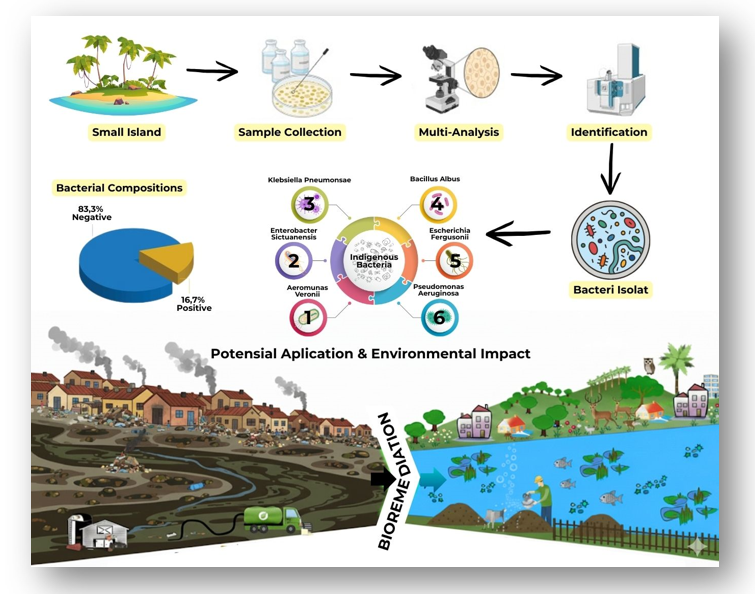
Graphical Abstract
Highlights
- Six indigenous bacterial isolates were successfully obtained from domestic wastewater of a small tropical island in Indonesia;
- Morphological, biochemical, and physiological analyses revealed diverse metabolic traits and environmental adaptability;
- The isolates showed strong tolerance to variable salinity (5–10% NaCl) and pH (6–9), reflecting resilience in marine-influenced wastewater;
- Findings highlight the potential of indigenous bacteria for low-cost, nature-based wastewater treatment in small island communities, supporting progress toward UN-SDG 6.
Keywords
Subjects
OPEN ACCESS
©2026 The author(s). This article is licensed under a Creative Commons Attribution 4.0 International License, which permits use, sharing, adaptation, distribution and reproduction in any medium or format, as long as you give appropriate credit to the original author(s) and the source, provide a link to the Creative Commons license, and indicate if changes were made. The images or other third party material in this article are included in the article’s Creative Commons license, unless indicated otherwise in a credit line to the material. If material is not included in the article’s Creative Commons license and your intended use is not permitted by statutory regulation or exceeds the permitted use, you will need to obtain permission directly from the copyright holder. To view a copy of this license, visit: http://creativecommons.org/licenses/by/4.0/
PUBLISHER NOTE
GJESM Publisher remains neutral concerning jurisdictional claims in published maps and institutional affiliations.
MAJOR DATABASES, CITATION METRICS & CAPTURES
Google Scholar | Scopus - SJR | Web of Science | Biological Abstracts: Clarivate | Biosis Preview: Clarivate | PlumX Metrics | Altmetrics | Mendeley |
CURRENT PUBLISHER
GJESM Publisher




Letters to Editor
[1] Letters that include statements of statistics, facts, research, or theories should include appropriate references, although more than three are discouraged.
[2] Letters that are personal attacks on an author rather than thoughtful criticism of the author’s ideas will not be considered for publication.
[3] Letters can be no more than 300 words in length.
[4] Letter writers should include a statement at the beginning of the letter stating that it is being submitted either for publication or not.
[5] Anonymous letters will not be considered.
[6] Letter writers must include their city and state of residence or work.
[7] Letters will be edited for clarity and length.