Document Type : CASE STUDY
Authors
1
Department of Environmental Science, School of Postgraduate, Universitas Gadjah Mada, Yogyakarta, Indonesia
2
Department of Chemical Engineering, Faculty of Engineering, Universitas Gadjah Mada, Yogyakarta, Indonesia
3
Department of Environmental Geography, Faculty of Geography, Universitas Gadjah Mada, Yogyakarta, Indonesia
Abstract
BACKGROUND AND OBJECTIVES: Small islands with high population density are facing various environmental problems such as domestic wastewater pollution. Generally, in small islands lacking adequate wastewater management, pollution from domestic sources can severely affect the health of marine ecosystem. Therefore, this study was conducted on one of the most densely populated islands, namely Bungin Island, in Sumbawa Regency, West Nusa Tenggara Province, Indonesia. This study sought to analyze the state of surface seawater as influenced by the pollution stemming from domestic wastewater contamination.
METHODS: Water samples were collected from April to August 2024 during rainy and dry seasons. Three locations along marine area were tested ex-situ using six parameters for seawater, including physical, chemical, and microbiological. The assessment of marine water quality status was conducted through the application of the pollution index formula, which facilitated calculation and analysis. Alongside the analysis of surface seawater samples, this study incorporated domestic wastewater samples, employing seven parameters to evaluate and predict the pollution load affecting the aquatic ecosystem.
RESULTS: The results showed that, in general, indications of light pollution were found at three test points in seawater of Bungin Island. Major pollution was influenced by the contribution of domestic activities. The key parameters identified during the dry season were the levels of dissolved oxygen and the values of total suspended solids. Meanwhile, the critical parameters in rainy season were salinity and orthophosphate values. Testing of domestic wastewater indicated that several quality indicators, such as chemical oxygen demand, total suspended solids, oil and grease, and total coliform, were below the acceptable quality thresholds. Consequently, this may lead to an escalation in the daily pollution load as time progresses. This pollution load was certainly a problem for marine ecosystem on Bungin Island.
CONCLUSION: The increase in population over time on densely populated islands will cause problems in the future related to domestic wastewater problems that threaten marine ecosystem. To prevent the escalation of environmental problems in the future, it is imperative to undertake appropriate mitigation strategies. This study provides a real picture concerning the threat of environmental damage that threatens one of the most densely populated islands in the world. Additionally, the results present further information that is beneficial for the worldwide sustainability of aquatic ecosystems.
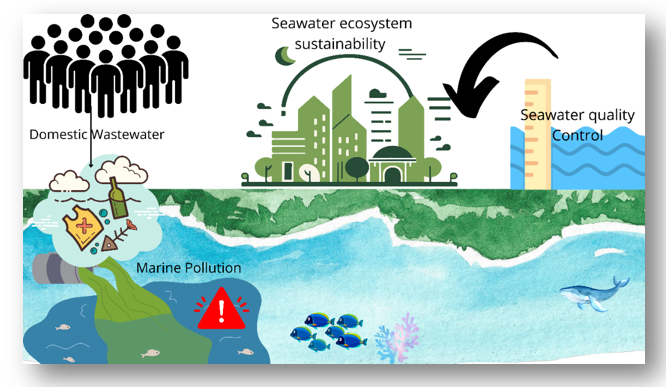
Graphical Abstract
Highlights
- Domestic wastewater from Bungin Island was found to contain pollutants such as COD, TSS, oil and grease, and total coliform, which were below standard but contributed to an increasing pollution load threatening the marine ecosystem;
- The study highlights the future risks posed by population growth on densely populated islands, with domestic wastewater becoming a significant challenge to marine ecosystems if proper management is not implemented;
- This study offers valuable insights into the environmental pressures on small islands globally and underscores the need for sustainable wastewater management to protect aquatic ecosystems.
Keywords
Subjects
OPEN ACCESS
©2025 The author(s). This article is licensed under a Creative Commons Attribution 4.0 International License, which permits use, sharing, adaptation, distribution and reproduction in any medium or format, as long as you give appropriate credit to the original author(s) and the source, provide a link to the Creative Commons license, and indicate if changes were made. The images or other third party material in this article are included in the article’s Creative Commons license, unless indicated otherwise in a credit line to the material. If material is not included in the article’s Creative Commons license and your intended use is not permitted by statutory regulation or exceeds the permitted use, you will need to obtain permission directly from the copyright holder. To view a copy of this license, visit:
http://creativecommons.org/licenses/by/4.0/
PUBLISHER NOTE
GJESM Publisher remains neutral concerning jurisdictional claims in published maps and institutional affiliations.
CITATION METRICS & CAPTURES
Google Scholar | Scopus | Web of Science | PlumX Metrics | Altmetrics | Mendeley |
CURRENT PUBLISHER
GJESM Publisher




Letters to Editor
[1] Letters that include statements of statistics, facts, research, or theories should include appropriate references, although more than three are discouraged.
[2] Letters that are personal attacks on an author rather than thoughtful criticism of the author’s ideas will not be considered for publication.
[3] Letters can be no more than 300 words in length.
[4] Letter writers should include a statement at the beginning of the letter stating that it is being submitted either for publication or not.
[5] Anonymous letters will not be considered.
[6] Letter writers must include their city and state of residence or work.
[7] Letters will be edited for clarity and length.