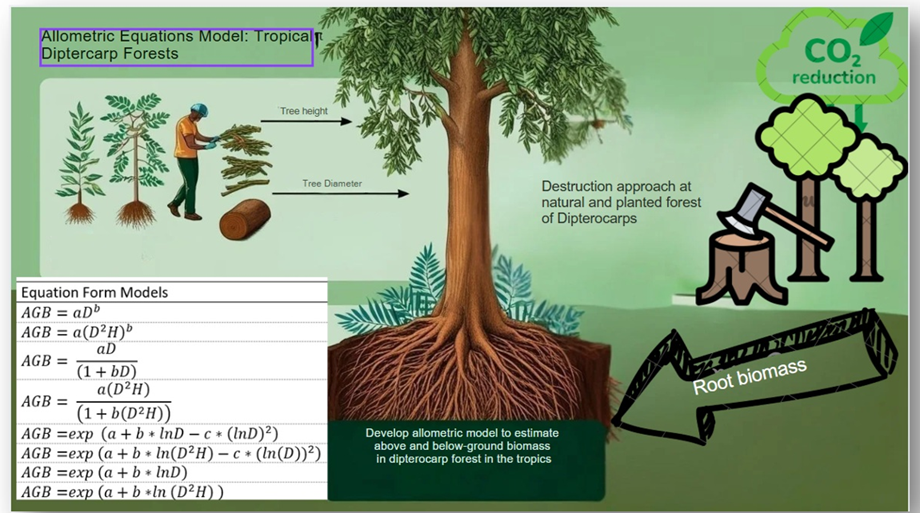
Allometric equations model for estimating an above and below ground biomass of dipterocarp forest in the tropics

Document Type : CASE STUDY

Authors

1 Research Center for Ecology and Ethnobiology, National Research and Innovation Agency, Jalan Raya Jakarta-Bogor, Cibinong, Bogor, Jawa Barat 16911, Indonesia

2 Research Center for Population, National Research and Innovation Agency, Jalan Gatot Subroto, Mampang Prapatan Jakarta Selatan, DKI Jakarta 12710, Indonesia

3 Department of Tropical Silviculture, Faculty of Forestry and Environment, IPB University, Jalan Raya Dramaga, Bogor 16680, Indonesia

Abstract
BACKGROUND AND OBJECTIVES: Accurate measurement of carbon stocks is essential for assessing the forest carbon dynamics. One of carbon stocks measurement is an allometric equation that offer a cost-effective alternative for estimating tree biomass and carbon stocks by only measuring tree attributes, such as diameter and height of tree. Many allometric equations have been developed for estimating the forest biomass in tropical región. However, only few studies were found focusing on dipterocarp species, and most of them  applying allometric equations for aboveground biomass only. Objective of the study was to improve the accurate allometric equations for Dipterocarp Forest by developing its allometric equations of above-ground, root, and total biomass.
METHODS: The study was conducted in tropical natural and planted forests in Indonesia (Sumatra, Java, and Kalimantan) and Peninsular Malaysia (Johor, Perak, and Pahang), with a total of eight plots at different provinces. All tree samples were collected using destructive analysis and categorized into living branches and twigs, dead branches and twigs, leaves and roots. A set of general equations for allometric model was developed to estimate tree volume and biomass. Then, the allometric equations were validated using validation models.
FINDINGS: Generally, there are a positive relationship between tree diameter and height, tree volume and biomass. This study successfully developed several equations following the scenarios for above-ground, root-, and total- biomass using parameter diameter solely and a combination of tree diameter and height. Also, the validation of models against actual data showed that models for above-ground, root-, and total- biomass were not significantly different (probability value > 5 percent). Based on forest type, planted forests show more uniform relationships between tree diameter, height and biomass components, indicative of managed growing conditions. Whereas, natural forests exhibit greater variability, especially for larger trees, reflecting the heterogeneity of natural ecosystems.
CONCLUSION: Allometric model for estimating biomass in dipterocarp forests was developed and validated using diameter and a combination of diameter and height as predictor variables. The models demonstrated a high coefficient of determination (> 90 percent), indicating strong predictive power for above-ground, root- and total biomass. Model 1 for above-ground biomass, Model 7 for root biomass, and Model 8 for total biomass were identified as the best-fitting models based on statistical significance and practical applicability.

Graphical Abstract

Allometric equations model for estimating an above and below ground biomass of dipterocarp forest in the tropics

Highlights

  • Tree diameter alone or combination of tree diameter and height could be used as an accurate predictor for aboveground, root, and total biomass of tropical Dipterocarp forest;
  • Composition of Dipterocarp species and tree diameter in natural forest is more heterogenous than in plantation forest;
  • The growth of Dipterocarp species in natural forest is more dynamic than in plantation forest;
  • Stem biomass showed the highest contribution for aboveground and total biomass of the Dipterocarp species in both natural and plantation forest.

Keywords

Subjects

OPEN ACCESS

©2025 The author(s). This article is licensed under a Creative Commons Attribution 4.0 International License, which permits use, sharing, adaptation, distribution and reproduction in any medium or format, as long as you give appropriate credit to the original author(s) and the source, provide a link to the Creative Commons license, and indicate if changes were made. The images or other third party material in this article are included in the article’s Creative Commons license, unless indicated otherwise in a credit line to the material. If material is not included in the article’s Creative Commons license and your intended use is not permitted by statutory regulation or exceeds the permitted use, you will need to obtain permission directly from the copyright holder. To view a copy of this license, visit: 

http://creativecommons.org/licenses/by/4.0/


PUBLISHER NOTE

GJESM Publisher remains neutral concerning jurisdictional claims in published maps and institutional affiliations.


MAJOR DATABASES, CITATION METRICS & CAPTURES

Google Scholar | Scopus - SJR | Web of Science | Biological Abstracts: Clarivate | Biosis Preview: Clarivate | PlumX Metrics | Altmetrics | Mendeley |


CURRENT PUBLISHER

GJESM Publisher

Letters to Editor

GJESM Journal welcomes letters to the editor for the post-publication discussions and corrections which allows debate post publication on its site, through the Letters to Editor. Letters pertaining to manuscript published in GJESM should be sent to the editorial office of GJESM within three months of either online publication or before printed publication, except for critiques of original research. Following points are to be considering before sending the letters (comments) to the editor.

[1] Letters that include statements of statistics, facts, research, or theories should include appropriate references, although more than three are discouraged.
[2] Letters that are personal attacks on an author rather than thoughtful criticism of the author’s ideas will not be considered for publication.
[3] Letters can be no more than 300 words in length.
[4] Letter writers should include a statement at the beginning of the letter stating that it is being submitted either for publication or not.
[5] Anonymous letters will not be considered.
[6] Letter writers must include their city and state of residence or work.
[7] Letters will be edited for clarity and length.

Send comment about this article
Enter Name.
Enter a valid email address.
Enter a vaid affiliation.
Enter comments (At leaset 10 words)
CAPTCHA Image
Enter Security Code Correctly.
Volume 11, Issue 3 - Serial Number 43
Summer 2025
Pages 1199-1220


Article Podcasts

  • Receive Date 28 December 2024
  • Revise Date 01 February 2025
  • Accept Date 10 April 2025