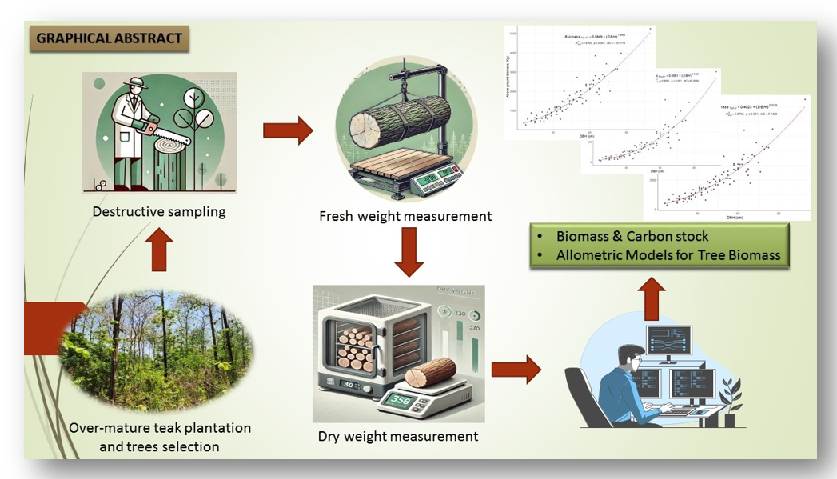
A model designed for estimating biomass and carbon pool stock in over-mature plantations of teak; Tectona grandis

Document Type : RESEARCH ARTICLE

Authors

Research Center for Ecology and Ethnobiology, National Research and Innovation Agency, Jl. Raya Jakarta-Bogor, Jawa Barat, Indonesia

Abstract
BACKGROUND AND OBJECTIVES: Teak (Tectona grandis L.f.) plantations are essential for wood production and reducing atmospheric carbon dioxide levels by storing carbon. Allometric equations, which establish a correlation between quantifiable characteristics of trees (such as diameter, height, or volume) and their biomass and carbon content, are essential for measuring the amount of carbon stored in forests. This study seeks to fill the substantial knowledge void by formulating and confirming allometric equations that are applicable for estimating biomass and carbon stock in mature teak plantations. This study plays a significant role in informing sustainable forest management practices and refining the precision of carbon offset assessments. The primary aim of the study was to bridge the significant knowledge gap by formulating and validating allometric equations that estimate biomass and carbon stocks in over-mature teak plantations.
METHODS: The study was carried out in the Cemoro Modang teak plantation region, located in the lowland forest zone, utilizing a method of sampling known as destructive sampling. A total of ninety-five trees were analyzed, and five of these were specifically chosen for the evaluation of root biomass. The term biomass describes the aggregate mass of various tree components, which consist of roots, stems, branches, and leaves. The overall quantity of carbon present in teak trees is also assessed. The biomass of each item may be determined using the allometric relationships between the diameter at breast height and the total dry weight. In addition, the biomass of necromass, litter, and understorey were quantified to determine the amount of carbon content and carbon potential across all variables.
FINDINGS: The allometric equations derived from this work may be utilized to estimate the biomass of mature teak trees, including above-ground, below-ground, and total biomass. The estimation process involves measuring the diameter of the tree trunk at breast height. These equations demonstrate statistical reliability and can effectively estimate tree biomass across various locations, provided the climatic zones are comparable. In addition, litter, and understorey ranges from 0.78 to 18.62 tons per hectare. Biomass generation was maximized at a diameter of 99 centimeters for the teak trees. The carbon content per hectare of 199.88 tons is comparable to a potential carbon dioxide emission of 439.49 tons.
CONCLUSION: This study produces three allometric equations as: Y=0.5849 x1.9999 (adjusted coefficient of determination 0.8765, coefficient of determination 0.8778) for the above-ground biomass, Y=0.061 x2.8128 (adjusted coefficient of determination 0.8691, coefficient of determination 0.8705) for the below-ground biomass, and Y=0.4023 x2.1539 (adjusted coefficient of determination 0.8763, coefficient of determination 0.8776) for the total biomass. This equation has proven more accurate in estimating biomass in over-mature teak trees than using equations made from samples of younger teak trees. The average estimated biomass at the plantation level was found to be 145.2 tons per hectare, accompanied by a carbon stock of 93.3 tons per hectare, which corresponds to an absorption capacity of 342.0 tons per hectare carbon dioxide equivalent.

Graphical Abstract

A model designed for estimating biomass and carbon pool stock in over-mature plantations of teak; Tectona grandis

Highlights

  • In this study, biomass measurements are carried out directly using the destructive sampling method, which represents the real biomass because it includes cutting down trees and excavating out their roots, making it very comparable to the actual carbon stock;
  • The findings calculating the carbon stock in teak plants are relatively precise considering the object of research involves an old teak with a large diameter;
  • The allometric equations modelled from this work potentially be utilized to estimate the biomass of mature teak trees, including above-ground, below-ground, and total biomass.

Keywords

Subjects

Letters to Editor

GJESM Journal welcomes letters to the editor for the post-publication discussions and corrections which allows debate post publication on its site, through the Letters to Editor. Letters pertaining to manuscript published in GJESM should be sent to the editorial office of GJESM within three months of either online publication or before printed publication, except for critiques of original research. Following points are to be considering before sending the letters (comments) to the editor.

[1] Letters that include statements of statistics, facts, research, or theories should include appropriate references, although more than three are discouraged.
[2] Letters that are personal attacks on an author rather than thoughtful criticism of the author’s ideas will not be considered for publication.
[3] Letters can be no more than 300 words in length.
[4] Letter writers should include a statement at the beginning of the letter stating that it is being submitted either for publication or not.
[5] Anonymous letters will not be considered.
[6] Letter writers must include their city and state of residence or work.
[7] Letters will be edited for clarity and length.

Send comment about this article
Enter Name.
Enter a valid email address.
Enter a vaid affiliation.
Enter comments (At leaset 10 words)
CAPTCHA Image
Enter Security Code Correctly.

Article Podcasts

  • Receive Date 21 October 2024
  • Revise Date 26 January 2025
  • Accept Date 28 February 2025