Intervention strategy for sustainable waste management systems in developing countries using community of practice

Document Type : REVIEW PAPER

Authors

1 Research Center for Public Policy, National Research and Innovation Agency, Jl. Gatot Subroto, Kuningan Bar., Kec. Mampang Prapatan, Kota Jakarta Selatan, DKI Jakarta, Indonesia

2 School of Business and Management, Bandung Institute of Technology, Jl. Ganesa, Lb. Siliwangi, Jawa Barat, Kota Bandung, Indonesia

Abstract
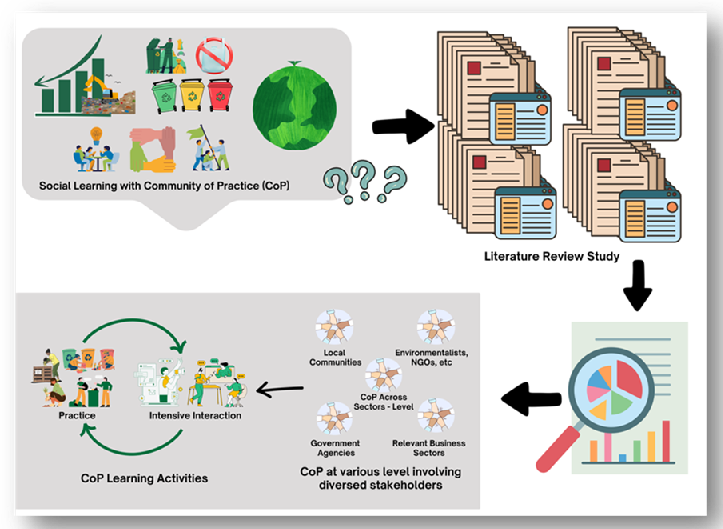
Collaborative systems from various sectors, including public community, are encouraged to tackle the complexity of waste problems. However, identifying the most effective intervention strategies to promote sustainable participation in collaboration remains a challenge. Some studies suggest that social learning with a community of practice platform enables collaboration while also facilitating collective learning to support transformative change in waste management. This study aimed to diagnose the characteristics of expected intervention strategies to sustain community participation in waste management program from past studies conducted in developing countries. This study also figured out the possibility of the community of practice implementation in waste management domain. Using a literature review method, this study selected and analysed thoroughly 52 papers related to waste management topics and 31 papers related to community of practice implementation in various domains, especially environmental management and waste management issues. The selected papers were fully reviewed and coded using qualitative data analysis software. There were 2 categories to map the content of the studies related to waste management topics, while 2 categories and 7 sub-categories were used to map the content of the selected papers on Community of Practice topic. The study found that social learning using Community of Practice platform is implementable in waste management system in developing countries as it can facilitate multi-loop learning activities including single loop learning that facilitates technical change, double loop learning that enable reflection to start mindset or psychological change, and triple loop learning that encourage systemic change. Research has demonstrated that multi-loop learning drives significant transformation from the individual level to the system, thereby bolstering the new waste management paradigm. The community of practice also enables collaborative action from multi-stakeholders across sectors and across organization at various level, which is crucial for the effectiveness of collaborative waste management system. The study’s main contribution and novelty lie in the proposed model which comprehensively describes the inter-relationships among parties across levels and sectors in waste management system at local and regional level. It also suggested a multi loop learning model that describe the expected learning cycles in the waste management system which have not been found in any previous studies. This finding is crucial for policymakers and government agencies in many developing countries to find new insight to improve waste management system through collaboration that enable social learning among involved stakeholders. Further studies are required to test the proposed model of community of practice and measure the effect and its effectiveness in nurturing learning outcomes for every loop of learning. 

Graphical Abstract

Intervention strategy for sustainable waste management systems in developing countries using community of practice

Highlights

  • CoP facilitates collaboration with different stakeholders across sectors and level that is implementable for waste management improvement;
  • Expected stakeholders that need to join are including government agencies, local communities, business, experts, researchers and academia, NGOs, environmentalists;
  • CoP can be in many group communities at community level up to regional level;
  • CoP enables social learning with multi-loop learning that leads to individual, community and systemic change in sustainable way.

Keywords

Subjects

Letters to Editor

GJESM Journal welcomes letters to the editor for the post-publication discussions and corrections which allows debate post publication on its site, through the Letters to Editor. Letters pertaining to manuscript published in GJESM should be sent to the editorial office of GJESM within three months of either online publication or before printed publication, except for critiques of original research. Following points are to be considering before sending the letters (comments) to the editor.

[1] Letters that include statements of statistics, facts, research, or theories should include appropriate references, although more than three are discouraged.
[2] Letters that are personal attacks on an author rather than thoughtful criticism of the author’s ideas will not be considered for publication.
[3] Letters can be no more than 300 words in length.
[4] Letter writers should include a statement at the beginning of the letter stating that it is being submitted either for publication or not.
[5] Anonymous letters will not be considered.
[6] Letter writers must include their city and state of residence or work.
[7] Letters will be edited for clarity and length.

Send comment about this article
Enter Name.
Enter a valid email address.
Enter a vaid affiliation.
Enter comments (At leaset 10 words)
CAPTCHA Image
Enter Security Code Correctly.

Article Podcasts

  • Receive Date 29 May 2024
  • Revise Date 01 July 2024
  • Accept Date 05 September 2024