Document Type : CASE STUDY
Authors
1
Research Center for Sustainable Production System and Life Cycle Assessment, National Research and Innovation Agency, Jakarta, Indonesia
2
Research Center for Behavioral and Circular Economy, National Research and Innovation Agency, Jakarta, Indonesia
3
Research Center for Transportation Technology, National Research and Inovation Agency, Jakarta, Indonesia
4
Research Center for Agroindustry, National Research and Innovation Agency, Jakarta, Indonesia
5
Research Center for Appropriate Technology, National Research and Innovation Agency, Jakarta, Indonesia
6
Maritime and Transportation Industry, Coordinating Ministry for Maritime Affairs and Investment, Jakarta, Indonesia
7
Indonesian Land Transportation Polytechnic - Indonesian Land Transportation College, Ministry of Transportation, West Java, Indonesia
8
Regional Research and Innovation, National Research and Innovation Agency, Indonesia, Jakarta, Indonesia
Abstract
BACKGROUND AND OBJECTIVES: Developing Southeast Asian countries, including Indonesia, have significant hurdles in addressing the increasing usage of motorized vehicles and their detrimental impact on air quality, traffic, energy security, liability, and greenhouse gas emissions. is to assess the viability of transforming traditional internal combustion engine motorcycles into electric vehicles powered by batteries in Indonesia. The analysis will concentrate on the positive environmental outcomes, including decreased greenhouse gas emissions and energy usage, in addition to examining the economic and social consequences of this transition. The absence of exhaust emissions could create the impression that converting to battery-powered electric vehicles will consistently yield favorable environmental outcomes, such as reducing greenhouse gas emissions and energy consumption. Meanwhile, the economic and social impacts associated with electric vehicle conversion programs are also taken into account savings during post-conversion.
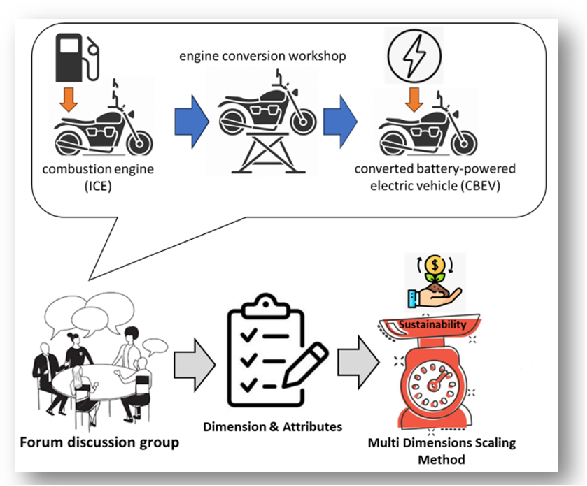
METHODS: Primary data was acquired through the distribution of questionnaires, conducting in-depth interviews with workshop managers, and obtaining scientific evaluations from participating experts. The Rapfish multidimensional scaling application was used to handle and evaluate the data. The analysis of the data involved the examination of five dimensions, namely social, economic, ecological, technological, and institutional, with each dimension comprising 37 variables.
FINDINGS: The sustainability index, which stands at 70.39 percent, indicating a fair level of sustainability, implies that there is significant development potential in the conversion process of internal combustion engine motorbikes to battery electric vehicles by strategically focusing on key leverage factors across various dimensions. The institutional dimension registers the lowest value at 48.92 percent, whereas the environmental, technological, social, and economic dimensions’ exhibit values of 85.25 percent, 79.13 percent, 76.29 percent, and 62.37 percent, respectively. Achieving sustainability requires focused enhancements in various key areas: setting up waste conversion facilities in the environmental aspect, educating employees on environmental conservation and boosting business incentives in the social aspect, ensuring a stable supply of raw materials and maximizing market penetration in the economic aspect, and improving experience management and skill acquisition in the technological aspect. Additionally, the presence of funding, the involvement of marketing intermediaries, and the backing for initiatives aimed at converting vehicles to electric power within the institutional framework are key aspects that demand concentrated efforts.
CONCLUSION: The multidimensional assessment indicates that Indonesia's electric vehicle conversion program is progressing effectively, achieving an average sustainability index of 70.39 percent, categorized as fair. The results indicate that the initiative has effectively created a resilient, sustainable conversion framework that can be tailored to various environments and scenarios. To further enhance sustainability within these conversion initiatives, it is imperative to prioritize institutional dimensions, particularly financial and marketing support, as well as the critical role of the electric vehicle conversion itself. This model provides significant perspectives for policymakers and government entities when developing and executing forthcoming policies and initiatives.
Graphical Abstract
Highlights
- This study employs Rapfish to analyze sustainability of electric vehicle conversions, examining social, economic, ecological, technological, and institutional factors;
- Electric motorcycle conversion in Indonesia varies in sustainability: strong in environmental and technological aspects, moderate in social, needing economic and institutional improvements;
- The study offers actionable insights for policymakers, highlighting the necessity for financial and marketing support, better waste conversion, and worker environmental knowledge.
Keywords
Subjects
OPEN ACCESS
©2024 The author(s). This article is licensed under a Creative Commons Attribution 4.0 International License, which permits use, sharing, adaptation, distribution and reproduction in any medium or format, as long as you give appropriate credit to the original author(s) and the source, provide a link to the Creative Commons license, and indicate if changes were made. The images or other third party material in this article are included in the article’s Creative Commons license, unless indicated otherwise in a credit line to the material. If material is not included in the article’s Creative Commons license and your intended use is not permitted by statutory regulation or exceeds the permitted use, you will need to obtain permission directly from the copyright holder. To view a copy of this license, visit:
http://creativecommons.org/licenses/by/4.0/
PUBLISHER NOTE
GJESM Publisher remains neutral concerning jurisdictional claims in published maps and institutional affiliations.
CITATION METRICS & CAPTURES
Google Scholar | Scopus | Web of Science | PlumX Metrics | Altmetrics | Mendeley |
CURRENT PUBLISHER
GJESM Publisher




Letters to Editor
[1] Letters that include statements of statistics, facts, research, or theories should include appropriate references, although more than three are discouraged.
[2] Letters that are personal attacks on an author rather than thoughtful criticism of the author’s ideas will not be considered for publication.
[3] Letters can be no more than 300 words in length.
[4] Letter writers should include a statement at the beginning of the letter stating that it is being submitted either for publication or not.
[5] Anonymous letters will not be considered.
[6] Letter writers must include their city and state of residence or work.
[7] Letters will be edited for clarity and length.