Document Type : RESEARCH ARTICLE
Authors
1
Department of Pharmaceutical Chemistry, K M College of Pharmacy, Madurai 625107, Tamil Nadu, India
2
1137 Spectrum, Irvine, Orange County 92618 USA
3
Department of Environmental Health Engineering, Tehran University of Medical Sciences, Tehran, Iran
4
Faculty of Health and Life Sciences, INTI International University, Putra Nilai 71800, Negeri Sembilan, Malaysia
5
Department of Management, Mittal School of Business, Lovely Professional University, Phagwara, Punjab, 144411 India
6
Kalasalingam Business School, Kalasalingam Academy of Research and Education, Krishnankoil, Tamil Nadu, 626126 India
Abstract
BACKGROUND AND OBJECTIVES: Mechanical recycling of municipal plastic waste can reduce landfill burden, energy demand, and environmental impacts while recovering reusable polymers. The study objectives were to assess the performance of polyethylene terephthalate, high-density polyethylene, and low-density polyethylene using polymer-specific pre-processing methods, shredding, thermal consolidation, and compression moulding. The assessment focused on waste minimization, material recovery, energy requirements, estimated carbon dioxide emission reductions, sustainability, and mechanical and thermal performance.
METHODS: A total of 37 kilograms of pre-sorted post-consumer polyethylene terephthalate, high-density polyethylene, and low-density polyethylene was separately processed using polymer-specific treatment and compression moulding. Environmental performance was evaluated within a cradle-to-gate framework using secondary emission factors, and the Sustainability Index was derived from predefined parameters. Recycled materials were evaluated for mechanical and thermal properties. Exploratory one-way analysis of variance assessed polymer differences, with probability values adjusted using the Benjamini–Hochberg false discovery rate procedure.
FINDINGS: Waste reduction and material recovery rates exceeded 95 percent for all polymers, with low-density polyethylene achieving the highest recovery of 99 percent. Low-density polyethylene also showed the lowest energy consumption of 0.95 kilowatt-hours per kilogram and the observed sustainability index of 82.6 ± 2.1, although polymer-specific differences in the Sustainability Index were not statistically significant. Polyethylene terephthalate showed the highest tensile strength (55.2 megapascals), compressive strength (83.4 megapascals), density (1.36 grams per cubic centimetre), and carbon dioxide emission reduction (2.10 kilograms of carbon dioxide per kilogram). High-density polyethylene showed intermediate performance. Analysis of variance indicated polymer-specific differences, with F-statistic values of 1.72–412.3 and probability values of <0.001–0.27. After Benjamini–Hochberg adjustment, most physical and mechanical properties, energy consumption, and carbon dioxide emission reduction showed significant differences, whereas landfill diversion and the Sustainability Index did not differ significantly.
CONCLUSION: Polymer-specific mechanical recycling of pre-sorted post-consumer polyethylene terephthalate, high-density polyethylene, and low-density polyethylene achieved high material recovery while maintaining mechanical and thermal properties. The polymers showed differences in material recovery, energy consumption, carbon dioxide emission reduction, and evaluated material properties. Further evaluation using heterogeneous municipal plastic waste and larger-scale processing is required.
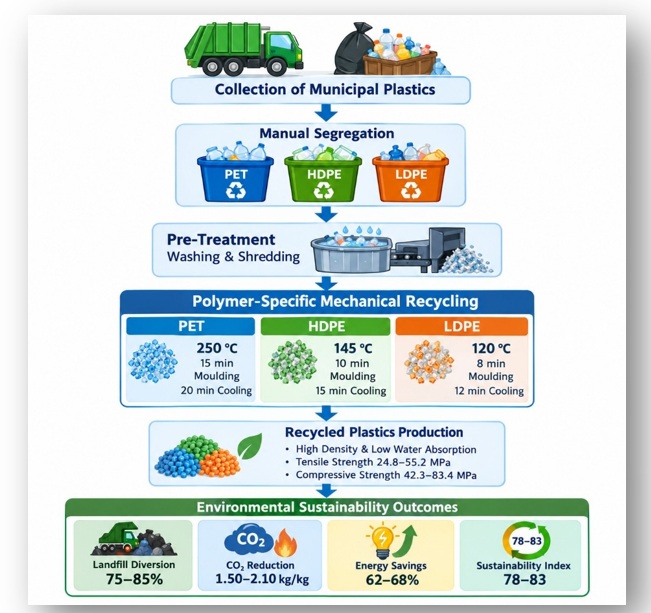
Graphical Abstract
Highlights
Ø LDPE achieved highest waste reduction and material recovery at 99 ± 0.5 %;
Ø PET showed maximum tensile strength 55.2 MPa and compressive strength 83.4 MPa;
Ø LDPE consumed lowest energy 0.95 kWh/kg, yielding highest sustainability index 82.6 ± 2.1;
Ø ANOVA identified significant polymer-specific differences in most physical, mechanical, and environmental properties.
Keywords
Subjects
OPEN ACCESS
©2027 The author(s). This article is licensed under a Creative Commons Attribution 4.0 International License, which permits use, sharing, adaptation, distribution and reproduction in any medium or format, as long as you give appropriate credit to the original author(s) and the source, provide a link to the Creative Commons license, and indicate if changes were made. The images or other third party material in this article are included in the article’s Creative Commons license, unless indicated otherwise in a credit line to the material. If material is not included in the article’s Creative Commons license and your intended use is not permitted by statutory regulation or exceeds the permitted use, you will need to obtain permission directly from the copyright holder. To view a copy of this license, visit: http://creativecommons.org/licenses/by/4.0/
PUBLISHER NOTE
GJESM Publisher remains neutral concerning jurisdictional claims in published maps and institutional affiliations.
MAJOR DATABASES, CITATION METRICS & CAPTURES
Google Scholar | Scopus - SJR | Web of Science | Biological Abstracts: Clarivate | Biosis Preview: Clarivate | PlumX Metrics | Altmetrics | Mendeley |
CURRENT PUBLISHER
GJESM Publisher



Letters to Editor
[1] Letters that include statements of statistics, facts, research, or theories should include appropriate references, although more than three are discouraged.
[2] Letters that are personal attacks on an author rather than thoughtful criticism of the author’s ideas will not be considered for publication.
[3] Letters can be no more than 300 words in length.
[4] Letter writers should include a statement at the beginning of the letter stating that it is being submitted either for publication or not.
[5] Anonymous letters will not be considered.
[6] Letter writers must include their city and state of residence or work.
[7] Letters will be edited for clarity and length.