
5.2
CiteScore
2.9
Impact Factor
Document Type : RESEARCH ARTICLE
Authors
1 Study Program of Coastal and Marine Resources Management, Department of Aquatic Resources Management, Faculty of Fisheries and Marine Sciences, IPB University, Bogor, West Java, 16680 Indonesia
2 Department of Aquatic Resources Management, Faculty of Sciences, Nahdlatul Ulama University of West Sumatra, Padang, 25136 Indonesia
3 Department of Aquatic Resources Management, Faculty of Fisheries and Marine Sciences, IPB University, Bogor, 16680, West Java, Indonesia
4 Center for Coastal and Marine Resources Studies, International Research Institute for Maritime, Ocean and Fisheries, IPB University, Bogor, West Java, 16127 Indonesia
Graphical Abstract
Highlights
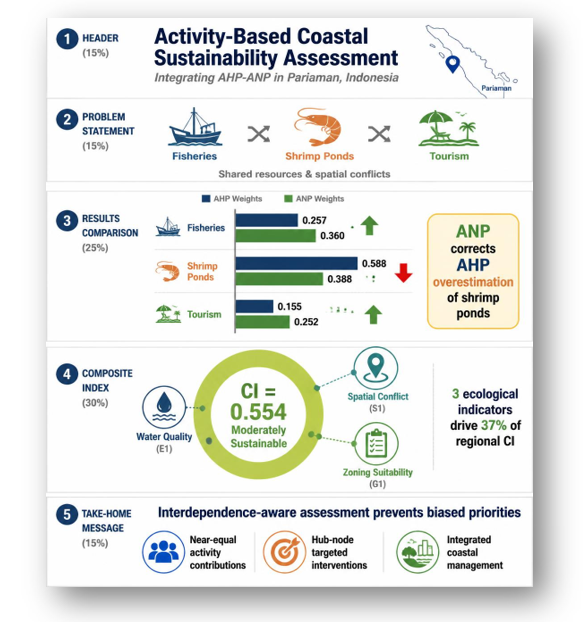
Ø The ANP revealed that AHP overestimated the contribution of shrimp ponds substantially (Wi_AHP = 0.588 vs. Wi_ANP = 0.388; Δ = −0.200), while underestimating the role of the Fisheries and Tourism network;
Ø Three Aquatic Quality hub nodes (pond zone WQI 40.79 vs open sea 64.33), Spatial Conflict, and Zoning Suitability were identified as critical cross-activity dependency points with field empirical evidence;
Ø The Regional Sustainability Composite Index with an ANP weight (0.554) provides a more valid zoning planning basis than the AHP-based CI (0.529).
Keywords
OPEN ACCESS
©2027 The author(s). This article is licensed under a Creative Commons Attribution 4.0 International License, which permits use, sharing, adaptation, distribution and reproduction in any medium or format, as long as you give appropriate credit to the original author(s) and the source, provide a link to the Creative Commons license, and indicate if changes were made. The images or other third party material in this article are included in the article’s Creative Commons license, unless indicated otherwise in a credit line to the material. If material is not included in the article’s Creative Commons license and your intended use is not permitted by statutory regulation or exceeds the permitted use, you will need to obtain permission directly from the copyright holder. To view a copy of this license, visit: http://creativecommons.org/licenses/by/4.0/
PUBLISHER NOTE
GJESM Publisher remains neutral concerning jurisdictional claims in published maps and institutional affiliations.
MAJOR DATABASES, CITATION METRICS & CAPTURES
Google Scholar | Scopus - SJR | Web of Science | Biological Abstracts: Clarivate | Biosis Preview: Clarivate | PlumX Metrics | Altmetrics | Mendeley |
CURRENT PUBLISHER

| Article View | 848 |
| PDF Download | 532 |

Letters to Editor
[1] Letters that include statements of statistics, facts, research, or theories should include appropriate references, although more than three are discouraged.
[2] Letters that are personal attacks on an author rather than thoughtful criticism of the author’s ideas will not be considered for publication.
[3] Letters can be no more than 300 words in length.
[4] Letter writers should include a statement at the beginning of the letter stating that it is being submitted either for publication or not.
[5] Anonymous letters will not be considered.
[6] Letter writers must include their city and state of residence or work.
[7] Letters will be edited for clarity and length.