Document Type : CASE STUDY
Authors
1
Department of Environmental and Natural Resources Management, Universitas Sumatera Utara, Medan 20155, Indonesia
2
Center of Excellence for Mangrove, Universitas Sumatera Utara, Medan 20155, Indonesia
3
Department of Forestry, Faculty of Forestry, Universitas Sumatera Utara, Medan 20155, Indonesia
4
School of Environmental and Geographical Sciences, University of Nottingham, Malaysia Campus, Selangor, Semenyih, Malaysia
Abstract
BACKGROUND AND OBJECTIVES: Mangroves have high potential for advancing ecotourism because of their position at the intersection of land and sea. Many studies have reported that mangroves and coastal environments are the right places for the development of sustainable ecotourism. Ecotourism aims to preserve natural environments, playing a crucial role in conservation efforts and serving as a unique type of tourism experience. The aim of this study is to assess the tourism prospects of significant mangrove ecosystems in Sumatra, Indonesia, and to identify suitable approaches for fostering ecotourism. The implementation of ecotourism can serve as a means to safeguard the ecosystem while also influencing the socio-economic conditions of the local community.
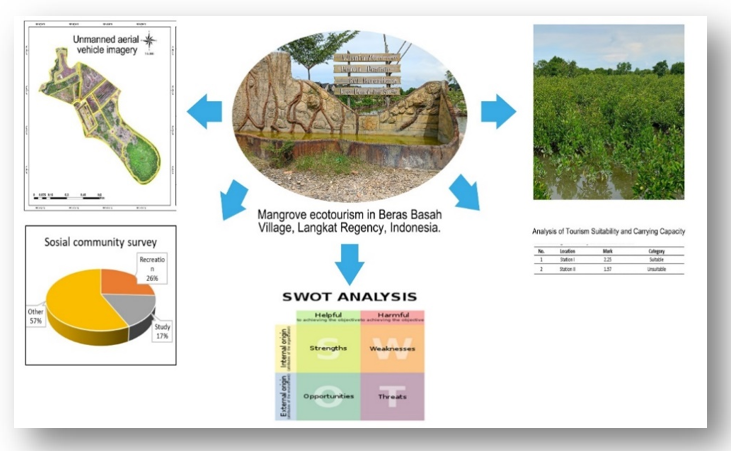
METHODS: The research was conducted in Beras Basah Village, located in the Pangkalan Susu District of Langkat Regency, North Sumatra, Indonesia. It commenced in November 2023 with the initiation of the Beras Basah ecotourism project and concluded in January 2024. The research commenced by introducing the ecotourism landscape through the utilization of a geographic information system. Subsequently, questionnaires and discussion group forums were employed to analyze the community, visitors, and relevant stakeholders. Furthermore, an assessment of the potential mangrove ecosystem was conducted, encompassing transects, ecological suitability, and carrying capacity. Lastly, a comprehensive analysis of the research findings was performed, focusing on the strengths, weaknesses, opportunities, and threats associated with the study.
FINDINGS: The potential area for ecotourism covers 38 hectares with various well-designed facilities and infrastructures. The mangroves were utilized as a source of sustenance with the overall condition of community. This study obtained 8 species of mangroves consisting of Rhizophora apiculata, Rhizophora mucronata, Rhizophora stylosa, Sonneratia alba, Avicennia marina, Bruguiera gymnorrhiza, Xylocarpus granatum, and Scyphiphora hydrophyllacea. The species of fauna observed were two species of birds (Haliaetus leucogaster, Bubulcus ibis), three species of reptiles (Varanus salvator, Fordonia leucobalia, Mabouia multifasciata), three types of mammals (Macaca fascicularis, Tupaia glis, Martes flavigula), seven types of fish (Plotosus canius, Epinephelus lanceolatus, Ophiocara porocephala, Lutjanus argentimaculatus, Lates calcarifer, Scatophagus argus, Mugil cephalus), five types of mollusks (Cerithidea cingulata, Telescopium telescopium, Cerithidea quadrata, Murex trapa, Polymesoda bengalensis), and four types of crustaceans (Scylla serrata, Metapograpsus sp., Panaeus monodon, Panaeus merguensis). The two studied stations exhibited varying levels of ecological suitability. One approach to protection is the enforcement of a visitor quota based on the carrying capacity of the areas, was 86 individuals per day. Furthermore, the analysis of strengths, weaknesses, opportunities, and threats revealed that the improvement of mangrove ecosystem management, the addition of supporting facilities, and the provision of environmental and conservation education to tourists can contribute to the enhancement of ecotourism.
CONCLUSION: Ecotourism plays a crucial role in preserving the sustainability of the mangrove ecosystem while also influencing socio-economic factors. Through thorough study and analysis of both human behavior and natural processes, effective management strategies can be developed to support ecotourism initiatives. This investigation has the potential to support the preservation of the mangrove ecosystem in Beras Basah District through the introduction of landscape management strategies for the advancement of ecotourism. The findings of this study highlight the significance of ecotourism and emphasize the importance of expanding ecotourism initiatives, enhancing infrastructure, and promoting environmental awareness.
Graphical Abstract
Highlights
- There are 8 types of mangroves and fauna that have natural potential and can be developed as superior ecotourism products;
- Based on the suitability index, the Beras Basah research site has a value of 2.5 and is optimal as a ecotourism;
- Efficient management, adding supporting facilities, and providing environmental/conservation education to tourists are mangrove ecotourism management strategies.
Keywords
Subjects
OPEN ACCESS
©2024 The author(s). This article is licensed under a Creative Commons Attribution 4.0 International License, which permits use, sharing, adaptation, distribution and reproduction in any medium or format, as long as you give appropriate credit to the original author(s) and the source, provide a link to the Creative Commons license, and indicate if changes were made. The images or other third party material in this article are included in the article’s Creative Commons license, unless indicated otherwise in a credit line to the material. If material is not included in the article’s Creative Commons license and your intended use is not permitted by statutory regulation or exceeds the permitted use, you will need to obtain permission directly from the copyright holder. To view a copy of this license, visit:
http://creativecommons.org/licenses/by/4.0/
PUBLISHER NOTE
GJESM Publisher remains neutral concerning jurisdictional claims in published maps and institutional affiliations.
CITATION METRICS & CAPTURES
Google Scholar | Scopus | Web of Science | PlumX Metrics | Altmetrics | Mendeley |
CURRENT PUBLISHER
GJESM Publisher




Letters to Editor
[1] Letters that include statements of statistics, facts, research, or theories should include appropriate references, although more than three are discouraged.
[2] Letters that are personal attacks on an author rather than thoughtful criticism of the author’s ideas will not be considered for publication.
[3] Letters can be no more than 300 words in length.
[4] Letter writers should include a statement at the beginning of the letter stating that it is being submitted either for publication or not.
[5] Anonymous letters will not be considered.
[6] Letter writers must include their city and state of residence or work.
[7] Letters will be edited for clarity and length.