Environmental and economic performance of hybrid charging stations

Document Type : RESEARCH ARTICLE

Authors

1 Research Center for Sustainable Industrial and Manufacturing Systems, National Research and Innovation Agency, South Tangerang, Indonesia

2 Faculty of Engineering and Informatics, Universitas Multimedia Nusantara, South Tangerang, Indonesia

3 Research Center for Limnology and Water Resources, National Research and Innovation Agency, Bogor, Indonesia

4 Bureau of Public Communication, General Affairs, and Secretariat, National Research and Innovation Agency, South Tangerang, Indonesia

5 Postgraduate Program of Science in Sustainability, Faculty of Infrastructure Planning, Universitas Pertamina, Jakarta, Indonesia

Abstract
BACKGROUND AND OBJECTIVES: The global use of electric vehicles is growing rapidly as a strategy to prevent climate change. In Indonesia, although there is a growing number of electric vehicle charging stations, the majority still depend on electricity produced from fossil fuels, which consequently restricts the overall environmental advantages. The integration of photovoltaic systems into charging infrastructure offers a low-carbon alternative, but their implementation may entail environmental trade-offs. The study aimed to evaluate trade-offs by employing an integrated life-cycle assessment and life-cycle costing framework for the first hybrid charging station in Indonesia, as well as to offer comparative insights for sustainable charging infrastructure.
METHODS: The life cycle assessment was conducted with a cradle-to-grave system boundary. 1 kilowatt-hour of electricity was implemented as a functional unit to compare the energy source scenarios. The Ecoinvent 3.8 database for secondary data and the ReCiPe 2016 midpoint (H) method are employed on Open-life cycle assessment software. The analysis of life-cycle costs encompassed capital expenditures, operational and maintenance costs, along with the revenue from the hybrid charging station, projected for a 20-year operational timeframe.
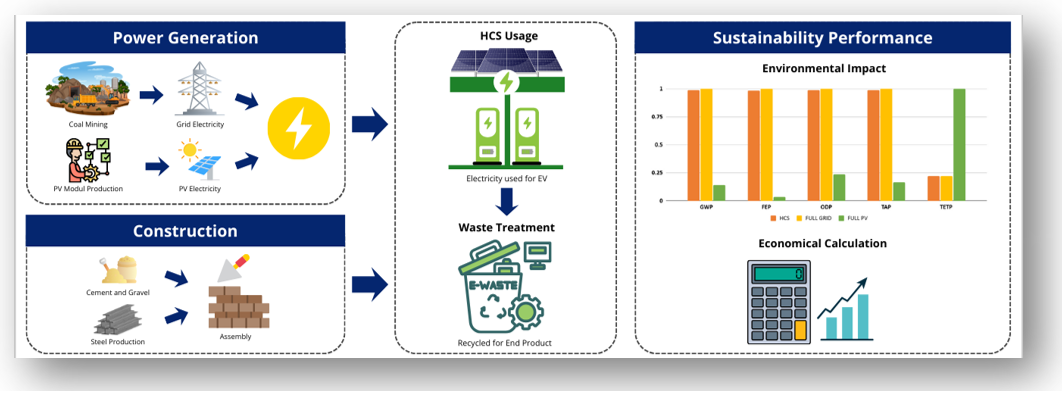
FINDINGS: This study showed that charging stations powered by photovoltaic energy emitted the lowest environmental impacts. The minimal impact was observed across nearly all categories, except for the terrestrial ecotoxicity potential. The global warming potential associated with the hybrid charging station was measured at 1.1104 kilograms of carbon dioxide equivalent, which is 0.8 percent lower than the electricity from the full-grid scenario. Implementing the full photovoltaic system can reduce the global warming potential impact by up to 85 percent. Life cycle cost analysis showed that the hybrid charging station maximizes long-term net economic value, with a net present value of United States Dollar 237,533.75 and a total life cycle cost of United States Dollar 251,785.77. Although the comprehensive grid configuration showed enhanced short-term performance, the full photovoltaic system realized the minimal levelized cost of energy.
CONCLUSION: Hybrid charging stations offer the best economic performance, while full PV solar systems offer the best environmental benefits. The combination of the two energy sources, along with an increase in renewable energy generation, can contribute to a more sustainable electric vehicle charging station infrastructure.

Graphical Abstract

Environmental and economic performance of hybrid charging stations

Highlights

Ø The assessment of Cradle-to-grave LCA–LCC identifies distinct environmental and economic trade-offs within charging infrastructure systems;

Ø The integrated PV-powered charging stations exhibit substantially lower environmental impacts than grid-dependent systems;

Ø Life cycle cost analysis indicates markedly lower expenditure for PV-based configurations compared with grid-reliant systems.

Keywords

Subjects

OPEN ACCESS

©2026 The author(s). This article is licensed under a Creative Commons Attribution 4.0 International License, which permits use, sharing, adaptation, distribution and reproduction in any medium or format, as long as you give appropriate credit to the original author(s) and the source, provide a link to the Creative Commons license, and indicate if changes were made. The images or other third party material in this article are included in the article’s Creative Commons license, unless indicated otherwise in a credit line to the material. If material is not included in the article’s Creative Commons license and your intended use is not permitted by statutory regulation or exceeds the permitted use, you will need to obtain permission directly from the copyright holder. To view a copy of this license, visit: http://creativecommons.org/licenses/by/4.0/

PUBLISHER NOTE

GJESM Publisher remains neutral concerning jurisdictional claims in published maps and institutional affiliations.

MAJOR DATABASES, CITATION METRICS & CAPTURES

Google Scholar | Scopus - SJR | Web of Science | Biological Abstracts: Clarivate | Biosis Preview: Clarivate | PlumX Metrics | Altmetrics | Mendeley |

CURRENT PUBLISHER

GJESM Publisher

Letters to Editor

GJESM Journal welcomes letters to the editor for the post-publication discussions and corrections which allows debate post publication on its site, through the Letters to Editor. Letters pertaining to manuscript published in GJESM should be sent to the editorial office of GJESM within three months of either online publication or before printed publication, except for critiques of original research. Following points are to be considering before sending the letters (comments) to the editor.

[1] Letters that include statements of statistics, facts, research, or theories should include appropriate references, although more than three are discouraged.
[2] Letters that are personal attacks on an author rather than thoughtful criticism of the author’s ideas will not be considered for publication.
[3] Letters can be no more than 300 words in length.
[4] Letter writers should include a statement at the beginning of the letter stating that it is being submitted either for publication or not.
[5] Anonymous letters will not be considered.
[6] Letter writers must include their city and state of residence or work.
[7] Letters will be edited for clarity and length.

Send comment about this article
Enter Name.
Enter a valid email address.
Enter a vaid affiliation.
Enter comments (At leaset 10 words)
CAPTCHA Image
Enter Security Code Correctly.

Article Podcasts

  • Receive Date 12 August 2025
  • Revise Date 18 November 2025
  • Accept Date 22 December 2025