Document Type : RESEARCH ARTICLE
Authors
1
Integrated Science Program Multidisciplinary and Interdisciplinary School, Chiang Mai University, Chiang Mai, Thailand
2
Department of Electrical Engineering, Faculty of Engineering, Chiang Mai University, Chiang Mai, Thailand
3
Research Unit for City Environment and Disaster Management, Chiang Mai University, Chiang Mai, Thailand
4
Department of Civil Engineering, Faculty of Engineering, Chiang Mai University, Chiang Mai, Thailand
5
Department of Mechanical Engineering, Faculty of Engineering, Chiang Mai University, Chiang Mai, Thailand
6
6Division of Sustainable Energy and Environmental Engineering, Graduate School of Engineering, Osaka University, Osaka, Japan
7
Center of Excellence in Urban Mobility Research and Innovation, Faculty of Architecture and Planning Thammasat University, Khlong Luang, Pathumthani, Thailand
8
Tokai Gakuen University. Postal address: 2-901 Nakahira, Tenpaku-ku, Nagoya 468-8514, Japan
Abstract
BACKGROUND AND OBJECTIVES: Thailand is a significant emitter of greenhouse gases especially emissions from the energy sector, originated from the transportation sector. The government is prioritizing carbon reduction efforts in Thailand; concurrently, the battery electric vehicle industry is experiencing global growth. It stresses the need to decrease carbon emissions in transportation by moving towards battery electric vehicles. Conversely, Thailand lacks a comprehensive understanding of how battery electric vehicles influence carbon emissions. The study objectives were to explore the carbon reduction potential of the transition to electric vehicles and develops methods for estimating carbon emissions using micro-simulations.
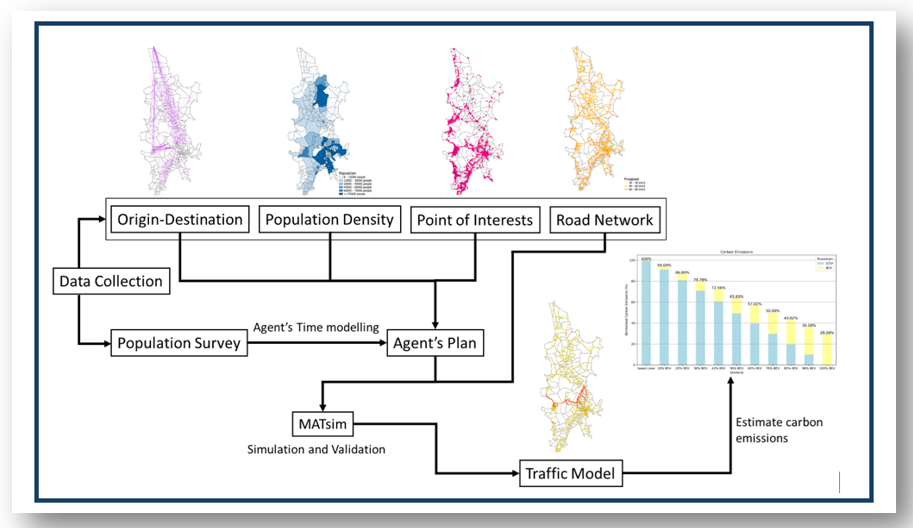
METHODS: The Multi-Agent Transport Simulation was used for simulation of the traffic in Phuket, Thailand. There were two attributes for simulation: a road network and an agent’s plan. The road network contained details of road segments in Phuket. The agent’s proposal featured trips for Phuket residents, formulated from population assumptions based on survey data. The model from the simulation is validated with actual traffic reports of main roads in Phuket and estimated carbon emissions for every single person. Subsequently, scenarios were created by analyzing the proportions of internal combustion engine vehicles in relation to battery electric vehicles on the network to evaluate carbon emissions.
FINDINGS: The model captures general travel behavior trends. Despite moderate alignment between simulated and observed traffic speeds and trip durations, the model demonstrates reasonable validity for representing typical travel behavior in Phuket. Nonetheless, the modest coefficient of determination value, along with the exaggerated trip durations, points to possible constraints in the network intricacies and population estimates. For carbon emission estimation, the emission trend exhibited an approximately linear relationship. Increasing the proportion of battery electric vehicles to 10 per cent resulted in an approximate 7 per cent reduction in total carbon emissions. Notably, emissions from internal combustion engine vehicles decreased by roughly 10 percent, in contrast to the 3 percent increase in emissions from battery electric vehicles.
CONCLUSION: Model accuracy could be enhanced by incorporating more detailed input data, including a greater variety of vehicle types, and a more complete transport network (such as minor roads). Furthermore, thorough survey data encompassing population activity times, home addresses, and workplace coordinates would significantly boost the model's performance. Even though the model can provide any probability of battery electric vehicle proportion. In the practical way, an optimal proportion depends on subsidization from government departments. The anticipated outcomes are intended to serve as guidelines for detailed planning policies focused on enhancing the quantity of battery electric vehicles and minimizing carbon output in Thailand's transportation system.
Graphical Abstract
Highlights
- An agent-based transport simulation model assessed the potential for carbon reduction from BEV adoption under various powertrain proportion scenarios;
- The model was simulated by the MATSim simulation framework and was validated using observed traffic speed and duration data;
- A 10% BEV share led to an estimated 7% reduction in total carbon emissions. This reduction is primarily driven by a 10% decrease in emissions from ICEVs, while emissions from BEVs increase by only 3%;
- Findings support policymakers to plan policies where BEV adoption offers the best cost-benefit balance for BEV promotion in Thailand’s transport sector.
Keywords
Subjects
OPEN ACCESS
©2025 The author(s). This article is licensed under a Creative Commons Attribution 4.0 International License, which permits use, sharing, adaptation, distribution and reproduction in any medium or format, as long as you give appropriate credit to the original author(s) and the source, provide a link to the Creative Commons license, and indicate if changes were made. The images or other third party material in this article are included in the article’s Creative Commons license, unless indicated otherwise in a credit line to the material. If material is not included in the article’s Creative Commons license and your intended use is not permitted by statutory regulation or exceeds the permitted use, you will need to obtain permission directly from the copyright holder. To view a copy of this license, visit:
http://creativecommons.org/licenses/by/4.0/
PUBLISHER NOTE
GJESM Publisher remains neutral concerning jurisdictional claims in published maps and institutional affiliations.
MAJOR DATABASES, CITATION METRICS & CAPTURES
Google Scholar | Scopus - SJR | Web of Science | Biological Abstracts: Clarivate | Biosis Preview: Clarivate | PlumX Metrics | Altmetrics | Mendeley |
CURRENT PUBLISHER
GJESM Publisher




Letters to Editor
[1] Letters that include statements of statistics, facts, research, or theories should include appropriate references, although more than three are discouraged.
[2] Letters that are personal attacks on an author rather than thoughtful criticism of the author’s ideas will not be considered for publication.
[3] Letters can be no more than 300 words in length.
[4] Letter writers should include a statement at the beginning of the letter stating that it is being submitted either for publication or not.
[5] Anonymous letters will not be considered.
[6] Letter writers must include their city and state of residence or work.
[7] Letters will be edited for clarity and length.