Document Type : CASE STUDY
Authors
1
Ho Chi Minh City University of Technology and Education, Ho Chi Minh City, Vietnam
2
Saigon University, Ho Chi Minh City, Vietnam
3
University of Social Sciences and Humanities, Vietnam National University, Ho Chi Minh City, Vietnam
Abstract
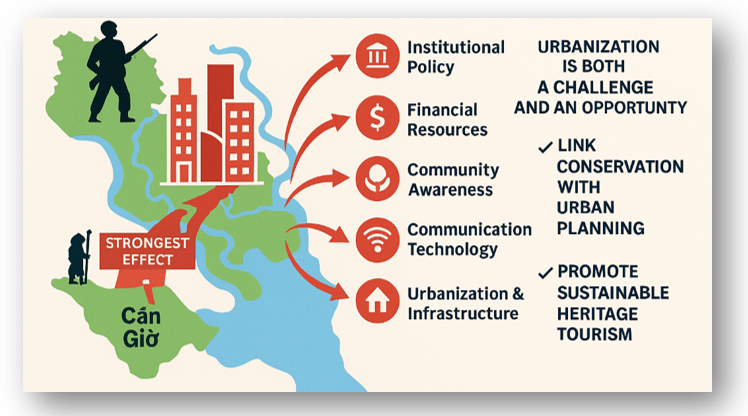
BACKGROUND AND OBJECTIVES: Vietnam’s rapidly expanding urban centers, particularly Ho Chi Minh City, are encountering significant challenges in preserving revolutionary historical sites. These locations not only reflect the cultural and historical heritage of the country but also play educational, symbolic, and socio-political functions. However, urbanization has intensified land-use conflicts, led to the degradation of surrounding environments, and threatened the authenticity of these heritage spaces. The study aimed to analyze the connection between urbanization impacts the preservation of revolutionary heritage, in addition to evaluating the potential for including these sites in enduring sustainable tourism strategies. The Rừng Sác Revolutionary Site in Cần Giờ District is selected as a representative case due to its exceptional historical significance and location within an ecologically sensitive biosphere reserve.
METHODS: This study employs a quantitative methodology, using survey data obtained from two hundred eleven participants, comprising residents, managers of heritage sites, and policy specialists. A structural equation modeling (also referred to as structural equation modeling in the main text) framework is developed to assess the influence of five primary factors on preservation outcomes: institutional policy, financial resources, community awareness, communication technology, and urbanization and infrastructure development.
FINDING: All five factors were found to have a statistically significant positive influence on heritage preservation efforts. The most impactful factor has been urbanization, with communication technologies and public awareness following closely behind. While urbanization introduces substantial risks such as encroachment, landscape alteration, and authenticity loss, it simultaneously offers new opportunities to reposition revolutionary heritage within broader urban development and planning strategies.
CONCLUSION: This study presents a validated analytical framework that merges policy, technology, and social aspects in managing heritage under urban challenges. It underscores the importance of policy alignment, digital innovation, and community involvement. The findings from the Rừng Sác case contribute to the broader discourse on managing cultural assets in rapidly transforming urban environments and offer valuable insights for cities facing similar development-preservation tensions.
Graphical Abstract
Highlights
Ø Urbanization has both positive and negative impacts on heritage conservation in the context of Ho Chi Minh City.
Ø Digitalization plays a crucial role in supporting heritage preservation amidst urban development;
Ø Structural modeling identifies key factors such as policy, financial resources, and community awareness influencing conservation outcomes;
Ø Practical recommendations are provided to link heritage conservation with sustainable urban and tourism planning.
Keywords
Subjects
OPEN ACCESS
©2026 The author(s). This article is licensed under a Creative Commons Attribution 4.0 International License, which permits use, sharing, adaptation, distribution and reproduction in any medium or format, as long as you give appropriate credit to the original author(s) and the source, provide a link to the Creative Commons license, and indicate if changes were made. The images or other third party material in this article are included in the article’s Creative Commons license, unless indicated otherwise in a credit line to the material. If material is not included in the article’s Creative Commons license and your intended use is not permitted by statutory regulation or exceeds the permitted use, you will need to obtain permission directly from the copyright holder. To view a copy of this license, visit: http://creativecommons.org/licenses/by/4.0/
PUBLISHER NOTE
GJESM Publisher remains neutral concerning jurisdictional claims in published maps and institutional affiliations.
MAJOR DATABASES, CITATION METRICS & CAPTURES
Google Scholar | Scopus - SJR | Web of Science | Biological Abstracts: Clarivate | Biosis Preview: Clarivate | PlumX Metrics | Altmetrics | Mendeley |
CURRENT PUBLISHER
GJESM Publisher




Letters to Editor
[1] Letters that include statements of statistics, facts, research, or theories should include appropriate references, although more than three are discouraged.
[2] Letters that are personal attacks on an author rather than thoughtful criticism of the author’s ideas will not be considered for publication.
[3] Letters can be no more than 300 words in length.
[4] Letter writers should include a statement at the beginning of the letter stating that it is being submitted either for publication or not.
[5] Anonymous letters will not be considered.
[6] Letter writers must include their city and state of residence or work.
[7] Letters will be edited for clarity and length.