Document Type : CASE STUDY
Authors
1
Department of Electrical Engineering, Faculty of Engineering, Semarang University, Indonesia
2
Department of Physics, Faculty of Science and Mathematics, Diponegoro University, Semarang, Indonesia
Abstract
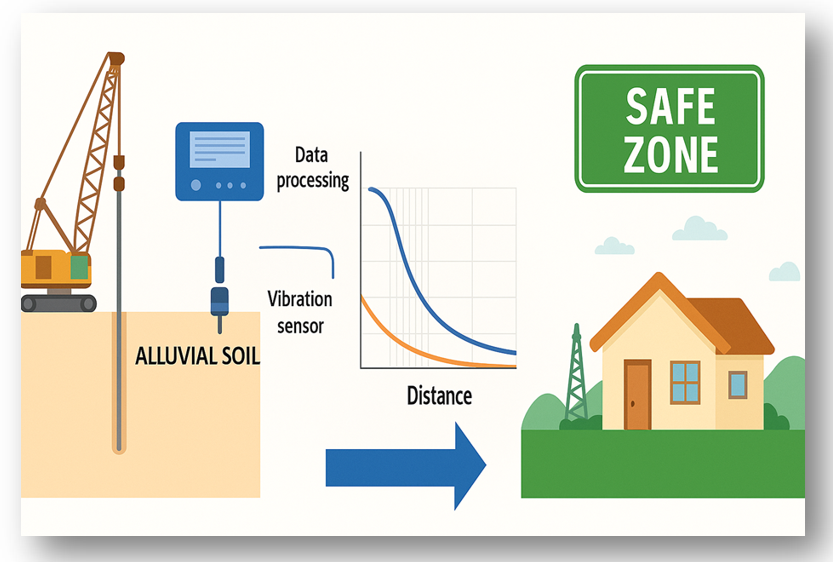
BACKGROUND AND OBJECTIVES: Pile driving is widely used in infrastructure projects but it often generates strong ground vibrations that can spread into surrounding neighborhoods. These vibrations are more than just an engineering issue; they can be understood as a type of environmental pollution, similar to noise. Communities near construction sites frequently experience reduced comfort, annoyance, and even health concerns, while fragile houses and public facilities may be at risk of structural damage. In tropical alluvial soils, such as those found in Yogyakarta, Indonesia, low-frequency waves travel efficiently over long distances, which magnifies their environmental consequences. The main objectives of this study were to evaluate pile-driving vibrations as an environmental hazard, linking the technical results to wider concerns about human well-being and sustainable urban development.
METHODS: Measurements were conducted during railway construction near Yogyakarta International Airport in Kulon Progo Regency. A triaxial geophone recorded vibrations at three distances: 10, 50, and 70 meters. Parameters included peak particle velocity, ground displacement, and dominant frequency. A power-law regression was utilized to model the decrease of vibration energy with increasing distance. Results were assessed against Indonesian regulations and compared with international vibration standards commonly applied in environmental monitoring in Germany and the United Kingdom.
FINDINGS:The analysis showed that low-frequency waves between 5 and 15 hertz were dominant. These intersected with the natural frequencies of nearby residential properties, which raised concerns regarding environmental impact and safety. At 10 meters from the pile, peak particle velocity reached 5.6 millimeters per second, far above both the comfort limit of 0.3 millimeters per second and the damage threshold of 2.0 millimeters per second. At distances of 50 meters and 70 meters, the values of peak particle velocity dropped, but they still stayed above the comfort thresholds. A buffer of around 60 meters was needed to avoid discomfort, while 30 meters was necessary to prevent building damage.
CONCLUSION:The results demonstrate that pile-driving vibrations should be managed as a form of environmental pollution. They diminish community stability, pose risks to vulnerable infrastructures, and complicate sustainable advancement in tropical locales. The findings advocate for the inclusion of vibration monitoring in evaluating environmental impacts, alongside the development of regulations and buffer zones to ensure the protection of residents and infrastructure.
Graphical Abstract
Highlights
- Vibration attenuation models revealed significant PPV reduction with distance at low frequencies;
- Multi-standard comparisons defined minimum safe distances for residential comfort and structural safety;
- Dominant vibration frequencies were below 20 Hz, indicating high transmission efficiency in soft subsoil;
- Findings provide practical guidelines for urban construction near settlements in tropical alluvial areas.
Keywords
Subjects
OPEN ACCESS
©2025 The author(s). This article is licensed under a Creative Commons Attribution 4.0 International License, which permits use, sharing, adaptation, distribution and reproduction in any medium or format, as long as you give appropriate credit to the original author(s) and the source, provide a link to the Creative Commons license, and indicate if changes were made. The images or other third party material in this article are included in the article’s Creative Commons license, unless indicated otherwise in a credit line to the material. If material is not included in the article’s Creative Commons license and your intended use is not permitted by statutory regulation or exceeds the permitted use, you will need to obtain permission directly from the copyright holder. To view a copy of this license, visit: http://creativecommons.org/licenses/by/4.0/
PUBLISHER NOTE
GJESM Publisher remains neutral concerning jurisdictional claims in published maps and institutional affiliations.
MAJOR DATABASES, CITATION METRICS & CAPTURES
Google Scholar | Scopus - SJR | Web of Science | Biological Abstracts: Clarivate | Biosis Preview: Clarivate | PlumX Metrics | Altmetrics | Mendeley |
CURRENT PUBLISHER
GJESM Publisher



Letters to Editor
[1] Letters that include statements of statistics, facts, research, or theories should include appropriate references, although more than three are discouraged.
[2] Letters that are personal attacks on an author rather than thoughtful criticism of the author’s ideas will not be considered for publication.
[3] Letters can be no more than 300 words in length.
[4] Letter writers should include a statement at the beginning of the letter stating that it is being submitted either for publication or not.
[5] Anonymous letters will not be considered.
[6] Letter writers must include their city and state of residence or work.
[7] Letters will be edited for clarity and length.