Document Type : RESEARCH ARTICLE
Authors
1
Department of Natural and Exact Sciences, Universidad de la Costa, Calle 58 Nº 55-66, Barranquilla, Colombia
2
Corporación Universitaria de Ciencias Empresariales, Educación y Salud – Corsalud, Calle 64 N° 52-62, Barranquilla, Colombia
3
Department of Physics, Faculty of Basic Sciences, Universidad del Atlántico, km 7 Antigua vía Puerto Colombia, Colombia
4
Faculty of Engineering, Universidad Libre, Cra 51B #135 -100, Cra 46 N° 48-170, Barranquilla, Colombia
5
Faculty of Basic Sciences, Department of Chemistry, Universidad de Córdoba, Cra 6 #77-305, Montería, Colombia
Abstract
BACKGROUND AND OBJECTIVES: The increase in industrial effluent discharges from sectors such as smelting, electroplating, pharmaceuticals, and ceramics has led to a rise in heavy metal presence in ecosystems, posing a growing environmental risk. In the search for increasingly efficient materials, there has been growing interest in using adsorbents derived from both biological sources and industrial waste, due to their low cost, availability, and effectiveness in removing heavy metals from aqueous environments. The objective of this study was to assess the potential of a modified adsorbent resin, synthesized from mineral coal waste originating in Cesar, Colombia, for the removal of cadmium and lead from aqueous solutions as a sustainable remediation strategy.
METHODS: The coal waste was chemically modified using sodium hydroxide and carbon disulfide to synthesize the adsorbent resin. Batch adsorption experiments were conducted at potential of hydrogen levels ranging from 3 to 8 to evaluate the removal performance. The influence of potential of hydrogen on adsorption efficiency was investigated, and the experimental data were subjected to a comparative modeling approach. Adsorption equilibrium was assessed using the Freundlich, Langmuir, and Langmuir–Freundlich isotherms, while kinetic behavior was interpreted through pseudo-first- and second-order models.
FINDINGS: The results demonstrated that the removal efficiencies varied with potential of hydrogen, reaching maximum values when it was adjusted to 6, with 98 percent for lead and 97 percent for cadmium. The adsorption process followed the Freundlich isotherm, suggesting a multilayer adsorption mechanism, and the pseudo-second-order kinetics indicated that chemisorption was the dominant mechanism.
CONCLUSION: This study highlighted the potential of modified mineral coal waste as an effective adsorbent for the removal of cadmium and lead, offering a promising alternative for the treatment of industrial wastewater. In addition to its high performance, this strategy contributes to the valorization of solid waste from coal mining, promoting a circular economy and reducing the environmental impact associated with its disposal.
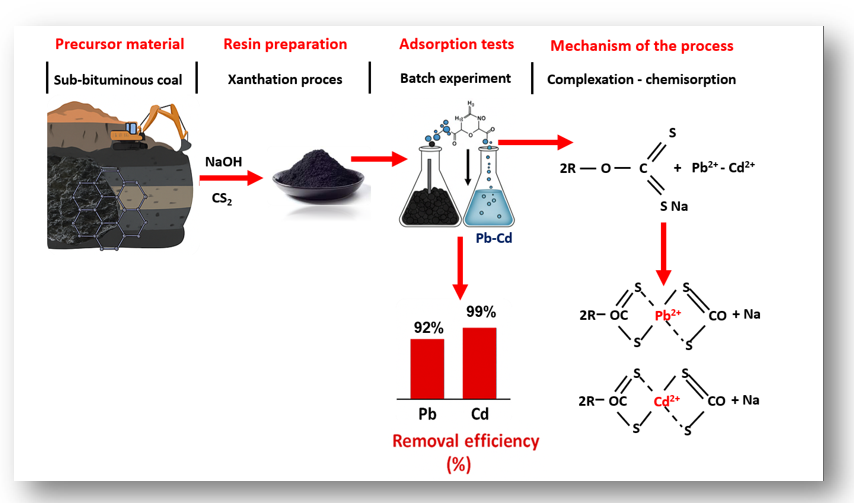
Graphical Abstract
Highlights
- The xanthate-modified coal exhibited high adsorption capacities, removing 98% of Pb and 97% of Cd from aqueous solutions.
- Adsorption followed the Freundlich isotherm and pseudo-second-order kinetics, confirming multilayer chemisorption on a heterogeneous surface.
- Equilibrium was achieved rapidly within 100 minutes, indicating fast kinetics and superior performance compared to other carbon-based adsorbents.
- In complex matrices with natural organic matter, the modified coal maintained removal efficiencies of 99 % for Cd and 92% for Pb, demonstrating strong selectivity and environmental applicability.
Keywords
Subjects
OPEN ACCESS
©2025 The author(s). This article is licensed under a Creative Commons Attribution 4.0 International License, which permits use, sharing, adaptation, distribution and reproduction in any medium or format, as long as you give appropriate credit to the original author(s) and the source, provide a link to the Creative Commons license, and indicate if changes were made. The images or other third party material in this article are included in the article’s Creative Commons license, unless indicated otherwise in a credit line to the material. If material is not included in the article’s Creative Commons license and your intended use is not permitted by statutory regulation or exceeds the permitted use, you will need to obtain permission directly from the copyright holder. To view a copy of this license, visit:
http://creativecommons.org/licenses/by/4.0/
PUBLISHER NOTE
GJESM Publisher remains neutral concerning jurisdictional claims in published maps and institutional affiliations.
MAJOR DATABASES, CITATION METRICS & CAPTURES
Google Scholar | Scopus - SJR | Web of Science | Biological Abstracts: Clarivate | Biosis Preview: Clarivate | PlumX Metrics | Altmetrics | Mendeley |
CURRENT PUBLISHER
GJESM Publisher




Letters to Editor
[1] Letters that include statements of statistics, facts, research, or theories should include appropriate references, although more than three are discouraged.
[2] Letters that are personal attacks on an author rather than thoughtful criticism of the author’s ideas will not be considered for publication.
[3] Letters can be no more than 300 words in length.
[4] Letter writers should include a statement at the beginning of the letter stating that it is being submitted either for publication or not.
[5] Anonymous letters will not be considered.
[6] Letter writers must include their city and state of residence or work.
[7] Letters will be edited for clarity and length.