Document Type : RESEARCH ARTICLE
Authors
1
Research Center for Horticulture, National Research and Innovation Agency, Bogor, West Java 16911, Indonesia
2
Research Center for Estate Crops, National Research and Innovation Agency, Bogor, West Java 16911, Indonesia
3
Research Center for Fishery, National Research and Innovation Agency, Bogor, West Java 16911, Indonesia
4
Agriculture Faculty, University of Jenderal Soedirman, Purwokerto, Central Java, Indonesia
5
Research Center for Climate and Atmosphere, National Research and Innovation Agency, South Tangerang, Banten 15310, Indonesia
6
Research Center for Food Crops, National Research and Innovation Agency, Bogor, West Java 16911, Indonesia
Abstract
BACKGROUND AND OBJECTIVES: Integrated rice–fish farming (Minapadi) enhances agricultural sustainability but remains challenged by pest management practices that often rely on environmentally harmful synthetic insecticides. This study aims to develop and assess an eco-friendly pest control strategy using botanical insecticides, ensuring safe integration of rice and fish farming while maintaining ecological balance and improving profitability.
METHODS: Field experiments were conducted in Central Java, Indonesia, with four treatments: conventional rice monoculture, Minapadi without insecticide, Minapadi with synthetic insecticides, and Minapadi with botanical insecticides (eugenol-based). Key parameters including arthropod biodiversity, pest incidence, fish survival, rice yield, and economic feasibility were monitored over two planting seasons.
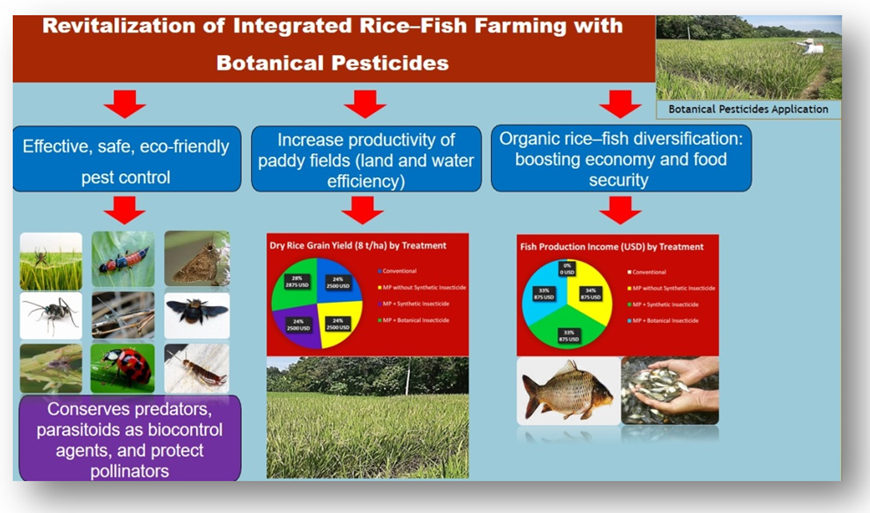
FINDINGS: Results showed that Botanical insecticide treatment enhanced arthropod diversity (11 morphospecies versus 9 under synthetic treatments) while effectively reducing pest damage (less than 1 percent caterpillar damage, less than 5 percent grasshopper infestation). No insecticide residues were found in fish, soil, or water samples. Fish survival remained high (more than 90 percent), and rice yields increased by 15 percent compared to conventional practices. Economically, botanical Minapadi systems improved farmers’ net income by approximately 16 percent per hectare.
CONCLUSION: The botanical insecticide–based Minapadi system offers a sustainable, eco-friendly approach to managing pests by leveraging plant-derived compounds that biodegrade rapidly and pose minimal risk to non-target organisms, including fish and beneficial arthropods. By integrating these biopesticides into rice–fish farming, we observed not only effective suppression of key rice pests, but also enhanced water and soil quality, leading to healthier fish populations and increased overall system resilience. Economically, the slightly higher input costs of botanical sprays were offset by improved rice yields, reduced post-harvest losses, and higher fish survival rates, resulting in significant gains in net farm income. Taken together, these findings underscore the potential for wider adoption of environmentally sustainable rice–fish integration, contributing to the twin goals of sustainable agriculture and regional food security while offering a scalable model for smallholder farmers.
Graphical Abstract
Highlights
- First field trial of eugenol-based botanical insecticides in integrated Minapadi rice–fish farming systems;
- Botanical sprays preserved beneficial arthropod biodiversity better than synthetic pesticides;
- Eugenol-based treatment resulted in no detectable pesticide residues in fish, water, or soil, ensuring environmental safety;
- Sustainable botanical pest management improved rice yields and increased farmers’ net income by approximately 16% per hectare;
- Developed an integrated model combining Minapadi rice–fish farming with botanical pest management for sustainable tropical agriculture.
Keywords
Subjects
OPEN ACCESS
©2025 The author(s). This article is licensed under a Creative Commons Attribution 4.0 International License, which permits use, sharing, adaptation, distribution and reproduction in any medium or format, as long as you give appropriate credit to the original author(s) and the source, provide a link to the Creative Commons license, and indicate if changes were made. The images or other third party material in this article are included in the article’s Creative Commons license, unless indicated otherwise in a credit line to the material. If material is not included in the article’s Creative Commons license and your intended use is not permitted by statutory regulation or exceeds the permitted use, you will need to obtain permission directly from the copyright holder. To view a copy of this license, visit:
http://creativecommons.org/licenses/by/4.0/
PUBLISHER NOTE
GJESM Publisher remains neutral concerning jurisdictional claims in published maps and institutional affiliations.
MAJOR DATABASES, CITATION METRICS & CAPTURES
Google Scholar | Scopus - SJR | Web of Science | Biological Abstracts: Clarivate | Biosis Preview: Clarivate | PlumX Metrics | Altmetrics | Mendeley |
CURRENT PUBLISHER
GJESM Publisher




Letters to Editor
[1] Letters that include statements of statistics, facts, research, or theories should include appropriate references, although more than three are discouraged.
[2] Letters that are personal attacks on an author rather than thoughtful criticism of the author’s ideas will not be considered for publication.
[3] Letters can be no more than 300 words in length.
[4] Letter writers should include a statement at the beginning of the letter stating that it is being submitted either for publication or not.
[5] Anonymous letters will not be considered.
[6] Letter writers must include their city and state of residence or work.
[7] Letters will be edited for clarity and length.