Mariculture site selection based on water quality, cultivation and ecological condition

Document Type : RESEARCH ARTICLE

Authors

1 Research Center for Conservation of Marine and Inland Water Resources, National Research and Innovation Agency, Jl. M.H. Thamrin Jakarta, Indonesia

2 Research Center for Geoinformatics, National Research and Innovation Agency, Jl. M.H. Thamrin Jakarta, Indonesia

3 Research Center for Limnology and Water Resources, National Research and Innovation Agency, Jl. M.H. Thamrin Jakarta, Indonesia

4 Faculty of Fisheries and Marine Sciences, IPB University, Bogor, Indonesia

5 Faculty of Marine and Fisheries Sciences of Hasanuddin University, Makassar, Indonesia

6 Organic Chemistry, Environmental Chemistry and Bioremediation Laboratory, Chemical Engineering Department, Fajar University, Jl. Professor Abdurrahman Basalamah, Panakkukang, Makassar, 90231, South Sulawesi, Indonesia

7 Faculty of Mathematics and Natural Science, Tadulako University, Palu, Indonesia

Abstract
BACKGROUND AND OBJECTIVES: Choosing a location for mariculture is very important because it affects water quality, while problems that affect cultivation and the environment can be avoided by choosing the right location. The objective of this study is to develop a methodological strategy for integrating and analyzing spatial data, which will facilitate the identification of optimal locations for mariculture. In this context, the ecosystem approach to mariculture is analyzed with an emphasis on evaluating water quality conditions and determining primary productivity values.
METHODS: Water quality parameter data was analyzed using principal component analysis, values, and distribution of primary productivity using the kriging interpolation method using geographic information system. Spatial analysis employing Geographic Information System applications is used to evaluate the appropriateness of locations for mariculture.
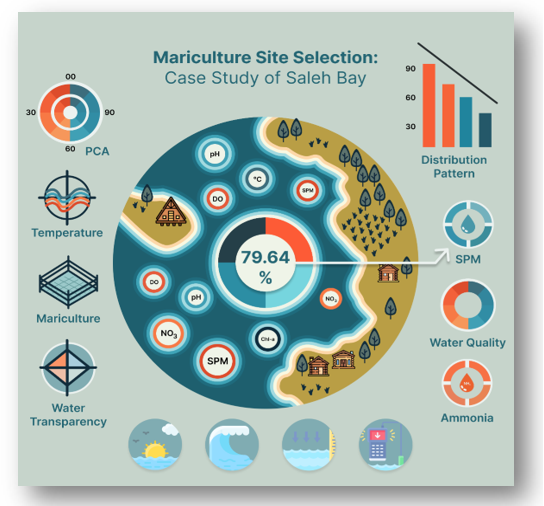
FINDINGS: The distribution pattern of primary productivity is strongly influenced by the distribution of phytoplankton and the highest concentration values are located in coastal waters and small islands. The analysis identified three primary components that account for 79.64 percent of the results. The most influential factors include suspended particulate matters, nitrate, temperature, salinity, ammonia, current, and water transparency. According to the study results, the principal component values indicate that the most affected regions by pollutant pressure are agricultural lands that drain into rivers and watersheds, along with coastal residential neighborhoods.
CONCLUSION: The status of water quality is the main limiting factor in determining the location of mariculture, therefore it is necessary to relocate existing mariculture, improve agricultural cultivation techniques, and/or regulate the use of pesticides that not carried out during the rainy season. These findings may assist the appropriate authorities in the selection and oversight of mariculture sites. The innovative aspect of this study lies in its focus on adaptive management of sustainable marine cultivation, designed to align with regional conditions and promote ecological health alongside the socio-economic prosperity of local communities.

Graphical Abstract

Mariculture site selection based on water quality, cultivation and ecological condition

Highlights

  • Integration of water quality and primary productivity contributes to site selection to support sustainable production;
  • Good water quality and productivity reduce potential environmental risks and provide optimal production results;
  • Suitable areas can be well distinguished and classified in a suitability matrix scale. This approach is relatively easy, efficient and effective to apply to various coastal systems.

Keywords

Subjects

OPEN ACCESS

©2025 The author(s). This article is licensed under a Creative Commons Attribution 4.0 International License, which permits use, sharing, adaptation, distribution and reproduction in any medium or format, as long as you give appropriate credit to the original author(s) and the source, provide a link to the Creative Commons license, and indicate if changes were made. The images or other third party material in this article are included in the article’s Creative Commons license, unless indicated otherwise in a credit line to the material. If material is not included in the article’s Creative Commons license and your intended use is not permitted by statutory regulation or exceeds the permitted use, you will need to obtain permission directly from the copyright holder. To view a copy of this license, visit: 

http://creativecommons.org/licenses/by/4.0/


PUBLISHER NOTE

GJESM Publisher remains neutral concerning jurisdictional claims in published maps and institutional affiliations.


CITATION METRICS & CAPTURES

Google Scholar | Scopus | Web of Science | PlumX Metrics | Altmetrics | Mendeley |


CURRENT PUBLISHER

GJESM Publisher

Letters to Editor

GJESM Journal welcomes letters to the editor for the post-publication discussions and corrections which allows debate post publication on its site, through the Letters to Editor. Letters pertaining to manuscript published in GJESM should be sent to the editorial office of GJESM within three months of either online publication or before printed publication, except for critiques of original research. Following points are to be considering before sending the letters (comments) to the editor.

[1] Letters that include statements of statistics, facts, research, or theories should include appropriate references, although more than three are discouraged.
[2] Letters that are personal attacks on an author rather than thoughtful criticism of the author’s ideas will not be considered for publication.
[3] Letters can be no more than 300 words in length.
[4] Letter writers should include a statement at the beginning of the letter stating that it is being submitted either for publication or not.
[5] Anonymous letters will not be considered.
[6] Letter writers must include their city and state of residence or work.
[7] Letters will be edited for clarity and length.

Send comment about this article
Enter Name.
Enter a valid email address.
Enter a vaid affiliation.
Enter comments (At leaset 10 words)
CAPTCHA Image
Enter Security Code Correctly.

Article Podcasts

  • Receive Date 26 August 2024
  • Revise Date 02 November 2024
  • Accept Date 06 December 2024