Document Type : CASE STUDY
Authors
1
Department of Environmental Engineering, Faculty of Civil Engineering, Planning, and Geo-Engineering, Institut Teknologi Sepuluh Nopember, Surabaya, Indonesia
2
Research Center for Infrastructure and Sustainable Environment, Institut Teknologi Sepuluh Nopember, Surabaya, Indonesia
3
Civil Engineering Studies, College of Engineering, Universiti Teknologi MARA, Cawangan Pulau Pinang, Permatang Pauh Campus, 13500 Pulau Pinang, Malaysia
Abstract
BACKGROUND AND OBJECTIVES: Food waste has major environmental, economic, and social impacts, contributing to greenhouse gas emissions, soil depletion, global food insecurity, and rising food prices. Addressing the global challenge of food waste necessitates a heightened focus on food waste treatment. This investigation analyzed the extent of food waste reduction achieved at composting and recycling centers in Surabaya. The objective of this study is to evaluate the effectiveness of food waste reduction at composting and recycling facilities.
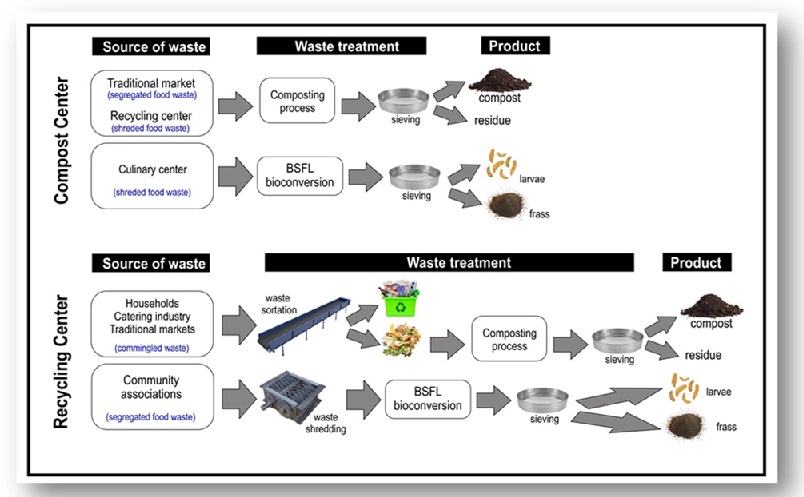
METHODS: The study utilized material flow analysis to assess food waste reduction at the Wonorejo composting and the Jambangan recycling centers. The present analysis examines the quantity and dynamics of food waste, starting with i) the pre-treatment stage that encompasses sorting, shredding, and sieving; ii) the composting process, which involves the generation of compost and the loss of water; and finally, iii) the bioconversion process facilitated by black soldier fly larvae, highlighting the production of larvae biomass and frass.
FINDINGS: At the Wonorejo composting and Jambangan recycling centers, composting served as the main approach for the treatment of food waste. At the Wonorejo composting center, over 99 percent of food waste was composted, whereas 0.22 percent was managed through black soldier fly larvae bioconversion. Within this composting center, the conversion rates revealed that 70.71 percent of the food waste was processed into mature compost. Furthermore, 0.03 percent was utilized for larval biomass production, 24.94 percent was lost to moisture, and 4.32 percent remained as residual waste. At the Jambangan recycling center, 85.74 percent of food waste was composted, whereas the remaining 14.26 percent was handled through black soldier fly larva bioconversion. Approximately 40.03 percent was transformed into mature compost, 1.37 percent into larval biomass, 29.26 percent lost as moisture, and the remaining 29.34 percent was landfilled.
CONCLUSION: Material flow analysis revealed that compost and recycling center facilities preferred composting over black soldier fly larva bioconversion for food waste reduction. Composting proved to be an effective method for processing over 85 to 99 percent of food waste, while the application of black soldier fly larvae bioconversion resulted in a mere 0.2 to 14 percent of food waste being treated. In light of the significant volume of food waste that continues to be disposed of in landfills, it is imperative for the Surabaya City Government to establish additional composting facilities in various locations. Furthermore, the implementation of supplementary strategies, including the management of surplus food distribution and the encouragement of composting at the household level, is essential for enhancing food waste management throughout the supply chains.
Graphical Abstract
Highlights
- The composting center was more effective than the recycling center in reducing food waste;
- Total food waste reduction at the Wonorejo composting center was 95.67%. Over 70% of food waste was turned into compost, whereas 0.03 and 0.09% were valorized as black soldier fly larvae biomass and frass, respectively;
- The total food waste reduction at the Jambangan recycling center was 70.65%. The valorization of food waste has resulted in 37.24% compost, 1.37% black soldier fly larva biomass, and 2.78% black soldier fly larvae frass;
- The current number of composting centers are inadequate to reduce Surabaya’s high food waste generation.
Keywords
Subjects
OPEN ACCESS
©2024 The author(s). This article is licensed under a Creative Commons Attribution 4.0 International License, which permits use, sharing, adaptation, distribution and reproduction in any medium or format, as long as you give appropriate credit to the original author(s) and the source, provide a link to the Creative Commons license, and indicate if changes were made. The images or other third party material in this article are included in the article’s Creative Commons license, unless indicated otherwise in a credit line to the material. If material is not included in the article’s Creative Commons license and your intended use is not permitted by statutory regulation or exceeds the permitted use, you will need to obtain permission directly from the copyright holder. To view a copy of this license, visit:
http://creativecommons.org/licenses/by/4.0/
PUBLISHER NOTE
GJESM Publisher remains neutral concerning jurisdictional claims in published maps and institutional affiliations.
CITATION METRICS & CAPTURES
Google Scholar | Scopus | Web of Science | PlumX Metrics | Altmetrics | Mendeley |
CURRENT PUBLISHER
GJESM Publisher




Letters to Editor
[1] Letters that include statements of statistics, facts, research, or theories should include appropriate references, although more than three are discouraged.
[2] Letters that are personal attacks on an author rather than thoughtful criticism of the author’s ideas will not be considered for publication.
[3] Letters can be no more than 300 words in length.
[4] Letter writers should include a statement at the beginning of the letter stating that it is being submitted either for publication or not.
[5] Anonymous letters will not be considered.
[6] Letter writers must include their city and state of residence or work.
[7] Letters will be edited for clarity and length.