Document Type : CASE STUDY
Authors
1
Environmental Science Program, Riau University, Bina Widya, Simpang Baru, Tampan District, Pekanbaru City, Riau Province, Indonesia
2
Faculty of Social and Political Science, Riau University, Bina Widya, Simpang Baru, Tampan District, Pekanbaru City, Riau Province, Indonesia
3
Faculty of Fisheries and Marine, Riau University, Bina Widya, Simpang Baru, Tampan District, Pekanbaru City, Riau Province, Indonesia
Abstract
BACKGROUND AND OBJECTIVES: The flooding phenomenon in Pekanbaru City is an interrelated problem between socio-economic and environmental problems. One of the socio-economic problems that causes flooding every year in Pekanbaru City is waste management. Another socio-economic problem is water use behavior. This oversight represents a significant weakness in flood mitigation strategies, as those most vulnerable to flooding are frequently the ones whose needs are neglected in the planning process. It is crucial that effective flood management and disaster response prioritize socio-economic considerations as a fundamental principle. The aim of this study is to develop spatial planning strategies and community behavior towards flood control in the Sail Watershed, Pekanbaru City. This study innovation is a combination of the spatial concept of urban flooding phenomena and community behavior which has never been done before, previous research only focused on providing physical flood control to reduce the impact of disasters.
METHODS: Analysis of spatial planning strategies and community behavior towards flood control efforts using participatory prospective analysis. Prospective analysis in this study was used to determine the dominant variables that influence strategy determination. The prospective method is a tool used for policy analysis, especially in study involving sustainable development, because it can facilitate the anticipation of change in an unstable environment.
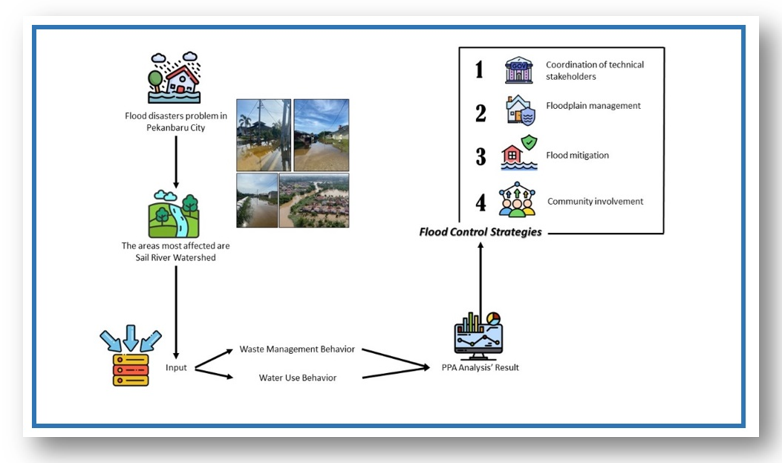
FINDINGS: The results of the study show that minimizing flood disasters can be done through structural development and synergized with non-structural development that provides space for community behavior so that the results are more optimal. Flood control are carried out in an integrated and comprehensive manner starting from stakeholder coordination, flood disaster management, flood handling and involving the community. Strategies that can be taken to control floods are coordination of technical stakeholders related to flood control, floodplain management, flood mitigation, and community involvement.
CONCLUSION: This study shows that coordination is the most influential variable with a weight of 3750 for direct influence and 3597 for indirect influence. Then followed by the variables management, mitigation, involvement. Spatial planning strategies and community behavior in flood control are carried out with the coordination of technical stakeholders related to flood control, flood management includes before a disaster occurs, during a disaster and after a disaster, flood plain management, includes determining flood boundaries, determining zoning, supervision and monitoring as well as community involvement.
Graphical Abstract
Highlights
- The novelty of the study combines the spatial concept of urban flooding phenomena and community behavior which has never been done before, previous research only focused on providing physical flood control to reduce the impact of disasters;
- The study uses a modified participatory prospective analysis with a geographic information system for the analysis of flood control strategies;
- The study reveals that coordination is the most influential factor for flood control strategies. Then followed by management, mitigation, and involvement. This shows that the main flood control strategy is coordination of technical stakeholders.
Keywords
Subjects




Letters to Editor
[1] Letters that include statements of statistics, facts, research, or theories should include appropriate references, although more than three are discouraged.
[2] Letters that are personal attacks on an author rather than thoughtful criticism of the author’s ideas will not be considered for publication.
[3] Letters can be no more than 300 words in length.
[4] Letter writers should include a statement at the beginning of the letter stating that it is being submitted either for publication or not.
[5] Anonymous letters will not be considered.
[6] Letter writers must include their city and state of residence or work.
[7] Letters will be edited for clarity and length.