Document Type : RESEARCH ARTICLE
Authors
1
Graduate School, Istanbul Technical University, 34469 Maslak, Istanbul, Turkey
2
Vocational School, Construction Technology Department, Bilecik Seyh Edebali University, 11230, Bilecik, Turkey
3
Hydraulics Division, Civil Engineering Department, Istanbul Technical University,34469 Maslak, Istanbul, Turkey
Abstract
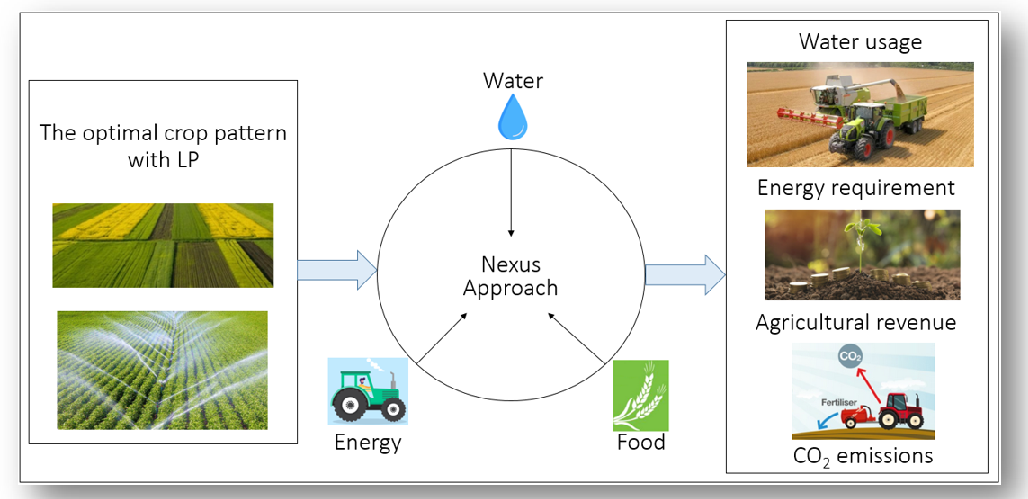
BACKGROUND AND OBJECTIVES: Agriculture plays a significant role in the overall consumption of freshwater resources, accounting for approximately 70 percent of the total use. Energy is also essential at various stages of agriculture and the food chain. On a global scale, the agricultural and food industries account for approximately 30 percent of the overall energy consumption, with a significant portion derived from fossil fuel sources. This underscores the intricate interconnection between food, energy, and water resources. This study utilizes a linear programming model to determine the optimal cropping pattern while minimizing water usage in agriculture. This study's primary contribution lies in its dual approach: it identifies the optimal cropping patterns for a specified objective function through linear programming while simultaneously conducting a comprehensive analysis of these patterns by integrating considerations of food, energy, and water nexus.
METHODS: The constraints applied in linear programming involve maintaining nearly the same agricultural revenue, conserving the total cultivation area, and limiting the change intervals in cultivation area by 5 percent. Using linear programming, crop patterns were determined for the periods of 2017, 2025-2050, 2050-2075, and 2075-2100. In each scenario, calculations were conducted to assess water consumption, energy demands, agricultural income, and carbon dioxide emissions, all framed within the context of the food-energy-water nexus. The various scenarios were subsequently analyzed to assess their effects. An evaluation was conducted regarding the sustainability of water usage in agricultural production.
FINDINGS: All the scenarios examined resulted in lower water usage, reduced energy requirements, and decreased carbon dioxide emissions. Throughout various time periods, scenario 6, which permits a 5 percent variation in cultivation areas without imposing a total cultivation area limit, consistently proved to be the most favorable choice. It achieved an average reduction of 3.94 percent in water usage, 2.95 percent in energy requirements, and 1.62 percent in carbon dioxide emissions compared to the base scenario. Scenario 11, allowing for a 5 percent variation in cultivation areas while maintaining a total cultivation area limit, was evaluated as the second most effective scenario in terms of water conservation. It achieved an average reduction in water use of 3.45 percent, an average reduction in energy requirements of 1.85 percent, and a minimal reduction in carbon dioxide emissions of 0.11 percent across all time periods.
CONCLUSION: The outcomes of this study reveal that the proposed model can play a crucial role in advancing sustainable agricultural management strategies. The obtained results indicate that significant reductions in water usage, energy requirements, and carbon dioxide emissions can be achieved simply by modifying the crop pattern, while agricultural income remains largely at the same level. The imposition of a constraint requiring the total cultivation area to be equal to or greater than that of the baseline scenario in the linear programming model has been found to restrict the extent of these reductions.
Graphical Abstract
Highlights
- Significant reductions in water use, energy needs and CO2 emissions can be achieved through changes in cropping patterns alone, while agricultural income remains largely unchanged;
- The inclusion of a constraint in the linear programming model requiring the total cropland area to be equal to or greater than in the baseline scenario limited the potential reductions in the parameters examined;
- The best performing scenario achieved an average reduction of 3.93% in water use, 2.95% in energy needs and 1.62% in CO2 emissions compared to the baseline scenario.
Keywords
Subjects
OPEN ACCESS
©2024 The author(s). This article is licensed under a Creative Commons Attribution 4.0 International License, which permits use, sharing, adaptation, distribution and reproduction in any medium or format, as long as you give appropriate credit to the original author(s) and the source, provide a link to the Creative Commons license, and indicate if changes were made. The images or other third party material in this article are included in the article’s Creative Commons license, unless indicated otherwise in a credit line to the material. If material is not included in the article’s Creative Commons license and your intended use is not permitted by statutory regulation or exceeds the permitted use, you will need to obtain permission directly from the copyright holder. To view a copy of this license, visit:
http://creativecommons.org/licenses/by/4.0/
PUBLISHER NOTE
GJESM Publisher remains neutral concerning jurisdictional claims in published maps and institutional affiliations.
CITATION METRICS & CAPTURES
Google Scholar | Scopus | Web of Science | PlumX Metrics | Altmetrics | Mendeley |
CURRENT PUBLISHER
GJESM Publisher




Letters to Editor
[1] Letters that include statements of statistics, facts, research, or theories should include appropriate references, although more than three are discouraged.
[2] Letters that are personal attacks on an author rather than thoughtful criticism of the author’s ideas will not be considered for publication.
[3] Letters can be no more than 300 words in length.
[4] Letter writers should include a statement at the beginning of the letter stating that it is being submitted either for publication or not.
[5] Anonymous letters will not be considered.
[6] Letter writers must include their city and state of residence or work.
[7] Letters will be edited for clarity and length.