Document Type : RESEARCH ARTICLE
Authors
Department Environmental Science, Graduated School of Sustainable Development, Universitas Indonesia, Jalan Salemba Raya, Jakarta Pusat, DKI Jakarta 10430 Indonesia
10.22034/gjesm.2027.**.19.
Abstract
BACKGROUND AND OBJECTIVES: Industrial development in Jakarta has increased carbon load and the prevalence of respiratory diseases. The study objectives were to evaluate the integration of social cost of carbon indicators into the water, sanitation, and hygiene assessment framework to examine pollution exposure and respiratory disease incidence within industrial settings.
METHODS: This study utilizes secondary data from Jakarta covering the period from 2022 to 2024, obtained from the Air Pollution Monitoring and Detection Survey database and the National Health System, encompassing five automotive industrial hubs. This study investigates respiratory disease mortality by quantifying both the absolute count and proportional share of deaths attributed to pollution exposure among vulnerable populations, specifically children under five years of age and older adults. Cluster analysis, principal component analysis, and multivariate regression were applied. Industrial areas were categorized into small, medium, and advanced-scale clusters using the k-means algorithm, with the optimal number of clusters determined via the Elbow method.
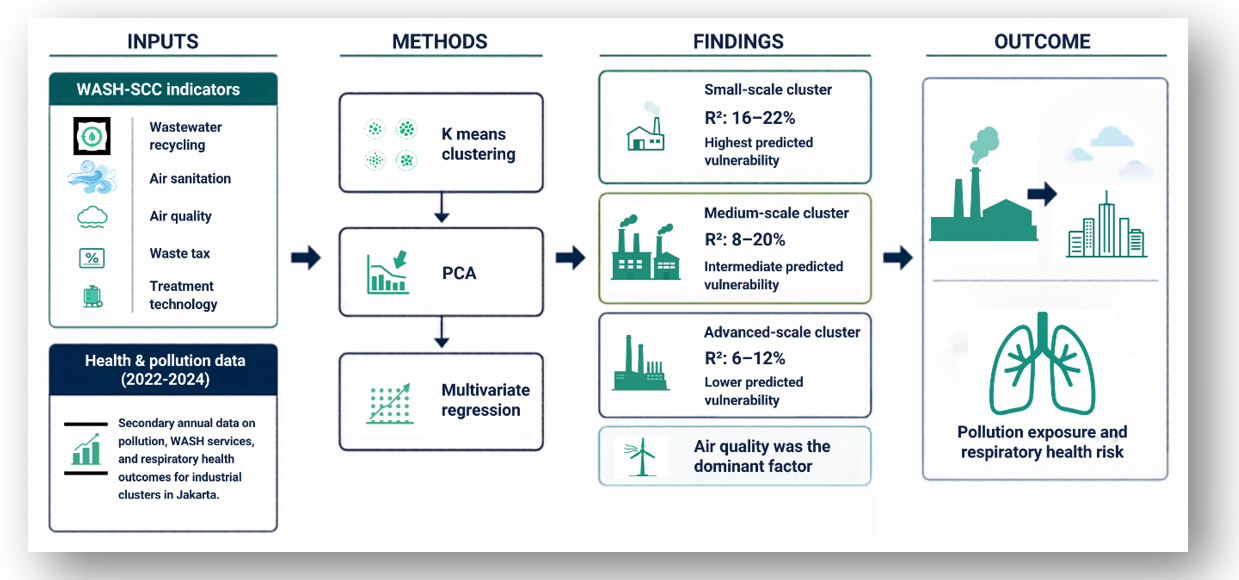
FINDINGS: The Adjusted R-squared values vary by cluster and outcome, ranging from 1.3 to 23.1 percent in models for age groups under 5 years and over 65 years, with no single cluster consistently demonstrating the highest predictive power. Air quality emerges as the predominant determinant, explaining greater than 10 percent of the observed variance, driven primarily by raw material combustion and fossil fuel consumption. Acute respiratory infections account for approximately 69 percent of deaths among children under five (out of a total of 6,000), while chronic respiratory diseases account for approximately 31 percent of deaths among individuals aged 65 and older (out of a total of 4,000). The regression model is significant at a probability value of 0.05.
CONCLUSION: These findings support the implementation of comprehensive emission control measures, as well as public participation in carbon tax systems. Integrating the social cost of carbon as an analytical indicator into water, sanitation, and hygiene assessments is critical for strengthening waste management practices and mitigating environmental health risks.
Graphical Abstract
Highlights
Ø Adjusted R² values ranged from 1.3% to 23.1% across cluster-specific models, with no single cluster consistently highest;
Ø Air quality explained more than 10% of the variance in WASH assessments across industrial clusters;
Ø Raw material combustion (PC2 loading=-0.75) and fossil fuel use (PC2 loading=0.85) were the main factors associated with pollution.
Keywords
Subjects



Letters to Editor
[1] Letters that include statements of statistics, facts, research, or theories should include appropriate references, although more than three are discouraged.
[2] Letters that are personal attacks on an author rather than thoughtful criticism of the author’s ideas will not be considered for publication.
[3] Letters can be no more than 300 words in length.
[4] Letter writers should include a statement at the beginning of the letter stating that it is being submitted either for publication or not.
[5] Anonymous letters will not be considered.
[6] Letter writers must include their city and state of residence or work.
[7] Letters will be edited for clarity and length.