Document Type : SHORT COMMUNICATION
Authors
1
jalan sriwijaya XII/6
2
Department of Plant Protection, Faculty of Agriculture, Universitas Jember, Jember, Indonesia
3
Research Center for Estate Crops, National research and Innovayion Agency, Bogor, Indonesia
4
Department of Agrotechnology, Faculty of Agriculture, Universitas Pekalongan, Pekalongan, Indonesia
5
Department of Management Laboratory, Graduate School, Universitas Negeri Surabaya
10.22034/gjesm.2027.**.23
Abstract
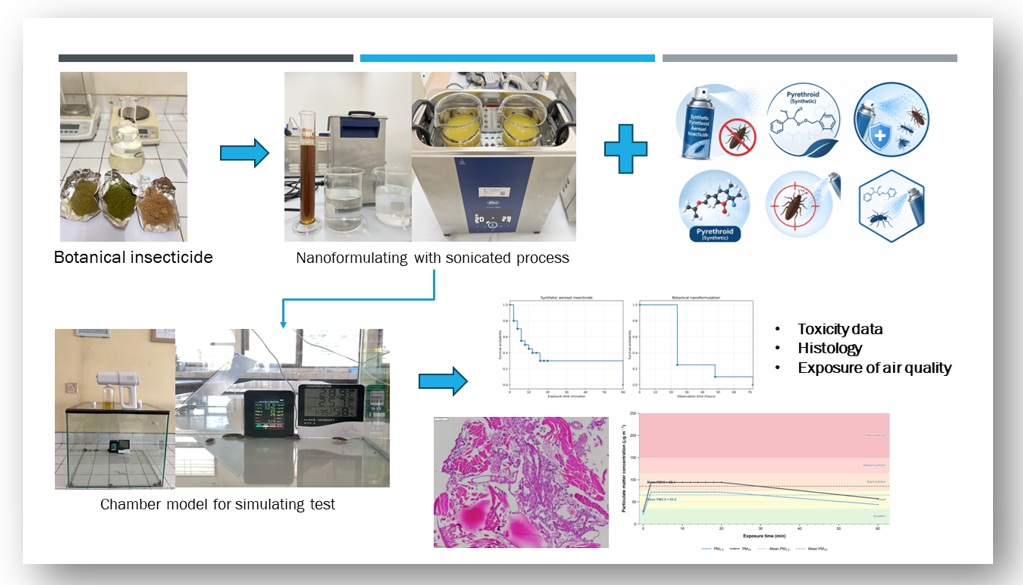
BACKGROUND AND OBJECTIVES: Synthetic insecticides remain widely used as a primary approach to pest control because of their perceived practicality and effectiveness compared with botanical alternatives. Cockroaches are recognised as household pests and potential vectors of human diseases. They also contain bioactive peptides that may contribute to immune-related biological activities. Nanoformulated botanical pesticides have emerged as a potential alternative to reduce reliance on synthetic insecticides. The study objectives were to evaluate insecticidal toxicity, visualise tissue-level responses through histological examination, and characterise the effects of active compound aerosols on air quality using a chamber-based exposure model.
METHODS: The botanical insecticide formulation consisted of extracts from Aglaia odorata, Ageratum conyzoides, and Azadirachta indica. The bioactive compounds were obtained using a rotary evaporator with ethanol as the extraction solvent. The nanoformulation was prepared using an emulsion containing Cinnamomum verum and processed with a sonicator. The experimental exposure model was established using a closed acrylic chamber, equipped with an air quality monitoring detector. In vivo experiments were conducted using IV to V instar cockroaches. The synthetic aerosol insecticide contained pyrethroid active ingredients, comprising cypermethrin, imiprothrin, and prallethrin.
FINDINGS: Mortality in cockroaches exposed to the synthetic aerosol insecticide was faster than after exposure to the nanoformulated botanical insecticide. In the synthetic insecticide treatment, 50 percent mortality was recorded among the 20 tested cockroaches within 8 minutes. Mortality subsequently increased to 100 percent after 60 minutes. In contrast, exposure to the nanoformulated botanical insecticide resulted in 50–75 percent mortality after 24 hours. This indicated a substantial difference in the time required to induce mortality between the two insecticide treatments. Both air quality monitoring results showed that Particulate Matter 2.5 and 10 concentrations following synthetic aerosol insecticide application were in a good category.
CONCLUSION: The comparative application of synthetic aerosol insecticides and nanoformulated botanical insecticides provides insights into their toxicity and the behavioural responses of cockroaches during the progression of systemic damage and eventual mortality. This study provides insights into potential exposure risks, the application of botanical insecticides as an alternative pest control approach, and the assessment of indoor air quality under simulated exposure conditions.
Graphical Abstract
Highlights
Ø Synthetic aerosol insecticide showed greater effectiveness than the botanical formulation.
Ø Post-application PM2.5 concentrations were 65.5 µg/m3 for the synthetic aerosol and 61.5 µg/m3 for the botanical nanoformulation.
Ø Post-application PM10 concentrations were 85.1 µg/m3for the synthetic aerosol and 80.2 µg/m3 for the botanical nanoformulation.
Ø Particulate measurements provided an indication of indoor air quality changes but did not quantify insecticide-specific chemical residues.
Keywords
Subjects
OPEN ACCESS
©2027 The author(s). This article is licensed under a Creative Commons Attribution 4.0 International License, which permits use, sharing, adaptation, distribution and reproduction in any medium or format, as long as you give appropriate credit to the original author(s) and the source, provide a link to the Creative Commons license, and indicate if changes were made. The images or other third party material in this article are included in the article’s Creative Commons license, unless indicated otherwise in a credit line to the material. If material is not included in the article’s Creative Commons license and your intended use is not permitted by statutory regulation or exceeds the permitted use, you will need to obtain permission directly from the copyright holder. To view a copy of this license, visit: http://creativecommons.org/licenses/by/4.0/
PUBLISHER NOTE
GJESM Publisher remains neutral concerning jurisdictional claims in published maps and institutional affiliations.
MAJOR DATABASES, CITATION METRICS & CAPTURES
Google Scholar | Scopus - SJR | Web of Science | Biological Abstracts: Clarivate | Biosis Preview: Clarivate | PlumX Metrics | Altmetrics | Mendeley |
CURRENT PUBLISHER
GJESM Publisher



Letters to Editor
[1] Letters that include statements of statistics, facts, research, or theories should include appropriate references, although more than three are discouraged.
[2] Letters that are personal attacks on an author rather than thoughtful criticism of the author’s ideas will not be considered for publication.
[3] Letters can be no more than 300 words in length.
[4] Letter writers should include a statement at the beginning of the letter stating that it is being submitted either for publication or not.
[5] Anonymous letters will not be considered.
[6] Letter writers must include their city and state of residence or work.
[7] Letters will be edited for clarity and length.