Integrating ocean literacy into vocational education for sustainable blue economy workforce development

Document Type : RESEARCH ARTICLE

Authors

1 Department of Aquatic Resource Management, Universitas Nusa Cendana, Kupang, Indonesia

2 Department of Mechanical Engineering, Universitas Nusa Cendana, Kupang, Indonesia

3 Department of Agribusiness, Universitas Nusa Cendana, Kupang, Indonesia

4 Department of Business Education, Universitas Negeri Surabaya, Surabaya, Indonesia

5 Department of Technical and Vocational Education, Universitas Pendidikan Indonesia, Bandung, Indonesia

6 Department of Building Engineering Education, Universitas Nusa Cendana, Kupang, Indonesia

7 Department of Civil Engineering, Balikpapan State Polytechnic, Balikpapan, Indonesia

10.22034/gjesm.2027.**.17.
Abstract
BACKGROUND AND OBJECTIVES: Ocean literacy is necessary for sustainable ocean management, but it is not yet treated as a workforce competence. Although technical and vocational institutions train much of the blue economy workforce, national policy remains ambiguous regarding whether formal education is assigned this mandate. The study objectives were to examine how Indonesia's Blue Economy Roadmap 2023-2045 positions education, ocean literacy and skills, and what a vocational curriculum consistent with it must contain.
METHODS: Directed content analysis with a documented nine-theme lexicon was applied to 1,072 action statements in the Roadmap's five implementation phases and four missions. Coding was validated against an independent large-language-model coding of 150 statements reviewed by a second author, and by precision, residual and sensitivity checks. Subsequently, a conceptual framework was developed through an iterative synthesis of the scholarship on ocean literacy, vocational education, and the blue economy. Structured as a theory of change, this model applies constructive alignment to ensure coherence across intended learning outcomes, pedagogical activities, and assessment criteria.
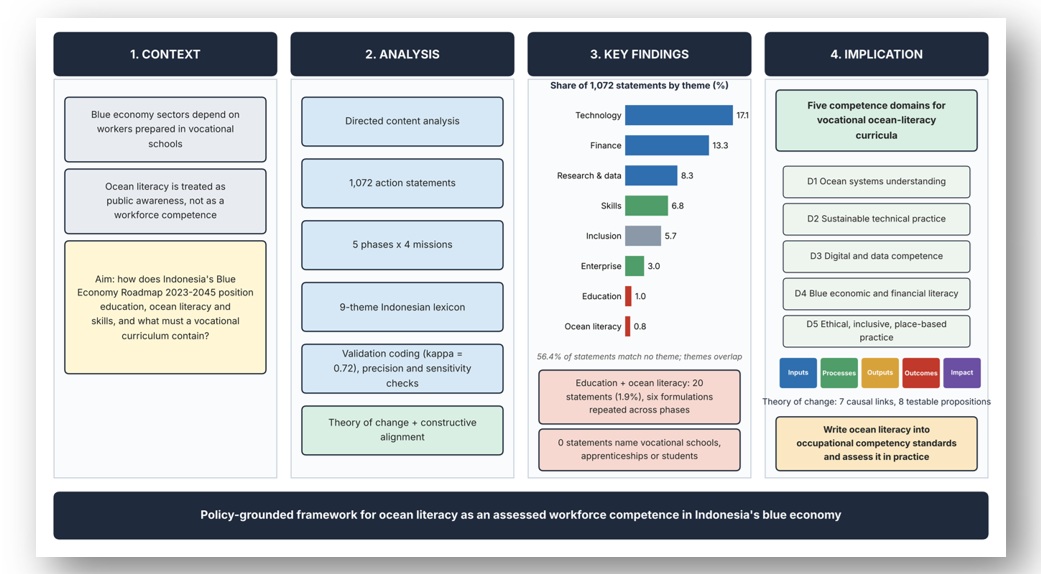
FINDINGS: Education statements (n = 11; 1.0 percent) and ocean literacy statements (n = 9; 0.8 percent) were scarce and recurred almost verbatim across phases; the 20 statements resolved into six formulations, and only about 490 of the 1,072 statements were distinct. Agreement was 95.9 percent (Cohen's kappa = 0.72), and theme rankings were unchanged under every lexicon variant. No statement named vocational schools, apprenticeships or students. Technology (17.1 percent) and finance (13.3 percent) statements dominated, and skills statements (6.8 percent, 87.7 percent of them in Mission 3) were framed as training, certification and job placement. From this synthesis, five core competence domains emerged (ocean systems understanding, sustainable technical practice, digital and data competence, blue economic and financial literacy, and ethical, inclusive and place-based practice) alongside a five-stage theory of change containing eight testable propositions.
CONCLUSION: Ocean literacy still matters, but awareness programmes for coastal communities are no longer enough. Because the Roadmap provides minimal direction for vocational training programs, ocean literacy needs to be codified within occupational competency standards and evaluated in applied settings. Rather than demonstrating curricular effectiveness, this framework offers a policy-informed model for empirical testing.

Graphical Abstract

Integrating ocean literacy into vocational education for sustainable blue economy workforce development

Highlights

Ø  Education and ocean literacy account for only 20 of 1,072 Roadmap action statements (1.9%), and they repeat almost verbatim across five phases;

Ø  No Roadmap action statement names vocational schools, apprenticeships or students, although the Roadmap counts vocational schools in its index;

Ø  Technology (17.1%) and finance (13.3%) dominate the action agenda and describe the operating environment in which vocational graduates will need capabilities beyond occupational skill;

Ø  Five competence domains and a theory of change with eight testable propositions link ocean literacy to assessed vocational practice.

Keywords

Subjects

OPEN ACCESS

©2027 The author(s). This article is licensed under a Creative Commons Attribution 4.0 International License, which permits use, sharing, adaptation, distribution and reproduction in any medium or format, as long as you give appropriate credit to the original author(s) and the source, provide a link to the Creative Commons license, and indicate if changes were made. The images or other third party material in this article are included in the article’s Creative Commons license, unless indicated otherwise in a credit line to the material. If material is not included in the article’s Creative Commons license and your intended use is not permitted by statutory regulation or exceeds the permitted use, you will need to obtain permission directly from the copyright holder. To view a copy of this license, visit: http://creativecommons.org/licenses/by/4.0/

PUBLISHER NOTE

GJESM Publisher remains neutral concerning jurisdictional claims in published maps and institutional affiliations.

MAJOR DATABASES, CITATION METRICS & CAPTURES

Google Scholar | Scopus - SJR | Web of Science | Biological Abstracts: Clarivate | Biosis Preview: Clarivate | PlumX Metrics | Altmetrics | Mendeley |

CURRENT PUBLISHER

GJESM Publisher

Letters to Editor

GJESM Journal welcomes letters to the editor for the post-publication discussions and corrections which allows debate post publication on its site, through the Letters to Editor. Letters pertaining to manuscript published in GJESM should be sent to the editorial office of GJESM within three months of either online publication or before printed publication, except for critiques of original research. Following points are to be considering before sending the letters (comments) to the editor.

[1] Letters that include statements of statistics, facts, research, or theories should include appropriate references, although more than three are discouraged.
[2] Letters that are personal attacks on an author rather than thoughtful criticism of the author’s ideas will not be considered for publication.
[3] Letters can be no more than 300 words in length.
[4] Letter writers should include a statement at the beginning of the letter stating that it is being submitted either for publication or not.
[5] Anonymous letters will not be considered.
[6] Letter writers must include their city and state of residence or work.
[7] Letters will be edited for clarity and length.

Send comment about this article
Enter Name.
Enter a valid email address.
Enter a vaid affiliation.
Enter comments (At leaset 10 words)
CAPTCHA Image
Enter Security Code Correctly.

Articles in Press, Accepted Manuscript
Available Online from 24 November 2026


  • Receive Date 13 August 2026
  • Revise Date 15 October 2026
  • Accept Date 24 November 2026