Eco-friendly biocontrol through biodegradation of autotoxic phenolic acids by Aspergillus species during cultivation of Pogostemon cablin

Document Type : RESEARCH ARTICLE

Authors

1 Research Center for Estate Crops, National Research and Innovation Agency, Jl. Raya Jakarta-Bogor, Cibinong, Indonesia

2 Department Center for Horticulture, National Research and Innovation Agency, Jl. Raya Jakarta-Bogor, Cibinong, Indonesia

10.22034/gjesm.2027.**.16.
Abstract
BACKGROUND AND OBJECTIVES: Continuous monoculture cultivation of patchouli (Pogostemon cablin Benth) leads to severe continuous cropping obstacles caused by bacterial wilt (Ralstonia solanacearum) and autotoxicity driven by accumulated phenolic acid allelochemicals such as p-hydroxybenzoic acid. The study objectives were to evaluate p-hydroxybenzoic acid phytotoxicity, screen rhizosphere microorganisms for dual biological control and autotoxin degradation and characterize the environmental remediation mechanisms of a promising fungal isolate.
METHODS: Patchouli plantlets were exposed to p-hydroxybenzoic acid concentrations ranging from 0 to 1,000 part per million to quantify plant mortality and biomass decline. To identify a highly sensitive test organism, seedling root elongation bioassays were conducted using water spinach (ipomoea aquatica), maize (Zea mays), and mung bean (Vigna radiata). Three hundred rhizosphere isolates were screened for antagonistic activity against Ralstonia solanacearum via double-layer agar overlay assays.The candidates were systematically evaluated for their capacity to promote seedling growth recovery and facilitate the biodegradation of -hydroxybenzoic acid in culture media utilizing high-performance liquid chromatography. Top isolate S37 was identified through internal transcribed spacer sequencing and cryogenic field-emission scanning electron microscopy, while secondary metabolites were profiled using gas chromatography-mass spectrometry.
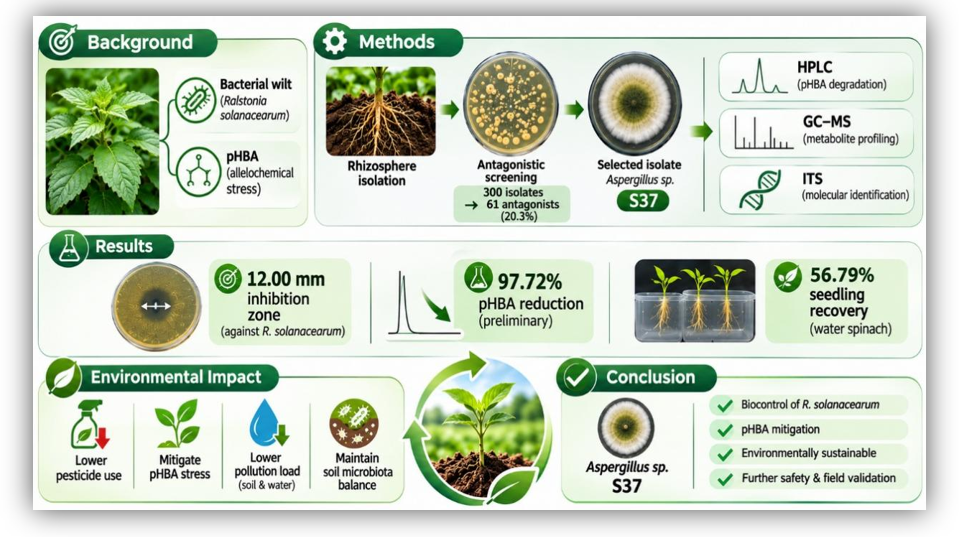
FINDINGS: Exposure to 1,000 parts per million p-hydroxybenzoic acid caused 100 percent patchouli mortality and 98.52 percent root length inhibition in water spinach, establishing water spinach as a sensitive indicator organism. Of the 300 rhizosphere isolates screened, 61 (20.3 percent) exhibited antagonistic activity against Ralstonia solanacearum. Notably, isolate S37 demonstrated superior efficacy, producing the largest inhibition zone (12.00 millimeters), restoring water spinach seedling growth by 56.79 percent under autotoxin-induced stress, and degrading 97.72 percent of p-hydroxybenzoic acid within seven-day period. Sequence alignment and morphology confirmed strain S37 as Aspergillus species. Metabolite profiling identified antibacterial 2,4-di-tert-butylphenol (3.63 percent) and diketopiperazine derivatives (18.57 percent), while biosafety assays verified non-hemolytic and non-pathogenic traits.
CONCLUSIONS: Aspergillus species S37 acts as a dual-function biological agent capable of suppressing bacterial wilt and bio-detoxifying autotoxic phenolic acids. The deployment of strain S37 offers a sustainable biological approach for the restoration of continuous cropping soils, mitigating agrochemical dependence and preventing environmental contamination in essential oil crop production.

Graphical Abstract

Eco-friendly biocontrol through biodegradation of autotoxic phenolic acids by Aspergillus species during cultivation of Pogostemon cablin

Highlights

Ø  Isolation and identification of Aspergillus sp. S37 demonstrated an exceptional 97.72% HPLC-verified degradation of p-hydroxybenzoic acid (pHBA) alongside robust antibacterial activity;

Ø  The study successfully validated water spinach (Ipomoea aquatica) as a highly sensitive biological model organism to assess the alleviation of phenolic autotoxin phytotoxicity;

Ø  GC-MS profiling revealed candidate metabolites, including antibacterial 2,4-di-tert-butylphenol and cyclic diketopiperazines, that drive pathogen inhibition and autotoxin tolerance;

Ø  Deploying strain S37 offers a sustainable biological solution for restoring sick soils, eliminating reliance on toxic soil fumigants, and mitigating agrochemical pollution.

Keywords

Subjects

OPEN ACCESS

©2027 The author(s). This article is licensed under a Creative Commons Attribution 4.0 International License, which permits use, sharing, adaptation, distribution and reproduction in any medium or format, as long as you give appropriate credit to the original author(s) and the source, provide a link to the Creative Commons license, and indicate if changes were made. The images or other third party material in this article are included in the article’s Creative Commons license, unless indicated otherwise in a credit line to the material. If material is not included in the article’s Creative Commons license and your intended use is not permitted by statutory regulation or exceeds the permitted use, you will need to obtain permission directly from the copyright holder. To view a copy of this license, visit: http://creativecommons.org/licenses/by/4.0/

PUBLISHER NOTE

GJESM Publisher remains neutral concerning jurisdictional claims in published maps and institutional affiliations.

MAJOR DATABASES, CITATION METRICS & CAPTURES

Google Scholar | Scopus - SJR | Web of Science | Biological Abstracts: Clarivate | Biosis Preview: Clarivate | PlumX Metrics | Altmetrics | Mendeley |

CURRENT PUBLISHER

GJESM Publisher

Letters to Editor

GJESM Journal welcomes letters to the editor for the post-publication discussions and corrections which allows debate post publication on its site, through the Letters to Editor. Letters pertaining to manuscript published in GJESM should be sent to the editorial office of GJESM within three months of either online publication or before printed publication, except for critiques of original research. Following points are to be considering before sending the letters (comments) to the editor.

[1] Letters that include statements of statistics, facts, research, or theories should include appropriate references, although more than three are discouraged.
[2] Letters that are personal attacks on an author rather than thoughtful criticism of the author’s ideas will not be considered for publication.
[3] Letters can be no more than 300 words in length.
[4] Letter writers should include a statement at the beginning of the letter stating that it is being submitted either for publication or not.
[5] Anonymous letters will not be considered.
[6] Letter writers must include their city and state of residence or work.
[7] Letters will be edited for clarity and length.

Send comment about this article
Enter Name.
Enter a valid email address.
Enter a vaid affiliation.
Enter comments (At leaset 10 words)
CAPTCHA Image
Enter Security Code Correctly.

Articles in Press, Accepted Manuscript
Available Online from 19 November 2026


  • Receive Date 07 August 2026
  • Revise Date 10 October 2026
  • Accept Date 19 November 2026