Document Type : RESEARCH ARTICLE
Authors
1
Public Health Study Program, Faculty of Health Sciences, Abulyatama University, Indonesia
2
Occupational Health and Safety Study Program, Faculty of Health Sciences, Abulyatama University, Indonesia
10.22034/gjesm.2027.**.09.
Abstract
BACKGROUND AND OBJECTIVES: Artisanal and small-scale gold mining operations subject laborers to multifaceted physical, chemical and ergonomic hazards, nevertheless, safety interventions remain largely unsystematic, and empirical evidence disaggregated by operational stage is notably scarce. The study objectives were to identify hazards at each stage of Artisanal and small-scale gold mining in South Aceh, determine risk levels, identify risk factors and existing controls, and prioritise risks for control.
METHODS: A descriptive qualitative study in April-May 2026 involved five miners selected purposively at a single site; Gampong Paya Ateuk, South Aceh, in one site visit. Observational data, semi-structured interviews, and documentary evidence were systematically analyzed following the qualitative analytical framework established by Miles and Huberman. Risk was assessed with hazard identification, risk assessment and risk control (likelihood × severity, scale 1-5) following the Malaysian Department of Occupational Safety and Health guideline and prioritised with failure mode and effects analysis (risk priority number = severity × occurrence × detection). Due to data limitations, burning events were omitted from scoring, and ergonomic hazards were similarly excluded. Furthermore, risk ratings were assigned by researchers without direct quantitative exposure measurements.
FINDINGS: Physical (landslide, slipping, machine entrapment), chemical (mercury exposure) and ergonomic (not scored) hazards were identified. Hazard identification, risk assessment and risk control rated mercury exposure (25) and landslide (20) as high, and machine entrapment (9) and slipping (9) as medium. Inconsistent personal protective equipment use (20, high) and work fatigue (12, medium) were contributing factors, not independent hazards. Failure mode and effects analysis ranked landslide first (Risk priority number: 80), followed by inconsistent personal protective equipment use (64) and mercury exposure (60); the rest tied at 36. The mercury score reflects hazard potential, not measured exposure. Key occupational risk factors comprised irregular personal protective equipment compliance, driven by burning discomfort, treacherous transit routes, sleep deprivation, and deficient ventilation alongside inadequate ground stabilization. Furthermore, mitigation measures such as personal protective equipment and timber supports proved notably inconsistent.
CONCLUSION: Landslide and mercury exposure were the highest priority hazards, and inconsistent personal protective equipment use was the highest priority contributing factor. Combining both methods separated risk level from priority for action. As these observations remain preliminary and localized, subsequent validation through expanded cohort investigations is warranted, incorporating quantitative exposure biomonitoring alongside standardized scoring of burning and ergonomic risk factors.
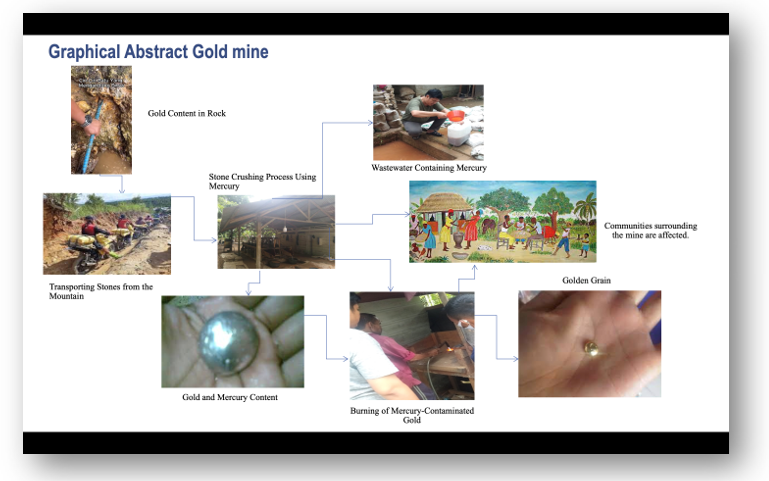
Graphical Abstract
Highlights
Ø Hazards were identified at four work stages of artisanal gold mining in South Aceh, Indonesia;
Ø HIRARC rated mercury exposure and landslide as High risks and inconsistent PPE use as a High contributing factor;
Ø FMEA ranked landslide first (RPN 80), followed by inconsistent PPE use (64) and mercury exposure (60);
Ø Controls should follow the hierarchy of controls, not rely on PPE alone, and cover the burning stage.
Keywords
Subjects
OPEN ACCESS
©2027 The author(s). This article is licensed under a Creative Commons Attribution 4.0 International License, which permits use, sharing, adaptation, distribution and reproduction in any medium or format, as long as you give appropriate credit to the original author(s) and the source, provide a link to the Creative Commons license, and indicate if changes were made. The images or other third party material in this article are included in the article’s Creative Commons license, unless indicated otherwise in a credit line to the material. If material is not included in the article’s Creative Commons license and your intended use is not permitted by statutory regulation or exceeds the permitted use, you will need to obtain permission directly from the copyright holder. To view a copy of this license, visit: http://creativecommons.org/licenses/by/4.0/
PUBLISHER NOTE
GJESM Publisher remains neutral concerning jurisdictional claims in published maps and institutional affiliations.
MAJOR DATABASES, CITATION METRICS & CAPTURES
Google Scholar | Scopus - SJR | Web of Science | Biological Abstracts: Clarivate | Biosis Preview: Clarivate | PlumX Metrics | Altmetrics | Mendeley |
CURRENT PUBLISHER
GJESM Publisher



Letters to Editor
[1] Letters that include statements of statistics, facts, research, or theories should include appropriate references, although more than three are discouraged.
[2] Letters that are personal attacks on an author rather than thoughtful criticism of the author’s ideas will not be considered for publication.
[3] Letters can be no more than 300 words in length.
[4] Letter writers should include a statement at the beginning of the letter stating that it is being submitted either for publication or not.
[5] Anonymous letters will not be considered.
[6] Letter writers must include their city and state of residence or work.
[7] Letters will be edited for clarity and length.