
5.2
CiteScore
2.9
Impact Factor
Document Type : CASE STUDY
Authors
1 Trisakti School of Tourism, Tanah Kusir, Jl. IKPN Bintaro, RT.4/RW.10, Bintaro, Kec. Pesanggrahan, Kota Jakarta Selatan, Jakarta, 12330, Indonesia
2 Department of Geography, University of Indonesia, Faculty of Social and Political Sciences, Indonesia
3 Department Biology, Faculty of Mathematics and Natural Sciences, Universitas Indonesia, Indonesia
4 Department of Sociology, Faculty of Social and Political Sciences, Universitas of Indonesia. Indonesia
Graphical Abstract
Highlights
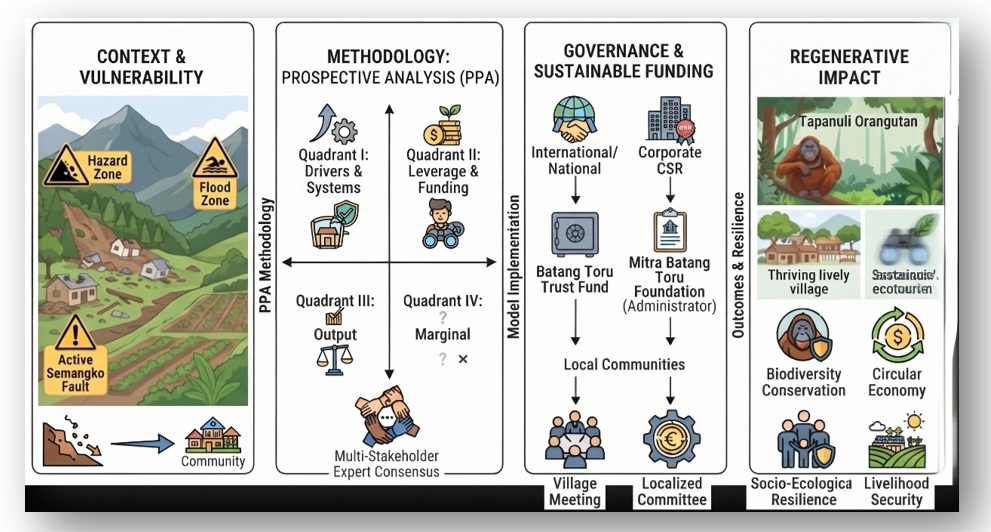
Ø Institutional strengthening and partner engagement emerge as primary systemic drivers, reinforced by sustainable funding and wildlife-based ecotourism as vital leverage variables ensuring long-term resilience;
Ø An integrated governance framework featuring a dedicated Trust Fund administered by the Mitra Batang Toru Foundation successfully guarantees financial self-reliance and structural stability;
Ø The model effectively empowers local institutions, specifically Village-Owned Enterprises (BUMDes) and Tourism Awareness Groups (Pokdarwis), through structured multi-stakeholder coordination;
Ø The proposed regenerative tourism approach successfully synthesizes post-disaster circular economic recovery with high-level biodiversity conservation for the critically endangered Tapanuli Orangutan (Pongo tapanuliensis).
Keywords
INTRODUCTION
Contemporary rural destination governance necessitates a comprehensive systemic restructuring, driven by the rapid acceleration of global climate volatility, intensifying anthropogenic pressures, and escalating tectonic instability. Rural tourism destinations that depend on natural capital and close-knit community structures face exceptional exposure to severe economic disruption in the wake of disasters. Fistola and La Rocca (2017) observed that tourism activities exhibit a dual nature: while serving as a catalyst for circular economic growth, exceeding ecological capacity thresholds can induce an exponential rise in environmental entropy. This spatial vulnerability is evident in Indonesia on the western slopes of Bukit Barisan, a critical landscape, particularly in the Batang Toru Watershed (DAS) corridor and in Garoga Village, which lies within South Tapanuli Regency. Catastrophic flash floods and landslides on November 25th, 2025 have paralyzed the traditional agricultural system on which 98 percent (%) of residents depend for their livelihoods. Confronted with the physical reality of the active Semangko fault's "Red Zone,", regional reconstruction must transcend conventional extractive economic paradigms, transitioning instead toward an adaptive, climate-resilient tourist village ecosystem of high added value. This approach aligns with the sustainable rural livelihoods framework, which underscores the necessity for vulnerable populations to cultivate adaptive capacity against severe environmental shocks and stresses (Chambers and Conway, 1992). Tourism initiatives rooted in the community have substantial potential to act as drivers of economic recovery after disasters if they are grounded in local cultural values and mutual cooperation. Law No. 6/2014 on Villages grants Indonesian rural jurisdictions autonomous authority to guide local development, to put community assets to use, and to safeguard indigenous heritage as the Law No. 6/2014 (Republik Indonesia, 2014). The primary drawing force of rural destinations is rooted in local cultural wisdom, articulated through distinctive traditions, deeply embedded social cohesion, and authentic landscape management practices. Local populations are empowered under Community-Based Tourism (CBT) models, tourism village frameworks in particular, which cast residents as primary stewards and direct economic beneficiaries (Scheyvens, 1999). Over the past three decades, sustainable tourism theory has evolved from abstract conceptual frameworks into pragmatic, site-specific interventions (Huang et al. 2019). Integrating post-disaster recovery, biodiversity conservation, and the revitalization of local economies serves as a basic pillar of socio-ecological resilience in hazard-prone regions of Indonesia. Batang Toru District in South Tapanuli Regency holds profound strategic conservation significance, as it encompasses the final global habitat of the critically endangered species, the Tapanuli Orangutan (Pongo tapanuliensis), within the Batang Toru Landscape (Samsuri et al., 2023). This ecologically sensitive landscape overlaps directly with highly vulnerable post-disaster communities in Garoga Village. Consequently, establishing a strategic roadmap for the development of Garoga Tourism Village, alongside wildlife-based ecotourism and geotourism across Batang Toru, is an urgent priority. Because catastrophic events severely disrupted the socio-economic fabric of Garoga, long-term revitalization cannot rely on resource-depleting paradigms; rather, it must operationalize the principles of the green economy and regenerative tourism. Successful ecotourism implementation in fragile ecosystems requires equitable profit-sharing and local control across economic, social, psychological, and political dimensions (Scheyvens, 1999). Concurrently, exceptional geological and biological endowments endow the Batang Toru region with world-class ecotourism potential. Ecological investigations in Sitandiang demonstrate that the habitat selection and foraging dynamics of the Tapanuli Orangutan are strictly contingent upon the canopy species of intact primary and secondary forest, with a notable reliance on Lithocarpus tapanuliensis and associated arboreal flora (Sinaga and Setyawatiningsih, 2025; Harapan et al. 2023). The Aek Parsariran river site and comparable natural hydrological features show strong domestic tourist demand connected to the watershed ecosystem of Batang Toru (Rambe et al. 2025). The integration of wildlife ecotourism, geological heritage, and community-led disaster recovery constitutes a robust strategy for enhancing regional disaster resilience and mitigating poverty (Fistola and La Rocca, 2017; Ogutu, 2002). The research gap is that traditional frameworks treat post-disaster recovery, circular economy, and habitat conservation as isolated silos, lacking a unified operational model for high-hazard zones harboring critically endangered species (Pongo tapanuliensis). Furthermore, prevailing models remain heavily dependent upon short-term relief grants or ad hoc corporate social responsibility (CSR) allocations; when coupled with centralized top-down governance, these funding mechanisms frequently precipitate administrative paralysis and community alienation. This study aims to devise a sustainable, post-disaster regenerative tourism model that nurtures a circular economy for the local community and, at the same time, safeguards the habitat of the Tapanuli orangutan (Pongo tapanuliensis). The study will take place in Garoga Village and the Batang Toru Ecosystem, within the South Tapanuli Regency of Indonesia, in 2026.
MATERIALS AND METHODS
Study area, tectonic setting, and geomorphological risks
Active tectonic dynamics linked to the Great Sumatran Fault line characterize the geology of the Batang Toru landscape, which lies in South Tapanuli Regency, North Sumatra, Indonesia. This tectonic framework generates distinct geothermal manifestations including sulfur thermal springs and ancient volcanic rock exposures, while simultaneously imposing severe geomorphological risks. The confluence of steep topography, fractured bedrock, and intense tropical precipitation renders the region highly prone to landsliding and downstream flash flooding, a vulnerability underscored by the catastrophic event on November 25th, 2025. Topographically, Garoga Village occupies a confined valley restricted by active strike-slip fault traces situated along the Batang Toru watershed. This structural setting is exacerbated by aggressive lateral stream migration across a 432 square kilometers (km²) catchment area. When extreme atmospheric events induce torrential precipitation within the upper catchment, massive sediment loads and slope debris surge into the constricted valley floor, precipitating catastrophic flash floods (Figs. 1 and 2). The November 2025 flood resulted in 47 fatalities, swept away 147 residences, and permanently displaced 200 households (BPBD Tapanuli Selatan, 2025). Agricultural fields were buried under thick sediment and timber debris, paralyzing the traditional wet-rice farming that sustained 98% of the village population. The designation of the former settlement area as a high-risk 'Red Zone' necessitates a complete spatial and economic reconfiguration of the village. When global climate anomalies induce extreme precipitation upper catchments, accumulated sediment and slope material surge into the constricted valley floor, precipitating catastrophic flash floods, a phenomenon vividly exemplified by the disaster of November 25th, 2025. The socio-ecological consequences of these physical characteristics have been profound: 47 lives lost, 147 homes swept away, and 200 households forced into permanent displacement. The local livelihood structure, highly homogeneous, with 98% of the population entirely dependent on traditional wet-rice farming, has been completely paralyzed, as rice paddies have been buried under a thick layer of solid debris, including sand, rocks, and timber logs. At the community level, the psychosocial impact manifests as acute trauma, which is further exacerbated by inadequate institutional support for the physical rehabilitation the physical restoration of the land. The designation of the original settlement area as a "Red Zone" (a high-risk disaster area) necessitates a radical restructuring of the village’s spatial layout (Fig. 2).
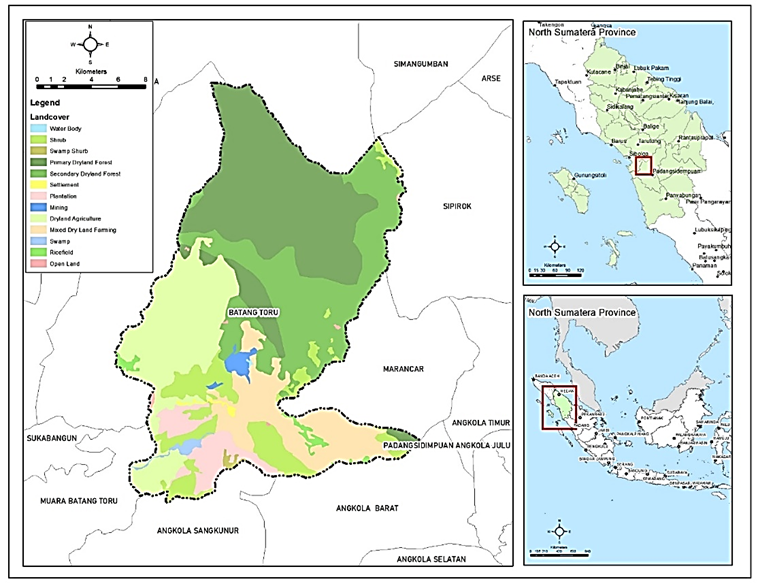
Fig. 1: Geographical location of the study area in Batang Toru District, Indonesia
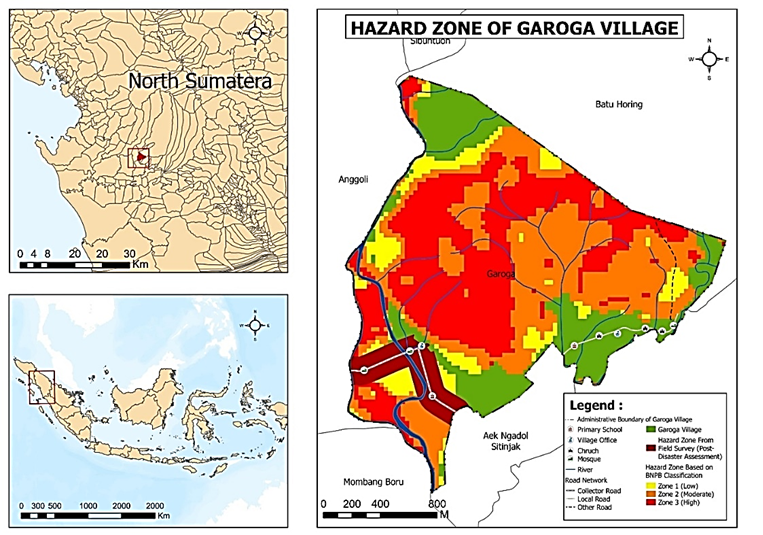
Fig. 2: Hazard zone map of Garoga Village, Batang Toru District, South Tapanuli Regency
Participatory prospective analysis (PPA) framework
PPA was the approach used in this study to build a regenerative tourism model for the post-disaster setting that fits these complex dynamics. PPA is a structured qualitative-quantitative methodology for scenario planning that explores plausible future states of a system and supports the formulation of strategic policy (Godet, 2004). Integrating insights from diverse stakeholder panels, PPA isolates primary systemic drivers, delineates variable interdependencies, and formulates prospective operational scenarios for long-term strategic planning and implementation. Adhering to the methodological framework established by Godet et al. (2004) subsequently synthesized in Mariati et al. (2023), the procedural steps are delineated as follows:
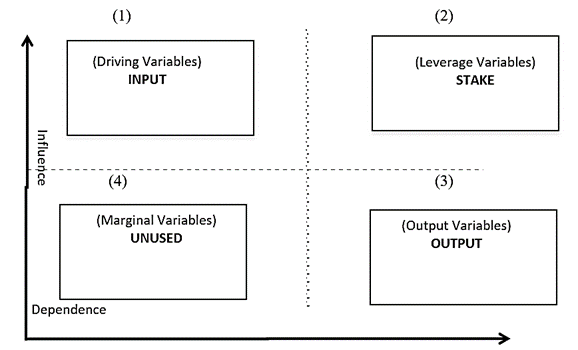
Scenario Generation and Typology Classification: The matrix input was run through prospective analysis software, which assigns the variables to four analytical quadrants (Fig. 3) according to Bourgeois and Jesus (2004): Quadrant I, driving variables (high influence, low dependency); quadrant II, leverage variables (high influence, high dependency); Quadrant III, Output Variables (low influence, high dependency); and quadrant IV, marginal variables (low influence, low dependency).
Direct influence matrix scoring mechanics and operational definitions
The direct influence matrix is the analytical core of the PPA methodology. It quantifies pairwise causal relationships among the ten identified systemic requirement variables, coded A (Institutional Reorganization), B (Institutional strengthening program), C (Inter-institutional relations), D (Partnership engagement), E (Sustainable financing), F (River tourism), G (Wildlife-based Ecotourism), H (Geology-based ecotourism), I (Educational tourism), and J (Culinary/souvenir tourism), thereby clarifying their interdependencies and relative influence within the overall management framework. Panelists evaluated pairwise direct influences by addressing the standardized question: 'To what extent does a direct structural or policy change in Variable i immediately force an operational or functional change in Variable j Scores were assigned using a standard 4-point prospective scale (Godet, 2004), strictly interpreted through explicit operational criteria (Table 1).
Data entry matrix of cross impact multiplications applied to a classification software (MICMAC)
1. Launch the MICMAC software and create a new project (File > New).
2. Define your variables (Variables > Data entry). Use the exact short labels and full names in the same sequence as your Excel sheet.
3. Enter the matrix values by going to Matrices > Matrix of Direct Influences (MID) > Data entry. Input the numbers precisely as they appear in your 'Pengaruh Langsung' Excel sheet.
Table 1: Operational scoring criteria and structural impact definitions for direct influence evaluation (Godet, 2004)
|
Score |
Influence level |
Explicit operational criteria and systemic causality |
|
0 |
No direct Influence |
Variable i exerts no direct structural impact or functional dependency on Variable j (Causality = 0%). |
|
1 |
Minor influence |
Variable i exerts a weak, indirect, or long-term delayed impact on Variable j without altering its core operational state. |
|
2 |
Moderate influence |
Variable i exerts a noticeable direct impact on Variable j, altering its operational conditions but not dictating its existence. |
|
3 |
Very strong influence |
Variable i exerts an immediate, critical, and decisive direct control over Variable j (Variable j cannot function without Variable i). |
Calculation and analysis
1. Navigate to the 'Calculation' tab to run the cross-impact multiplications. This computes the Matrix of Indirect Influences (MII).
2. Generate the Cartesian diagram to visualize the variables by going to Graphs > Direct/ Indirect influence/dependence map.
Independent assignment, aggregation protocol, and subjectivity control
To maintain evaluation objectivity, a four-step protocol comprising 25 experts was executed. First, a standardized briefing established mutual comprehension of the evaluation criteria. Second, each expert independently scored the matrix to prevent cross-contamination of judgments. Third, individual scores were aggregated via median calculation to mitigate the influence of extreme outliers. Finally, in instances of significant scoring divergence, anonymous group results were stratified, and participants re-evaluated the items iteratively until a robust consensus was achieved. Prospective analysis software processes the aggregated matrix outcomes derived from expert evaluations. Subsequently, these outputs are mapped onto a two-dimensional plane illustrating the direct influence and dependence among systemic factors, as delineated in Fig. 3. Bourgeois and Jesus (2004) describe the diagram quadrants as differing in the character of the factors they hold, as follows: 1) the first quadrant (driving variables), comprising factors characterized by high direct influence and low dependence; these elements govern the system and constitute its foundational drivers. 2) the second quadrant (leverage variables), characterized by factors combining strong direct influence with high interdependence, several of which function as robust structural attributes. 3) the third quadrant (output variables), comprising factors exhibiting weak direct influence alongside high dependence; and 4) the fourth quadrant (marginal variables), encompassing factors characterized by both weak direct influence and low dependence. Because these peripheral elements operate relatively independently within the system, the resulting structural model is anchored in the analytical workflow outlined below, providing a systematic basis for subsequent model development and validation:
1. Determine the status of a factor.
2. Draw up the scenarios, then choose among them. Each scenario must incorporate all systemic factors, subject to the condition that exactly one status is selected per factor, and no mutually incompatible statuses may be included.
3. Examine the scenarios and derive strategies from them. Strategies are formulated either to facilitate preferred trajectories or to avert pathways detrimental the system.
4. Build an optimal model from the selected scenarios, giving weight to how easily it can be implemented on the ground and to whether supporting resources are available.
Stakeholder composition, selection criteria, and sampling rationale
The PPA expert panel comprises 25 stakeholders across five distinct sectors, forming a multi-tiered governance structure that spans macro-policy, meso-technical, meso-operational, and micro-community representation levels. It includes regional policymakers and government officials (n = 7) providing macro-level statutory alignment, spatial zoning, budget allocation, and post-disaster rehabilitation policy; academic experts and senior researchers (n = 6) offering meso-technical expertise in prospective analysis, biodiversity conservation (Pongo tapanuliensis), GIS mapping, and sustainable tourism models; private sector representatives (n = 4) driving meso-operational capital allocation, corporate CSR grants, and infrastructure support; non-governmental organization officers (n = 4) executing field-level wildlife habitat monitoring, community-based conservation, and advocacy; and local community leaders and practitioners (n = 4) contributing micro-level grassroots insights, traditional ecological knowledge, post-disaster trauma recovery, and local tourism village execution.
Model validation protocol and evaluation criteria
To establish structural validity, operational feasibility, and institutional alignment, the proposed post-disaster regenerative tourism model was evaluated through a structured, multi-method validation protocol combining quantitative expert scoring, qualitative debate tracking, structural model revisions, and independent external peer evaluation (Godet et al. 2004; Mariati et al. (2023).
1. Validation Criteria and Quantitative Scoring Rubric: Model evaluation was operationalized across four explicit criteria:
a. C1: Structural completeness and variable relevance (Ensuring all critical driving, leverage, and outcome variables are represented).
b. C2: Logical and systemic consistency (Verifying that direct/indirect influence dependencies accurately reflect landscape dynamics).
c. C3: Operational feasibility and community readiness (Assessing the realistic capacity of BUMDes, Pokdarwis, and local stakeholders to execute proposed interventions).
d. C4: Institutional alignment and ecological safeguards (Ensuring compliance with statutory spatial plans and habitat protections for Pongo tapanuliensis).
Each criterion was scored on a 4-point ordinal rubric (1 = Inadequate, 2 = Marginally Adequate, 3 = Adequate, 4 = Highly Adequate). A sub-panel of N = 15 evaluators comprising 4 regional policymakers, 4 senior academics, 2 corporate CSR leads, 3 conservation Non-governmental organizations (NGOs) directors, and 2 community BUMDes/Pokdarwis leads independently completed evaluation rubrics. The results were then validated quantitatively using the item content validity index (I-CVI) and Scale-Level CVI Average (S-CVI/Avg) were calculated, applying a validation threshold of S-CVI ≥ 0.80 (Lynn, 1986). Qualitative focus group (FDG) discussions and disagreement tracking: On June 26, 2026, a validation FGD was convened in Medan, attended by academic leaders (5 individuals) as well as officials from the South Tapanuli regional government, including the Regional Secretary of South Tapanuli, the Head of the South Tapanuli Regional Development Planning Agency, the Head of the South Tapanuli Environmental Agency, and the Head of the South Tapanuli Agriculture Agency. Rather than soliciting passive consensus, the FGD implemented a structured critique protocol wherein participants actively appraised scenario assumptions, identified operational bottlenecks, and proposed structural revisions to strengthen model reliability and applicability.
2. Independent External Review: Prior to the FGD, the preliminary model structure was submitted for independent blind review by two external non-author experts: a senior specialist in disaster risk governance (Universitas of Indonesia) and an ecotourism expert of Trisakti Institute of Tourism. Their written evaluations provided an external baseline prior to stakeholder synthesis.
RESULTS AND DISCUSSION
The prospective analysis was initiated identifying nine candidate requirement variables deemed critical to post-disaster regenerative tourism development: Institutional reorganization (A), Institutional strengthening program (B), Inter-institutional relations (C), Partnership engagement (D), Sustainable financing (E), River tourism (F), Wildlife-based ecotourism (G), Geology-based ecotourism (H), Educational tourism (I), and Culinary/souvenir tourism (J), as shown in Table 2. The direct influence matrix scores (Table 3) were derived from structured expert consultations involving key regional stakeholders and administrative authorities, including the Regent of South Tapanuli, the Regional Secretary, the Head of Batang Toru District, the Head of Garoga Village, and the Regional Development Planning Agency (Bappeda). Subsequent software-based prospective analysis yielded the influence-dependency quadrant distribution depicted in Fig. 4. Table 3 presents the matrix of direct influences among systemic factors derived through prospective analysis software. Furthermore, Fig. 4 illustrates the resulting degrees of influence and dependence, categorized into the system's factors, classified into the factor quadrants established by Bourgeois and Jesus (2004). Partner Engagement (0.98; 1.05) and Institutional Strengthening (0.80; 1.08) fall in Quadrant I (Driving Variables), as mapped in Fig. 4. These variables exert strong systemic influence with comparatively low dependency, establishing them as the primary drivers governing the system. Quadrant II (Leverage Variables) holds Educational Tourism (1.08; 1.03), Wildlife-based Ecotourism (1.10; 1.05), and Sustainable Funding (1.15; 1.13). Exhibiting high simultaneous influence and dependency, these variables function as critical leverage points that reinforce the core drivers.
Post-disaster regenerative tourism model
The post-disaster regenerative tourism management model is derived from prospective scenarios projecting future conditions, constructed around varying states of the model’s primary success factors (quadrants I and II). Within these future scenarios, the combined action of driving factors and levers dictates the ultimate success of the model. The factors in quadrant III (output factors) and quadrant IV (marginal factors) are independent and are therefore not included in the model scenario, although during implementation they can be brought into the model formulation scenario. According to the prospective analysis, institutional strengthening and stakeholder involvement constitute the primary driving forces underpinning the success of the post-disaster regenerative tourism management model, whereas sustainable funding, wildlife-based tourism act as critical auxiliary propellers of that success over the long term.
Table 2: Recapitulation of requirement factors for a post-disaster regenerative tourism model
|
No. |
Variable |
Need factor |
Code |
|
1. |
Institutional |
Institutional reorganization |
A |
|
Institutional strengthening program |
B |
||
|
2 |
Partnership |
Inter-institutional relations |
C |
|
Partnership engagement |
D |
||
|
Sustainable financing |
E |
||
|
3 |
Tourism potential |
River tourism |
F |
|
Wildlife-based ecotourism |
G |
||
|
Geology-based ecotourism |
H |
||
|
Education tourism |
I |
||
|
Culinary tourism |
J |
Table 3: Synthesized direct influence matrix among systemic factors
|
From To |
Institutional reorganization |
Institutional strengthening program |
Inter-institutional relations |
Partnership engagement |
Sustainable funding |
River tourism |
Wildlife-based ecotourism |
Geology-based ecotourism |
Educational tourism |
Culinary and souvenir tourism |
|
Institutional reorganization |
|
3 |
2 |
2 |
3 |
2 |
3 |
3 |
2 |
2 |
|
Institutional Strengthening program |
3 |
|
3 |
3 |
3 |
3 |
3 |
3 |
3 |
3 |
|
Inter-institutional relations |
2 |
3 |
|
3 |
3 |
2 |
2 |
2 |
2 |
2 |
|
Partnership engagement |
2 |
2 |
2 |
|
3 |
3 |
2 |
2 |
2 |
2 |
|
Sustainable funding |
2 |
2 |
2 |
3 |
|
3 |
3 |
3 |
2 |
3 |
|
River Tourism |
3 |
3 |
2 |
3 |
3 |
|
3 |
3 |
2 |
1 |
|
Wildlife-based ecotourism |
2 |
2 |
1 |
2 |
3 |
3 |
|
3 |
3 |
3 |
|
Geology-based ecotourism |
2 |
2 |
1 |
2 |
3 |
3 |
3 |
|
3 |
3 |
|
Educational Tourism |
3 |
3 |
3 |
2 |
2 |
2 |
3 |
3 |
|
3 |
|
Culinary and souvenir tourism |
3 |
3 |
2 |
2 |
2 |
2 |
2 |
2 |
2 |
|
Note: 0 means no direct influence; 1 means minor influence; 2 means moderate influence; 3 means very strong influence.
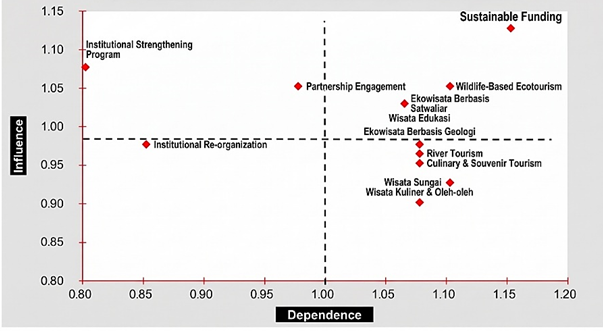
Fig. 4: Overview of the importance levels of influencing factors
Determinant and driver factor approach
Prospective analysis identifies institutional strengthening and partner engagement as foundational determinants, whereas sustainable funding, wildlife-based tourism, and educational tourism foundational determinants, whereas the post-disaster regenerative tourism management model. The systematic approach adopted to configure these factors into prospective scenarios is delineated as follows:
1. Institutional strengthening and partner engagement factors. Positioning these variables as foundational drivers of model success aligns with prospective development challenges, which remain inextricably linked to broader global concerns, including food-energy-water security, intensifying competition, climate change, and the diminishing carrying capacity of the development. Garoga Village and the Batang Toru ecosystem hold a crucial position, particularly in addressing climate change and declining environmental carrying capacity. Future management of the Batang Toru ecosystem requires institutional transformation and strengthening to navigate changing dynamics and management challenges, efforts that must align with the regenerative tourism management model. Formulating this model for Garoga Tourism Village and Batang Toru District focuses on realizing more effective and sustainable institutional strengthening and partner engagement programs. This entails formulating a forward-looking operational framework to delineate stakeholder and governmental roles and responsibilities, alongside the fiscal requirements necessary to achieve self-reliant regenerative tourism management.
2. Sustainable funding, wildlife-based tourism, and educational tourism function as key driving forces supporting the success of the post-disaster regenerative tourism management model. Because land cover has changed in Garoga Village and Batang Toru District, a new concept is required, both for developing Batang Toru District and for turning Garoga into a tourism village.
Integrated future scenarios
To operationalize the prospective findings, three future development trajectories were formulated based on varying degrees of intervention across Quadrants I and II Table 4. These trajectories provide a comparative basis for evaluating alternative intervention strategies and their implications for long-term system sustainability.
1. Business-as-usual scenario (1A-2A-3A-4A-5A): Assumes the absence of proactive policy intervention, resulting in uncoordinated recovery trajectories and sustained environmental vulnerability.
2. Collaborative management scenario (1B-2B-3B-4B-5B): Characterized by fragmented and uncoordinated stakeholder participation alongside dispersed CSR support.
3. Integrated regenerative tourism scenario (1C-2C-3C-4C-5C): Incorporates optimal, highly integrated interventions encompassing capacity building, multi-stakeholder governance frameworks, and sustainable endowment financing.
Table 4: Post-disaster regenerative tourism model scenarios
|
No |
Key factor |
Future conditions |
||
|
A |
B |
C |
||
|
1 |
Institutional Strengthening Program |
No institutional strengthening program |
Institutional strengthening program implemented without considering staff capacity-building needs |
Institutional strengthening program implemented based on the needs of post-disaster regenerative tourism management |
|
2 |
Partner Engagement |
Weak partner engagement (solely to fulfill obligations) |
Moderate partner engagement |
Strong partner engagement based on post-disaster regenerative tourism management needs |
|
3 |
Sustainable Funding |
No sustainable funding |
Sustainable funding from (CSR) |
Sustainable funding from national and international partners |
|
4 |
Wildlife-based Ecotourism |
Current limited management of potential |
Wildlife-based ecotourism management involving local partners |
National and international wildlife-based ecotourism management |
|
5 |
Educational Tourism |
Educational tourism development remains at current levels |
Educational tourism development involving local partners for the domestic market |
Educational tourism development involving local partners for national and international markets |
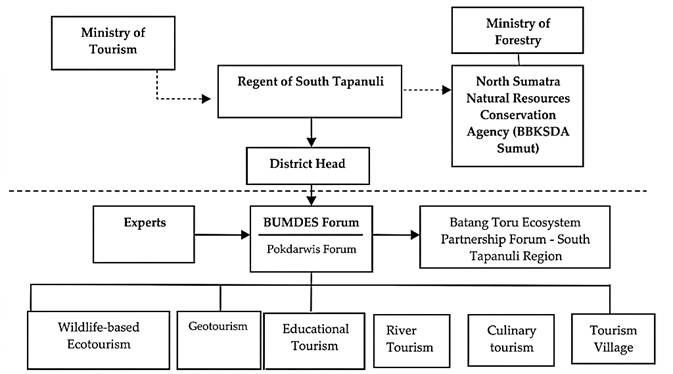
Implementation of the optimal prospective model (Condition C) rests on governance arranged in several tiers (Fig. 5). Foundational oversight at the policy level comes from three sources: the Regent of South Tapanuli, who gives statutory backing; the Ministry of Forestry, with technical alignment via North Sumatra Natural Resources Conservation Agency (BBKSDA) Sumut; and the Ministry of Tourism, which offers promotional support. Technical guidance at the local operational level is provided to village-owned enterprises (BUMDes) and tourism awareness groups (Pokdarwis) by academic expert panels and by the Batang Toru Ecosystem Partnership Forum. Through this structural configuration, tourism operates as an integrated regenerative model wherein destination management is fully embedded within local community networks and ecological assets (Cawley and Gillmor, 2008; Gannon, 1994). The village-owned enterprise (Bumdes) forum and the tourism awareness group (Pokdarwis) will receive input from experts and the Batang Toru ecosystem partnership forum (South Tapanuli region). This initiative aims to ensure the effective and autonomous execution of post-disaster regenerative development and management, underpinned by initial capital contributions from corporate and institutional partners within the Batang Toru ecosystem. Consequently, rural tourism serves not merely as a recreational activity, but as a strategic instrument for income diversification and job creation in rural areas (Gannon, 1994). To secure optimal development, rural tourism should embrace the paradigm of "Integrated Rural Tourism," in which tourism activities are fully embedded within regional resources, the local economy, and community's social networks, thereby mitigating the risk of rural decline (Cawley and Gillmor, 2008). This model demonstrates substantial resilience and persistence, withstanding global market dynamics effectively (Brouder, 2012; Lane and Kastenholz, 2018).
Operational scenario for post-disaster regenerative tourism
The operational scenarios for post-disaster regenerative tourism must be evaluated against specific operational criteria spanning institutional strengthening, stakeholder engagement, sustainable financing, and broader socio-economic dimensions to ensure implementation effectiveness. The operational details regarding social aspects address the institutional strengthening factor (1C), while those regarding economic aspects address the sustainable funding factor (3C). Operational details concerning effective management and environmental aspects cover partner engagement (2C), wildlife ecotourism (4C), and educational tourism (5C).
Sustainable social aspects of post-disaster regenerative tourism scenarios
Operational details for post-disaster regenerative tourism viewed through the lens of sustainable social and economic aspects begin with an institutional strengthening program (1C). Effective management of post-disaster regenerative tourism necessitates multi-stakeholder coordination and targeted capacity-building frameworks tailored to the operational requirements of the sector. Interviews and multi-stakeholder consultations indicate that the institutional strengthening factor can be implemented within the post-disaster regenerative tourism management scenarios through two primary activities:
Sustainable management and funding for post-disaster regenerative tourism require coordination and collaboration with the Batang Toru Collaborative Forum and other parties. This guarantees effective governance and institutes sustainable funding mechanisms, enabling the tourism initiative to achieve long-term self-sufficiency while strengthening community resilience and accountability. Drawing on the strategic plan for post-disaster regenerative tourism, along with discussions and interviews involving experts, several partner-related activities must be undertaken.
Sustainable funding
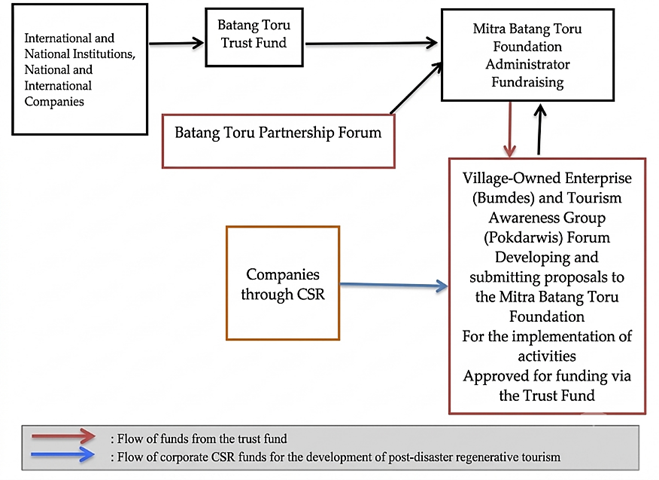
To overcome the historical fragility of short-term government grants or sporadic CSR funding, the model establishes a dedicated Batang Toru Trust Fund managed by the Mitra Batang Toru Foundation (Fig. 6). Capital aggregated from corporate environmental funds, national budgetary allocations, and international conservation grants is administered through endowment, sinking fund, or revolving fund mechanisms. Operating with full public transparency and rigorous auditing, the foundation disburses grants directly to BUMDes and Pokdarwis proposals, guaranteeing long-term financial self-reliance for local regenerative projects.
Operational feasibility, governance structure, and disbursement architecture of the Batang Toru trust fund
To transition the Batang Toru Trust Fund from a conceptual proposition into an operationally viable financing vehicle, the framework is structured across six distinct operational pillars, as Illustrated in Fig. 6, ensuring financial accountability, transparent resource allocation, and sustained community participation throughout implementation.
1. Capitalization and diversified funding sources: The trust fund implements a multi-source financial capitalization model designed to mitigate structural dependency risks. Anchor capitalization is anchored by CSR and environmental mitigation commitments from major private concessions operating within the watershed (notably PT Agincourt Resources under PKS No. 0134/UN2.F.LST.K/PKS/2026). This core private capital is augmented by municipal disaster rehabilitation matches from Bappeda South Tapanuli, national eco-fund allocations (Badan Pengelola Dana Lingkungan Hidup-BPDLH), and bilateral/international conservation grants (e.g., GEF, Global Wildlife Program).
2. Tripartite governance structure: To mitigate risks of elite capture and administrative paralysis, governance responsibilities are distributed among three distinct entities: (a) Board of Trustees (Strategic oversight and asset policy, comprising UI/Trisakti academics, Ministry of Forestry, and regional leaders); (b) Executive Administrator (Mitra Batang Toru Foundation, tasked with daily fund management, proposal evaluation, and monitoring); and (c) Joint Supervisory Board (Ex-officio seats for Regional Secretary, Bappeda Head, and local BUMDes/Pokdarwis representatives to ensure statutory alignment with RTRW spatial planning).
3. Fiduciary safeguards and financial integrity: Stringent financial controls reinforce public accountability through three primary mechanisms: i) a mandatory annual financial audit carried out by an independent Public Accounting Firm (KAP); ii) a real-time public dashboard that discloses fund allocations, proposal statuses, and disbursement tranches; and iii) anti-corruption firewalls and conflict-of-interest safeguards that strictly prohibit board members from directly receiving institutional grants.
4. Beneficiary eligibility criteria: Proposals submitted to the Trust Fund are evaluated against four non-negotiable screening criteria: (c1) Statutory legal registration of the applicant entity (licensed BUMDes or registered Pokdarwis); (c2) Spatial footprint are strictly restricted to hazard-affected 'Red Zones' or Tapanuli Orangutan conservation areas (Pongo tapanuliensis) canopy corridors; (c3) Strict zero-deforestation and low-carbon operational compliance; and (c4) Minimum 30% active female representation in project management leadership, ensuring inclusive and equitable decision-making processes.
5. Fund-disbursement mechanics: Grants are disbursed through a structured 4-stage milestone protocol: Stage I (Call for Proposals and Public Briefing) → Stage II (Technical and Financial Review by Academic Panel) → Stage III (Milestone-Based Tranche Disbursement: 40% Mobilization, 40% Mid-term Review, 20% Final Audit) → Stage IV (Post-Implementation Impact Evaluation).
6. Long-term sustainability mechanism: Financial permanence is secured via a hybrid fund architecture wherein 70% of aggregated capital is allocated to a permanent endowment fund, with investment yields reinvested in low-risk green sovereign bonds (Sukuk Negara) to generate perpetual annual operating revenue. This arrangement preserves capital while ensuring sustainable financing for conservation and community development. The remaining 30% operates as a Sinking/Revolving Fund designated for immediate micro-grants to BUMDes post-disaster recovery projects.
Effective management and environmental aspects: post-disaster regenerative tourism management scenario
Effective management protocols and environmental parameters are operationalized through the application of wildlife ecotourism (4C) and educational tourism (5C) paradigms. Based on multi-stakeholder discussions and interviews, a post-disaster regenerative tourism management scenario incorporating these factors can be implemented through the following activities:
Validation of the post-disaster regenerative tourism management model in Indonesia
Quantitative evaluation across N = 15 evaluators yielded an overall scale-level content validity index average (S-CVI/Avg) of 0.90 (Table 1), confirming high structural validity. Criteria scores ranged from 3.47 (Operational feasibility) to 3.80 (Institutional Alignment), reflecting strong policy consensus alongside constructive scrutiny regarding community-level implementation capacity and long-term operational sustainability under changing conditions. The qualitative FGD sessions yielded three substantive contention points that challenged the foundational model assumptions, thereby prompting direct structural modifications (Table 5).
Strategic institutional governance and stakeholder collaboration
The placement of institutional strengthening and partner involvement in Quadrant I underlines that system dynamics in fragile socio-ecological landscapes such as Garoga Village and the Batang Toru Ecosystem are primarily governed by institutional capacity and multi-stakeholder synergies. In the context of post-disaster governance, conventional dependence on municipal-level interventions frequently engenders bureaucratic inertia and acute resource constraints. Mondino and Beery (2019) showed, for the Monviso Transboundary Biosphere Reserve, that effective destination management depends on shifting from restrictive authority toward adaptive co-management, in which regional authorities, local communities, and external partners hold shared governance responsibilities. Furthermore, Kia (2021) established that foundational structural and operational constraints confronting rural ecotourism in Indonesia are driven by top-down administrative frameworks, uncooperative bureaucratic behaviors, and elite domination, which systematically marginalize local communities. The proposed post-disaster regenerative tourism model directly resolves these structural bottlenecks by institutionalizing the Batang toru ecosystem partnership forum and establishing formal governance links between village-owned enterprises (BUMDes) and tourism awareness groups (Pokdarwis). Integrating local stakeholders within a unified governance structure (Condition C) enables the model to counteract the hazards of top-down marginalization while bolstering enduring institutional capacity. Research by Endah et al. (2026) points in the same direction, producing an integrative model that advances "smart rural tourism" through a community-based green economy and local wisdom in the Sukapulang Agrotourism Area, Sukasetia Village, Indonesia. Kuswandi et al. (2025) likewise found that sustainable tourism villages can emerge from joint efforts by public authorities, private-sector actors, community members, higher education institutions, and the media. Community stakeholders maintain fundamental accountability for the enduring viability of tourism villages, whereas formal management protocols and regulatory frameworks remain under the purview of village administrations. The private sector supports the development of infrastructure, such as homestays, road access, and local transportation. Higher education institutions contribute through academic studies on models for developing sustainable tourism villages. Social media is utilized as the primary promotional tool to introduce the tourism potential of Bantaragung Village to a wider audience. Conversely, Bellato et al. (2023) conceptualized a framework for developing sustained ecotourism development anchored in supportive governmental policy instruments, thereby safeguarding environmental resources while preserving the economic resilience and social welfare of local populations (Almunawwaroh et al., 2026). In Europe, the Food and Agriculture Organization of the United Nations (FAO) has used the concept of a "Global Management Approach", which illustrates how such an approach can be put to work in building rural tourism that is sustainable, with particular attention to various aspects of its implementation (Gannon, 1994).
Table 5: Summary of stakeholder debate points, initial critiques, structural model revisions, and independent expert evaluations
|
Debate focus / Variable |
Initial model assumption |
Stakeholder critique/ disagreement |
Structural model revision applied |
|
BUMDes management capacity (Var B and C) |
Immediate full operational control of tourism assets by local BUMDes. |
Grassroots BUMDes lack technical competence in ecotourism and financial reporting post-disaster. |
Embedded an Academic Advisory Mentorship Panel (UI and Trisakti) for 2-year co-management during capacity building. |
|
Trust Fund Governance (Var E) |
Non-state foundation managing funds without municipal state representation. |
Regional government raised audit liability and spatial planning (RTRW) alignment concerns. |
Established a Joint Supervisory Board with ex-officio Bappeda/Sekda seats and mandatory annual public audits. |
|
River Ecotourism Safety (Var E*) |
Unrestricted river tourism along Batang Toru watershed. |
NGOs highlighted recurring flash flood hazards and Semangko tectonic fault instabilities. |
Integrated automated upstream hydrometeorological flood-warning sensors managed by BPBD Tapanuli Selatan. |
Sustainable financing via grant-making trust funds
A fundamental structural fragility inherent to post-disaster tourism ventures in emerging nations stems from their acute reliance on short-term public relief allocations and episodic CSR capital, which consistently fail to yield enduring fiscal resilience. Sustainable funding, according to the study's findings, is a vital leverage variable (Quadrant II) and is indispensable for driving long-term recovery. To operationalize this, the proposed model introduces a dedicated Trust Fund administered by a grant-making foundation (Batang Toru Partner Foundation). This financial framework aligns with strategic planning models used in global ecotourism destinations. Illustrating this perspective, Mallick et al. (2020) utilized a quantitative strategic planning matrix (QSPM) analysis in Rameswaram to establish that long-term environmental and infrastructural viability is critically contingent upon resilient, diversified capital streams and active private-sector collaboration. By pooling funds from corporate CSR programs, national budget allocations, and international conservation grants into endowment or sinking fund mechanisms, the Batang Toru Trust Fund ensures self-reliant financial disbursement directly to community-level initiatives (BUMDes). This fiscal independence equips host populations to sustain low-carbon tourism assets, restore degraded agrarian tracts, and conduct continuous local oversight unencumbered by recurring fiscal constraints (Triharyuni et al., 2027; Pananganan et al., 2027).
Community empowerment, behavioral alignment, and life satisfaction
Moving beyond passive participation, the regenerative tourism model highlights the necessity of active community engagement across all stages of tourism planning, execution, and economic utilization. However, the governance of destination spatial configuration is contingent upon geographic information system (GIS) modeling, thereby facilitating the high-precision assessment of spatiotemporal geomorphological vulnerability (Encalada et al. 2018; Longley et al. 2011). Drawing on Adom (2019) examination of rural Ghana, the marginalization of local populations, cultural identities, and traditional ecological knowledge within tourism development frameworks undermines public participation, thereby engendering profound socio-economic and environmental collapse. Weaver (2005) notes that a comprehensive model adopts a holistic, global approach to tourist attractions and their interpretation, fostering environmental improvement, a deeper understanding, and behavioral transformation in order to achieve sustainable tourism. In Garoga Village, where recurrent flash floods and landslides have severely disrupted agrarian systems—the transformation of vulnerable landscapes into educational and ecotourism complexes fosters alternative, adaptive community livelihood. From a socio-psychological perspective, the transition of local residents and tourists toward pro-environmental behavior can be explained through value-belief-norm dynamics and self-construal theories, which shape environmental attitudes and actions. In landslide-prone areas, planting sugar palm along steep slopes serves as a mechanical anchor for the soil, reducing the risks posed by landslides triggered by extreme rainfall (Fatih et al. 2025). Economically, the cultivation of sugar palm yields vital community revenue while accelerating downstream agricultural diversification. Building upon this foundation, Local micro-, small-, and medium-scale enterprises (MSMEs) manufacture regional culinary goods for ecotourism markets, cultivating robust household fiscal buffering against escalating climatic threats (Makhrani et al. 2022). As established by Hwang and Lee (2018), interdependent self-construals significantly strengthen ecological beliefs, namely the New Ecological Paradigm (NEP), and these, in turn directly raise willingness to pay (WTP) for eco-services and spur actual ecotourism behavior. Crucially, Hwang and Lee (2018) proved that engaging in value-congruent ecotourism behavior directly enhances individuals' overall satisfaction with life (SWL). Jin et al. (2020) demonstrated that positive destination images and emotional attachment strongly motivate individuals' desire, along with their behavioral intentions, to visit and protect nature-based sites. In Garoga, the cultivation of place attachment and environmental consciousness through educational tourism modalities transmutes post-disaster psychological distress into active ecological custodianship, simultaneously advancing host subjective well-being and tourist fulfillment. This agrees with Lerario and Di Turi (2018), whose research centers on efforts to realize sustainable tourism, an aim that has also inspired various approaches such as pro-poor tourism, responsible tourism, and ecotourism. Sociological indicators of psychological, social, and political empowerment (Scheyvens, 1999; Lai and Nepal, 2006) center specifically on full control by the local community.
Ecosystem conservation and biodiversity integration
The Tapanuli Orangutan (Pongo tapanuliensis) is critically endangered, and the Batang Toru landscape is the only habitat that still remains for it. The predictive assessment demonstrates that wildlife ecotourism and educational geotourism function as critical determinants that reinforce ecological integrity. In the Wuyi Mountain ecological tourism zone, Zheng et al. (2018) showed that greater environmental knowledge directly encourages optimistic environmental attitudes and active conservation behaviors. By integrating wildlife viewing guidelines, hydrological landscape interpretation (e.g., Aek Parsariran), and Semangko Fault geological education into the tourism framework enables the model to transition ecotourism from a potentially detrimental endeavor into an active educational preservation mechanism. This nature-based solution directly regulates environmental entropy, prevents further land encroachment in critical fault zones, and secures the primary and secondary forest corridors necessary for arboreal flora (Lithocarpus tapanuliensis) and wildlife survival. Accordingly, the model harmonizes economic revitalization with rigorous biodiversity preservation, thereby demonstrating that post-disaster regenerative tourism functions as a paradigm for sustainable landscape administration within vulnerable rural geographies. It should be noted that tourism development in disaster-prone regions must account for carrying capacity. The challenges emerging in various destinations due to unchecked tourism growth have given rise to the phenomenon of "overtourism" an issue that is receiving increasing attention due to its negative environmental impacts (Misrahi, 2017). Promoting wildlife ecotourism within the restricted endemic range of the critically endangered Tapanuli Orangutan (Pongo tapanuliensis) engenders a fundamental ecological paradox: whereas tourism activities generate essential capital for habitat preservation, unmitigated human intrusion simultaneously undermines biodiversity conservation. Unchecked tourism can exacerbate environmental entropy rather than reduce it (Fistola and La Rocca, 2017). To substantiate the model's capacity to protect the endemic habitat of the critically endangered Tapanuli Orangutan (Pongo tapanuliensis) while sustaining landscape ecological integrity, a quantitative monitoring and impact assessment architecture has been integrated into destination governance: quantifiable Conservation Indicators: Habitat integrity is operationalized across three biological metrics: (a) Orangutan Population and Nest Density: Sustaining a minimum nest density baseline of ≥0.8 nests/km² verified through quarterly line-transect surveys; (b) Canopy Connectivity and Key Food Species: Preserving >85% continuous canopy retention and systematic monitoring of critical feed trees, particularly Lithocarpus tapanuliensis and Ficus species (Harapan et al., 2023), and (c) Landscape Biodiversity Metrics: Maintaining a Shannon-Wiener Diversity Index (H' ≥ 2.5) and Species Evenness (E ≥ 0.75) within avian and mammalian communities inhabiting ecotourism corridors.
The core regenerative pillars
This study developed a prospective framework for integrating post-disaster recovery, community livelihoods, circular economy principles, and biodiversity conservation in Garoga Village and the Batang Toru ecosystem. Participatory prospective analysis involving 25 experts identified institutional strengthening and partner engagement as principal driving variables, supported by sustainable financing, wildlife-based ecotourism, and educational tourism as leverage variables. These findings reflect stakeholder assessments of systemic relationships rather than empirically established causal effects. Participatory Prospective Analysis, supported by MICMAC influencedependence mapping, suits examining interconnected institutional, financial, and tourism-development priorities under post-disaster uncertainty. Independent expert scoring, median aggregation, and iterative reconsideration of divergent judgments provide a structured basis for identifying perceived interdependencies and constructing internally consistent scenarios. However, these procedures do not eliminate expert-selection bias or establish causal relationships. The method is therefore appropriate for strategic diagnosis and scenario development, but not sufficient on its own to predict ecological recovery, financial viability, or reductions in disaster risk. It should also be distinguished from spatial suitability assessment: decisions concerning tourism locations require complementary analysis of hazard exposure, habitat sensitivity, accessibility, and statutory land-use restrictions. The integrated regenerative scenario offers a framework to coordinate these priorities through multi-stakeholder governance, community-level management, and a dedicated financing mechanism. Its suitability lies in linking institutional coordination with livelihood diversification and conservation objectives rather than treating tourism development as an isolated recovery intervention. Nevertheless, suitability for planning does not mean it is ready for implementation. Application requires site-specific assessment of institutional capacity, community priorities, financial feasibility, ecological limits, and disaster preparedness. The proposed Batang Toru Trust Fund could support greater funding continuity, but its capacity to sustain community initiatives remains contingent on capitalization, investment performance, administrative costs, and accountable governance. Similarly, circular resource use and biodiversity protection remain intended outcomes requiring operational specification and empirical assessment. The reported content validity index of 0.90 indicates evaluator agreement on the model’s content adequacy; it does not demonstrate implementation effectiveness or long-term socio-ecological benefits. Therefore, application should proceed through phased pilots, with tourism activities subject to disaster-risk assessment, spatial restrictions, community participation, and safeguards against habitat disturbance. Distinguish restoration interventions in hazardous or conservation-sensitive areas from visitor infrastructure and tourism access. Wildlife-based activities should proceed only where conservation assessment establishes their acceptability; educational interpretation need not depend on direct access to sensitive orangutan habitat. For future regenerative tourism, the framework suggests assessing success through improvements in ecosystem condition, equitable livelihood opportunities, and local capacity to manage environmental uncertainty, rather than visitor growth alone. Community institutions should have meaningful roles in decision-making, benefit allocation, and monitoring. Translate circular economy objectives into measurable practices, including waste prevention, resource reuse, and locally appropriate supply chains. Monitoring results should inform adaptive decisions, including restricting or discontinuing tourism activities where ecological disturbance, unequal benefits, or unacceptable hazard exposure emerge. The study’s principal contribution is an integrated, stakeholder-informed planning framework rather than a demonstrated recovery intervention. Future research should establish baselines and monitor livelihood diversification, benefit distribution, financial performance, circular resource flows, visitor-related risks, and habitat condition to determine whether implementation delivers measurable regenerative outcomes. Comparative testing across destinations would help identify which governance principles transfer and which components require local redesign. The model should therefore be regarded as an adaptable framework for testing regenerative tourism pathways, not a universally applicable blueprint.
AUTHOR CONTRIBUTIONS
S. Mariati, the corresponding author contributed in writing, development of the PPA model, and manuscript drafting. T. Nurlambang, interpreted the study results and assisted in drafting the manuscript. J. Supriatna was involved in the manuscript's writing and editing, R.S. Adnan participated in its drafting, and T.G. Pin provided guidance on creating the maps.
ACKNOWLEDGEMENT
The study was carried out in Garoga Village, located in Batang Toru District within South Tapanuli Regency, by a team of specialists in tourism socio-economics from the Faculty of Mathematics and Natural Sciences (FMIPA) at the University of Indonesia and the Trisakti Institute of Tourism. The data analysis and the preparation of this manuscript are part of a collaborative program involving the University of Indonesia’s Faculty of Mathematics and Natural Sciences, funded by PT Agincourt Resources number: [0134/UN2.F.LST.K/PKS/2026].
CONFLICT OF INTEREST
The authors declare that there is no conflict of interest regarding the publication of this manuscript. In addition, the ethical issues, including plagiarism, informed consent, misconduct, data fabrication and/or falsification, double publication and/or submission, and redundancy, have been completely observed by the authors.
OPEN ACCESS
©2027 The author(s). This article is licensed under a Creative Commons Attribution 4.0 International License, which permits use, sharing, adaptation, distribution, and reproduction in any medium or format, as long as you give appropriate credit to the original author(s) and the source, provide a link to the Creative Commons license, and indicate if changes were made. The images or other third-party material in this article are included in the article’s Creative Commons license, unless indicated otherwise in a credit line to the material. If material is not included in the article’s Creative Commons license and your intended use is not permitted by statutory regulation or exceeds the permitted use, you will need to obtain permission directly from the copyright holder. To view a copy of this license, visit: http://creativecommons.org/licenses/by/4.0/
PUBLISHER’S NOTE
GJESM Publisher remains neutral with regard to jurisdictional claims in published maps and institutional affiliations.
NEGATIVE AI STATEMENT
The author(s) declare that no AI tools or services were not used or not highly applied during the preparation of this work.
ABBREVIATIONS
|
% |
Percent |
|
Bappeda |
Regional Development Planning Agency |
|
BBKSDA Sumut |
North Sumatra Natural Resources Conservation Agency |
|
BPM |
Best practice management |
|
BUMDes |
Village-Owned Enterprises |
|
CBT |
Community based tourism |
|
CSR |
Corporate Social Responsibility |
|
DAS |
Daerah Aliran Sungai (Watershed) |
|
DOI |
Digital object identifier |
|
FMIPA |
Faculty of Mathematics and Natural Sciences |
|
GIS |
Geographic Information Systems |
|
GJESM |
Global Journal of Environmental Science and Management |
|
GPS |
Global positioning system |
|
ha |
Hectares |
|
ID |
Identification / Identifier |
|
km |
Kilometers |
|
km² |
Square Kilometers |
|
MICMAC |
Matrix of cross impact multiplications applied to a classification |
|
MoU |
Memorandum of Understanding |
|
NEP |
New ecological paradigm |
|
NGOs |
Non-governmental organizations |
|
ORCID |
Open Researcher and Contributor ID |
|
PPA |
Participatory prospective analysis |
|
Pokdarwis |
Tourism awareness groups |
|
QSPM |
Quantitative strategic planning matrix |
|
SDP |
Sustainable development and planning |
|
SWL |
Satisfaction with life |
|
UNESCO |
United Nations Educational, Scientific and Cultural Organization |
|
URL |
Uniform resource locator |
|
USD |
United States Dollar |
|
WoS |
Web of Science |
REFERENCES
Adom, D., (2019). The place and voice of local people, culture, and traditions: A catalyst for ecotourism development in rural communities in Ghana. Sci. Afr., 6: e00184 (12 Pages).
Almunawwaroh, M.; Suhardjanto, D.; Honggowati, S.; Widarjo, W., (2026). Government power to promote substantive biodiversity disclosure and compliance with environmental requirements. Global J. Environ. Sci. Manage., 12(3): 1129-1148 (20 pages).
Bellato, L.; Frantzeskaki, N.; Nygaard, C.A., (2023). Regenerative tourism: A conceptual framework leveraging theory and practice. Tourism Geogr., 25(4): 1026–1046 (21 Pages).
BPBD Tapanuli Selatan, (2025). Laporan Data Korban dan Kerusakan Akibat Bencana Banjir Bandang Desa Aek Garoga, Kecamatan Batang Toru, 25–29 November 2025. Padangsidimpuan: BPBD Kabupaten Tapanuli Selatan. https://bpbdtapanuliselatan.com/
Bourgeois, R.; Jesus, F., (2004). Participatory prospective analysis: Exploring and Anticipating challenges with stakeholders. Monographs, United Nations Centre for alleviation of poverty through secondary crops' development in Asia and the Pacific (CAPSA), number 32731 (112 Pages).
Brouder, P., (2012). Creative Outposts: Tourism’s Place in Rural Innovation. Tourism Plan. Dev., 9(4): 383–396 (14 pages).
Cawley, M.; Gillmor, D., (2008). Integrated rural tourism: Concepts and practice. Ann. Tourism Res., 35(2): 316–337 (22 Pages).
Chambers, R., Conway, G. (1992). Sustainable rural livelihoods: Practical concepts for the 21st century (IDS Discussion Paper No. 296). Institute of Development Studies (33 Pages).
Encalada, L.; Ferreira, C.C.; Rocha, J.; Boavida-Portugal, I., (2018). Geographical patterns in the tourist city: GIS for spatiotemporal analysis. In S. Chaudhur and N. Ray (Eds.), GIS Applications in the Tourism and Hospitality Industry. IGI Global. 76–97 (22 Pages).
Endah, K.; Vestikowati, E.; Firmanto, C.; Dastina, W., (2026). An integrative model of smart rural tourism development: harmonizing community-based green economy and local wisdom in Sukasetia village, Indonesia. Interdiscip. Int. J. Conserv. Culture. 3(2): 75–80 (6 Pages).
Fatih, M.Z.A.; Lintang, A.F.; Baeha, N.S.; Gultom, Q.; Marbun, S.F., (2025). Analisis Spasial Hubungan Antara Kondisi Geomorfologi dan Pola Mata Pencaharian Tradisional di Provinsi Sumatera Utara. Jurnal Intelek Dan Cendikiawan Nusantara, 2(5): 9992-10000 (9 Pages).
Fistola, R.; La Rocca, R.A., (2017). Driving functions for urban sustainability: The double-edged nature of urban tourism. Int. J. Sustainable Dev. Plan., 12(3): 425–434 (10 Pages).
Gannon, A., (1994). Rural tourism as a factor in rural community economic development for economies in transition. J. Sustainable Tourism. 2: 51–60 (10 Pages).
Godet, M.; Monti, R.; Meunier, F.; Roubelat, F., (2004). Scenarios and Strategies: a Toolbox for Scenario Planning. Paris: Laboratory for Investigation in Prospective and Strategy (20 Pages).
Harapan, T.S.; Tan, W. H.; Febriamansyah, T.; Nurainas.; Syamsuardi.; Strijk, J.S., (2023). Lithocarpus tapanuliensis (Fagaceae), a new stone oak from northern Sumatra and its role as an important resource for critically endangered orangutans. PhytoKeys, 234: 167–179 (13 Pages).
Huang, R.Y.; Chang, W.J.; Chung, Y.C.; Yin, Y.S.; Yen, J.C., (2019). A literature review of sustainable tourism (1990-2016): Development trajectory and framework. Int. J. Tourism Hospitality Rev., 6(1): 20–49 (30 Pages).
Hwang, K.; Lee, J., (2018). Antecedents and consequences of ecotourism behavior: Independent and interdependent self-construals, ecological belief, willingness to pay for ecotourism services and satisfaction with life. Sustainability. 10(3): 789 (18 Pages).
Jin, M.L.; Choi, Y.; Lee, C.K.; Ahmad, M.S., (2020). Effects of place attachment and image on revisit intention in an ecotourism destination: Using an extended model of goal-directed behavior. Sustainability. 12(18): 7831 (16 Pages).
Kia, Z., (2021). Ecotourism in Indonesia: Local community involvement and the affecting factors. J. Governance Public Policy. 8(2): 93–105 (13 Pages).
Kuswandi, A.; Al Rasyid, M.H.; Nuraini, S.; Sa’diyyah, N.S., (2025). Pendekatan Pentahelix dalam Tata Kelola Desa Wisata Berkelanjutan di Desa Bantaragung Kabupaten Majalengka. J. Pemerintahan dan Politik, 10(2): 324–343 (20 Pages).
Lai, P.H.; and Nepal, S.K., (2006). Local perspectives of ecotourism development in Tawushan Nature Reserve, Taiwan. Tourism Manage., 27(6): 1117–1129 (13 Pages).
Lane, B.; Kastenholz, E., (2015). Rural tourism: the evolution of practice and research approaches. J. Sustainable Tourism. 23(8-9), 1133-1156 (24 Pages).
Lerario, A.; Di Turi, S., (2018). Sustainable Urban Tourism: Reflections on the Need for Building-Related Indicators. Sustainability. 10(6): 1981 (25 Pages).
Longley, P.A.; Goodchild, M. F.; Maguire, D. J.; Rhind, D. W., (2011). Geographic Information Systems and Science (3rd ed.). John Wiley and Sons (539 Pages).
Makhrani.; Harahap, D. S.; Lubis, A. L., (2022). Pengembangan Ekonomi Masyarakat Melalui Pemberdayaan Usaha Mikro Kecil dan Menengah (Studi Di Hapesong Baru Kecamatan Batang Toru). J-Abdi: Jurnal Pengabdian Kepada Masyarakat, 2(3): 4579–4586 (8 Pages).
Mallick, S.K.; Rudra, S.; Samanta, R., (2020). Sustainable ecotourism development using SWOT and QSPM approach: A study on Rameswaram, Tamil Nadu. International Journal of Geoheritage and Parks, 8(3): 185–193 (9 Pages).
Mariati, S.; Rahmanita, M.; Ingkadijaya, R.; Habibie, F.H., (2023). Integrated historical and religious tourism model of Syech Quro's tomb complex in Karawang Regency, West Java Province, Indonesia. Ibda: Jurnal Kajian Islam dan Budaya 21(1): 89–108 (20 Pages).
Misrahi, T., (2017). Wish You Weren’t Here: What Can We Do About Over-Tourism? World Economic Forum LLC.
Mondino, E.; Beery, T., (2019). Ecotourism as a learning tool for sustainable development. The case of Monviso Transboundary Biosphere Reserve, Italy. J. Ecotourism. 18(2): 107–121 (15 pages).
Ogutu, Z.A., (2002). The impact of ecotourism on livelihood and natural resource management in Eselenkei, Amboseli ecosystem, Kenya. Land Degrad. Dev., 13(3): 251–256 (6 Pages).
Pananganan B.G.S.; Salmo, S.G.III; Sado, T.; Isowa, Y.; Imai, H.; Sato, Y.; Nagai, H.; Basyuni, M.; Yamamoto, T.; Imura, S.; Ishigaki, K.; Motomura, H.; Miya, M.; Kajita, T., (2027). Environmental deoxyribonucleic acid metabarcoding reveals fish diversity in subtropical island mangrove rivers. Global J. Environ. Sci. Manage., 13(1): 27-50 (24 pages).
Republik Indonesia, (2014). Undang-Undang Republik Indonesia Nomor 6 Tahun 2014 tentang Desa. Sekretariat Negara Republik Indonesia.
Rambe, F.; Sitio, R.J.T.; Simbolon, R.; Sitepu, Y.K.S.; and Nadeak, T.R.J., (2025). Strategi Pengembangan Objek Wisata Pemandian Aek Parsariran Di Kecamatan Batang Toru Kabupaten Tapanuli Selatan Tahun 2023. J. Manajemen Pariwisata dan Perhotelan, 3(4): 40–52 (13 Pages).
Samsuri.; Kuswanda, W.; Nasution, R.; Zaitunah, A., (2023). Analysis of the tapanuli orangutan (Pongo tapanuliensis) population in other land use areas, Arse Sub-District, South Tapanuli Regency. Global Forest J., 1(1): 01–10 (10 Pages).
Scheyvens, R., (1999). Ecotourism and the empowerment of local communities. Tourism Manage., 20(2): 245–249 (5 Pages).
Sinaga, A.P.A.; Setyawatiningsih, S.C., (2025). Tapanuli Orangutan Feeding (Pongo tapanuliensis) In Sitandiang Hamlet, Bulu Mario Village, Sipirok District, South Tapanuli. J. Biologi Tropis, 25(1): 991–1004 (14 Pages).
Triharyuni, S.; Supriatna, A.K.; Anggriani, N.; Puspasari, R., (2027). Bridging single-species models to ecosystem based maximum sustainable yield for environmental sustainability in marine fisheries. Global J. Environ. Sci. Manage., 13(1): 553-574 (22 pages).
Weaver, D.B., (2005). Comprehensive and minimalist dimensions of ecotourism. Ann. Tourism Res., 32(2): 439–455 (17 Pages).
Zheng, Q.J.; Xu, A.X.; Kong, D.Y.; Deng, H.P.; Lin, Q.Q., (2018). Correlation between the environmental knowledge, environmental attitude, and behavioral intention of tourists for ecotourism in China. Appl. Ecol. Environ. Res., 16(1): 51–62 (12 pages).
OPEN ACCESS
©2027 The author(s). This article is licensed under a Creative Commons Attribution 4.0 International License, which permits use, sharing, adaptation, distribution and reproduction in any medium or format, as long as you give appropriate credit to the original author(s) and the source, provide a link to the Creative Commons license, and indicate if changes were made. The images or other third party material in this article are included in the article’s Creative Commons license, unless indicated otherwise in a credit line to the material. If material is not included in the article’s Creative Commons license and your intended use is not permitted by statutory regulation or exceeds the permitted use, you will need to obtain permission directly from the copyright holder. To view a copy of this license, visit: http://creativecommons.org/licenses/by/4.0/
PUBLISHER NOTE
GJESM Publisher remains neutral concerning jurisdictional claims in published maps and institutional affiliations.
MAJOR DATABASES, CITATION METRICS & CAPTURES
Google Scholar | Scopus - SJR | Web of Science | Biological Abstracts: Clarivate | Biosis Preview: Clarivate | PlumX Metrics | Altmetrics | Mendeley |
CURRENT PUBLISHER

| Article View | 195 |
| PDF Download | 68 |

Letters to Editor
[1] Letters that include statements of statistics, facts, research, or theories should include appropriate references, although more than three are discouraged.
[2] Letters that are personal attacks on an author rather than thoughtful criticism of the author’s ideas will not be considered for publication.
[3] Letters can be no more than 300 words in length.
[4] Letter writers should include a statement at the beginning of the letter stating that it is being submitted either for publication or not.
[5] Anonymous letters will not be considered.
[6] Letter writers must include their city and state of residence or work.
[7] Letters will be edited for clarity and length.