Document Type : CASE STUDY
Authors
1
Social Environment, Community Engagement, and Environmental Economics Research Cluster, Graduated School of Sustainable Development, Universitas Indonesia, Jalan Salemba Raya, Jakarta Pusat, DKI Jakarta 10430, Indonesia
2
Department Environmental Science, Graduated School of Sustainable Development, Universitas Indonesia, Jalan Salemba Raya, Jakarta Pusat, DKI Jakarta 10430, Indonesia
3
School of Business and Economics, United International University, Dhaka 1212, Bangladesh
Abstract
BACKGROUND AND OBJECTIVES: The rapid increase in electronic waste has created increasingly complex environmental and health challenges, especially in developing countries like Indonesia. The study objectives were to analyze the relationships and influences of the levels of awareness and accessibility of electronic waste management facilities on household consumer participation, while accounting for socioeconomic factors, demographics, and the region's spatial characteristics.
METHODS: This study uses a quantitative, cross-sectional survey design to examine household consumers living near electronic waste management facilities in Indonesia. Data analysis was conducted using Spearman correlation to test the relationship between variables, ordinary least square regression to analyze the effect of awareness and accessibility on the level of participation, Kruskal-Wallis test to determine differences, and Geographic Information System-based spatial analysis to evaluate the role of distance and accessibility of recycling facilities in the effectiveness of electronic waste management systems.
FINDINGS: Consumer awareness of the consequences of electronic waste showed a significant positive correlation with the intention to manage electronic waste, with a correlation coefficient of 0.340, but showed no significant correlation with actual behaviour, with a correlation coefficient of only 0.067. Accessibility showed a significant positive correlation with both intention and actual behaviour, with correlation coefficients of 0.197 and 0.416, respectively. Accessibility was the strongest predictor of actual behaviour, with a standardized coefficient of 0.449, followed by awareness of consequences, with a standardized coefficient of 0.182. The Kruskal-Wallis test confirmed significant differences in intention and actual behaviour across accessibility levels, with chi-square values of 11.67 and 35.91, respectively. Spatial analysis using the nearest neighbour method produced a nearest neighbour ratio of 0.60 with a negative z score of 10.01. This findings confirming that consumers with higher awareness and participation are significantly clustered rather than randomly distributed, and generally reside within the accessible range of electronic waste facilities, with average distances of 10 to 30 kilometres and travel times of 10 to 30 minutes.
CONCLUSION: The findings underscore the need for electronic waste management policies that prioritise facility accessibility and spatially based approaches to strengthen community participation within a circular economy framework.
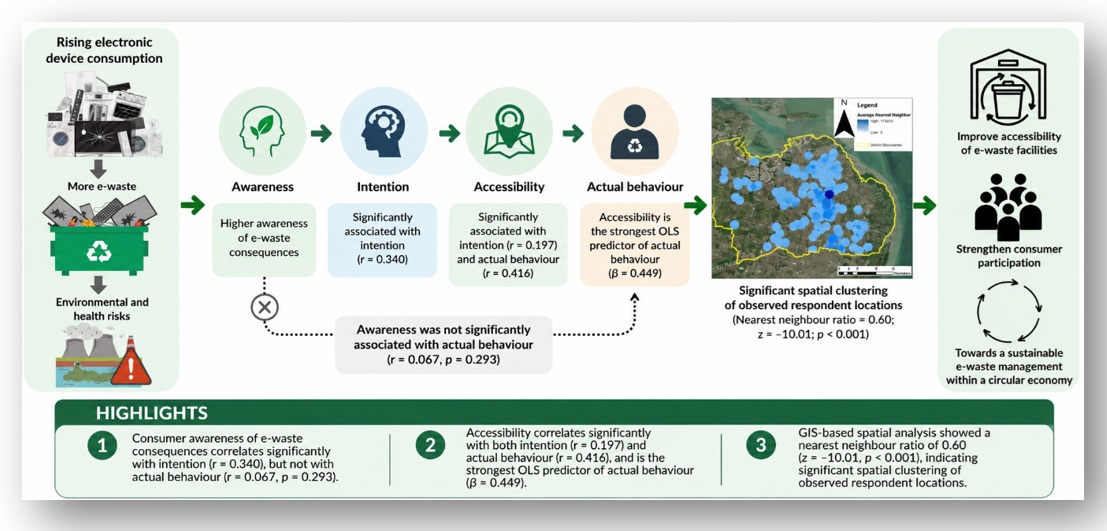
Graphical Abstract
Highlights
Ø Consumer awareness of e-waste consequences correlates significantly with intention (r = 0.340), but not with actual behaviour (r = 0.067, p = 0.293);
Ø Ø Accessibility correlates significantly with both intention (r = 0.197) and actual behaviour (r = 0.416), and is the strongest OLS predictor of actual behaviour (β = 0.449);
Ø GIS-based spatial analysis showed a nearest neighbour ratio of 0.60 (z = −10.01, p < 0.001), indicating significant spatial clustering of observed respondent locations.
Keywords
Subjects
OPEN ACCESS
©2027 The author(s). This article is licensed under a Creative Commons Attribution 4.0 International License, which permits use, sharing, adaptation, distribution and reproduction in any medium or format, as long as you give appropriate credit to the original author(s) and the source, provide a link to the Creative Commons license, and indicate if changes were made. The images or other third party material in this article are included in the article’s Creative Commons license, unless indicated otherwise in a credit line to the material. If material is not included in the article’s Creative Commons license and your intended use is not permitted by statutory regulation or exceeds the permitted use, you will need to obtain permission directly from the copyright holder. To view a copy of this license, visit: http://creativecommons.org/licenses/by/4.0/
PUBLISHER NOTE
GJESM Publisher remains neutral concerning jurisdictional claims in published maps and institutional affiliations.
MAJOR DATABASES, CITATION METRICS & CAPTURES
Google Scholar | Scopus - SJR | Web of Science | Biological Abstracts: Clarivate | Biosis Preview: Clarivate | PlumX Metrics | Altmetrics | Mendeley |
CURRENT PUBLISHER
GJESM Publisher



Letters to Editor
[1] Letters that include statements of statistics, facts, research, or theories should include appropriate references, although more than three are discouraged.
[2] Letters that are personal attacks on an author rather than thoughtful criticism of the author’s ideas will not be considered for publication.
[3] Letters can be no more than 300 words in length.
[4] Letter writers should include a statement at the beginning of the letter stating that it is being submitted either for publication or not.
[5] Anonymous letters will not be considered.
[6] Letter writers must include their city and state of residence or work.
[7] Letters will be edited for clarity and length.