
5.2
CiteScore
2.9
Impact Factor
Document Type : RESEARCH ARTICLE
Authors
1 Department of Civil Engineering, Chiang Mai University, Thailand
2 Lamphun Irrigation Project, Office of Regional Irrigation 1, Ministry of Agriculture and Cooperatives, Thailand
3 Department of Civil Engineering, National Taiwan University, Taiwan
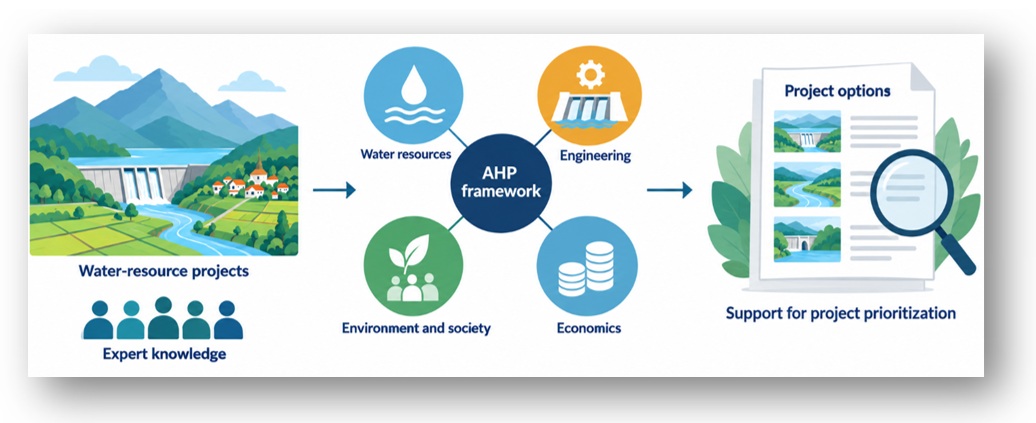
Graphical Abstract
Highlights
Ø Developed an expert-based AHP framework integrating four dimensions and 18 subcriteria for water-resource project prioritization;
Ø Engineering feasibility received the highest dimension weight (32.58%), while cost effectiveness led the subcriteria (13.99%);
Ø The top 11 subcriteria captured 81.88% of total weight and spanned all four dimensions, supporting a multidimensional approach to project assessment.
Keywords
INTRODUCTION
Water-resource management is a major challenge for sustainable development because water systems must accommodate increasing demands from population growth, economic activity, agriculture, and urban expansion, while water availability and distribution vary substantially across space and time (Gebre et al., 2021). These vulnerabilities are further exacerbated by climate variability and long-term anthropogenic climate change, which disrupt precipitation regimes, regional water yields, and extreme event frequencies, thereby compounding uncertainty regarding future hydrological resource availability and demand projections (Wu et al., 2025). In many regions, water scarcity therefore reflects not only physical limitations in supply but also rising demand, inefficient resource use, and increasing pressure on ecosystems (Konstadinos et al., 2025; Meskine et al., 2025). Under these conditions, water-resource management must move beyond responding to sector-specific demands toward systematic planning and allocation that balance water security, economic development, user needs, and long-term ecosystem sustainability (Gebre et al., 2021; Wu et al., 2025). The prioritization of water-resource development initiatives constitutes an inherently multidimensional decision-making paradigm. Project suitability depends not only on hydrological potential but also on engineering feasibility, environmental and social implications, and economic viability (Jafari et al., 2026; Sandoval et al., 2025). These criteria encompass both quantitative and qualitative attributes, frequently entailing trade-offs among competing objectives. For instance, enhancing water-delivery efficiency may necessitate substantial capital investment, whereas an alternative that is technically viable may encounter ecological or social-acceptance constraints (Jafari et al., 2026; Sandoval et al., 2025). The problem becomes more consequential when projects must compete for limited budgets, time, and implementation resources, making simultaneous development of all potentially beneficial projects impractical (Chaitongrat et al., 2026; Mochani et al., 2025). Consequently, the primary challenge lies not merely in identifying a singular optimal initiative, but in formulating a transparent evaluative architecture wherein multiple criteria and their relative priorities can be systematically appraised to guide project prioritization (Macchiaroli et al., 2023; Sandoval et al., 2025). Given the need to evaluate multiple criteria and trade-offs simultaneously, multi-criteria decision-making (MCDM) has been widely applied to support water-resource decisions because it can accommodate quantitative and qualitative criteria with different units and levels of importance (Gebre et al., 2021). Among MCDM approaches, the analytic hierarchy process (AHP) is especially advantageous for decomposing complex decision problems into structured hierarchies of objectives, criteria, and sub-criteria, while systematically translating pairwise comparisons into relative priorities (Abastante et al., 2019). This approach enables expert knowledge and professional experience to be expressed as a transparent weighting structure whose internal consistency can be assessed before the priorities are used for project comparison (Sandoval et al., 2025). Consequently, the AHP has consequently been extensively adopted within water-resources and flood-management studies to bridge technical evaluation with structured decision frameworks (Alfian et al., 2026; Kaewwichian et al., 2025). Beyond water-resource management, AHP has also been extended to prioritize environmental risks in concrete construction initiatives across developing economies, effectively synthesizing expert evaluations and stakeholder perspectives through pairwise comparisons (Solaimanian, 2025). Northern Thailand, and Chiang Mai in particular, provides a useful empirical setting for examining this type of multidimensional prioritization problem. The province combines diverse topography, changing land use, and strong interactions between water systems, economic activities, agriculture, and communities (Chayakul et al., 2026; Gu et al., 2025). Water-resource development must therefore address multiple objectives, including agricultural water supply, flood-related concerns, community needs, and environmental and land-use constraints (Gu et al., 2025; Wu et al., 2025). Studies of irrigation projects in Thailand likewise indicate that technical, environmental, financial, and implementation factors are closely interrelated in project decision-making (Chaitongrat et al., 2026). Accordingly, Chiang Mai serves in this investigation as an empirical setting for developing and testing a multidimensional prioritization framework, rather than acting as its exclusive geographical boundary. The challenge is thus not merely the number of criteria involved, but how those criteria are organized into a structure that can be applied consistently across projects. Recent MCDM and AHP studies in water resources have addressed problems ranging from alternative water-resource assessment and sustainable water management (Konstadinos et al., 2025; Pham et al., 2026) to irrigation-project prioritization and urban water-management measures (Demir et al., 2025; Sandoval et al., 2025). Irrigation-modernization studies further demonstrate the need to consider technical, economic, social, and environmental factors jointly (Jafari et al., 2026). Nevertheless, evaluation criteria employed in prior studies are frequently customized for specific project typologies, spatial settings, or decision objective, thereby constraining their utility as generalized frameworks for heterogeneous water-resource initiatives. Indicator-development research also emphasizes that criteria should be both conceptually comprehensive and operationally applicable (Asadi and Alibaygi, 2026; Li, 2023). Consequently, this underscores a methodological imperative for an integrated operational architecture capable of organizing diverse project dimensions and assigning relative priorities while retaining adaptability to local decision environments. The contribution of the present framework lies not in introducing a new AHP technique, but in consolidating heterogeneous project-assessment considerations into a common hierarchical structure that integrates hydrological, engineering and implementation, environmental and social, and economic dimensions. By bridging four primary dimensions with 18 operational sub-criteria and segregating dimension-level, local, and global priorities, the framework establishes a coherent architecture for synthesizing expert evaluations across multifaceted water-resource project assessment. To address this need, this study develops a framework for prioritizing water-resource projects using four main dimensions and 18 operational sub-criteria covering water resource and hydrological performance, engineering and implementation feasibility, environmental and social sustainability, and economic performance. Expert-based AHP is then applied to derive the relative priorities of the criteria and construct a transparent priority structure. Rather than selecting or ranking individual project alternatives, this study establishes a methodical foundation for deriving the relative weighting of assessment criteria, which, when integrated with project-level performance data and explicit scoring protocols, can systematically guide future project comparison and prioritization across diverse infrastructure development contexts. The proposed framework is intended as an adaptable structure for project prioritization across different decision contexts. Accordingly, this study aims to develop an analytic hierarchy process-based multi-criteria decision-making framework for deriving criterion weights for water resources management project assessment, using Chiang Mai Province, Thailand, as the empirical context. The study was conducted in Chiang Mai Province, Thailand, in 2025 and 2026, using an existing expert-based water-resource project assessment dataset. Chiang Mai Province, Thailand, is used as the empirical setting to illustrate realistic water-resource development conditions.
MATERIALS AND METHODS
Chiang Mai Province, Thailand, was used as the empirical context for developing and examining the water-resource project prioritization framework. The province contains diverse physical and land-use conditions, including mountainous terrain, agricultural areas, and expanding urban settlements that interact with water systems at multiple spatial scales. These intrinsic characteristics render water-resource planning highly susceptible to hydrological variability, conflicting sectoral demands, and complex land-water feedback loops (Chayakul et al., 2026; Gu et al., 2025). Chiang Mai therefore provides a suitable real-world setting in which project development must simultaneously consider water-resource performance, engineering feasibility, environmental and social implications, and economic performance. In this study, the province functions as an empirical testbed for evaluating the architecture and relative priorities of the proposed framework rather than serving as an isolated case study of a single project. Fig. 1 represent the proposed project area in Chiang Mai province, Thailand. A previous study of water-resource project assessment in Chiang Mai (Sangunsri, 2022) was used primarily to provide contextual background and to illustrate the practical need for a more integrated criterion-weighting framework. Selected project attributes and evaluative criteria from prior studies were integrated with the broader literature to inform the development of the framework. The present study, however, adopts a revised analytical structure consisting of four main dimensions and 18 operational sub-criteria, developed to address the current research objective rather than to reproduce the analytical structure of the previous study. Although Chiang Mai was used as the empirical setting, the conceptual scope of the framework is not restricted to this location. Its four dimensions represent recurring components of multidimensional water-resource project prioritization, whereas the resulting relative weights remain context-sensitive and may vary across regions and management systems (Asadi and Alibaygi, 2026; Pham et al., 2026). Consequently, the research design was structured into three distinct phases: 1) the establishment of the criteria framework, 2) the evaluation of expert judgments via the analytic hierarchy process (AHP), and 3) the subsequent synthesis of local and global criterion weights. The overall analytical workflow and its relationship with the subsequent methodological and results sections are illustrated in Fig. 2.
Criteria structuring and framework development
The criteria framework was developed by synthesizing water resources management principles, technical criteria, and approaches from relevant MCDM studies. The aim was to organize diverse assessment criteria into a clear structure suitable for practical application (Konstadinos et al., 2025; Sandoval et al., 2025). This procedure prioritized both conceptual relevance and operational utility, ensuring that every criterion captured a substantive dimension of the decision process while remaining tethered to empirical project-level data or assessments (Asadi and Alibaygi, 2026; Jafari et al., 2026). The resulting framework comprises four main dimensions and 18 operational sub-criteria. The dimensions are Water Resource and Hydrological Performance, Engineering and Implementation Feasibility, Environmental and Social Sustainability, and Economic Performance. Table 1 outlines the mapping between the criteria established in this study and the corresponding relevant literature. During framework development, conceptually related criteria were also reviewed to minimize potential overlap and double counting. Distinct operational boundaries were enforced between criteria addressing distinct facets of project evaluation. For example, water availability (A1) represents the availability of the water resource that can support project demand, whereas storage and hydrological adequacy (A2) concerns the adequacy of storage and hydrological conditions for regulating and supplying that resource. Ecological impact (C1) addresses potential consequences of project deployment on local biological conditions, while watershed and conservation constraints (C2) delineate site-specific limitations linked to hydrological and conservation settings. Similarly, cost effectiveness (D2) considers the relationship between project cost and the benefits or service delivered, whereas economic return (D3) represents the economic benefits or returns generated by the project. These distinctions were maintained to reduce conceptual redundancy within the hierarchical structure.
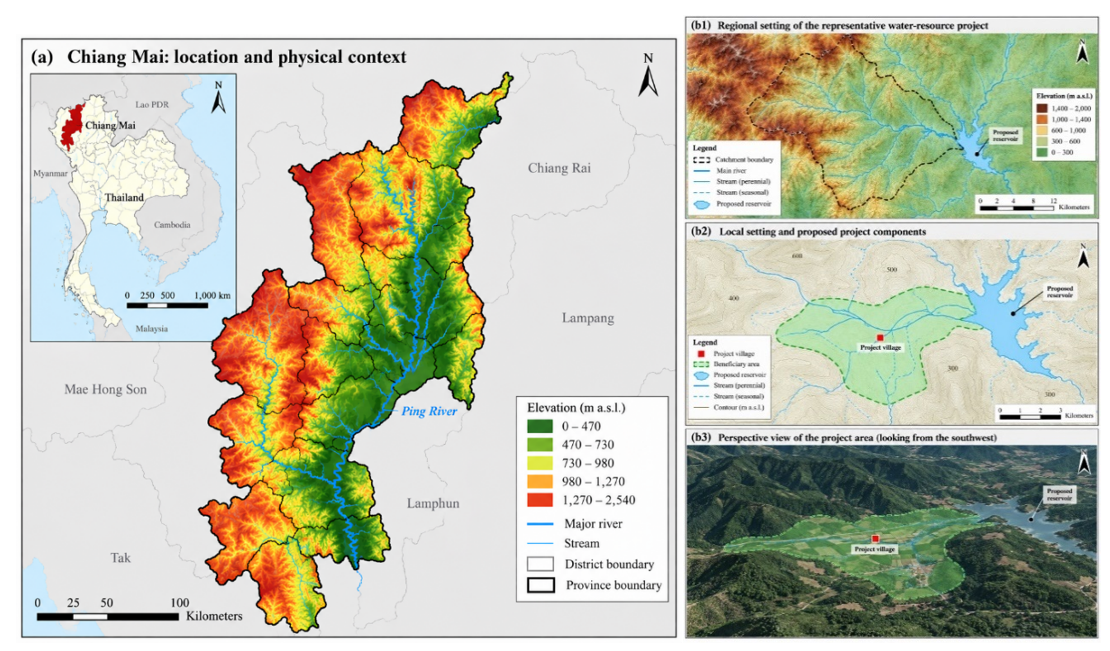
Fig. 1: Geographical location and spatial context and example of a water-resource development setting in Chiang Mai, Thailand (a) location, terrain, elevation, and major drainage characteristics of Chiang Mai Province; (b1) regional setting of an example water-resource project; (b2) local setting and proposed project components, including the reservoir and beneficiary area; and (b3) perspective view of the project area
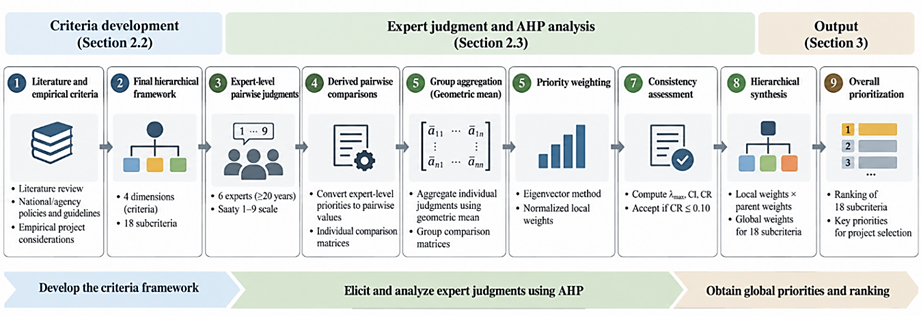
Fig. 2: Analytical workflow for developing the AHP-based criterion-weighting framework for water-resource project assessment
Table 1: Literature synthesis of criteria for water-resource project prioritization
|
Dimension/ subcriterion |
||||||||||
|
A. Water resource and hydrological performance |
||||||||||
|
A1 Water availability |
✓ |
✓ |
✓ |
✓ |
✓ |
✓ |
||||
|
A2 Storage and hydrological adequacy |
✓ |
✓ |
✓ |
✓ |
✓ |
✓ |
||||
|
A3 Irrigation water need |
✓ |
✓ |
✓ |
|||||||
|
A4 Irrigation service potential |
✓ |
✓ |
✓ |
|||||||
|
B. Engineering and implementation feasibility |
||||||||||
|
B1 Structural scale |
✓ |
✓ |
✓ |
✓ |
||||||
|
B2 Earthwork requirement |
✓ |
✓ |
||||||||
|
B3 Foundation suitability |
✓ |
✓ |
✓ |
|||||||
|
B4 site accessibility |
✓ |
✓ |
✓ |
✓ |
||||||
|
B5 Implementation duration |
✓ |
✓ |
||||||||
|
C. Environmental and social sustainability |
||||||||||
|
C1 ecological impact |
✓ |
✓ |
✓ |
✓ |
✓ |
✓ |
✓ |
|||
|
C2 watershed and conservation constraints |
✓ |
✓ |
✓ |
✓ |
✓ |
✓ |
||||
|
C3 environmental assessment Requirement |
✓ |
✓ |
✓ |
✓ |
✓ |
|||||
|
C4 beneficiary Coverage |
✓ |
✓ |
✓ |
✓ |
||||||
|
C5 social acceptability and land impact |
✓ |
✓ |
✓ |
✓ |
✓ |
✓ |
||||
|
D. Economic performance |
||||||||||
|
D1 project cost |
✓ |
✓ |
✓ |
✓ |
✓ |
✓ |
||||
|
D2 cost effectiveness |
✓ |
✓ |
✓ |
✓ |
✓ |
✓ |
||||
|
D3 economic return |
✓ |
✓ |
✓ |
✓ |
✓ |
|||||
|
D4 long-term economic value |
✓ |
✓ |
✓ |
✓ |
✓ |
|||||
To facilitate uniform interpretation of the hierarchical structure, the operational definitions of the four primary dimensions and their 18 sub-criteria were explicitly detailed, drawing upon evaluation considerations synthesized during framework development. Table 2 summarizes these operational definitions together with indicative measures or units, where applicable. The illustrative metrics presented in Table 2 delineate how individual criteria can be construed within an operational assessment context; they do not establish a rigid project-scoring or data normalization protocol. The definitions also maintain distinct assessment boundaries among conceptually related sub-criteria, thereby reducing potential overlap within the hierarchy. This operationalized structure formed the basis for the subsequent expert-based AHP weighting procedure.
Table 2: Operational definitions of the criteria and sub-criteria used in the AHP framework
|
Code |
Criterion / Subcriterion |
Operational definition and indicative measurement |
|
A |
Water resource and hydrological performance |
Assesses project suitability in terms of water-resource and hydrological conditions relevant to project development and service provision, including water availability, storage adequacy, irrigation need, and irrigation service potential. |
|
A1 |
Water availability |
Availability and adequacy of natural water resources to support project development and operation, represented by long-term mean annual rainfall (mm/y) and mean annual runoff volume (m³/y or Mm³/y). |
|
A2 |
Storage and hydrological adequacy |
Adequacy of project storage relative to local hydrological conditions, represented by storage capacity (m³ or Mm³), storage-to-annual-runoff ratio (%), and maximum flood discharge (m³/s). |
|
A3 |
Irrigation water need |
Need for project investment arising from water shortages or unmet irrigation demand, represented by water-deficit conditions, severity or frequency of shortages, and proportion of unmet water demand. |
|
A4 |
Irrigation service potential |
Capacity of the project to serve existing irrigation areas and support future expansion, represented by irrigated area (rai or ha), potential expansion area, and percentage expansion (%). |
|
B |
Engineering and implementation feasibility |
Assesses the feasibility of project design, construction, and implementation under site conditions, considering structural scale, earthwork requirements, foundation conditions, site accessibility, and implementation duration. |
|
B1 |
Structural scale |
Physical size and complexity of the principal hydraulic structure, represented by structure height (m) and structure length (m). |
|
B2 |
Earthwork Requirement |
Amount of earthwork required for construction, including excavation, filling, and site preparation, represented primarily by earthfill volume (m³). |
|
B3 |
Foundation suitability |
Suitability of geological and foundation conditions for structural stability and construction, represented by foundation geology or foundation-suitability class based on geological and geotechnical assessment. |
|
B4 |
Site accessibility |
Ease of access from the existing transport network to the construction site, represented by distance from the main road to the project site (km). |
|
B5 |
Implementation duration |
Time required for project preparation, construction, commissioning, and handover, represented by the implementation period (months or years). |
|
C |
Environmental and social sustainability |
Assesses project suitability in terms of ecological impacts, conservation constraints, environmental assessment requirements, beneficiary coverage, social acceptance, and land-related impacts. |
|
C1 |
Ecological impact |
Direct effects of project development on natural resources and ecosystems, represented by inundated forest area (ha) and information on wildlife or habitat impacts/severity. |
|
C2 |
Watershed and conservation constraints |
Spatial and regulatory constraints associated with watershed protection and conservation areas, represented by watershed class, conservation-area designation, affected area (ha), and degree of restriction. |
|
C3 |
Environmental assessment requirement |
Level of environmental assessment and review required according to project characteristics, scale, location, and anticipated impacts, represented by the required environmental-assessment level or study category. |
|
C4 |
Beneficiary coverage |
Social reach of project benefits, represented by the number of beneficiary households or persons, and where appropriate the proportion of the target population or households (%). |
|
C5 |
Social acceptability and land impact |
Community acceptance and land-related effects associated with project development, represented by public participation or beneficiary acceptance together with land-acquisition area. |
|
D |
Economic performance |
Assesses project suitability in terms of investment requirements, resource-use efficiency, economic return, and long-term economic value. |
|
D1 |
Project cost |
Absolute financial resources required for project development and construction, represented by construction or total project cost (USD or million USD). |
|
D2 |
Cost effectiveness |
Investment efficiency in terms of physical outputs or services delivered per unit of cost, represented by construction cost per unit water volume (USD/m³) and construction cost per unit irrigated area (USD/ha). |
|
D3 |
Economic return |
Economic benefits generated relative to project costs over the investment period, represented primarily by the Benefit–Cost Ratio (BCR). |
|
D4 |
Long-term economic value |
Net economic value generated over the analysis period after accounting for the timing of benefits and costs, represented by Net Present Value (NPV; USD or million USD) under a specified discount rate and analysis period. |
Expert judgment and AHP analysis
Determining the relative importance of criteria for water resources project prioritization requires both technical knowledge and practical experience in project planning and implementation. Consequently, this study utilized an expert-based decision analysis framework, employing purposive, criterion-based sampling to select experts rather relying on random sampling designed to reflect the general population. Selection emphasized relevant professional roles, domain expertise, and experience directly related to the decision problem. This approach is consistent with multi-criteria decision analysis (MCDA) studies that select experts based on specialized qualifications and experience (Min et al., 2025). Similar approaches are used in water-related decision support, where participants are selected for their technical expertise, institutional roles, and knowledge of the system under study (Alfian et al., 2026), and in water governance indicator development, where purposive sampling identifies experts with knowledge relevant to the assessment (Asadi and Alibaygi, 2026). Consequently, the panel was assembled to furnish informed insights rooted in specialized expertise, rather than to achieve statistical representativeness (Caraveo Gomez Llanos et al., 2024). The panel comprised six senior water resources and irrigation professionals, each with at least 20 years of experience in planning, developing, and implementing water resources projects. Their experience included project appraisal, assessment of technical constraints, and operational decision-making, enabling them to provide judgments grounded in professional practice. This selection methodology aligns with the principles of expert-based AHP, which prioritizes specialized knowledge and contextual experience directly pertinent to the decision problem (Caraveo Gomez Llanos et al., 2024). Unlike population surveys, expert-based AHP does not determine panel size using conventional statistical sample-size requirements, as its purpose is to synthesize informed judgments rather than estimate population parameters. Furthermore, panel adequacy is governed by variations in criterion priorities, expert heterogeneity, judgment variability, and ranking stability, rather than being determined by panel size alone (Zeki et al., 2026). The six-member panel should therefore be considered in relation to its qualifications and expertise, and should not be interpreted as a universally appropriate size for all AHP applications (Caraveo Gomez Llanos et al., 2024; Zeki et al., 2026). While Table 3 outlines the professional profiles of the experts, the evaluations rendered by this panel were systematically processed via the AHP across five sequential phases. The expert panel was purposively selected to provide informed professional judgments rather than statistical representation of a broader population. The six participants were senior professionals with at least 20 years of experience in water-resource planning, engineering, or project-related decision-making. Consequently, the derived weighting parameters constitute an expert-driven priority architecture bounded by the professional and institutional milieu of the panel. They should not be interpreted as population-level preferences or as universally applicable weights across all stakeholder groups and decision contexts.
Step 1: Individual pairwise judgments
Expert judgments were collected through AHP pairwise comparisons using Saaty’s 1–9 scale, ranging from 1 for equal importance to 9 for extreme importance of one criterion over another (Abastante et al., 2019). The survey instrument administered pairwise comparisons of criteria, requiring experts to designate the more critical parameter and quantify the relative magnitude of difference, as depicted in Fig. 3. Judgments were retained at the individual-expert level to preserve differences in opinion before group aggregation (Alfian et al., 2026; Caraveo Gomez Llanos et al., 2024). The pairwise comparison values were organized into a reciprocal comparison matrix following AHP principles. If represents the importance of criterion relative to criterion , the reverse comparison is defined as , while the diagonal entries are (Abastante et al., 2019). This matrix provides the basis for calculating priority weights and assessing consistency in the subsequent steps.
Table 3: Professional profile of the expert panel
|
Expert |
Professional role/category* |
Relevant experience |
Water-resource responsibility |
|
E1 |
Senior water-resources development executive |
>30 years |
Water-resource project planning and construction; contract administration for weirs, reservoirs, conveyance systems, and irrigation structures |
|
E2 |
Senior engineering director |
>30 years |
Water-resource project planning; design of weirs, reservoirs, conveyance systems, and irrigation structures |
|
E3 |
Senior water-management director |
>30 years |
Water-resource project planning; water management; operation and maintenance of weirs, reservoirs, conveyance systems, and irrigation structures |
|
E4 |
Senior irrigation-project director |
>20 years |
Construction and maintenance of water-resource projects; contract administration for weirs, reservoirs, conveyance systems, and irrigation structures |
|
E5 |
Senior irrigation engineering professional |
>20 years |
Engineering and implementation of water-resource and irrigation projects |
|
E6 |
Senior irrigation/water-resources professional |
>20 years |
Planning, engineering, implementation, and management of water-resource projects |
Note: *Expert identities are anonymized as E1–E6. All experts had at least 20 years of relevant professional experience in water-resource and irrigation development.
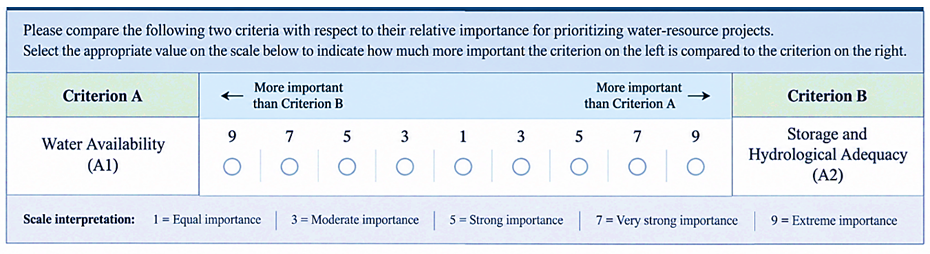
Fig. 3: Example of the pairwise-comparison questionnaire used for expert judgment
Step 2: Construction of individual pairwise comparison matrices
For analysis under the final hierarchy, pairwise comparisons were organized separately for each expert and for each comparison level of the framework. The expert evaluations were structured into reciprocal comparison matrices in accordance with AHP guidelines, thereby preserving individual judgment variances prior to final aggregation. Each pairwise entry quantified the relative significance of one criterion against another (Abastante et al., 2019; Al-Jabal and Al-Khafaji, 2025). Once all individual matrices were constructed, they were combined through group aggregation in the next step.
Step 3: Aggregation of expert judgments
To synthesize individual insights into a unified group comparison matrix, the geometric mean was applied to aggregate the experts' pairwise comparison matrices—a standard procedure in group AHP applications. For each pair of criteria, the group comparison value was calculated, using Eq. 1 (Alfian et al., 2026; Caraveo Gomez Llanos et al., 2024):
āᵢⱼ = (∏ₖ₌₁ᵐ aᵢⱼ⁽ᵏ⁾)¹⁄ᵐ (1)
Where: āᵢⱼ is the group comparison value between criteria i and j, aᵢⱼ⁽ᵏ⁾ is the judgment provided by expert k, and m is the number of experts, which was six in this study. The geometric mean was calculated for every pair of criteria at each level of the hierarchy to construct a reciprocal group comparison matrix. This approach preserves the ratio-scale properties of pairwise judgments and is suitable for synthesizing judgments from multiple experts (Asadi and Alibaygi, 2026).
Step 4. Priority weighting and consistency assessment
Once the group comparison matrix was constructed, criterion weights were derived from the eigenvector corresponding to the maximum eigenvalue, following AHP principles. The weights were normalized to sum to 1 within each comparison set. The consistency of pairwise judgments was then assessed using the maximum eigenvalue (λₘₐₓ), consistency index (CI), and consistency ratio (CR), using the following equations: Eqs. 2 and 3 (Abastante et al., 2019):
CI = (λₘₐₓ - n) / (n - 1) (2)
and
CR = CI / RI (3)
Where: n is the number of criteria in the comparison matrix, and RI is the random index corresponding to the matrix size. A consistency ratio (CR) of ≤ 0.10 was used to indicate an acceptable level of judgment inconsistency for AHP analysis (Alfian et al., 2026; Caraveo Gomez Llanos et al., 2024). Prior to the final synthesis of priority weights, the consistency of the group matrices was evaluated across every hierarchical tier.
Step 5: Hierarchical synthesis and global prioritization
The local priority weights within each dimension were synthesized to obtain the global priorities of all 18 sub-criteria. The global weight of each subcriterion was computed by scaling its local weight against the weight of its corresponding parent dimension, expressed in Eq. 4 (Caraveo Gomez Llanos et al., 2024; Jafari et al., 2026):
GWᵢ = LWᵢ × PWᵢ (4)
Where: GWᵢ is the global weight of subcriterion i, LWᵢ is its local weight within its dimension, and PWⱼ is the priority weight of its parent dimension i. This hierarchical synthesis allows sub-criteria from different dimensions to be compared on a common scale, with the resulting global weights used to rank all 18 sub-criteria (Caraveo Gomez Llanos et al., 2024; Jafari et al., 2026).
RESULTS AND DISCUSSION
Priority structure and consistency
Individual-expert results are reported in Tables 4 to 8 for the main dimensions and their respective sub-criteria, together with the corresponding geometric-mean aggregated results. reveal divergences in expert preference structures that remain obscured when relying solely on aggregated values. Furthermore, all individual comparison matrices met the established consistency threshold (CR < 0.10). It should be emphasized that CR represents the internal consistency of each comparison structure and should not be interpreted as a measure of inter-expert agreement. The individual results also reveal differences in the relative emphasis assigned by the six experts. For example, engineering and implementation feasibility (B) received the highest weight from E1, E3, and E4, whereas environmental and social sustainability (C) was weighted highest by E2 and E6, and economic performance (D) by E5. These variations highlight that satisfying individual consistency thresholds does not ensure uniform priority configurations among experts. Consequently, employing geometric-mean aggregation of the six individual assessments, the synthesized group weights were propagated across the hierarchy to derive the local and global criterion priorities detailed in Table 9. At the main-dimension level, engineering and implementation feasibility (B) received the highest weight at 32.58%, followed by economic performance (D) at 25.84%, environmental and social sustainability (C) at 21.87%, and water resource and hydrological performance (A) at 19.71%.
Table 4: Individual expert priorities, consistency, and aggregated results for the main dimensions
|
Expert |
A: Water resource and hydrological performance |
B: Engineering and implementation feasibility |
C: Environmental and social sustainability |
D: Economic performance |
λmax |
CI |
CR |
|
E1 |
0.251 |
0.552 |
0.108 |
0.090 |
4.022 |
0.007 |
0.008 |
|
E2 |
0.109 |
0.104 |
0.433 |
0.354 |
4.025 |
0.008 |
0.009 |
|
E3 |
0.196 |
0.480 |
0.108 |
0.216 |
4.021 |
0.007 |
0.008 |
|
E4 |
0.185 |
0.370 |
0.100 |
0.345 |
4.010 |
0.004 |
0.004 |
|
E5 |
0.246 |
0.246 |
0.210 |
0.298 |
4.061 |
0.020 |
0.023 |
|
E6 |
0.108 |
0.216 |
0.480 |
0.196 |
4.021 |
0.007 |
0.008 |
|
Aggregated |
0.197 |
0.326 |
0.219 |
0.258 |
4.003 |
0.001 |
0.001 |
Table 5: Individual expert priorities, consistency, and aggregated results for the water resource and hydrological performance (A)
|
Expert |
A1: Water availability |
A2: Storage and hydrological adequacy |
A3: Irrigation water need |
A4: Irrigation service potential |
λmax |
CI |
CR |
|
E1 |
0.308 |
0.541 |
0.106 |
0.044 |
4.052 |
0.017 |
0.019 |
|
E2 |
0.171 |
0.467 |
0.171 |
0.191 |
4.020 |
0.007 |
0.008 |
|
E3 |
0.218 |
0.461 |
0.103 |
0.218 |
4.006 |
0.002 |
0.002 |
|
E4 |
0.345 |
0.370 |
0.100 |
0.185 |
4.010 |
0.003 |
0.004 |
|
E5 |
0.461 |
0.218 |
0.218 |
0.103 |
4.006 |
0.002 |
0.002 |
|
E6 |
0.158 |
0.615 |
0.101 |
0.126 |
4.041 |
0.014 |
0.015 |
|
Aggregated |
0.275 |
0.453 |
0.135 |
0.137 |
4.006 |
0.002 |
0.002 |
Table 6: Individual expert priorities, consistency, and aggregated results for the Engineering and Implementation Feasibility (B)
|
Expert |
B1: Structural scale |
B2: Earthwork requirement |
B3: Foundation suitability |
B4: Site accessibility |
B5: Implementation duration |
λmax |
CI |
CR |
|
E1 |
0.289 |
0.289 |
0.289 |
0.102 |
0.030 |
5.010 |
0.002 |
0.002 |
|
E2 |
0.345 |
0.082 |
0.329 |
0.079 |
0.165 |
5.006 |
0.001 |
0.001 |
|
E3 |
0.377 |
0.097 |
0.377 |
0.097 |
0.051 |
5.003 |
0.001 |
0.001 |
|
E4 |
0.341 |
0.082 |
0.327 |
0.072 |
0.178 |
5.018 |
0.005 |
0.004 |
|
E5 |
0.284 |
0.241 |
0.262 |
0.111 |
0.103 |
5.033 |
0.008 |
0.007 |
|
E6 |
0.416 |
0.190 |
0.291 |
0.068 |
0.036 |
5.060 |
0.015 |
0.013 |
|
Aggregated |
0.355 |
0.151 |
0.325 |
0.091 |
0.078 |
5.003 |
0.001 |
0.001 |
Table 7: Individual expert priorities, consistency, and aggregated results for the Environmental and Social Sustainability (C)
|
Expert |
C1: Ecological impact |
C2: Watershed and conservation constraints |
C3: Environmental assessment requirement |
C4: Beneficiary coverage |
C5: Social acceptability and land impact |
λmax |
CI |
CR |
|
E1 |
0.079 |
0.081 |
0.081 |
0.158 |
0.600 |
5.003 |
0.001 |
0.001 |
|
E2 |
0.120 |
0.363 |
0.347 |
0.077 |
0.093 |
5.038 |
0.009 |
0.008 |
|
E3 |
0.054 |
0.214 |
0.238 |
0.064 |
0.4290 |
5.019 |
0.005 |
0.004 |
|
E4 |
0.124 |
0.347 |
0.271 |
0.035 |
0.223 |
5.043 |
0.011 |
0.010 |
|
E5 |
0.108 |
0.203 |
0.203 |
0.101 |
0.384 |
5.010 |
0.002 |
0.002 |
|
E6 |
0.095 |
0.393 |
0.340 |
0.086 |
0.086 |
5.018 |
0.004 |
0.004 |
|
Aggregated |
0.107 |
0.272 |
0.258 |
0.091 |
0.272 |
5.004 |
0.001 |
0.001 |
Table 8: Individual expert priorities, consistency, and aggregated results for the Economic Performance (D)
|
Expert |
D1: Project cost |
D2: Cost effectiveness |
D3: Economic return |
D4: Long-term economic value |
λmax |
CI |
CR |
|
E1 |
0.082 |
0.235 |
0.449 |
0.235 |
4.004 |
0.001 |
0.001 |
|
E2 |
0.049 |
0.469 |
0.241 |
0.241 |
4.001 |
0.001 |
0.001 |
|
E3 |
0.206 |
0.662 |
0.064 |
0.068 |
4.031 |
0.010 |
0.012 |
|
E4 |
0.177 |
0.689 |
0.067 |
0.067 |
4.033 |
0.011 |
0.012 |
|
E5 |
0.095 |
0.467 |
0.277 |
0.160 |
4.031 |
0.010 |
0.011 |
|
E6 |
0.078 |
0.559 |
0.228 |
0.135 |
4.031 |
0.010 |
0.011 |
|
Aggregated |
0.113 |
0.542 |
0.196 |
0.149 |
4.003 |
0.001 |
0.001 |
Table 9: Priority weights of criteria and sub-criteria for water-resource project prioritization
|
Main dimension [A] |
Main weight |
Subcriterion [B] |
Local weight |
Global weight [A × B] |
Overall rank |
|
A. Water resource and hydrological performance |
0.197 |
A1 Water availability |
0.275 |
0.054 |
8 |
|
A2 Storage and hydrological adequacy |
0.453 |
0.089 |
4 |
||
|
A3 Irrigation water need |
0.135 |
0.027 |
15 |
||
|
A4 Irrigation service potential |
0.137 |
0.027 |
14 |
||
|
B. Engineering and implementation feasibility |
0.326 |
B1 Structural scale |
0.355 |
0.116 |
2 |
|
B2 Earthwork requirement |
0.151 |
0.049 |
10 |
||
|
B3 Foundation suitability |
0.325 |
0.106 |
3 |
||
|
B4 Site accessibility |
0.091 |
0.030 |
12 |
||
|
B5 Implementation duration |
0.078 |
0.025 |
16 |
||
|
C. Environmental and social sustainability |
0.219 |
C1 Ecological impact |
0.107 |
0.023 |
17 |
|
C2 Watershed and conservation constraints |
0.272 |
0.060 |
5 |
||
|
C3 Environmental assessment requirement |
0.258 |
0.056 |
7 |
||
|
C4 Beneficiary coverage |
0.091 |
0.020 |
18 |
||
|
C5 Social acceptability and land impact |
0.272 |
0.059 |
6 |
||
|
D. Economic performance |
0.258 |
D1 Project cost |
0.113 |
0.029 |
13 |
|
D2 Cost effectiveness |
0.542 |
0.140 |
1 |
||
|
D3 Economic return |
0.196 |
0.051 |
9 |
||
|
D4 Long-term economic value |
0.149 |
0.038 |
11 |
Consequently, the resulting priority hierarchy was established as B>D>C>A, demonstrating that the panel assigned primary importance to engineering and implementation feasibility, followed by closely economic considerations. Consistency assessment of the 4 × 4 group comparison matrix yielded , , and . The resulting CR remained well beneath the 0.10 threshold, confirming satisfactory internal consistency across the primary-dimension comparisons for AHP evaluation. Within dimension A: Water Resource and Hydrological Performance, Storage and Hydrological Adequacy (A2) received the highest local weight at 45.32%, followed by water availability (A1) at 27.49%, Irrigation Service Potential (A4) at 13.65%, and Irrigation Water Need (A3) at 13.54%. Within Dimension B: Engineering and Implementation Feasibility, Structural Scale (B1) ranked first at 35.54%, followed by Foundation Suitability (B3) at 32.53%, Earthwork Requirement (B2) at 15.04%, Site Accessibility (B4) at 9.12%, and Implementation Duration (B5) at 7.77%. A2 and A1 therefore held the highest local priorities within dimension A, while B1 and B3 received substantially greater weights than the remaining sub-criteria within dimension B. within dimension C: Environmental and social sustainability, watershed and conservation constraints (C2) received the highest local weight at 27.24%, closely followed by Social Acceptability and Land Impact (C5) at 27.22%, Environmental assessment requirement (C3) at 25.76%, Ecological Impact (C1) at 10.73%, and beneficiary coverage (C4) at 9.06%. Within dimension D: economic performance, cost effectiveness (D2) received the highest local weight by a clear margin at 54.15%, followed by Economic Return (D3) at 19.61%, Long-Term Economic Value (D4) at 14.90%, and project cost (D1) at 11.34%. These findings demonstrate that conservation constraints and social acceptability were accorded comparable priority within Dimension C, while experts assigned greater significance to cost effectiveness than on overall project expenditure within Dimension D. The global priorities, calculated by multiplying each subcriterion’s local weight by its parent-dimension weight, showed that cost effectiveness (D2) ranked first at 13.99%, followed by structural scale (B1) at 11.58%, foundation suitability (B3) at 10.60%, and Storage and Hydrological Adequacy (A2) at 8.93%. Subsequent priorities comprised watershed and conservation constraints (C2) at 5.96%, social acceptability and Land Impact (C5) at 5.95%, and environmental assessment requirement (C3) at 5.63%. In contrast to local weights, global weights account for both a sub-criterion's relative significance within its parent dimension and the overarching importance of that dimension within the complete hierarchy, thereby establishing a unified basis for comparing and ranking all 18 sub-criteria across the framework (Caraveo Gomez Llanos et al., 2024). Table 9 presents the calculated weights and rankings. The consistency assessment showed that both individual and group pairwise comparison matrices had values below the AHP acceptance threshold of 0.10 (Abastante et al., 2019). The individual comparison matrices underlying this analysis had been checked for consistency within the present framework. The main-dimension group matrix had a , while those for Dimensions A and B were approximately and respectively, indicating high internal coherence. Nevertheless, these exceptionally low values should be construed as indicators of the internal mathematical coherence of the derived pairwise relationships rather than as a measure of consensus among experts, given that the evaluates alignment solely within an individual comparison matrix rather than inter-expert agreement.
Interpretation and comparison
The analysis revealed differences in the relative importance of the four main dimensions, ranked in descending order as engineering and implementation feasibility (B), economic performance (D), environmental and social sustainability (C), and water resource and hydrological performance (A). Although water resource and hydrological performance (A) received the lowest relative weight among the four primary dimensions (19.71%), this outcome should not be construed as implying that hydrological performance lacks significance in water-resource projects. AHP weights represent relative priorities among the criteria considered within the decision structure rather than the absolute necessity of each dimension. The result indicates that, within the judgments of the present expert panel, engineering and implementation, economic, and environmental and social considerations received greater relative emphasis when the four dimensions were compared simultaneously. Moreover, storage and hydrological adequacy (A2) emerged as the fourth-highest global priority across all 18 sub-criteria at 8.93%, demonstrating that a specific hydrological factor retained substantial significance within the overarching priority architecture. To interpret this priority structure, the following discussion proceeds from the highest- to the lowest-weighted dimension, considering both main-dimension weights and local priorities within each dimension. This methodological strategy clarifies the rationale behind the emphasis assigned by experts to specific dimensions while isolating the underlying sub-criteria that govern those priorities, prior to evaluating the global priorities across all sub-criteria. The highest main-dimension weight assigned to engineering and implementation feasibility (B) indicates that water resources project priorities depend on both water demand and expected returns, as well as the ability to implement projects under engineering constraints and actual site conditions. Within this dimension, structural scale (B1) and foundation suitability (B3) attained the highest priority weights, underscoring their critical bearing on constructability, construction complexity, and implementation risk. This pattern aligns with existing literature on irrigation project prioritization and water infrastructure evaluation, which integrates technical feasibility and operational constraints alongside project benefits (Jafari et al., 2026; Sandoval et al., 2025). Technical and operational risks also play an important role in prioritizing irrigation projects in Thailand (Chaitongrat et al., 2026). Consequently, these findings reinforce the perspective that initiatives exhibiting substantial water resources or economic viability may not merit high priority when complex structural demands or challenging site conditions hinder execution (Al-Jabal and Al-Khafaji, 2025). The second-highest main-dimension weight assigned to Economic Performance (D) indicates that economic value remains an important consideration in water resources project prioritization, particularly when public budgets and investment resources are limited. Within this dimension, cost effectiveness attained the highest priority weight by a distinct margin at 54.15%, while project cost (D1) registered the lowest. This outcome indicates that experts placed greater emphasis on benefits or outputs relative to expenditure than on aggregate capital investment alone. This pattern is consistent with water infrastructure prioritization studies that use investment efficiency, cost–benefit relationships, and economic returns to support project selection under budget constraints (Macchiaroli et al., 2023; Mochani et al., 2025). Correspondingly, research on irrigation project prioritization underscores the evaluation of capital conversion efficiency—gauging how effectively investments translate into system-wide benefits, rather than relying solely on minimum-cost metrics cost alone (Jafari et al., 2026; Sandoval et al., 2025). These findings highlight cost effectiveness as a key link between budget constraints and the value of the outcomes a project can deliver. The weight assigned to Environmental and Social Sustainability (C), ranked third among the main dimensions, highlights the need to consider sustainability alongside engineering and economic feasibility in water resources project prioritization. Within this dimension, watershed and conservation constraints (C2) alongside Social Acceptability and Land Impact (C5) attained high and nearly equal weights, reflecting the critical significance of both environmental preservation and local stakeholder implications. This pattern is consistent with studies on sustainable water management and environmental decision support that integrate ecological constraints, community participation, and social acceptability into decision-making (Alfian et al., 2026; Shahat et al., 2026). Furthermore, research on water governance and environmental assessment also indicates that technically viable initiatives may encounter execution barriers when conservation impacts, land-use dynamics, and stakeholder concerns are insufficiently addressed (Asadi and Alibaygi, 2026; Chayakul et al., 2026; Jafari et al., 2026). These findings suggest that environmental and social considerations are integral to the project prioritization framework, rather than supplementary issues addressed only at a later stage. Although water resource and hydrological performance (A) recorded the lowest relative weight among the primary dimensions, this outcome should not be construed as implying that hydrological performance lacks significance in water resources development. AHP weights represent relative priorities derived from comparisons across multiple dimensions within a common hierarchy. Within dimension A, storage and hydrological adequacy (A2) received the highest local weight at 45.32% and ranked fourth globally among all sub-criteria, highlighting the continued importance of adequate storage and compatibility with hydrological conditions to project viability. Studies on alternative water resources, sustainable water management, and dam site selection similarly recognize water availability, storage capacity, and hydrological suitability as core fundamental considerations in project evaluation (Konstadinos et al., 2025; Pham et al., 2026; Shams et al., 2025). These findings therefore reflect trade-offs between hydrological adequacy and engineering, economic, environmental, and social constraints, rather than a diminished role for hydrological factors in decision-making (Sandoval et al., 2025). Contrasting these results with alternative AHP and MCDM studies in water resources management demonstrates that criterion weights fluctuate depending on the decision-making environment, stakeholder composition, and specific characteristics of the problem under study. Cross-country assessments of alternative water resources have found substantial differences in relative priorities across locations, even when similar assessment frameworks are used (Pham et al., 2026). Studies on sustainable water management and irrigation project prioritization likewise report variations in weights associated with resource constraints, project objectives, and expert perspectives (Konstadinos et al., 2025; Sandoval et al., 2025). Similarly, research on flood management, environmental assessment, and water governance indicators shows that stakeholder preferences and institutional context influence the priority structures derived through MCDM (Alfian et al., 2026; Asadi and Alibaygi, 2026; Jafari et al., 2026). Consequently, the weights derived from this study must be construed as a context-sensitive priority configuration, rather than universal values applicable across all geographic settings. Their interpretation requires accounting for localized conditions and the composition of the expert panel, precluding any treatment of the weights in isolation from the specific decision-making environment (Zeki et al., 2026).
Global priority concentration and two-tier priority interpretation
Two complementary views were used to interpret the concentration of global criterion weights. First, the ranked weights showed a visible break after the fourth-ranked subcriterion. The four highest-weighted sub-criteria—cost effectiveness, structural scale (B1), foundation suitability (B3), and storage and hydrological adequacy (A2)—accounted for 45.10% of the total global weight. This categorization is treated as a descriptive high-priority cluster derived from the observed weight distribution rather than as a statistically defined threshold. Second, a cumulative 80% priority threshold was implemented to determine how many ranked sub-criteria comprised the majority of the aggregate weight. The cumulative threshold surpassed 80% at the eleventh-ranked subcriterion, with the leading 11 elements accounting for 81.88% of the total weight. Serving strictly as a descriptive prioritization aid, this benchmark should not be equated with the classical 80/20 rule. Although global ranking establishes the relative order of sub-criteria within a common framework, ranks alone do not fully capture the concentration of priority weights. To examine this distribution, the global weights of all 18 sub-criteria were ordered from highest to lowest, and both individual and cumulative weights were assessed. This methodological strategy isolates the criteria exerting the most pronounced influence on the decision, alongside the broader subset responsible for a substantial portion of the aggregate weight. Cumulative thresholds have previously been used with AHP to identify key factors and support prioritization and screening (Tochaiwat et al., 2023). Concepts related to natural breaks, clustering, and data-driven classification also suggest that grouping can be informed by patterns and changes in the data, alongside predefined thresholds (Lv et al., 2025; Xu et al., 2018). The distribution of global weights showed that cost effectiveness ranked first at 13.99%, followed by structural scale (B1) at 11.58%, foundation suitability (B3) at 10.60%, and Storage and hydrological adequacy (A2) at 8.93%. Collectively, these four criteria represent a cumulative weight of 45.10%. Individual weights declined noticeably after the fourth rank: watershed and conservation constraints (C2) occupy the fifth position with a weight of 5.96%, whereas the remaining subsequent criteria predominantly cluster within the 2% to 6% range. This visible break in the ranked distribution provided the basis for identifying D2, B1, B3, and A2 as the dominant priority cluster. Rather than establishing a theoretical threshold at 45.10%, this interpretation relies on the observed shifts in individual criterion contributions to cumulative weight. Consequently, this approach isolates the specific cluster of factors exerting the most substantial influence on the overarching priority structure. Focusing on highly weighted criteria is also consistent with other applications of AHP-based prioritization, which use top-ranked items to guide the allocation of attention and resources (Chang et al., 2025). However, the dominant cluster alone may not capture the full breadth of the decision structure. Adopting an 80% cumulative threshold as an analytical screening benchmark in accordance with Pareto-based prioritization principles (Tochaiwat et al., 2023), showed that cumulative weight exceeded 80% at the eleventh rank. The top 11 sub-criteria: D2, B1, B3, A2, C2, C5, C3, A1, D3, B2, and D4, accounted for 81.88% of the total weight. This comprehensive priority set subsumes four primary dimensions: engineering and implementation feasibility, economic performance, environmental and social sustainability, and water resource and hydrological performance. Consequently, while the dominant cluster primarily concentrates on economic factors, engineering feasibility, and hydrological adequacy, capturing approximately 80% of the aggregate priority weight, achieving this threshold concurrently necessitates the incorporation of environmental and social considerations. As shown in Fig. 4, the broader priority set includes key elements from all four main dimensions rather than being concentrated in a single dimension. Although the highest global weights emphasize cost effectiveness and engineering feasibility, extending the assessment to cover a substantial share of cumulative priority highlights the continued importance of hydrological adequacy and environmental and social considerations. These findings underscore the multidimensional complexity of project prioritization, demonstrating that relying exclusively on economic or engineering criteria fails to adequately capture the comprehensive scope of determinants driving the overarching decision-making process. The distribution of global weights supports a two-tier priority interpretation for decision-making. Tier 1 comprises the sub-criteria that exert the greatest influence on the overall priority structure and can serve as an initial focus for rapid screening or preliminary project review. Tier 2 expands the evaluative scope by incorporating a more exhaustive array of critical parameters tailored for comparative assessment and portfolio-level prioritization. Using both tiers help balance efficiency in the decision-making process with adequate coverage of the key factors in the MCDM framework, without implying that lower-ranked criteria are irrelevant to project assessment.
Decision implications, applicability and methodological considerations
The findings facilitate water resources project prioritization by systematically structuring multidimensional decision parameters within a unified analytical framework. This structure enables the relative importance of engineering feasibility, economic performance, environmental and social sustainability, and hydrological performance to be considered systematically. When integrated with project-level performance data and a suitable operational scoring protocol, the resulting criterion-weighting architecture can effectively facilitate subsequent project screening, portfolio comparison, budgetary prioritization, and resource allocation. The framework serves as a decision-support structure that complements existing project appraisal and planning processes rather than replacing the technical, environmental, or economic appraisal of individual projects. At the project level, the AHP priority weights can provide a common weighting structure for comparing multiple projects using the same criteria. Each project would receive project-specific performance scores based on quantitative and qualitative data related to the 18 sub-criteria. Scoring scales for quantitative metrics, including project cost, cost per unit of benefit, storage capacity, irrigated area, and beneficiary coverage, can be systematically derived from empirical measurements. Qualitative criteria, such as foundation suitability, environmental constraints, and social acceptability, can be converted into scores using transparent assessment standards.
The integration of these performance scores with the global weights yields composite produce weighted project scores, thereby establishing a robust basis for comparative evaluation and portfolio-level prioritization. The AHP-derived weight of a criterion represents its relative importance in the decision structure and should not be interpreted as the performance score of a project on that criterion. Consequently, the present study does not pursue project-level ranking or empirical validation across a set of alternatives options. Such validation necessitates both project-specific performance data and a systematic operational scoring procedure capable of integrating these metrics with the established criterion weights. Applying the framework to actual project portfolios therefore represents a subsequent stage of evaluation rather than part of the present criterion-weighting analysis. The next step in applying the framework is therefore to develop an operational scoring rubric that links each subcriterion to measurable indicators, scoring scales, and decision thresholds appropriate to the intended context. Regarding practical applicability, the framework, comprising four primary dimensions and 18 sub-criteria, offers a highly transferable decision structure for alternative water resources project prioritization contexts, as it comprehensively encompasses hydrological performance, technical feasibility, socio-environmental sustainability, and economic viability. However, the priority weights obtained in this study should be treated as context-dependent parameters reflecting the characteristics of the study area and the expert judgments used in the analysis. Furthermore, the derived weights must be interpreted within the context of the expert panel composition. While the participants provided seasoned professional insights relevant to water-resource project evaluation, the resulting weights distribution does not necessarily capture the preferences of broader stakeholder cohorts, such as local communities, project beneficiaries, or decision makers operating under different institutional frameworks. Accordingly, applications to other locations or project types should retain or adapt the hierarchical structure as appropriate while recalibrating criterion weights, scoring scales, and decision thresholds to reflect the relevant stakeholder composition, local priorities, project characteristics, and planning objectives. From a methodological perspective, the AHP weights were elicited from the expert judgments of six specialists possessing extensive, practical experience in water resources and irrigation project planning. In expert-based AHP, panel suitability depends primarily on domain expertise and relevance to the decision problem, rather than statistical representativeness as required in general population surveys (Caraveo Gomez Llanos et al., 2024; Zeki et al., 2026). Consequently, the reported priority weights should be understood as a derived, expert-informed hierarchy that systematically aggregates subjective judgments within the specific criteria framework and operational decision context established in this study. Future research should operationalize the framework for direct application to project portfolios by developing a scoring rubric that links each subcriterion to measurable indicators and by testing the sensitivity and robustness of the results under different weighting assumptions. Comparisons with alternative MCDM methods and applications to portfolios containing larger numbers of projects would also help assess the framework’s stability and practical applicability across a wider range of decision settings. The present study employs the AHP as the weighting methodology. This approach is selected because its multi-tiered architecture seamlessly mirrors the structural organization of the four dimensions and 18 sub-criteria, thereby facilitating the derivation of robust criterion weights via structured pairwise comparisons. Other multi-criteria decision-making approaches, such as the Best–Worst Method, Technique for Order Preference by Similarity to Ideal Solution, or Preference Ranking Organization Method for Enrichment Evaluation, involve different elicitation or decision-aggregation procedures and could provide complementary perspectives. A formal cross-method comparison was beyond the analytical scope of the present study; however, future applications could examine whether alternative weighting or ranking methods produce comparable priority structures. Several methodological considerations should be recognized when interpreting the results. First, the criterion weights were elicited from a limited, purposively selected panel of senior experts; consequently, they encapsulate the specific professional and institutional perspectives inherent to this cohort rather than broad population-level or universally generalizable preferences. Second, although individual expert results reveal variation in priority structures, the reliance on expert judgment remains inherently context-dependent, and the consistency ratio evaluates internal judgment consistency rather than agreement among experts. Third, the derived weights were not empirically validated through application to actual project alternatives utilizing project-level performance data. Finally, the study omitted formal methodological stress-testing, such as perturbation-based sensitivity analysis, leave-one-expert-out evaluation, alternative aggregation testing, and ranking-stability verification. These considerations should therefore be taken into account when interpreting and transferring the derived priority structure to other project, stakeholder, or decision contexts.
CONCLUSION
This study developed an analytic hierarchy process-based framework for structuring assessment criteria and determining their relative importance in water resources project prioritization. The framework integrates four main dimensions and 18 sub-criteria covering hydrological performance, engineering and implementation feasibility, environmental and social sustainability, and economic performance. Analysis of judgments from six experienced professionals in the Chiang Mai context produced a common weighting structure for these diverse considerations. Consequently, this study establishes a foundational architecture for subsequent project evaluations, with its empirical findings determining criterion-specific priorities rather than individual project rankings. Engineering and implementation feasibility received the highest aggregate dimension weight (32.58%), followed sequentially by economic performance (25.84%), environmental and social sustainability (21.87%), and water resource and hydrological performance (19.71%). These priorities indicate that the panel placed particular emphasis on whether projects could be implemented under actual engineering and site constraints. At the subcriterion level, cost effectiveness had the highest global weight (13.99%), followed by structural scale (11.58%), foundation suitability (10.60%), and storage and hydrological adequacy (8.93%). Collectively, these findings indicate that investment efficiency, construction requirements, and the relationship between storage and water supply constitute pivotal considerations within the evaluated decision-making framework. The cumulative-weight analysis provided a complementary interpretation of the priority structure. The four highest-ranked sub-criteria accounted for 45.10% of total weight, identifying a concentrated group of influential factors. Extending the evaluation scope to encompass the top 11 sub-criteria accounts for 81.88% of the cumulative weight while successfully integrating all four primary dimensions. This expanded configuration demonstrates that socio-environmental factors remain fundamentally integral when capturing a substantial proportion of the aggregate priority weight. The two-tier interpretation can guide the initial focus and subsequent breadth of assessment. However, it does not justify excluding lower-ranked criteria or overriding mandatory environmental and regulatory requirements. The principal contribution is the organization of heterogeneous project considerations into an explicit hierarchy with context-specific priorities. Potential applications include project screening, portfolio comparison, and budget prioritization. These applications necessitate project-level performance data, transparent scoring mechanisms, and the appropriate normalization of indicators wherein higher values denote either positive benefits or operational constraints. The framework should therefore complement established technical, environmental, and economic appraisal procedures. Several limitations define the interpretation and transferability of the findings. The assigned weights capture the subjective evaluations of a limited expert panel within the specific decision framework investigated in this study. Their applicability to other stakeholder groups, locations, and project types remains to be assessed. Low consistency ratios indicate internal mathematical coherence of the comparison matrices; they do not establish agreement among experts or predictive validity. Subsequent investigations should focus on formulating an operational scoring rubric, evaluating model sensitivity to expert panel composition and weighting assumptions, and benchmarking outcomes against alternative decision-making methodologies. Applications to diverse project portfolios are also needed to assess ranking stability and practical usefulness. These steps would strengthen the evidence for using the framework in operational water resources planning.
O. Gorbunov was responsible for data curation, formal analysis, and implementation of the AHP analysis. C. Sinsabvarodom conducted validation of the initial results and contributed to critical review of the manuscript. D. Rinchumphu provided project supervision, strategic guidance, and critical revision of the manuscript. P. Sangunsri contributed to the local data recuitement and interpretation of the results. N. Phichetkunbodee contributed to methodological review, interpretation of the analytical results, and critical review of the manuscript. All authors reviewed and approved the final manuscript.
ACKNOWLEDGEMENT
This study was supported by the Presidential Scholarship Ph.D., Program, Chiang Mai University [660651034]. The authors are also thankful for the support from City Research and Development Center, Faculty of Engineering, Chiang Mai University.
CONFLICT OF INTEREST
The authors declare that there is no conflict of interests regarding the publication of this manuscript. In addition, the ethical issues, including plagiarism, informed consent, misconduct, data fabrication and/or falsification, double publication and/or submission, and redundancy have been completely observed by the authors.
OPEN ACCESS
©2027 The author(s). This article is licensed under a Creative Commons Attribution 4.0 International License, which permits use, sharing, adaptation, distribution and reproduction in any medium or format, as long as you give appropriate credit to the original author(s) and the source, provide a link to the Creative Commons license, and indicate if changes were made. The images or other third-party material in this article are included in the article’s Creative Commons license, unless indicated otherwise in a credit line to the material. If material is not included in the article’s Creative Commons license and your intended use is not permitted by statutory regulation or exceeds the permitted use, you will need to obtain permission directly from the copyright holder. To view a copy of this license, visit: http://creativecommons.org/licenses/by/4.0/
PUBLISHER’S NOTE
GJESM Publisher remains neutral with regard to jurisdictional claims in published maps and institutional affiliations.
POSITIVE AI STATEMENT
During the preparation of this work the author(s) have used Artificial Intelligence (AI) ChatGPT Plus in order to correct English sentences. After using this tool/service, the authors reviewed and edited the content as needed and took full responsibility for the content of the publication.
ABBREVIATIONS
|
% |
Percent |
|
λmax |
Maximum eigenvalue of the comparison matrix |
|
A |
Water resource and hydrological performance |
|
A1 |
Water availability |
|
A2 |
Storage and hydrological adequacy |
|
A3 |
Irrigation water need |
|
A4 |
Irrigation service potential |
|
AHP |
Analytic hierarchy process |
|
aij |
Pairwise comparison value for criterion i relative to criterion j |
|
aij(k) |
Pairwise comparison value provided by expert k |
|
āij |
Geometric mean of the experts’ pairwise comparison values |
|
B |
Engineering and implementation feasibility |
|
B1 |
Structural scale |
|
B2 |
Earthwork requirement |
|
B3 |
Foundation suitability |
|
B4 |
Site accessibility |
|
B5 |
Implementation duration |
|
BCR |
Benefit–cost ratio |
|
C |
Environmental and social sustainability |
|
C1 |
Ecological impact |
|
C2 |
Watershed and conservation constraints |
|
C3 |
Environmental assessment requirement |
|
C4 |
Beneficiary coverage |
|
C5 |
Social acceptability and land impact |
|
CI |
Consistency index |
|
CR |
Consistency ratio |
|
D |
Economic performance |
|
D1 |
Project cost |
|
D2 |
Cost effectiveness |
|
D3 |
Economic return |
|
D4 |
Long-term economic value |
|
E1–E6 |
Expert identifiers 1–6 |
|
GWi |
Global weight of subcriterion i |
|
ha |
Hectare |
|
i |
Subcriterion or criterion index, as applicable |
|
j |
Criterion or parent-dimension index, as applicable |
|
k |
Expert index |
|
km |
Kilometer |
|
LWi |
Local weight of subcriterion i |
|
m |
Meter when used as a unit; number of experts in the aggregation equation |
|
MCDA |
Multi-criteria decision analysis |
|
MCDM |
Multi-criteria decision-making |
|
Mm³ |
Million cubic meter |
|
Mm³/y |
Million cubic meter per year |
|
million USD |
Million United States dollars |
|
mm |
Millimeter |
|
mm/year |
Millimeter per year |
|
m³ |
Cubic meter |
|
m³/s |
Cubic meter per second |
|
m³/year |
Cubic meter per year |
|
n |
Number of criteria in a comparison matrix |
|
NPV |
Net present value |
|
PWj |
Priority weight of parent dimension j |
|
RI |
Random index |
|
USD |
United States Dollar |
|
USD/ha |
United States dollars per hectare of irrigated area |
|
USD/m³ |
United States dollars per cubic meter of water volume |
REFERENCES
Abastante, F.; Corrente, S.; Greco, S.; Ishizaka, A.; Lami, I.M., (2019). A new parsimonious AHP methodology: Assigning priorities to many objects by comparing pairwise few reference objects. Expert Syst. Appl., 127: 109-120 (12 Pages).
Al-Jabal, Z.M.; Al-Khafaji, M.S., (2025). SWOT and AHP-based analysis of the reality of irrigation projects’ water conveyance systems in Iraq. Civil Environ. Eng., 21(1): 643-670 (28 Pages).
Alfian, D.; Meilianda, E.; Achmad, A.; Syukri, M., (2026). Integrating hydrodynamic modeling and multi-criteria decision support for flood risk management in coastal systems. Global J. Environ. Sci. Manage., 12(3): 1287-1310 (24 Pages).
Asadi, S.; Alibaygi, A., (2026). Revolutionizing local water governance indicators: A combined Fuzzy Delphi and AHP methodological framework. Environ. Sustainability Indic., 31: 101306 (13 Pages).
Caraveo Gomez Llanos, A.F.; Vijaya, A.; Wicaksono, H., (2024). Rating ESG key performance indicators in the airline industry. Environ. Dev. Sustainability. 26(11): 27629-27653 (25 Pages).
Chaitongrat, T.; Kusonkhum, W.; Yuwanasiri, C.; Wiriyaphanit, E.; Lumlerdvoravith, I.; Pang, D., (2026). Clustering and machine learning-based risk prioritization for irrigation construction projects in Thailand. Irrig. Drain., 1-16 (16 Pages).
Chang, J.; Kim, H.; Lalonde, R.; Doraisamy, E.; Vargo, J., (2025). Fuzzy Analytical Hierarchy Process-based Risk Priority Number Approach in Failure Modes and Effects Analysis for Magnetic Resonance Imaging-guided High-dose-rate Brachytherapy for Gynecologic Cancer. Adv. Radiat. Oncol., 10(4): 101731 (10 Pages).
Chayakul, J.; Veldwisch, G.J.; Bruins, B.; Boelens, R., (2026). Scales and sustainability: The politics of riverine landscape governance in Chiang Mai, Thailand. Water. 18(9): 1049 (28 Pages).
Demir, S.; Dilman Gokkaya, M.; Ersoz, N.D., (2025). Prioritization blue-green infrastructure strategies: Developing a hybrid quantitative approach model for sustainable urban water management. Water Resour. Manage., 39(8): 3901-3919 (19 Pages).
Gebre, S.L.; Cattrysse, D.; Van Orshoven, J., (2021). Multi-criteria decision-making methods to address water allocation problems: A systematic review. Water, 13(2): 125 (28 Pages).
Gu, Z.; Phakdimek, S.; Nagami, K.; Komori, D., (2025). Relationship between urbanization-induced land use changes and flood risk: Case study in Chiang Mai, Thailand. Water. 17(3): 327 (20 Pages).
Jafari, M.; Soltani, J.; Shahdany Hashemy, S.M.; Monem, M.J.; Vasheghani Farahani, E.; Tork, H., (2026). Environmental analysis within a multi-criteria evaluation of agricultural water distribution system modernization strategies. Environ. Model. Assess., 31(2): 361-382 (22 Pages).
Kaewwichian, P.; Prapaporn, W.; Nachaisit, P.; Charmongkolpradit, S.; Prasanchum, H.; Chaipanha, W.; Auttha, W.; Duangsa, B., (2025). The adaptive hybrid MCDA for land use prioritization: Case study dry port size analysis. Eng. Access, 12(1): 86-98 (13 Pages).
Konstadinos, M.; Pantazis, G.; Dimitra, L.C.; Christos, M.; Stefanos, N.A.; Giovanna, S.; Mantent, K.J.; Joseph, A.-D., Adombilla, R., (2025). Assessing sustainable water management in a resource-scarce environment (Ghana, West Africa) via the Analytic Hierarchy Process. Agric. Water Manage., 313: 109497 (8 Pages).
Lamichhane, S.; Bista, S.; Khatri, D.; Devkota, N.; Karki, N.; Dawadi, S.; Pradhan, A.M.S., (2025). Application of a multi-criteria decision-making technique to prioritize the irrigation projects in southern Nepal. H2Open J., 8(3): 100-114 (15 Pages).
Li, J. (2023). Land suitability analysis of urban agriculture for different investment scenarios: Evidence from Fuzhou of China. Heliyon, 9(10): e20817 (15 Pages).
Lv, X.; Lin, H.; Chen, Z., (2025). Prevention and control strategies for rainwater and flood disasters in traditional villages: A concentrated contiguous zone approach. Buildings. 15: 1335 (17 Pages).
Macchiaroli, M.; Dolores, L.; De Mare, G., (2023). Multicriteria decision making and water infrastructure: An application of the Analytic Hierarchy Process for a sustainable ranking of investments. Appl. Sci., 13(14): 8284 (23 Pages).
Meskine, A.; Cherif, E.A.; Zerouali, B.; Ouadja, A.; Santos, C.A.G.; Bailek, N.; Bouznad, I.E.; Baba, A., (2025). Decision-support approaches for sustainable water resource management in northwest Algeria [journal article]. J. Ecol. Eng., 26(7): 24-43 (20 Pages).
Min, V.; Panuwatwanich, K.; Matsumoto, K., (2025). Evaluating key attributes for enhancing contractors’ performance in construction waste management: A Multi-Criteria Decision Analysis using the Best Worst Method. Int. J. Constr. Manage., 25(16): 1968-1981 (14 Pages).
Mochani, M.M.; Moridi, A.; Tehrani, M.D.; Khalili, R.; Haghighi, A.T., (2025). Site selection and investment prioritization for small hydropower plants using spatial multi-criteria decision-making models. Water Resour. Manage., 39(13): 6985-7004 (20 Pages).
Pham, N.L.; Su, Y.; Lee, H.-J.; Huh, S.-Y., (2026). Prioritising development criteria for alternative water resources: A comparative AHP analysis of South Korea and Vietnam. Sustainable Water Resour. Manage., 12(2): 21 (12 Pages).
Sandoval, A.; Requelme, N.; Cachipuendo, C., (2025). Multi-criteria decision making (MCDM) methodology for the prioritization of technical irrigation projects. Water Policy. 27(8): 804-822 (19 Pages).
Sangunsri, P. (2022). Application of analytic hierarchy process to select water resource development projects: A case study of Rai Dong village. Faculty of Engineering, Chiang Mai University. Chiang Mai, Thailand. (122 Pages).
Shahat, M.A.A.; Sayed, D.S.; Qorqor, M.M.; Abdel Hamed, H.N., (2026). An integrated framework for sustainable natural resources management in freshwater lakes. Global J. Environ. Sci. Manage., 12(4): 2061-2086 (26 Pages).
Shams, E.M.M.; Sawires, R.; Tawfik, S.N.E.; Youssef, H.R.; Kishida, T., (2025). Optimal sites for rainwater harvesting and proposed dams: A geospatial and analytic hierarchy process-based feasibility study in Western Saudi Arabia. J. Hydrol. Reg. Stud., 62: 102782 (21 Pages).
Solaimanian, S. (2025). Environmental risk assessment of concrete construction projects in developing countries based on Analytical Hierarchy Process method. Green Technol. Sustain., 3(3): 100178 (10 Pages).
Tochaiwat, K.; Rinchumphu, D.; Thumvisuttivarakorn, V., (2023). Measuring influences of residence decision to buy factors by Modified Analytical Hierarchy Process. ABAC J., 43(2): 161-175 (15 Pages).
Wu, W.; Eamen, L.; Dandy, G.; Maier, H.R.; Razavi, S.; Kwakkel, J.; Huang, J.; Kuczera, G., (2025). Beyond the traditional paradigm of water resources management: scenario thinking to address deep uncertainty. J. Hydrol., 661: 133547 (9 Pages).
Zeki, M.; Zeki, Ö.; Güner, P.; Kang, H.; Ozkaynak, M., (2026). Scenario-based sample-size requirements for stable hierarchical AHP rankings: A computational simulation and empirically anchored framework. Oper. Res. Perspect., 17: 100408 (20 Pages).
OPEN ACCESS
©2027 The author(s). This article is licensed under a Creative Commons Attribution 4.0 International License, which permits use, sharing, adaptation, distribution and reproduction in any medium or format, as long as you give appropriate credit to the original author(s) and the source, provide a link to the Creative Commons license, and indicate if changes were made. The images or other third party material in this article are included in the article’s Creative Commons license, unless indicated otherwise in a credit line to the material. If material is not included in the article’s Creative Commons license and your intended use is not permitted by statutory regulation or exceeds the permitted use, you will need to obtain permission directly from the copyright holder. To view a copy of this license, visit: http://creativecommons.org/licenses/by/4.0/
PUBLISHER NOTE
GJESM Publisher remains neutral concerning jurisdictional claims in published maps and institutional affiliations.
MAJOR DATABASES, CITATION METRICS & CAPTURES
Google Scholar | Scopus - SJR | Web of Science | Biological Abstracts: Clarivate | Biosis Preview: Clarivate | PlumX Metrics | Altmetrics | Mendeley |
CURRENT PUBLISHER

| Article View | 706 |
| PDF Download | 369 |
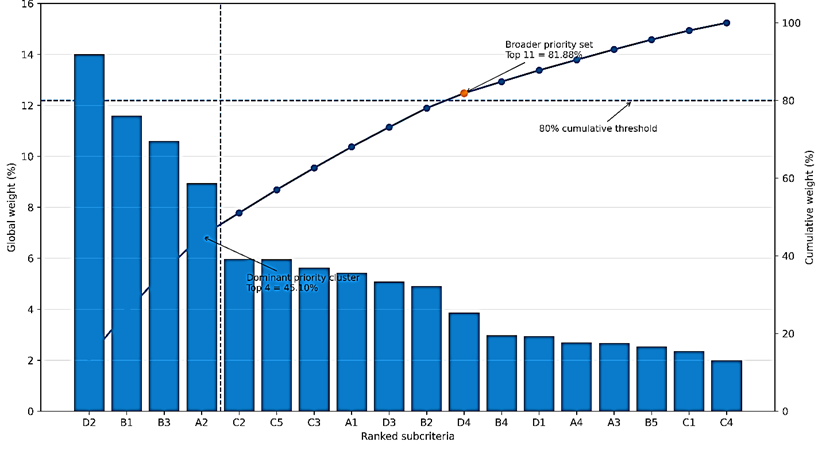

Letters to Editor
[1] Letters that include statements of statistics, facts, research, or theories should include appropriate references, although more than three are discouraged.
[2] Letters that are personal attacks on an author rather than thoughtful criticism of the author’s ideas will not be considered for publication.
[3] Letters can be no more than 300 words in length.
[4] Letter writers should include a statement at the beginning of the letter stating that it is being submitted either for publication or not.
[5] Anonymous letters will not be considered.
[6] Letter writers must include their city and state of residence or work.
[7] Letters will be edited for clarity and length.