Document Type : RESEARCH ARTICLE
Author
Civil and Environmental Engineering Department, Mutah University, Karak, Jordan
Abstract
BACKGROUND AND OBJECTIVES: Reclaimed wastewater is important in water-scarce regions, but safe reuse requires sustained effluent quality. The study objectives were to evaluate the quality and reuse potential of effluent discharged from the Karak domestic wastewater treatment plant in Jordan over the 2016–2025 period. The investigation employed a comprehensive framework integrating regulatory standards, water quality indices, temporal trend evaluations, multivariate statistical techniques, and positive matrix factorization.
METHODS: Seventeen physicochemical and microbiological parameters were assessed against Jordanian Standard 893:2021. Water quality index and water pollution index were applied as supplementary screening tools, and parameter-contribution and sensitivity analyses evaluated the magnitude of influence exerted by specific variables and the underlying weighting framework. Linear trends were estimated from 30 campaigns using ordinary least-squares regression, reporting slope, coefficient of determination, and p-value; Escherichia coli was evaluated on the log10 scale. Principal component analysis, hierarchical cluster analysis, and Environmental Protection Agency Positive Matrix Factorization 5.0 characterized covariance, similarity, and stable effluent-quality profiles.
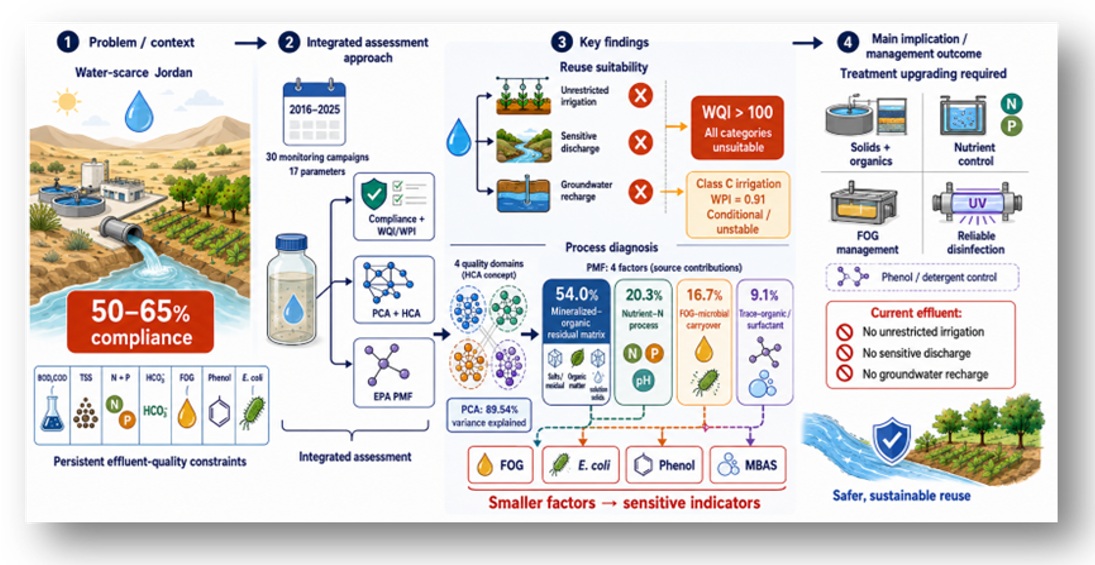
FINDINGS: Average parameter-level compliance ranged from 50 to 65 percent across reuse and discharge categories, with limitations from residual organic matter, suspended solids, nutrients, bicarbonate, phenol, fats, oils and grease, and Escherichia coli. Across all categories, water quality index values surpassed 100. Subsequent sensitivity evaluations revealed that Escherichia coli drove approximately 99.99 percent of the weighted index for Class D irrigation and groundwater recharge, whereas phenol dominated Classes B and C. Equal weighting reduced mean Class C water quality index below 100, confirming weighting sensitivity without changing the regulatory compliance conclusion. Water pollution index decomposition also showed dominant Escherichia coli influence. Significant decreasing linear trends occurred for biochemical oxygen demand, chemical oxygen demand, total dissolved solids, total suspended solids, total nitrogen, phosphate-phosphorus, chloride, and sodium adsorption ratio, whereas dissolved oxygen, phenol, and nitrate-nitrogen increased. Principal component analysis explained 89.54 percent of variance through four components, and positive matrix factorization resolved four stable profiles contributing 54.0, 20.3, 16.7, and 9.1 percent.
CONCLUSION: Index magnitudes were strongly affected by restrictive standards and dominant parameters, while temporal trends indicated directional change without establishing causal treatment mechanisms. Direct Jordanian Standard 893:2021 compliance should remain the primary basis for reuse decisions. Confirming underlying causal mechanisms or targeted treatment interventions necessitates higher-frequency monitoring protocols that encompass influent, hydraulic, operational, and source-specific metrics.
Graphical Abstract
Highlights
Ø Linear trend analysis (2016–2025) identified significant declines in BOD₅, COD, TDS, TSS, T-N, PO₄-P, Cl and SAR, alongside increasing DO; phenol and NO₃-N increased significantly;
Ø WQI/WPI sensitivity analysis showed that extreme Class D and groundwater-recharge index values were overwhelmingly driven by E. coli, while phenol dominated WQI leverage for Classes B and C;
Ø PMF resolved a dominant mineralized–organic residual profile (54.0%) and three secondary profiles; FOG and E. coli were dominated by Factor 3 and phenol and MBAS by Factor 4, while PCA explained 89.54% of total variance;
Ø Persistent 50–65% parameter-level compliance confirmed residual organics, suspended solids, nutrients, bicarbonate, phenol, FOG and E. coli as the principal constraints on safe wastewater reuse.
Keywords
Subjects
OPEN ACCESS
©2027 The author(s). This article is licensed under a Creative Commons Attribution 4.0 International License, which permits use, sharing, adaptation, distribution and reproduction in any medium or format, as long as you give appropriate credit to the original author(s) and the source, provide a link to the Creative Commons license, and indicate if changes were made. The images or other third party material in this article are included in the article’s Creative Commons license, unless indicated otherwise in a credit line to the material. If material is not included in the article’s Creative Commons license and your intended use is not permitted by statutory regulation or exceeds the permitted use, you will need to obtain permission directly from the copyright holder. To view a copy of this license, visit: http://creativecommons.org/licenses/by/4.0/
PUBLISHER NOTE
GJESM Publisher remains neutral concerning jurisdictional claims in published maps and institutional affiliations.
MAJOR DATABASES, CITATION METRICS & CAPTURES
Google Scholar | Scopus - SJR | Web of Science | Biological Abstracts: Clarivate | Biosis Preview: Clarivate | PlumX Metrics | Altmetrics | Mendeley |
CURRENT PUBLISHER
GJESM Publisher



Letters to Editor
[1] Letters that include statements of statistics, facts, research, or theories should include appropriate references, although more than three are discouraged.
[2] Letters that are personal attacks on an author rather than thoughtful criticism of the author’s ideas will not be considered for publication.
[3] Letters can be no more than 300 words in length.
[4] Letter writers should include a statement at the beginning of the letter stating that it is being submitted either for publication or not.
[5] Anonymous letters will not be considered.
[6] Letter writers must include their city and state of residence or work.
[7] Letters will be edited for clarity and length.