Satellite-based assessment of high ​​Andean wetlands and carbon sequestration under the influence of climate change

Document Type : RESEARCH ARTICLE

Authors

1 Universidad Nacional de Juliaca, San Román, 21101 Perú

2 Institute for Research in Water Science and Technology, National University of Altiplano, Puno, 21001 Perú

3 Faculty of Civil Engineering, Architecture and Urbanism, State University of Campinas, Campinas, 13083-970 Brazil

4 Facultad de Ciencias Biológicas. Universidad Nacional del Altiplano, Puno, 21001 Perú

Abstract
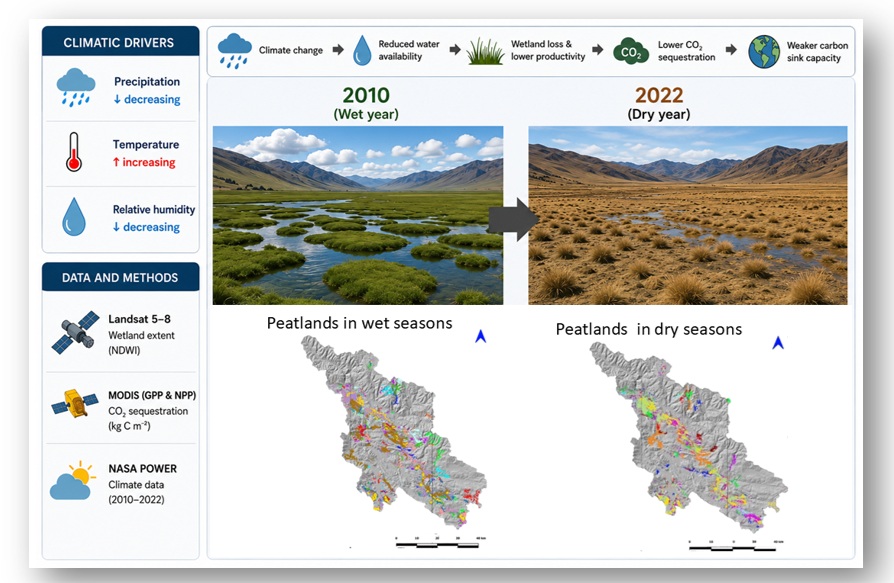
BACKGROUND AND OBJECTIVES: High-Andean wetlands play an important role in providing ecosystem services, particularly carbon sequestration. However, changes in climate may affect their extent and reduce their capacity to capture atmospheric Carbon. Therefore, the study objectives were to estimate carbon uptake in High-Andean wetlands using satellite imagery and to evaluate its relationship with climatic variables in the Huancané Basin, Peru.
METHODS: Google Earth Engine and RStudio integrated development environment (v4.3.1) were used with JavaScript and R programming languages. Wetland extent was determined from Landsat 5–8 imagery using the Linear Spectral Unmixing method during the wet and dry seasons. The wetland index was applied after converting digital numbers to reflectance values. carbon uptake was estimated from moderate resolution imaging spectroradiometer gross primary productivity and net primary productivity products. Climate data were obtained from the National Aeronautics and Space Administration power platform, and the relationships between wetland extent, carbon dioxide sequestration, and climatic variables were analyzed.
FINDINGS: Wetland extent decreased throughout the study period in both seasons. Between 2010 and 2022, wetland extent decreased by 109.43 square kilometres during the wet season and 85.60 square kilometres during the dry season. Carbon uptake also showed a decreasing trend during both seasons. Values ranged from 9.985 to 28.234 kilograms of carbon per square metre during the wet season and from 7.091 to 19.103 kilograms of carbon per square metre during the dry season. Significant relationships were found between wetland extent, carbon uptake, and climatic variables (p<0.05). Lower precipitation, higher maximum and minimum temperatures, lower relative humidity, and higher wind speed were associated with reductions in wetland extent and carbon uptake.
CONCLUSION: The results indicate that recent climatic changes have contributed to the degradation of high-Andean wetlands and to a reduction in their carbon uptake capacity in the Huancané Basin. These findings provide useful information for monitoring wetland dynamics and support the development of conservation and climate change mitigation strategies for future ecosystem management and sustainable conservation planning in vulnerable mountain regions worldwide.

Graphical Abstract

Satellite-based assessment of high ​​Andean wetlands and carbon sequestration under the influence of climate change

Highlights

Ø  High-Andean wetland extent in the Huancané Basin decreased by 109.43 km2 during the wet season and 85.60 km2 during the dry season between 2010 and 2022;

Ø  The reduction in wetland extent was accompanied by a marked decline in carbon uptake throughout the study period;

Ø  Lower precipitation and higher air temperatures were associated with lower wetland extent and carbon uptake.;

Ø  The integration of Landsat and MODIS satellite data allowed the evaluation of long-term changes in wetland extent and carbon uptake under changing climatic conditions.

Keywords

Subjects

©2027 The author(s). This article is licensed under a Creative Commons Attribution 4.0 International License, which permits use, sharing, adaptation, distribution and reproduction in any medium or format, as long as you give appropriate credit to the original author(s) and the source, provide a link to the Creative Commons license, and indicate if changes were made. The images or other third party material in this article are included in the article’s Creative Commons license, unless indicated otherwise in a credit line to the material. If material is not included in the article’s Creative Commons license and your intended use is not permitted by statutory regulation or exceeds the permitted use, you will need to obtain permission directly from the copyright holder. To view a copy of this license, visit: http://creativecommons.org/licenses/by/4.0/

PUBLISHER NOTE

GJESM Publisher remains neutral concerning jurisdictional claims in published maps and institutional affiliations.

MAJOR DATABASES, CITATION METRICS & CAPTURES

Google Scholar | Scopus - SJR | Web of Science | Biological Abstracts: Clarivate | Biosis Preview: Clarivate | PlumX Metrics | Altmetrics | Mendeley |

CURRENT PUBLISHER

GJESM Publisher

Letters to Editor

GJESM Journal welcomes letters to the editor for the post-publication discussions and corrections which allows debate post publication on its site, through the Letters to Editor. Letters pertaining to manuscript published in GJESM should be sent to the editorial office of GJESM within three months of either online publication or before printed publication, except for critiques of original research. Following points are to be considering before sending the letters (comments) to the editor.

[1] Letters that include statements of statistics, facts, research, or theories should include appropriate references, although more than three are discouraged.
[2] Letters that are personal attacks on an author rather than thoughtful criticism of the author’s ideas will not be considered for publication.
[3] Letters can be no more than 300 words in length.
[4] Letter writers should include a statement at the beginning of the letter stating that it is being submitted either for publication or not.
[5] Anonymous letters will not be considered.
[6] Letter writers must include their city and state of residence or work.
[7] Letters will be edited for clarity and length.

Send comment about this article
Enter Name.
Enter a valid email address.
Enter a vaid affiliation.
Enter comments (At leaset 10 words)
CAPTCHA Image
Enter Security Code Correctly.

  • Receive Date 12 May 2026
  • Revise Date 20 July 2026
  • Accept Date 27 August 2026