Document Type : RESEARCH ARTICLE
Authors
1
Multidisciplinary and Interdisciplinary School, Chiang Mai University, Chiang Mai, Thailand
2
Department of Electrical Engineering, Faculty of Engineering, Chiang Mai University, Chiang Mai, Thailand
3
Department of Civil Engineering, Faculty of Engineering, Chiang Mai University, Chiang Mai, Thailand
4
Department of Plant and Soil Sciences, Faculty of Agriculture, Chiang Mai University, Chiang Mai, Thailand
5
Department of Computer Engineering, Faculty of Engineering, Chulalongkorn University, Bangkok, Thailand
Abstract
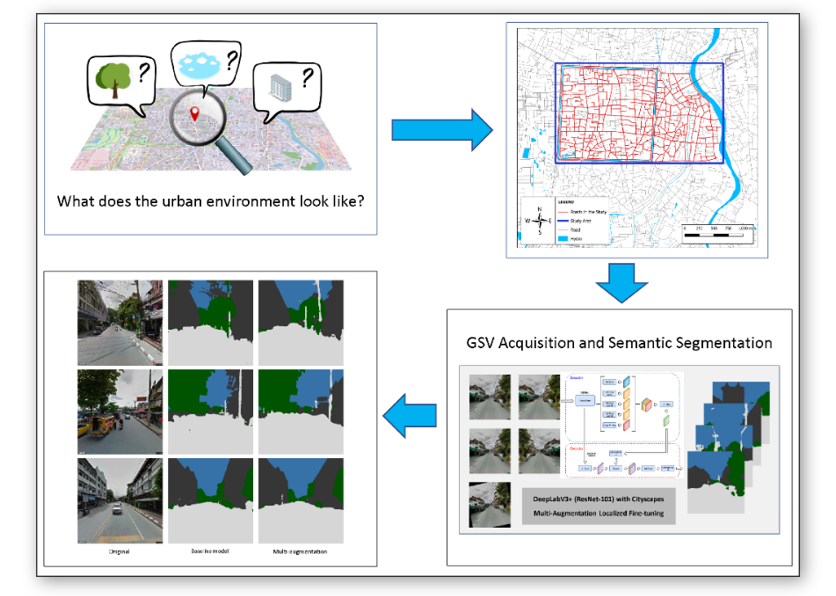
BACKGROUND AND OBJECTIVES: Street-level urban view factors are important indicators for assessing urban form. Environmental conditions and greenery exposure ultimately dictate residents’ quality of life; however, robust evaluation frameworks for assessing these determinants are still limited. This limitation is primarily due to the challenges in collecting extensive field data across large urban areas. To address this limitation, the objectives of this study were to leverage existing street-view imagery. This approach can be a cost-effective and widely available data source for urban environmental assessment. This study introduces an evaluative framework for quantifying building, tree, and sky view factors through the application of advanced deep learning models.
METHODS: A DeepLabV3+ model, pre-trained on the Cityscapes dataset, was selected for this study. To identify critical urban landscape features (buildings, trees, and sky), the model underwent localized fine-tuning aimed at enhancing predictive performance. In the fine-tuning process, manually annotated street-view images collected directly from the study area were used. The historic city center of Chiang Mai, Thailand, was selected as the research site. Street-view images were collected using the Google Street View Static application programming interface. To enhance segmentation performance under local urban conditions, several data augmentation strategies were examined and benchmarked against a baseline model.
FINDINGS: The site-specific fine-tuning significantly enhanced model performance. The results demonstrated that combining various data augmentation strategies provides greater robustness than single-method approaches. The multi-augmentation model achieved an optimal mean intersection over union of 0.908. This metric reflected robust performance in the segmentation of buildings, trees, and sky features. Statistical analysis revealed a strong negative correlation between building view factor and tree view factor (ρ= -0.71, p < 0.001). This inverse relation reflects both urban spatial arrangements and intrinsic compositional class limitations.
CONCLUSION: This study demonstrates the effectiveness of combining localized fine-tuning and multiple data-augmentation techniques to adapt DeepLabV3+ to the complex urban environment of Chiang Mai. The model improves urban view factor extraction accuracy. This study systematically evaluates localized fine-tuning and data-augmentation strategies and demonstrates that a relatively small, locally labelled dataset can effectively improve the performance of a pretrained model in a site-specific urban context.
Graphical Abstract
Highlights
Ø Localized fine-tuning improved DeepLabV3+ mIoU from 0.759 to 0.908;
Ø Multi-augmentation enhanced building, vegetation, and sky segmentation;
Ø VBVF and VTVF showed a strong inverse correlation (ρ = −0.71, p < 0.001).
Keywords
Subjects
OPEN ACCESS
©2026 The author(s). This article is licensed under a Creative Commons Attribution 4.0 International License, which permits use, sharing, adaptation, distribution and reproduction in any medium or format, as long as you give appropriate credit to the original author(s) and the source, provide a link to the Creative Commons license, and indicate if changes were made. The images or other third party material in this article are included in the article’s Creative Commons license, unless indicated otherwise in a credit line to the material. If material is not included in the article’s Creative Commons license and your intended use is not permitted by statutory regulation or exceeds the permitted use, you will need to obtain permission directly from the copyright holder. To view a copy of this license, visit: http://creativecommons.org/licenses/by/4.0/
PUBLISHER NOTE
GJESM Publisher remains neutral concerning jurisdictional claims in published maps and institutional affiliations.
MAJOR DATABASES, CITATION METRICS & CAPTURES
Google Scholar | Scopus - SJR | Web of Science | Biological Abstracts: Clarivate | Biosis Preview: Clarivate | PlumX Metrics | Altmetrics | Mendeley |
CURRENT PUBLISHER
GJESM Publisher



Letters to Editor
[1] Letters that include statements of statistics, facts, research, or theories should include appropriate references, although more than three are discouraged.
[2] Letters that are personal attacks on an author rather than thoughtful criticism of the author’s ideas will not be considered for publication.
[3] Letters can be no more than 300 words in length.
[4] Letter writers should include a statement at the beginning of the letter stating that it is being submitted either for publication or not.
[5] Anonymous letters will not be considered.
[6] Letter writers must include their city and state of residence or work.
[7] Letters will be edited for clarity and length.