
5.2
CiteScore
2.9
Impact Factor
Document Type : RESEARCH ARTICLE
Authors
1 Public Administration Science, Faculty of Social and Political Science, Universitas Sumatera Utara Medan 20155, North Sumatera, Indonesia
2 Political Science, Universitas Siliwangi, Tasikmalaya 46115, West Java Indonesia
Graphical Abstract
Highlights
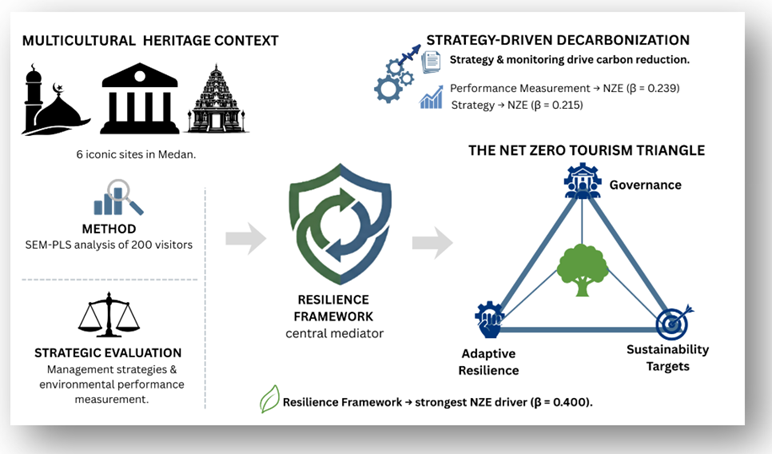
Ø Internal and external strategies positively influenced net zero emissions;
Ø Performance measurement had a significant positive effect on net-zero emissions;
Ø The resilience-based framework had the largest effect on net-zero emissions;
Ø Resilience significantly mediated the relationship between strategy and net zero emissions.
Keywords
INTRODUCTION
Climate change has emerged as the defining systemic challenge of the twenty-first century, placing unprecedented pressure on carbon-intensive economic sectors to fundamentally restructure their development pathways. As one of the global economy's largest sectors, tourism occupies a critical intersection between macroeconomic growth and environmental stewardship. The sector currently accounts for approximately 8–11 percent (%) of global greenhouse gas (GHG) emissions, equivalent to 4.0 gigatons of carbon dioxide equivalent (GtCO₂e) annually a figure encompassing transportation, accommodation, and destination-level activities (Lenzen et al., 2018; UNWTO, 2023). The urgency of this challenge has intensified following the 2022 Glasgow Declaration on Climate Action in Tourism, endorsed by over 700 signatories, which committed the global tourism sector to halving emissions by 2030 and achieving net-zero emissions (NZE) before 2050 (UNWTO, 2023). Achieving these benchmarks requires systemic transformations in destination governance and management rather than marginal efficiency gains to ensure long-term climate resilience (Gössling et al., 2024; Peeters and Papp, 2024). Indonesia presents a particularly compelling case for investigating the governance dimensions of this transformation. As the world's fourth most populous country and the largest archipelagic state, Indonesia has committed to achieving NZE by 2060 or sooner under its long-term strategy for low carbon and climate resilience submitted to the United Nations Framework Convention on Climate Change (UNFCCC) in 2021, with this commitment structurally embedded in the Seventh National Development Plan (RPJPN 2025–2045) mandating green and low-carbon sectoral restructuring (KLHKRI, 2021; Bappenas, 2025). Yet, Indonesia's NZE trajectory is rated 'Critically Insufficient' (Muslim and Hastuti, 2024), reflecting a structural governance gap between ambitious national commitments and the constrained implementation capacity of sub-national administrations. Accounting for 5.1% of GDP, 12.5 million jobs, and 13.9 million international arrivals in 2024, Indonesia’s travel and tourism sector represents a macroeconomic heavyweight that can no longer be omitted from the nation's decarbonization strategy (BPS, 2025a). The challenge, therefore, is not whether tourism must transition to NZE, but how this transition can be realistically governed at the destination level. The academic literature on sustainable tourism governance has advanced considerably over the past two decades, yielding three converging streams of inquiry. First, the sustainable tourism governance stream posits that destination management should be guided by the normative principles of economic viability, socio-cultural equity, and ecological integrity (Bramwell et al., 2017; Sharpley, 2021). Second, the destination resilience stream conceptualizes tourism destinations as complex adaptive systems capable of absorbing disturbances, reorganizing, and sustaining their essential functions in the face of climate variability, economic shocks, and public health crises (Cheer and Lew, 2017; Becken et al., 2020; Hall et al., 2024). Studies in this stream posits that destination management should be guided by the normative principles of economic viability, socio-cultural equity, and ecological integrity (Bangwayo-Skeete and Skeete, 2022; Azzaz and Elshaer, 2024). Third, the net-zero tourism transition stream focuses on decarbonization strategies, including carbon emission accounting, renewable energy adoption, and low-carbon mobility solutions, as the operational pathways toward sector-level emission neutrality (Gössling and Higham, 2021; Scott and Gössling, 2022; Peeters and Papp, 2024). Within this stream, performance measurement systems encompassing energy efficiency monitoring, waste reduction tracking, and carbon footprint assessment have been identified as critical instruments for evidence-based NZE governance (Becken et al., 2020; Becken and Scott, 2024). Furthermore, destination resilience research demonstrates that the capacity to withstand, adapt to, and recover from systemic shocks is inherently embedded within of institutional, economic, social, and ecological interdependencies (Conefrey et al., 2024; Falk et al., 2024). Innovative climate governance frameworks call for decentralized, multi-actor approaches that integrate stakeholder participation across city and destination administrative levels (Shtjefni et al., 2024). Complementary work in carbon-neutral city governance (Huovila et al., 2022) and tourism resilience theory (Ritchie and Jiang, 2019) further underscores that neither institutional adaptation nor technical decarbonization alone is sufficient their integration is required for durable sustainability outcomes. Despite recent progress, the separate literatures on sustainability governance, destination resilience, and NZE pathways remain siloed, without a cohesive empirical framework evaluating their structural interdependencies. However, four major theoretical and empirical gaps persist in the existing literature. First, the resilience-NZE nexus has not been empirically tested within a single, comprehensive quantitative framework. Although literature posits that reactive corrective actions fall short of achieving NZE targets and underscores the vital role of resilience-based adaptive capacity (Gössling and Higham, 2021), this theoretical assertion lacks empirical verification through structural modeling in a tourism destination context. Most prior studies examine these constructs in partial combinations resilience and governance, or governance and NZE, but not all three simultaneously leaving system-level dynamics and mediation mechanisms unexplored. Second, existing empirical models fail to disentangle how distinct management strategy components—such as internal and external actions, performance measurement, and corrective steps—individually influence resilience outcomes and NZE targets. Third, greenwashing risks and measurement validity in NZE governance studies have been insufficiently addressed: the absence of standardized carbon monitoring infrastructure in developing-country tourism destinations means that sustainability assessments frequently rely on perceptual proxies rather than verified emission data, creating an important methodological gap (Fahmi and Nuraini, 2024). Fourth, the interaction between cultural heritage conservation requirements and the implementation of low-carbon infrastructure remains theoretically underspecified in the current literature. Heritage conservation regulations typically restrict structural modification of protected sites, constraining the retrofitting of renewable energy installations and energy-efficient mechanical systems a dimension absent from existing NZE tourism models. To address these gaps, this study proposes and empirically tests an integrated Resilience–sustainability–net-zero emissions (RSNZE) framework. Within this model, destination resilience is operationalized as a dynamic mediating construct translating strategic management inputs into concrete NZE outcomes. Unlike prior studies that treat resilience, sustainability, and net-zero transition as separate theoretical constructs, this framework conceptualizes their interaction as a system: sustainability provides the normative governance foundation; resilience provides the adaptive institutional mechanism; and NZE constitutes the strategic decarbonization target. This framework is operationalized through structural equation modeling–partial least squares (SEM-PLS), allowing for the simultaneous estimation of direct path effects, mediation pathways, and predictive power. Three theoretical advances distinguish this study from prior work: 1) empirical validation of the resilience-to-NZE mediation pathway in a tourism destination context, addressing Gössling and Higham's (2021) unverified theoretical claim; 2) the first quantitative investigation of the RSNZE nexus in a multicultural urban heritage tourism setting; and 3) contextualization of the framework within a mid-tier developing-country city characterized by constrained governance capacity and heritage conservation constraints a governance archetype shared by a large class of destinations across Southeast Asia, South Asia, and Sub-Saharan Africa for which generalizable empirical evidence is currently lacking. This study was carried out at six principal heritage tourism destinations in Medan City, North Sumatra, Indonesia Al-Mashun Grand Mosque, Maimun Palace, Tjong A Fie House, Velangkani Temple, Medan Zoo, and the Crocodile Breeding Center in 2024. Grounded in this framework, the study addresses three distinct objectives: 1) to examine how internal and external destination strategies drive destination resilience and NZE outcomes; 2) to evaluate the empirical relationships connecting environmental performance metrics with NZE pathways and adaptive resilience capacity, thus offering fresh insights into the scholarly debate regarding whether monitoring systems alone are sufficient for fostering destination resilience; and 3) to examine the association between corrective action and NZE or resilience outcomes, testing the theoretical proposition that reactive management approaches are insufficient for the transformative change required by net-zero tourism transition. This study has been carried out in heritage tourism in Medan those were Al-Mashun Grand Mosque, Maimun Palace, Tjong a Fie House, Velangkani Temple, Medan Zoo, and Crocodile Breeding Center in 2024.
MATERIALS AND METHODS
Study area
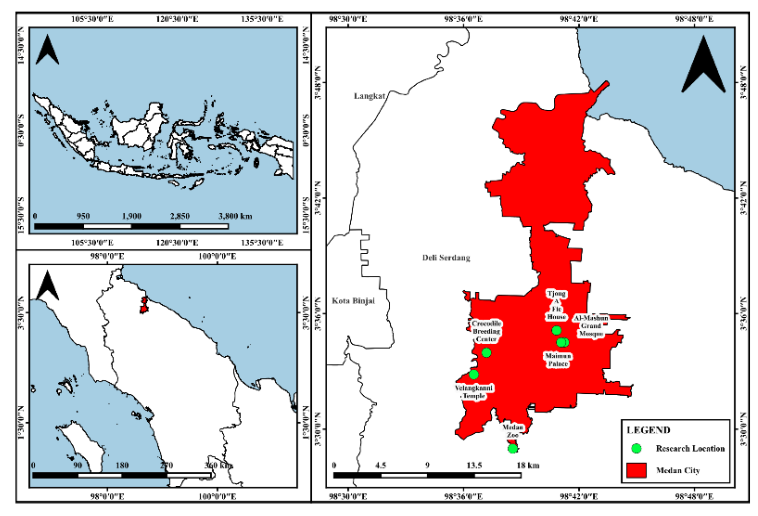
The study was conducted in Medan City, North Sumatra, Indonesia. Medan City serves as the primary administrative and economic hub of western Indonesia and its fourth-largest municipality, making it an ideal study area for three substantive reasons: 1) the city serves as the primary urban heritage tourism hub within the western Indonesian region, offering a highly concentrated cluster of historical assets that reflect diverse civilizational influences; 2) its urban tourism governance exhibits structural vulnerabilities typical of secondary cities in developing nations, characterized by limited sub-national climate governance capacity, inadequate carbon monitoring infrastructure, and a heritage conservation agenda that has historically been decoupled from low-carbon development planning; and 3) the city's trajectory of rapid tourism growth, with North Sumatra recording a 27.37% increase in international arrivals between January and November 2024 (BPS, 2025b), creates an empirically relevant context for testing the associations between destination management strategies, resilience, and NZE achievement. Data collection was executed across six preeminent heritage tourism destinations, which collectively reflect the city's inter-civilizational tourism mosaic: Al-Mashun Grand Mosque, Maimun Palace, Tjong A Fie House, Velangkani Temple, Medan Zoo, and the Crocodile Breeding Center Sunggal (Fig. 1). Collectively reflecting Medan's multicultural urban heritage landscape, these six sites provide the diverse visitor profiles, management contexts, and heritage typologies required to empirically test the study's theoretical framework (Fig. 1). Al-Mashun Grand Mosque (built 1906), featuring Islamic Malay-Mughal architecture represents the Islamic heritage typology and attracted 52 respondents. Maimun Palace (built 1888), a royal Malay heritage contributed 38 respondents. Data collection also captured 28 respondents from the Tjong A Fie Mansion (built 1895), representing Chinese-colonial heritage, and 22 respondents from the Velangkanni Church pilgrimage site. Medan Zoo, a 30-hectare recreational and conservation facility established in 1953 catering primarily to family and educational visitors, provided 38 respondents. The Crocodile Breeding Center Sunggal, an ecotourism and wildlife conservation facility serving domestic tourists and educational groups—accounted for 22 respondents within the final sample. Together, the six destinations span Islamic, Malay royal, Chinese-colonial, Christian, recreational, and ecological heritage typologies, providing the intra-city diversity of governance contexts and visitor profiles necessary for a robust cross-destination analysis of NZE governance perceptions.
Fig. 1: Geographical location of the study area in Medan City, North Sumatra, in Indonesia
Research design
This study employs a quantitative approach with an explanatory design to examine the causal inter-variable connections in the proposed conceptual model. This quantitative framework enables empirical hypothesis testing through rigorous statistical evaluation. The research model employed SEM-PLS due to its methodological advantages for complex models featuring several latent constructs, its effectiveness for medium sample sizes, and its suitability for data distributions that are not strictly normal. PLS-SEM was preferred over covariance-based SEM (CB-SEM) due to the model's emphasis on prediction and theoretical formulation, coupled with the integration of indicators that reflect each underlying construct. Furthermore, SEM-PLS offers greater flexibility regarding assumptions of data normality, which is appropriate for analyzing socio-economic contexts where data are frequently not normally distributed. This methodological choice carries an important interpretive boundary: SEM-PLS path coefficients are best understood as predictive associations identified within the proposed model rather than confirmatory causal estimates, and model adequacy is evaluated using prediction-oriented criteria (R², Q², SRMR) rather than the absolute fit indices conventionally reported in CB-SEM (e.g., CFI, RMSEA). Reflecting this epistemological boundary, the Results and Discussion section consistently utilizes associational rather than causal terminology to describe the structural pathways revealed by the model.
Data collection
Primary data were collected through a questionnaire prepared and organized based on the study literature and adapted to the context of urban tourism destinations. Prior to distribution, the questionnaire materials were pre-tested to ensure item clarity and measurement consistency. Enumerators conducted data collection directly after receiving brief instruction on data entry procedures and research ethics. Respondents were briefed on the research objectives and provided with explicit assurances regarding data anonymity and confidentiality. The data collection procedure employed non-probability sampling, specifically incidental sampling, in which respondents were visitors encountered at the research site who were willing to complete the questionnaire. A sample size of 200 respondents met the minimum standard for SEM-PLS. Sample size determination was guided by the 10-times rule, which mandates a minimum sample equivalent to ten times the number of indicators associated with the model's largest structural component. Considering the complexity of the model, which involves several latent variables, a total of 200 respondents was considered sufficient to provide satisfactory outcomes.
Measurement instrument
This study employs five main latent constructs comprising 10 sub-variables and 20 reflective indicators, measured on a five-point Likert scale (1 = strongly disagree; 5 = strongly agree), to investigate the factors influencing NZE achievement at the destination level. The first construct, internal and external strategy (X1), evaluates destination strategy encompassing operational efficiency management, renewable energy policy adoption, external stakeholder engagement, and sustainable procurement practices (Gössling et al., 2023; Scott and Gössling, 2022). Environmental performance assessment within the second construct (X2) is evaluated through four primary dimensions: carbon emission monitoring systems, energy efficiency tracking, waste management indicators, and the assessment of visitor environmental impacts (Becken et al., 2020; Becken and Scott, 2024). The third construct, corrective action (X3), evaluates reactive management interventions designed to modify policies and operational workflows. Specifically, it operationalizes these interventions through post-audit policy revisions, process adjustments following performance discrepancies, compliance training initiatives, and structural environmental remediation aimed at mitigating emissions and optimizing sustainability (Dredge, 2022; Peeters and Papp, 2024). The fourth construct, the resilience-based framework (Z), evaluates the adaptive capacity of the destination system to respond to a variety of external disturbances and ensure system durability amid change, measured through indicators of government green economy response, technological innovation capacity, local tourism manager adaptability, and consumer and employee environmental confidence (Cheer and Lew, 2017; Lew et al., 2020; Azzaz and Elshaer, 2024). The fifth construct, NZE (Y), evaluates participant perceptions regarding the efficacy of carbon emission reduction initiatives and organizational alignment with NZE objectives. This variable is operationalized through four core metrics: commitment to energy reduction, adoption of sustainable products and services, enhancement of environmental conditions enhancement , and the attainment of carbon neutrality targets (Scott and Gössling, 2022; Peeters and Papp, 2024; UNWTO, 2023).
Data analysis
Data analysis was conducted using SmartPLS software, comprising two primary stages: evaluation of the measurement model (outer model) and evaluation of the structural model (inner model). To confirm the validity and reliability of the research model's latent variables, an outer model evaluation was conducted. The constructs were benchmarked against conventional statistical criteria, requiring factor loadings ≥ 0.70, average variance extracted (AVE) ≥ 0.50, composite reliability (CR) ≥ 0.70, and Cronbach's Alpha ≥ 0.70. Discriminant validity was assessed using the Fornell-Larcker criterion. During model evaluation, indicators with a loading factor below 0.40 were excluded from the model, while indicators with loading factors between 0.40 and 0.70 were retained or removed depending on their impact on the AVE and CR values of each construct. Evaluation of the structural model (inner model) examines the relationships between constructs in the research model. This analytical approach evaluates path coefficients to ascertain the direction and magnitude of hypothesized relationships. Statistical significance is subsequently determined via $t$-statistics and $p$-values generated through a bootstrapping procedure utilizing 5,000 resamples. The model's capacity to explain endogenous variables was assessed using the coefficient of determination (R²). A mediation analysis (indirect effect) was also conducted to examine the role of the resilience-based framework as an intervening mechanism in the relationships between management strategy variables and net zero emissions. Given α = 0.05, a relationship between variables is considered significant if the p-value is below 0.05. To ascertain whether resilience serves as a mediating mechanism between management strategies and the achievement of NZE targets, the mediation effect was assessed by examining the statistical significance of the bootstrap-derived indirect effect.
Research design
This study adheres to academic ethical principles, ensuring that respondent participation was voluntary and that respondent identities remained confidential. All data collected were restricted strictly to the scope of this study and were not disseminated for external purposes.
RESULTS AND DISCUSSION
Measurement model evaluation
Assessment of the measurement model was conducted to ensure that the latent constructs employed in the study meet the criteria for validity and reliability. The latent constructs under examination were effectively operationalized by their respective indicators, all of which displayed factor loadings meeting the minimum retention criteria (Table 1). The average variance extracted (AVE) for all constructs exceeds the threshold of 0.50, indicating that each construct accounts for more than half of the variance in its indicators. Composite reliability values for all constructs exceed the recommended threshold of 0.70, indicating a high level of internal consistency. These findings demonstrate that the measurement model satisfies the established criteria for both convergent validity and internal consistency reliability. Discriminant validity, assessed using the Fornell-Larcker criterion, demonstrates that the square root of the AVE for each construct exceeds its correlation values with other constructs, confirming that each construct possesses adequate discriminant capability and that latent multicollinearity is not a concern in this research model.
Structural model and resilience-based pathways toward net zero emissions
Structural model assessment was executed via a bootstrapping procedure to evaluate the statistical significance of the hypothesized paths between the latent constructs. As shown in Table 2, internal and external strategy was significantly associated with NZE (β = 0.215, p = 0.005) and with the resilience-based framework (β = 0.331, p < 0.001). These results indicate that management strategies encompassing operational efficiency, resource management, and engagement with external stakeholders are associated with efforts to reduce carbon emissions at tourism destinations and demonstrate that competent destination management plays an important role in facilitating the transition to low-carbon tourism. Within the paradigm of sustainable tourism, effective destination management necessitates the strategic integration of economic, socio-cultural, and environmental dimensions to secure enduring sustainability. Prior research indicates that destination approaches combining regulatory frameworks with clean energy innovation are associated with reduced carbon emissions and enhanced competitiveness among tourism destinations (Gössling et al., 2023; Scott and Gössling, 2022).
Table 1: Evaluation of measurement model
|
Construct |
AVE |
Composite reliability |
|
Internal & External Strategy |
0.685 |
0.813 |
|
Net Zero Emission |
0.578 |
0.846 |
|
Performance Measurement |
0.645 |
0.844 |
|
Resilience-Based Framework |
0.547 |
0.780 |
|
Corrective Action |
0.842 |
0.914 |
Table 2: Structural model path coefficients
|
Relationship |
Path coefficient |
p-value |
|
Strategy → Net zero emissions |
0.215 |
0.005 |
|
Strategy → Resilience |
0.331 |
0.000 |
|
Performance measurement → Net zero emissions |
0.239 |
0.001 |
|
Performance measurement → Resilience |
0.026 |
0.804 |
|
Resilience → Net zero emissions |
0.400 |
0.000 |
|
Corrective action → Net zero emissions |
0.011 |
0.874 |
Tourism resilience refers to the capacity of a destination to withstand and recover from adverse events affecting the tourism system, to absorb disturbances, adapt to change, and sustain social and economic functions following a crisis (Cheer and Lew, 2017; Lew et al., 2020). Prior studies demonstrate that community participation and institutional capacity are critical determinants of a destination’s adaptive capacity, enabling tourism systems to mitigate climate vulnerabilities and sustain operations over time (Hall et al., 2024). Performance measurement was significantly associated with NZE (β = 0.239, p = 0.001) but showed no significant association with resilience (β = 0.026, p = 0.804). This finding suggests that environmental monitoring and evaluation systems play an important role in supporting carbon emission reduction. While performance measurements encompassing energy efficiency, waste management, and carbon emission reduction provide precise data for climate change mitigation, prior research indicates that sector-specific systems, such as those in tourism, are particularly crucial instruments for identifying primary emission sources and devising effective decarbonization policies (Becken et al., 2020; Becken and Scott, 2024; Gössling and Higham, 2024). However, the non-significant association between performance measurement and resilience suggests that environmental monitoring systems alone are currently insufficient to enhance destination resilience, which is a complex construct shaped by institutional capacity, human resources, and innovative capability (Dredge, 2022). Corrective action was not significantly associated with NZE (β = 0.011, p = 0.874) or with resilience. This finding demonstrates that reactive strategies possess limited efficacy in accelerating the tourism sector's transition toward a low-carbon economy. Achieving net-zero tourism requires systemic change involving technological innovation, shifts in visitor behavior, and multi-stakeholder engagement among government, industry actors, and local communities (Peeters and Papp, 2024). Among all constructs, the resilience-based framework exhibited the strongest association with NZE achievement (β = 0.400, p < 0.001). This finding underscores destination resilience as a pivotal determinant of sectoral decarbonization, suggesting that highly resilient destinations possess superior capacity for implementing effective climate change adaptation and mitigation strategies (Scott et al., 2024; Hall et al., 2024). To further evaluate the explanatory power of the model, the coefficient of determination (R²) was assessed (Table 3). The R² value for the NZE variable is 0.449, indicating that internal and external strategies, performance measurement, corrective action, and resilience collectively account for approximately 44.9% of the variation in NZE, which is classified as moderate. The structural model evaluation revealed an R² value of 0.167 for the resilience-based framework. This indicates that the combination of internal and external strategies, performance measurement, and corrective action account for approximately 16.7% of the variation in destination resilience.
Table 3: Coefficient of determination
|
Variable |
R² |
|
Net zero emission |
0.449 |
|
Resilience-based framework |
0.167 |
Mediation analysis
The mediation test demonstrates that the resilience-based framework significantly mediates the relationship between internal and external strategy and NZE, with resilience accounting for 38.0% of the total strategy-NZE relationship (VAF = 38.0%). These findings demonstrate that resilience functions exclusively as a significant partial mediator within the strategy-NZE nexus. This empirically validates the theoretical proposition that resilience operates as a pivotal transmission mechanism through which strategic management capacity is translated into substantive emission reduction outcomes. No significant mediation was found for the performance measurement-NZE or corrective action-NZE relationships, consistent with the non-significant direct associations between these variables and resilience reported above (Table 4).
Theoretical implications: the resilience, sustainability, and net zero tourism triangle
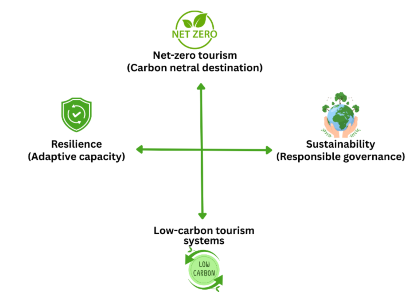
This study contributes theoretically by integrating three primary perspectives in the sustainable tourism literature: tourism resilience, sustainable tourism governance, and net-zero tourism transition (Fig. 2). Most prior studies address these three perspectives separately. Prior research in sustainable tourism heavily emphasizes the alignment of systemic resource management, civic participation, and responsible governance structures (Bramwell et al., 2017; Sharpley, 2021). Tourism resilience literature emphasizes the capacity of destinations to recover from crises such as natural disasters or pandemics (Cheer et al., 2021; Hall et al., 2024). Research on net-zero tourism, in contrast, emphasizes decarbonization techniques through carbon emission reduction, energy efficiency, and renewable energy utilization within the tourism sector (Gössling and Higham, 2024; Scott et al., 2024). The theoretical triangle model (Fig. 2) illustrates that the attainment of Net-Zero Tourism (NZT) is intrinsically linked to a systemic transformation of the tourism sector, a process fundamentally underpinned by the twin pillars of resilience and sustainability. Sustainability serves as a normative foundation that emphasizes the balance of economic, environmental, and social considerations in destination tourism management. Resilience functions as an adaptive mechanism that enables tourism systems to respond to diverse external disturbances, such as climate change and global crises. The interaction between these two pillars strengthens the sustainability and robustness of the tourism sector, serving as a critical pathway toward a low-carbon framework and ultimate NZE achievement. This model confirms that attaining NZE is associated with the convergence of governance, sustainability, and destination resilience capabilities. The revised triangle framework (Fig. 2) is grounded in three theoretical traditions. First, sustainability serves as a normative foundation draws from Brundtland's intergenerational equity principles operationalized through destination governance (Bramwell et al., 2017). Second, resilience as an adaptive mechanism rooted in complex adaptive systems theory (Becken et al., 2020) and socio-ecological resilience theory (Cheer and Lew, 2017).
Table 4: Mediation analysis results (bootstrapped indirect effects, 5,000 resamples)
|
Pathway |
Indirect effect |
SE |
95% CI |
p-value |
Conclusion |
|
Strategy → Resilience → NZE |
0.132 |
0.047 |
[0.047, 0.231] |
0.004 |
Significant partial mediation (VAF = 38.0%) |
|
Performance Measurement → Resilience → NZE |
0.010 |
0.015 |
[-0.018, 0.041] |
0.481 |
Non-significant (no mediation) |
|
Corrective Action → Resilience → NZE |
0.004 |
0.012 |
[-0.019, 0.032] |
0.743 |
Non-significant (no mediation) |
Finally, NZE is framed as a strategic transformation target, deriving from transition management theory (Peeters and Papp, 2024) and climate governance frameworks under the UNFCCC Paris Agreement. The revised figure incorporates the empirical path values obtained in this study (β = 0.400 for Resilience → NZE; β = 0.331 for Strategy → Resilience; β = 0.215 for the strategy → NZE direct path), the mediation pathway with its indirect effect value (0.132), R² values for the endogenous constructs, and ontological labels identifying sustainability as the normative foundation, resilience as the adaptive mechanism, and NZE as the strategic transformation target. The synergy among these three pillars establishes a theoretically robust and testable paradigm for executing sustainable transformation within the tourism sector. To clarify further how environmental, socio-economic, governance, heritage conservation, stakeholder participation, technological, and growth-pressure dimensions relate within this framework: sustainability establishes the normative foundation balancing environmental and socio-economic imperatives; resilience acts as the governance-driven adaptive mechanism; and NZE serves as the ultimate target toward which both pillars are oriented. Heritage conservation constraints (see earlier discussion), stakeholder equity and community participation, smart technology adoption, and the tension between visitor growth and emission intensity are best conceptualized as boundary conditions and moderating contextual factors that shape how strongly and how consistently the resilience-sustainability-NZE pathway operates in a given destination, rather than as additional empirically tested constructs within the present quantitative model. While the present study utilizes SEM-PLS to validate the core strategy-resilience-NZE pathway, several avenues for future research remain. Specifically, subsequent empirical investigations should operationalize heritage conservation conflict, stakeholder equity, and technology adoption as distinct latent constructs. Furthermore, expanding the geographic and environmental scope beyond urban heritage settings would test the boundary conditions and generalizability of the proposed framework.
Findings indicate that establishing NZE in the tourism sector depends not only on policy and technical measures for carbon emission reduction but also on the capacity of adaptive systems to respond to varied external disturbances. Consequently, highly resilient tourism destinations are better positioned to adopt innovative technologies, integrate supportive policies, and implement sustainable management practices. This perspective is consistent with recent studies emphasizing that effective environmental governance, ecosystem resilience, and adaptive management are fundamental for achieving long-term sustainability outcomes across natural resource systems (Harahap et al., 2025; Arthatiani et al., 2026). Furthermore, socio-environmental and territorial governance mechanisms have been shown to strengthen institutional adaptability and improve the effectiveness of sustainable resource management, thereby supporting resilience-based transitions toward low-carbon development (Díaz-Ponce et al., 2026). Therefore, the convergence of sustainability governance, adaptive resilience, and net-zero transitions constitutes a critical imperative for propelling the tourism industry toward a low-carbon paradigm. This study contributes to the development of an integrative resilience–sustainability–net-zero tourism model by linking the literature on sustainable tourism, resilient destinations, and climate change mitigation, while providing empirical evidence regarding the significant role of destination resilience in facilitating decarbonization within the tourism industry. The robust positive correlation between the resilience-based framework and NZE achievement (β = 0.400) aligns with a growing body of literature highlighting adaptive institutional capacity as a cornerstone of decarbonization governance and broader environmental resilience (Harahap et al., 2025; Díaz-Ponce et al., 2026; Arthatiani et al., 2026). This synergy is evident across diverse geographical contexts, including Pacific Island destinations (Hall et al., 2024), European ski resorts (Scott et al., 2024), and New Zealand (Becken et al., 2020). The absence of a significant association between corrective action and NZE (β = 0.011) is theoretically consistent with Gössling and Higham (2021) critique of reactive management paradigms in tourism decarbonization, and empirically echoes Dredge (2022) finding that institutional corrective capacity alone is insufficient without foundational resilience infrastructure. Such an outcome may be attributed to the relative underdevelopment of structured corrective management mechanisms within Indonesia's urban tourism governance infrastructure (Fahmi and Nuraini, 2024; Shtjefni et al., 2024). The non-significance of corrective action (β = 0.011, p > 0.05) aligns with the theoretical position advanced by Gössling and Higham (2021) that reactive management frameworks are structurally insufficient for net-zero transition, which demands systemic, anticipatory transformation rather than incremental post-hoc corrections. Peeters and Papp (2024) similarly argue that NZE achievement requires multi-stakeholder, technology-enabled transformations that transcend the scope of reactive corrective interventions. This evidence underscores a critical shift required in tourism governance, suggesting that sustainable destination management hinges on prioritizing anticipatory resilience and strategic decarbonization over traditional, reactive operational adjustments, thereby enhancing long-term adaptive capacity, climate resilience across destinations.
Practical implications
These findings carry significance for the formulation of sustainable tourism policy, particularly in supporting the transition to net-zero tourism. To address the substantial carbon footprint generated by tourist transit, literature underscores the need for regulatory bodies to mainstream climate mitigation policies into macro-level tourism development agendas. Effective governance in this domain requires a tripartite approach: incentivizing renewable energy adoption, optimizing sector-wide energy efficiency, and deploying sustainable transportation infrastructure (Peeters and Papp, 2024; Gössling et al., 2023). Destination managers should strengthen resilience-based management within destination administration. Destination resilience can be enhanced through economic diversification in tourism, strengthened institutional capacity, and improved local public participation in tourism management (Lew et al., 2020; Cheer et al., 2021), helping to ensure that destinations remain adaptable to environmental changes and economic uncertainties. Government and tourism stakeholders should also develop monitoring and reporting systems for carbon emissions in the tourism sector, which can assist in identifying primary emission sources and evaluating the effectiveness of mitigation policies. Prior studies demonstrate that carbon emission measurement is a critical determinant of successful sectoral decarbonization initiatives across the tourism industry (Becken and Scott, 2024; Scott and Gössling, 2022). Multi-stakeholder collaboration among government, the corporate sector, local communities, and international organizations is a critical factor in reaching net zero tourism goals, advancing innovation policy, technology transfer, and the development of more sustainable tourism practices (Bramwell et al., 2017; Hall et al., 2024). The empirical evidence demonstrate that a resilience-based framework serves as the primary determinant of NZE success, highlighting systemic resilience as a critical prerequisite for sectoral decarbonization. In contrast, reactive operational adjustments fail to demonstrate a significant correlation with NZE targets or adaptive destination capacity. The development of a carbon emission monitoring system, together with certification for low-carbon tourism, may serve as an important instrument in advancing sustainability practices within the tourism business. Beyond the scope of the current perceptual scale, the authors highlight two distinct practical limitations requiring further investigation. First, disaggregated, source-level data distinguishing emission contributions from visitor mobility and transportation versus on-site operational activities at each destination were not collected; given that transportation is widely documented as a dominant emission source in tourism systems (Lenzen et al., 2018; Scott and Gössling, 2022), it is recommended that future destination-level studies incorporate source-disaggregated carbon accounting validated against traffic counts, energy billing records, and waste audit data. Second, carbon offset mechanisms, carbon credit systems, and infrastructure lifecycle assessment, which are increasingly central to corporate and destination-level net-zero strategies globally (Peeters and Papp, 2024). Consequently, exploring these objective, non-perception-based pathways represents a critical avenue for future research to complement these findings. The financial sustainability of the resilience- and NZE-oriented initiatives discussed above, including cost-benefit analysis and funding mechanisms, was not evaluated in this study, as our model is perceptual and does not incorporate financial or budgetary data from destination management entities. These insights offer vital pragmatic direction for policymakers and destination administrators seeking to operationalize the study's empirical findings. Furthermore, the authors acknowledge several methodological limitations regarding stakeholder scope. Specifically, local community members were excluded from the survey sample, meaning that community participation and social equity were not evaluated as independent constructs. Additionally, the internal/external strategy dimension relies on a single indicator for external stakeholder engagement, which was captured solely through the perceptual lens of the surveyed visitors. This is a notable limitation given that social equity and community participation are widely recognized as central pillars of sustainable tourism governance (Bramwell et al., 2017; Sharpley, 2021). Relatedly, decarbonization strategies implemented without attention to distributional effects could plausibly affect informal vendors, small-scale tourism operators, or cultural practices reliant on existing infrastructure and visitor flow patterns at heritage sites. To align with a just-transition approach to tourism decarbonization, the future implementation of resilience-based NZE strategies should be accompanied by comprehensive social impact assessments. Such measures are vital to safeguarding local livelihoods and maintaining socio-cultural authenticity. Furthermore, future research designs must directly integrate community-level respondents to capture these socio-ecological dimensions empirically. Smart tourism technologies represent an important emerging lever for both resilience-building and emission reduction, including AI-based visitor flow optimization, IoT-enabled energy and waste monitoring, GIS-based spatial planning for carbon-efficient infrastructure, and digital real-time environmental monitoring dashboards. The evaluation of these specific technologies fell outside the scope of the present study, as the underlying measurement instrument was explicitly designed to assess constructs of management strategy, performance measurement, and corrective action constructs rather than specific digital technology adoption. This technology are a promising direction and recommend incorporating a dedicated digital and smart-technology adoption construct in future extensions of the proposed framework. In summary, the research offer the following stakeholder-differentiated recommendations. Collectively, the empirical insights yield distinct, stakeholder-specific recommendations. At the governance level, national and municipal governments should systematically integrate climate mitigation frameworks within comprehensive tourism planning strategies. This integration requires dismantling pervasive structural impediments, most notably the division of inter-agency jurisdictional authority and the budgetary limitations restricting municipal green-infrastructure investments. For destination managers: prioritize proactive resilience-building, encompassing economic diversification, institutional capacity, and local participation, over reactive corrective measures, consistent with our empirical finding on corrective action's non-significance. For heritage destination managers specifically: pursue non-invasive low-carbon interventions that respect conservation constraints, such as LED retrofitting and off-site renewable energy procurement, rather than structural retrofits.
Study limitations and future research
Although this study contributes important insight into the relationship between destination strategy, resilience, and net zero emissions, a number of limitations should be noted. Future research could also explore the role of digital technology and smart tourism in supporting carbon emission reduction in the tourism sector. As a cross-sectional survey study, causal directionality cannot be confirmed from these findings. Rather than demonstrating definitive causal mechanisms, the observed path coefficients reflect statistically significant relationships inherent to the proposed structural framework. Longitudinal research designs, quasi-experimental approaches, or natural experiments would be required to confirm causal mechanisms underlying the resilience-NZE relationship. The relatively modest R² for the resilience-based framework construct (R² = 0.167) indicates that the three management strategy variables, while statistically significant predictors, collectively explain only 16.7% of the variance in destination resilience. This finding highlights the inherently multidimensional and complex nature of destination resilience (Dredge, 2022), which encompasses institutional, financial, ecological, human capital, and social dimensions beyond the scope of the current model. To enhance the predictive validity of destination resilience frameworks within the NZE paradigm, future empirical inquiries should integrate a broader array of determinants, namely governance quality metrics, climate vulnerability indices, fiscal capacity, community social capital, and digital technology adoption levels. Regarding geographic scope, this study was deliberately limited to Medan City because it represents a strategically important but understudied multicultural urban heritage tourism context within Indonesia's broader NZE 2060 commitment. The external validity of these outcomes is primarily confined to equivalent mid-tier, developing-nation urban heritage environments. Such destinations are typically characterized by comparable structural and regulatory impediments, most notably deficits in carbon accounting infrastructure and stringent heritage preservation mandates. Transferability to rural destinations, or to developed-country contexts with more mature carbon governance infrastructure, should be treated with caution, and a comparative cross-context replication are recommended as a priority direction for future research. Several critical trajectories for subsequent empirical study emerge from this review. First, transitioning toward longitudinal methodologies is essential to verify temporal precedence and overcome the structural, non-causal constraints of the present cross-sectional framework. Second, mixed-method approaches combining the current quantitative SEM-PLS framework with qualitative key-informant interviews. Engaging stakeholders such as municipal officials, destination managers, and community representatives would serve to empirically substantiate the governance, institutional, and equity dimensions that were explored conceptually in this study but remained unmeasured. Third, biodiversity and ecological indicators, particularly relevant for the Medan Zoo and Crocodile Breeding Center sites, were not incorporated into the current resilience construct and merit dedicated measurement. Fourth, carrying capacity analysis provides a mechanism to scrutinize the aforementioned friction between continued tourist expansion and the decoupling of emissions intensity. Finally, explicit alignment with the United Nations Sustainable Development Goals, particularly SDG 11 (Sustainable Cities and Communities), SDG 13 (Climate Action), and SDG 8 (Decent Work and Economic Growth), would strengthen the policy relevance of future extensions of this study (UNWTO, 2023WTO2024). Finally, the findings suggest that the resilience-sustainability-NZE triangle proposed in this study can serve as a basis for periodic destination-level assessment, using the performance measurement construct as an entry point for a standardized monitoring and reporting system, ideally combining recurring visitor perception surveys with objective carbon accounting per the recommendations above. Consequently, destination authorities should apply this framework longitudinally to enable a continuous trend analysis of resilience and NZE indicators, thereby upgrading the static, cross-sectional evaluation provided in this study into a dynamic monitoring tool. Findings indicate that achieving NZE requires a systemic strategy that integrates sustainable tourism governance, destination resilience capability, and decarbonization methods within the tourism sector. By strengthening cooperation among stakeholders, tourism destinations may contribute significantly to climate change mitigation efforts while supporting the long-term sustainability of the tourism sector. Intensifying pressures from the global climate crisis are compelling the tourism industry to transition toward sustainable and low-carbon business model. This shift requires the sector to balance its role as an engine of economic growth with an active commitment to global climate change mitigation. The transition to net zero tourism should therefore be regarded as a fundamental component of the sustainable development agenda and of international commitments to carbon emission reduction.
CONCLUSION
This study offers empirical evidence that NZE achievement in the tourism sector is associated not only with the direct implementation of emission reduction strategies, but also with a destination's capacity to build adaptive, sustainable, and resilient management systems. The findings suggest that destination management strategies, environmental performance measures, and destination resilience are important factors underlying the transition toward low-carbon tourism. These results support the perspective that tourism decarbonization initiatives should be conceptualized as a core component of destination governance dedicated to long-term sustainability, rather than as a partial or incidental environmental program. Model analysis indicates that the resilience-based framework is the most influential factor associated with net zero emissions. This suggests that tourism destinations with high adaptive capacity, the ability to respond to environmental changes, and readiness to face external disturbances are better positioned to apply emission reduction strategies consistently and effectively. By embedding environmental, social, and economic parameters into governance frameworks, destination resilience enables stakeholders to reconcile the expansion of the tourism sector with rigorous environmental protection. Resilience is thus not only a risk mitigation mechanism but also an essential catalyst for accelerating the transition to a sustainable and carbon-neutral tourism system. Furthermore, the empirical evidence demonstrates that NZE attainment relies heavily on the dual contributions of internal and external destination management strategies. Tourism activities can lower their carbon emission intensity through internal strategies such as energy efficiency, use of renewable energy, waste management, and adoption of environmentally friendly operational practices. External strategies, such as engagement with government, the private sector, local communities, research institutions, and environmental organizations, are important in building capacity to implement sustainability programs. Stakeholder synergy plays a pivotal role in accelerating knowledge transfer, mobilizing green investments, and fostering policy frameworks that align with decarbonization targets within the tourism sector. The findings also emphasize the importance of environmental performance measurement and monitoring systems as effective control instruments. Precise tracking of sustainability metrics—including carbon emissions, energy consumption, resource utilization—enables destination administrators to evaluate policy efficacy and pinpoint areas for ongoing optimization. Ultimately, this quantitative baseline establishes a foundation for more data-driven, evidence-based decision making. Conversely, reactive corrective actions were not found to be significantly associated with NZE achievement. The outcomes suggest that post-hoc problem-solving mechanisms are insufficient for managing ecological impacts; conversely, preventive, strategic, and planned interventions yield significantly greater efficacy. The tourism sector therefore needs to shift its management orientation from reactive to proactive in pursuing emission mitigation and resilience building. Ultimately, these findings indicate that a successful transition to net-zero tourism cannot occur in isolation; rather, it demands a holistic approach combining effective governance and sustainable practices. Crucial enablers of this transition include institutional resilience, comprehensive environmental monitoring frameworks, and structured, long-term pathways for emission mitigation. The integration of these elements will strengthen the tourism sector's capacity to support the sustainable development agenda, improve destination competitiveness, and contribute meaningfully to global climate change mitigation targets and future net zero emissions commitments.
AUTHOR CONTRIBUTIONS
M.A. Nasution, as first author and corresponding author, conceived the research idea, design, and conceptualization, conducted sample collection, and contributed to resources, methodology, analytical measurements, manuscript preparation, review and editing, and visualization. E. Revida supervised the first author, contributed to the conception of the research idea and design of the experiment, analytical measurements, review and editing, data validation, and resources. F.F. Noorikhsan supervised the first author, contributed to sample collection writing, review and editing, visualization, validation, resources, and data curation. All authors confirm being contributors to this article and have approved it for publication
ACKNOWLEDGEMENT
The authors would like to extend their gratitude to the Ministry of Education, Culture, Research and Technology for the opportunity and research funding provided through the Fundamental Research Grant No: [0459/E5/PG.02.00/2024]. The authors would also like to express their appreciation for the assistance provided by the Research Institute of Universitas Sumatera Utara.
CONFLICT OF INTEREST
The authors declare that there is no conflict of interest regarding the publication of this manuscript. The authors confirm that ethical issues, including plagiarism, informed consent, misconduct, data fabrication and/or falsification, double publication and/or submission, and redundancy, have been fully observed.
OPEN ACCESS
©2026 The author(s). This article is licensed under a Creative Commons Attribution 4.0 International License, which permits use, sharing, adaptation, distribution and reproduction in any medium or format, as long as you give appropriate credit to the original author(s) and the source, provide a link to the Creative Commons license, and indicate if changes were made. The images or other third-party material in this article are included in the article’s Creative Commons license, unless indicated otherwise in a credit line to the material. If material is not included in the article’s Creative Commons license and your intended use is not permitted by statutory regulation or exceeds the permitted use, you will need to obtain permission directly from the copyright holder. To view a copy of this license, visit: http://creativecommons.org/licenses/by/4.0/
PUBLISHER’S NOTE
GJESM Publisher remains neutral with regard to jurisdictional claims in published maps and institutional afflictions.
R Negative AI Statement
The author(s) declare that no AI tools or services were not used or not highly applied during the preparation of this work.
ABBREVIATIONS
|
% |
Percent |
|
AVE |
Average variance extracted |
|
BPS |
Statistics Indonesia (Badan Pusat Statistik) |
|
Bappenas |
The Ministry of National Development Planning |
|
CB-SEM |
Covariance-based structural equation modeling |
|
CMB |
Common method bias |
|
CR |
Composite reliability |
|
GDP |
Gross domestic product |
|
GHG |
Greenhouse gas |
|
GtCO₂e |
Gigaton carbon dioxide equivalent |
|
HTMT |
Heterotrait-monotrait ratio |
|
NZE |
Net zero emissions |
|
NZT |
Net zero tourism |
|
PLS |
Partial least squares |
|
Q² |
Predictive relevance |
|
R² |
Coefficient of determination |
|
RSNZE |
Resilience–sustainability–net-zero emissions |
|
RPJPN |
Rencana Pembangunan Jangka Panjang Nasional |
|
SEM |
Structural equation modeling |
|
SEM-PLS |
Structural equation modeling–partial least squares |
|
SRMR |
Standardized root mean square residual |
|
UNFCCC |
United Nations Framework Convention on Climate Change |
|
UNWTO |
United Nations World Tourism Organization |
|
VAF |
Variance accounted for |
|
VIF |
Variance inflation factor |
REFERENCES
Arthatiani, F.Y.; Putri, M.R.; Bernawis, L.I.; Gusmawati, N.F.; Trenggono, S.W.; Kasim, K.; Yuwono, T.; Hidayat, F., (2026). Ocean health index status and the conservation priorities associated with marine protected park. Global J. Environ. Sci. Manage., 12(2): 603-624 (22 pages).
Banga, C.; Deka, A.; Kilic, H.; Ozturen, A.; Ozdeser, H., (2022). The role of clean energy in sustainable tourism: Does renewable energy use help to mitigate environmental pollution? A panel data analysis. Environ. Sci. Pollut. Res., 29: 59363-59373 (11 pages).
Bangwayo-Skeete, P.F.; Skeete, R.W., (2022). Modelling tourism resilience in small island states: A tale of two countries. Tour. Geogr., 23(3): 436-457 (22 pages).
BAPPENAS, (2025). Buku putih: Mewujudkan masa depan bisnis berkelanjutan melalui pemberdayaan UMKM hijau. The Ministry of National Development Planning.
Becken, S.; Whittlesea, E.; Loehr, J.; Scott, D., (2020). Tourism and climate change: Evaluating the extent of policy integration. J. Sustainable Tour., 28(10): 1603-1624 (22 pages).
BPS, (2025a). Statistik kunjungan wisatawan mancanegara (international visitor arrivals statistics) 2024. Statistic Indonesia Badan Pusat Statistik (BPS), Jakarta, Indonesia (90 pages).
BPS, (2025b). Perkembangan pariwisata Sumatera Utara Desember 2024. Statistic Indonesia. Toba. Berita Resmi Statistik No. 11/02/12/Th. XXII, Balige, Indonesia (8 pages).
Cheer, J.M.; Lapointe, D.; Mostafanezhad, M.; Jamal, T., (2021). Global tourism in crisis: Conceptual frameworks for research and practice. J. Tour. Futures. 7(3): 278-294 (17 pages).
Cheer, J.; Lew, A., (2017). Tourism, resilience and sustainability: Adapting to social, political and economic change. Routledge, London, UK, (286 pages).
Conefrey, A.; Hanrahan, J.; McTiernan, C.; Carty, J.; Byrne, D.; Melly, D., (2024). Tracking tourism enterprises decarbonisation actions to reach net-zero before 2050: A case study approach. J. Policy Res. Tour. Leis. Events., 18(2): 1-15 (15 pages).
Fahmi, N.; Nuraini, C., (2024). Revitalization of Kesawan District, Medan (2024): A theoretical evaluation based on Roger Trancik's concept of lost space. Int. Conf. Digit. Sci. Eng. Technol., 2(1): 286-295 (10 pages).
Falk, M.; Hagsten, E.; Lin, X., (2024). Importance of land characteristics for resilience of domestic tourism demand. Tourism Recreat. Res., 49(5): 938-949 (12 pages).
Gössling, S.; Balas, M.; Mayer, M.; Sun, Y.Y., (2023). A review of tourism and climate change mitigation: The scales, scopes, stakeholders and strategies of carbon management. Tour. Manage., 95: 1-18 (18 pages).
Gössling, S.; Higham, J., (2021). The low-carbon imperative: Destination management under urgent climate change. J. Travel Res., 60(6): 1167-1179 (13 pages).
Gössling, S.; Vogler, R.; Humpe, A.; Chen, N., (2024). National tourism organizations and climate change. Tour. Geogr., 26(3): 329-350 (22 pages).
Hall, C. M.; Prayag, G.; Fang, S., (2024). Destination transitions and resilience following trigger events and transformative moments. Scand. J. Hosp. Tour., 24(4-5): 390-411 (22 pages).
Harahap, Z.A.; Bengen, D.G.; Nurjaya, I.W.; Agus, S.B.; Naulita, Y.; Siringoringo, R.M.; (2025). The role of marine protected areas in enhancing coral cover and reef fish communities. Global J. Environ. Sci. Manage., 11(3): 963-982 (20 pages).
Huovila, A.; Siikavirta, H.; Antuña Rozado, C.; Rökman, J.; Tuominen, P.; Paiho, S.; Hedman, Å.; Ylén, P., (2022). Carbon-neutral cities: Critical review of theory and practice. J. Clean. Prod, 341: 130912 (18 pages).
KLHKRI, (2021). Indonesia long-term strategy for low carbon and climate resilience 2050. Kementerian Lingkungan Hidup dan Kehutanan Republik Indonesia. Minister of Environment and Forestry, Jakarta, Indonesia (156 pages).
Ketter, E.; Farkash, D., (2026). Tourism resilience in the face of crises: The adaptive capacity of travel demand. Int. J. Tour. Res., 28(2): 1-13 (13 pages).
Lenzen, M.; Su, Y.-Y.; Faturay, F.; Ting, Y.-P.; Geschke, A.; Malik, A., (2018). The carbon footprint of global tourism. Nat. Clim. Change. 8: 522-528 (7 pages).
Lew, A.A.; Cheer, J.M.; Haywood, M.; Brouder, P.; Salazar, N.B., (2020). Visions of travel and tourism after the global COVID-19 transformation of 2020. Tour. Geogr., 22(3): 455-466 (12 pages).
Muslim, P.A.; Hastuti, I.S., (2024). Analyzing Indonesia’s sustainable energy transition through the Just Energy Transition Partnership (JETP). J. Indones. Soc. Sci. Humanit., 14(1): 1-13 (13 pages).
Peeters, P.; Papp, B., (2024). Pathway to zero emissions in global tourism: Opportunities, challenges, and implications. J. Sustainable Tour., 32(9): 1784-1810 (27 pages).
Ritchie, B. W.; Jiang, Y., (2019). A review of research on tourism risk, crisis and disaster management. Ann. Tour. Res., 79: 102812 (15 pages).
Scott, D.; Gössling, S., (2022). Destination net-zero: What does the international energy agency roadmap mean for tourism? J. Sustainable Tour., 30(1): 14-31 (18 pages).
Scott, D.; Hall, C. M.; Rushton, B.; Gössling, S., (2024). A review of the IPCC Sixth Assessment and implications for tourism development and sectoral climate action. J. Sustainable Tour., 32(9): 1725-1742 (18 pages).
Sharpley, R., (2021). On the need for sustainable tourism consumption. Tour. Stud., 21(1): 96-107 (12 pages).
Shtjefni, D.; Ulpiani, G.; Vetters, N.; Koukoufikis, G.; Bertoldi, P., (2024). Governing climate neutrality transitions at the urban level: A European perspective. Cities, 148: 104883 (12 pages).
OPEN ACCESS
©2026 The author(s). This article is licensed under a Creative Commons Attribution 4.0 International License, which permits use, sharing, adaptation, distribution and reproduction in any medium or format, as long as you give appropriate credit to the original author(s) and the source, provide a link to the Creative Commons license, and indicate if changes were made. The images or other third party material in this article are included in the article’s Creative Commons license, unless indicated otherwise in a credit line to the material. If material is not included in the article’s Creative Commons license and your intended use is not permitted by statutory regulation or exceeds the permitted use, you will need to obtain permission directly from the copyright holder. To view a copy of this license, visit: http://creativecommons.org/licenses/by/4.0/
PUBLISHER NOTE
GJESM Publisher remains neutral concerning jurisdictional claims in published maps and institutional affiliations.
MAJOR DATABASES, CITATION METRICS & CAPTURES
Google Scholar | Scopus - SJR | Web of Science | Biological Abstracts: Clarivate | Biosis Preview: Clarivate | PlumX Metrics | Altmetrics | Mendeley |
CURRENT PUBLISHER

| Article View | 1,231 |
| PDF Download | 527 |

Letters to Editor
[1] Letters that include statements of statistics, facts, research, or theories should include appropriate references, although more than three are discouraged.
[2] Letters that are personal attacks on an author rather than thoughtful criticism of the author’s ideas will not be considered for publication.
[3] Letters can be no more than 300 words in length.
[4] Letter writers should include a statement at the beginning of the letter stating that it is being submitted either for publication or not.
[5] Anonymous letters will not be considered.
[6] Letter writers must include their city and state of residence or work.
[7] Letters will be edited for clarity and length.