
5.2
CiteScore
2.9
Impact Factor
Document Type : RESEARCH ARTICLE
Authors
1 Research Centre for Estate Crops, National Research and Innovation Agency, Cibinong Science Center, Jl. Raya Jakarta - Bogor, Cibinong, Bogor, 16915 Indonesia
2 Faculty of Agriculture, Brawijaya University, Jl. Veteran, Malang, 65145 Indonesia
Graphical Abstract
Highlights
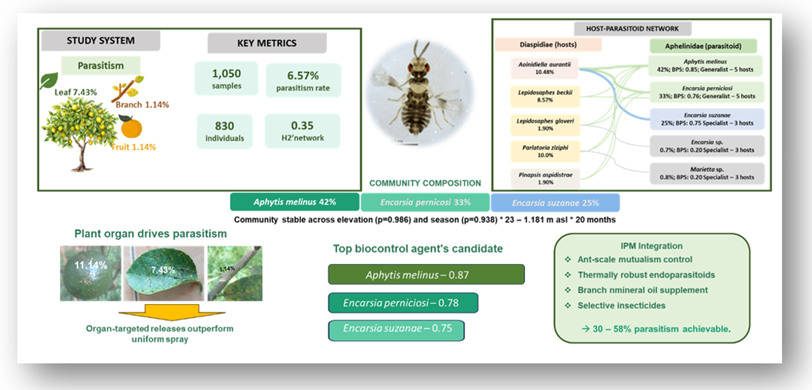
Ø Parasitoid community diversity was stable across elevation (23–1,181 m asl) and seasons, confirming year-round biological control potential;
Ø Plant organ, not elevation or seasonality, is the primary driver of host–parasitoid interaction structure, with parasitism nearly ten-fold higher on fruits than branches;
Ø Aphytis melinus (BPS 0.85), Encarsia perniciosi (BPS 0.78), and Encarsia suzanae (BPS 0.75) identified as high-priority candidates for augmentative biological control.
Keywords
INTRODUCTION
Armored scale insects (Hemiptera: Diaspididae) are among the most economically important citrus pests worldwide. As phloem-feeding insects, these pests deplete vital plant sap, directly precipitating reductions in both crop yield and quality while simultaneously compromising host defenses against secondary phytopathogenic infections (Mansour et al., 2017; Quesada et al., 2018). Among the 2,650 identified species (García Morales et al., 2016), approximately 15–20 are primary pests of commercial Citrus, including Aonidiella aurantii (California red scale), Lepidosaphes beckii (purple scale), and Parlatoria ziziphi (black parlatoria scale). Prolonged reliance on broad-spectrum insecticides has facilitated the development of resistant pest populations, induced non-target mortality, and destabilized beneficial arthropod communities (Parra et al., 2022)—consequences that underscore the critical imperative for parasitoid-based integrated pest management (IPM) as a viable alternative. Aphelinidae parasitoids are the most common natural enemies of Armored scales in citrus systems. There are more than 89 species of parasitoids from 15 hymenopteran families that have been found on citrus plants around the world. Members of the family Aphelinidae consistently exhibit both the highest taxonomic diversity and the greatest numerical dominance within the studied assemblages (Cusumano et al., 2016; Mansour et al., 2017). Aphytis melinus is the most widely deployed biological control agent against A. aurantii achieving parasitism rates exceeding 80 percent (%) in integrated California systems (van Lenteren, 2018). Encarsia perniciosi and specialist Encarsia spp. exhibit niche complementarity by targeting distinct ontogenetic stages of the host population (Correa et al., 2016). In Southeast Asia, A. melinus, A. lingnanensis, and Comperiella bifasciata have been recorded on L. beckii and P. ziziphi (Basheer et al., 2014; Kondo and Watson, 2022; Xi et al., 2025). Notwithstanding these historical records, regional parasitoid diversity region remains poorly characterized. This ongoing knowledge gap is exacerbated by the fact that molecular tools, such as deoxyribonucleic acid (DNA) barcoding, continually uncover cryptic species complexes within the genera Aphytis and Encarsia that confound conventional morphological diagnosis (Heraty et al., 2013). Three critical knowledge gaps persist in Indonesian citrus systems. First, there is no systematic inventory of Aphelinidae parasitoids associated with Diaspididae in any agroecosystem in Indonesia, as no comparable quantitative documentation has been described earlier in the regional literature (Mansour et al., 2017; Jangir et al., 2025). Second, community-level attributes, including host–parasitoid network architecture, microhabitat partitioning across distinct plant organs, and altitudinal diversity gradients—remain entirely undocumented (Ramos Aguila et al., 2023; Rappa et al., 2024). Third, a lack of empirical evaluation regarding indigenous parasitoid communities as biological control agents for Indonesian citrus, creates a critical data gap, thereby limiting the capacity of IPM programs to systematically incorporate natural enemies. The need for ecologically grounded, localized IPM is further indicated by concurrent regional constraints, such as intensive pesticide use, ant–scale mutualisms (Calabuig et al., 2014), and climate warming (Furlong and Zalucki, 2017; Cebolla et al., 2018). Although these specific variables fell outside the measurement scope of the current study, their documented impacts on parasitoid suppression and reduced Aphytis performance underscore their broader relevance (Rosen and DeBach, 2011). To effectively translate global knowledge into locally applicable IPM strategies, community-level analyses are required to explicitly link parasitoid diversity to ecosystem service delivery must be conducted. Citrus agroecosystems in East Java, which span an elevational gradient of 23 to 1,181 meters above sea level (masl), provide an ideal model system for investigating these ecological dynamics. The specific objectives of this study are to: 1) identify and document parasitoid species associated with Diaspididae along an elevational gradient; 2) characterize community diversity, abundance, and seasonal dynamics; 3) analyze the structure of host–parasitoid interactions using bipartite network analysis; and 4) assess the preliminary biological control potential of identified parasitoid species using multi-criteria decision analysis (MCDA) based on field-derived ecological attributes. This study was conducted in eight citrus-producing sites in East Java Province, Indonesia during 2023 to 2025.
MATERIALS AND METHODS
Study area and sampling
Field surveys were conducted at eight citrus-producing sites in East Java Province, Indonesia, spanning an elevational gradient of 23 to 1,181 masl (Fig. 1 and Table 1). Sites were selected based on two criteria: 1) active commercial citrus production with a minimum orchard area of 0.5 hectares (ha) and 2) Sites were selected based on a documented history of armored scale infestation, which was confirmed via preliminary visual inspections that recorded an infestation rate of 10% or greater per canopy. Sites represented Citrus reticulata, C. sinensis, C. aurantifolia, and C. nobilis. Three sites were in the low elevation category (<400 masl), three in medium (400–700 m asl), and two in high (>700 masl). To avoid confounding chemical effects, a minimum 30-day post-pesticide application window was required; orchards falling outside this threshold were excluded. Detailed orchard management histories beyond this criterion were not systematically recorded and represent a limitation of the sampling design. Sites were selected based on two criteria: 1) active commercial citrus production with a minimum orchard area of 0.5 ha; and 2) documented history of armored scale infestation, confirmed by preliminary visual inspection recording ≥10% infested shoots per canopy. Elevations were recorded by global positioning system (GPS) (Garmin eTrex 30x) and seasons classified as wet (November–March, >200 mm/month) and dry (April–October, <150 millimeters per month (mm/month). To achieve a fully balanced experimental design, monthly sampling was conducted over 20 months, yielding exactly 10 dry-season and 10 wet-season collection events per site across all sites and elevation categories.
Sample collection and rearing
At each site, 3–5 linear transects with 100–200 m was established, using a systematic parallel placement design, with a minimum inter-transect distance of 30 m, sampling 5–8 trees per transect (15–40 trees per site per visit). Infested plant material was harvested from both the canopy periphery and mid-canopy zones. At each site, sampling comprised: (1) 5 to 10 fruits measuring 4–8 centimeters (cm) in diameter; (2) 10 to 20 composite leaf samples; and (3) 3 to 5 sections of woody branches measuring 15–25 cm in length. Only samples with ≥10 armored scales were retained. Samples were placed in ventilated containers and transported to the Entomology Laboratory, Brawijaya University, within 6 hours. Rearing was conducted under controlled conditions with 25 ± 2.5 degrees Celsius (°C), 70 ± 5% relative humidity (RH), ~12L:12D) with daily monitoring for parasitoid emergence over 21 days. Sample numbers varied among plant organs to reflect differences in armored scale infestation density across the canopy. Because fruits and leaves typically harbored higher infestation densities than branches, fewer sample units were required to achieve the target threshold of ≥10 individuals per sample. This organ-specific sampling approach is consistent with standard practice in emergence-based parasitoid surveys (Correa et al., 2016; Dao et al., 2017). Samples yielding at least one adult parasitoid emergence were recorded as parasitized. At the conclusion of the rearing period, all remaining scales insects were dissected under a stereomicroscope to detect un-emerged parasitoid immatures (eggs, larvae, or pupae). Scales containing visible parasitoid immatures but yielding no adult emergence were recorded separately as parasitized-but-failed and excluded from parasitism rate calculations.
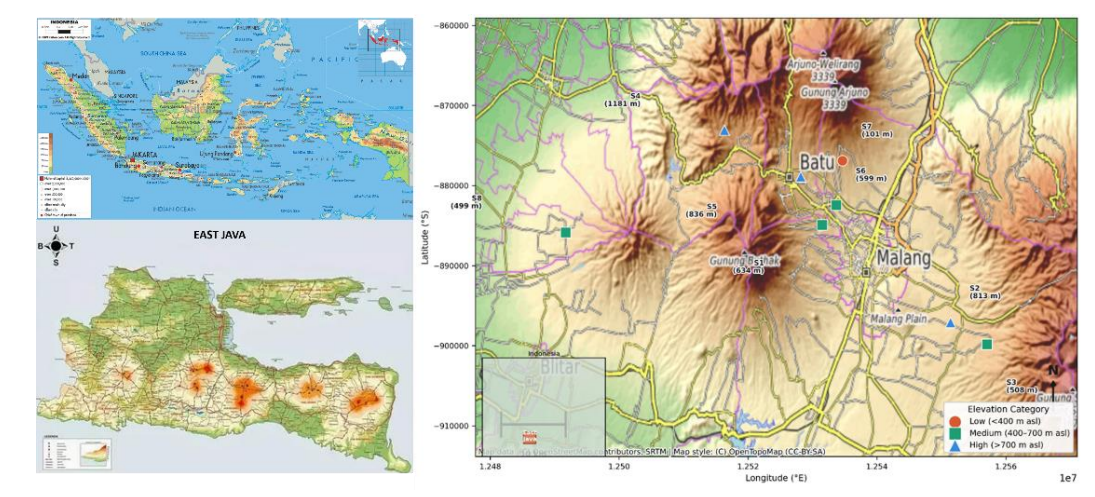
Fig. 1: Geographical location of the study area. Upper left: Map of Indonesia showing the location of East Java Province (red box). Lower left: Map of East Java Province showing the distribution of sampling sites across the province. Right: Detailed topographic map of the sampling area in Malang, Batu, and surrounding districts, East Java, Indonesia, showing the eight citrus orchard sampling sites (S1–S8) with elevation indicated in parentheses. Symbols denote elevation categories: circle = low (<400 m asl), square = medium (400–700 m asl), and triangle = high (>700 m asl). Map data: OpenStreetMap contributors, SRTM; Map style: © OpenTopoMap (CC-BY-SA)
Table 1: Ecological and climatic characteristics of the eight citrus orchard sampling sites in East Java Province, Indonesia
|
Site |
Location |
Coordinates |
Elevation (m asl) |
Elevation Category |
Citrus species |
Mean Temp. (°C) |
Mean Precip. (mm/mo) |
Dominant Season |
|
S1 |
Dau, Malang |
7°55'26"S, 112°34'20"E |
634 |
Medium |
C. reticulata |
23.3 |
93.5 |
Dry |
|
S2 |
Poncokusumo, Malang |
8°01'56"S, 112°45'04"E |
813 |
High |
C. reticulata |
23.3 |
91.8 |
Dry |
|
S3 |
Karangploso, Malang |
8°03'24"S, 112°48'08"E |
508 |
Medium |
C. reticulata |
22.5 |
216.4 |
Wet |
|
S4 |
Pujon, Malang |
7°49'07"S, 112°26'10"E |
1.181 |
High |
C. nobilis |
20.4 |
190.4 |
Wet |
|
S5 |
Pandanrejo, Batu |
7°52'13"S, 112°32'33"E |
836 |
High |
C. reticulata |
22.2 |
148.4 |
Wet |
|
S6 |
Pendem, Batu |
7°54'06"S, 112°35'32"E |
599 |
Medium |
C. sinensis |
23.5 |
36.1 |
Dry |
|
S7 |
Ngunut, Tulungagung |
7°51'09"S, 112°36'02"E |
101 |
Low |
C. aurantifolia |
21.2 |
95.6 |
Dry |
|
S8 |
Ngancar, Kediri |
7°55'56"S, 112°12'54"E |
499 |
Medium |
C. reticulata |
24.4 |
98 |
Dry |
Note: Temperature and precipitation represent means derived from recent historical data (Open-Meteo, 2025). Elevation categories: Low (<400 masl), Medium (400–700 m asl), and High (>700 m asl). Season at time of initial sampling: Dry (April–October) and Wet (November–March). Citrus species: C. reticulata Blanco (mandarin), C. nobilis Lour. (King mandarin), C. sinensis (L.) Osbeck (sweet orange), and C. aurantifolia (Christm.) Swingle (lime). Temperature and precipitation data are sourced from Open-Meteo API based on site coordinates.
Specimen identification
Emerged parasitoids were preserved in 80% ethanol at 4°C, slide-mounted in Canada balsam following clearance and graded ethanol dehydration, and examined at 100–400× (Olympus CX23) against Aphelinidae keys (Hayat, 1998; Polaszek et al., 1999). Armored scale species were identified based on the morphological characteristics of their scale covers and slide-mounted adult females, including associated second-instar female exuviae (Miller and Davidson, 2005; García Morales et al., 2016). Voucher specimens were deposited at Museum Zoologicum Bogoriense (MZB), BRIN, and are publicly accessible upon request. Molecular barcoding was not performed in the present study; all taxonomic identifications should be interpreted as morphospecies-level assignments pending genetic confirmation through future molecular validation studies.
Statistical analysis
Parasitism rate was calculated as the proportion of samples yielding confirmed adult parasitoid emergence. Generalized linear mixed models (GLMMs) with a binomial error distribution and logit link function were fitted to evaluate the data. Host species, plant organ, elevation category, and season were included as fixed effects; while sampling site and sampling occasion were treated as random effects (Brooks et al., 2017). Model selection was guided by the corrected Akaike information criterion (AICc). Effect sizes are reported as odds ratios with corresponding 95% confidence intervals (CI), and model fit was assessed using marginal and conditional R² values (Nakagawa and Schielzeth, 2013). Finally, potential overdispersion was evaluated using the residual diagnostics for hierarchical regression models (DHARMa) (Hartig, 2022). Parasitoid and host diversity were quantified using Hill numbers (q = 0, 1, 2) with Interpolation and extrapolation of species diversity (iNEXT), (Hsieh et al., 2016); sampling completeness was assessed via rarefaction curves; and differences among elevation zones and seasons were tested with Kruskal–Wallis. Host–parasitoid interactions were analyzed as bipartite networks using the framework outlined by Dormann et al. (2009) and Feala et al. (2012). To evaluate network robustness, a null model analysis based on 1,000 permutations were conducted. All five host and five parasitoid taxa were retained in the network regardless of abundance, with unobserved host–parasitoid combinations assigned a value of zero to represent unrealized interactions rather than missing data. Biological control potential was assessed using MCDA incorporating six equally weighted criteria: field abundance, host range breadth, parasitism rate, geographic distribution, collection frequency, and host specificity efficiency. Each criterion was normalized to a 0–1 scale using min-max scaling, ensuring that higher values consistently reflected superior biological control traits. These normalized values were subsequently averaged to generate an unweighted composite biocontrol potential score (BPS) for each species. Sensitivity analysis varying criterion weights from 0.10 to 0.30 across 30 combinations confirmed BPS ranking stability. Spatial autocorrelation was not formally tested; the sampling site random effect provides partial control for spatial non-independence. All analyses used R v4.3.1 (α = 0.05).
RESULTS AND DISCUSSION
Five Diaspididae host species and five Aphelinidae parasitoid species were identified from 1,050 samples collected across eight East Java sites (Table 2). While fewer than the 14–21 species found in similar Southeast Asian surveys (Dao et al., 2018; Dao et al., 2023), the five recorded Diaspididae reflect the targeted sampling approach rather than a comprehensive regional inventory. Focused faunistic surveys would undoubtedly reveal further species diversity within these agroecosystems. Aphytis melinus is consistent with its wide Indo-Pacific distribution as the dominant ectoparasitoid of A. aurantii (DeBach and Rosen, 1991; Boyero et al., 2014). Encarsia perniciosi, primarily documented from California (Correa et al., 2016), here achieves high abundance across all five host species, which extends its known range to tropical East Java. Members of the genus Marietta are predominantly documented as an obligate hyperparasitoid. If a hyperparasitic strategy was maintained in this system, its net effect on biological control would be inherently disruptive (Tena et al., 2011a; Hoddle et al., 2013; Tougeron and Tena, 2019); consequently, dissection-based or molecular confirmation of its precise trophic status remains a critical priority for future research. Several associations, including E. perniciosi parasitizing L. gloveri, P. ziziphi, and P. aspidistrae, and the occurrence of E. suzanae and Marietta sp. in East Java, represent new records requiring molecular verification. Exclusive reliance on morphological identification is associated with uncertainty; cryptic species within Aphytis and Encarsia (Heraty et al., 2013; Qin et al., 2018) may mean that the true number of interacting taxa is higher than reported. Among 1,050 collected samples, 69 (6.57%) yielded parasitoid emergence, producing a total of 830 individuals with a mean of 12.03 individuals per parasitized sample. Shannon diversity (H') varied across low (1.087), medium (1.190), and high (0.858) elevation categories, as well as between dry (0.892) and wet (0.895) seasons. However, generalized linear modeling indicated that neither elevation (p = 0.986) nor season (p = 0.938) significantly influenced community diversity (Fig. 2 and Table 3).
Table 2: Taxonomic classification of armored scale insects and their parasitoids
|
No. |
Species |
Order |
Family |
|
|
Hosts (Armored Scale Insects) |
|
|
|
H-1 |
Aonidiella aurantii Maskell (1879) |
Hemiptera |
Diaspididae |
|
H-2 |
Lepidosaphes beckii Newman (1869) |
Hemiptera |
Diaspididae |
|
H-3 |
Lepidosaphes gloveri Packard (1869) |
Hemiptera |
Diaspididae |
|
H-4 |
Parlatoria ziziphi Lucas (1853) |
Hemiptera |
Diaspididae |
|
H-5 |
Pinnaspis aspidistrae Signoret (1869) |
Hemiptera |
Diaspididae
|
|
|
Parasitoids |
|
|
|
P-1 |
Encarsia perniciosi (Tower 1913) |
Hymenoptera |
Aphelinidae |
|
P-2 |
Encarsia suzanae (Pedata and Giorgini, 2016) |
Hymenoptera |
Aphelinidae |
|
P-3 |
Encarsia sp. |
Hymenoptera |
Aphelinidae |
|
P-4 |
Aphytis melinus DeBach, 1959 |
Hymenoptera |
Aphelinidae |
|
P-5 |
Marietta sp. |
Hymenoptera |
Aphelinidae |
Rarefaction curves approached asymptote for both communities, indicating adequate sampling effort. The recorded parasitoid emergence rate of 6.57% aligns with the lower range established for unmanaged citrus agroecosystems (5–15%) (DeBach and Rosen, 1991). Several factors are likely associated with this modest rate: conventional management practices including periodic broad-spectrum insecticide applications; ant–scale mutualisms not controlled or measured at sampling sites (Calabuig et al., 2014); and sampling bias toward heavily infested material. Consequently, the 6.57% emergence rate characterizes a community subjected to environmental or management-driven suppression. This suggests that substantial increases in parasitism are biologically feasible through the implementation of optimized habitat or pest management practices. The stability across elevation and seasons is consistent with broad thermal tolerance of dominant A. melinus and E. perniciosi (Mohammed et al., 2020), though direct physiological measurements were not conducted. Three species were dominant: A. melinus (334 individuals, 40.2%), E. perniciosi (280 individuals, 33.7%), and E. suzanae (203 individuals, 24.5%), collectively accounting for 98.4% of total emergence. Marietta sp. (7, 0.8%) and Encarsia sp. (6, 0.7%) were documented with very low abundance, both in only two locations. The co-dominance of A. melinus and E. perniciosi aligns with the host-stage differentiation documented in similar systems, although this mechanism was not explicitly evaluated in the present study. The substantially higher abundance of E. perniciosi in East Java (33.7%) compared to Mediterranean systems (2.4%) (Boyero et al., 2014) aligns with the hypothesis of relaxed competitive displacement under tropical thermal conditions (Cebolla et al., 2018), though this geographical variation awaits experimental verification. The specialist-advantage hypothesis suggests that certain species have superior host-location efficiency (Rossinelli and Bacher, 2015). The restriction distribution of these two rare taxa implies a sensitivity to localized microhabitat characteristics. Their presence within a community dominated by generalist competitors is consistent with the insurance hypothesis, highlighting their potential role in buffering ecosystem services under fluctuating environmental and ecological concidtions, thereby enhancing long-term community stability and resilience. For Marietta sp., low abundance may be associated with hyperparasitoid dependence on primary parasitoid density across varying ecological and seasonal conditions (Tougeron and Tena, 2020); given its 0.8% contribution, its effect on parasitism estimates is considered negligible. Bipartite network analysis yielded moderate specialization (H2' = 0.35). No model analysis indicated that the observed value deviated significantly from random expectation (mean null H2' = 0.21 ± 0.04; p < 0.05), with 14 of 25 links realized (56%) (Table 4, and Fig. 3 and Fig. 4).
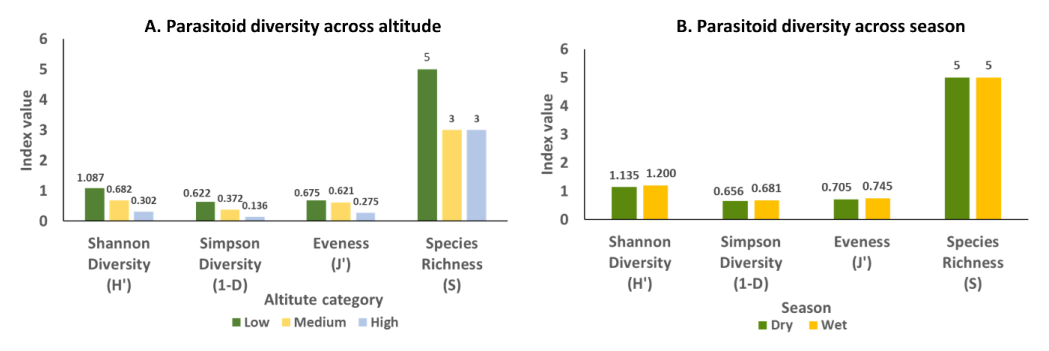
Fig. 2: Parasitoid diversity metrics across (A) elevation categories and (B) seasons. Metrics shown: Shannon index (H'), Simpson index (1-D), Pielou's evenness (J'), and species richness (S)
Table 3: Species diversity metrics for armored scale insects (Diaspididae) and parasitoid wasps (Aphelinidae) recorded across eight East Java citrus agroecosystem sites
|
Diversity Metric |
Hosts (Diaspididae) |
Parasitoids (Aphelinidae) |
|
Species richness (S) |
5 |
5 |
|
Shannon diversity index (H') |
1.283 (95% CI: 0.811–1.319) |
1.149 (95% CI: 0.788–1.200) |
|
Simpson diversity index (1−D) |
0.699 (95% CI: 0.455–0.718) |
0.661 (95% CI: 0.469–0.677) |
|
Pielou's evenness (J') |
0.797 (95% CI: 0.529–0.942) |
0.714 (95% CI: 0.550–0.927) |
|
Berger-Parker Dominance (D) |
0.398 (95% CI: 0.336–0.698) |
0.406 (95% CI: 0.348–0.692) |
Note: Bootstrap confidence intervals were computed by resampling sites (n = 8) with replacement over 999 iterations. Species richness (S) confidence intervals are not reported as S represents a fixed count based on all specimens identified across sites.
The observed network specialization value (H2' = 0.35) aligns with typical values reported for simplified agroecosystem networks (Derocles et al., 2020). However, given the small network dimensions (5 × 5 taxa) and the high probability of cryptic diversity within the Encarsia genus, this value should be interpreted as a preliminary characterization rather than definitive evidence of a stable ecological organization (Qin et al., 2018). The 44% unrealized links may be associated with host specificity constraints, spatial organ segregation, and insufficient sampling to detect rare interactions. Parasitism differed significantly among host species: A. aurantii (10.48%) and P. ziziphi (10.00%) received the highest parasitism, L. beckii intermediate (8.57%), and L. gloveri and P. aspidistrae the lowest (1.90% each). Plant organ was a strong and significant determinant (Kruskal-Wallis H = 29.04, p < 0.001): fruits (11.14%) > leaves (7.43%) > branches (1.14%; Fig. 5). Four host species showed peak parasitism on fruits (4.3–17.1%); P. ziziphi peaked on leaves (18.6%). This nearly ten-fold fruit-to-branch gradient may be attributable to microclimate differences, differential host accessibility (Hoffmann and Frodsham, 1993), organ-specific metabolite profiles (Tena and García-Marí, 2011b), and HIPV-mediated attraction (Abdala-Roberts et al., 2019), though none were directly measured. Scale populations on branches experienced a markedly lower parasitism rate (1.14%), indicating reduced parasitoid regulation in branch tissues; complementary management interventions, such as pruning or selective biorational applications, are highly recommended to suppress branch-associated refugia, regardless of parasitoid, to improve overall biological control efficiency. release strategy deployed. Multi-
criteria assessment yielded A. melinus (BPS = 0.85), E. perniciosi (BPS = 0.78), and E. suzanae (BPS = 0.75) as high-priority candidates (Fig. 6), with rankings robust across all 30 weight combinations (BPS ranges: 0.750–0.893, 0.738–0.891, and 0.411–0.571, respectively).
Table 4: Host (armored scale insects) and the parasitoid specialization in citrus plants
|
Species |
d' Value |
Classification |
|
Host |
||
|
Aonidiella aurantii |
0.4945 |
Moderate |
|
Lepidosaphes beckii |
0.2621 |
Generalist |
|
Lepidosaphes gloveri |
0.4109 |
Moderate |
|
Parlatoria ziziphi |
0.2464 |
Generalist |
|
Pinnaspis aspidistrae |
0.4927 |
Moderate |
|
Parasitoid |
||
|
Aphytis melinus |
0.2275 |
Generalist (5 hosts) |
|
Encarsia perniciosi |
0.2424 |
Generalist (5 hosts) |
|
Encarsia suzanae |
0.6756 |
Specialist (1 hosts) |
|
Encarsia sp. |
0.5439 |
Specialist (1 hosts) |
|
Marietta sp. |
0.5317 |
Specialist (1 hosts) |
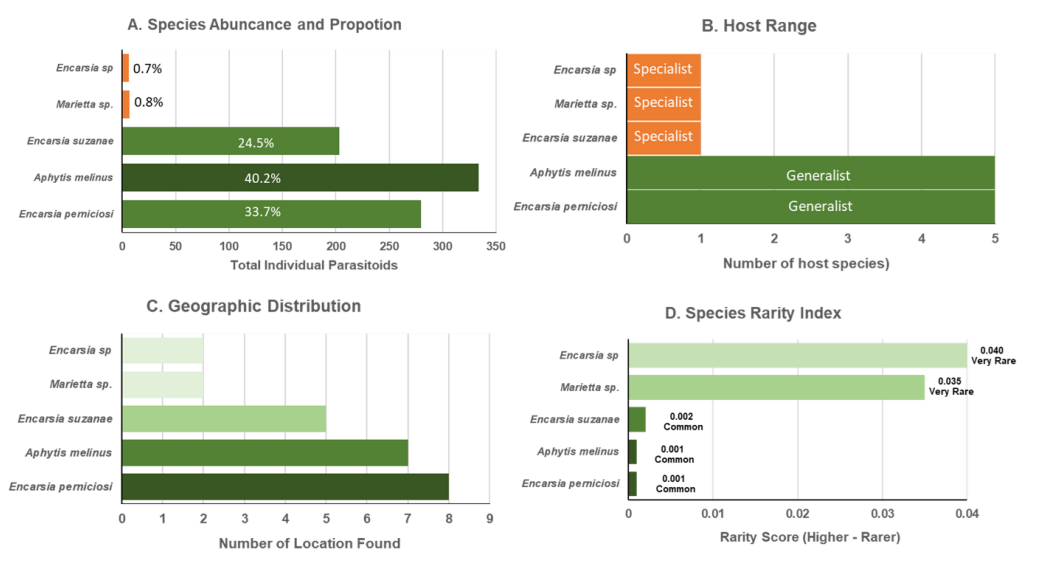
Fig. 3: Ecological characteristics of the five parasitoid species. (A) Total abundance and species composition; (B) Host range breadth; (C) Geographic distribution across sampling locations; (D) Species rarity index
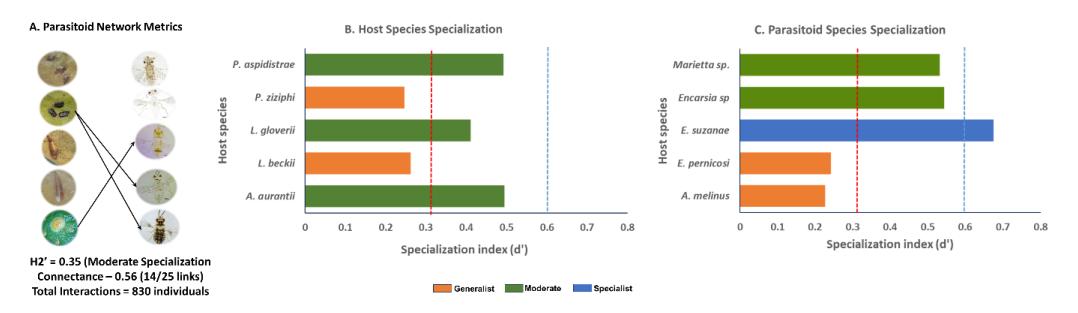
Fig. 4: Host–parasitoid interaction network and species-level specialization. (A) Bipartite network diagram; line thickness represents interaction strength. (B) Species-level specialization indices (d') for hosts and parasitoids; colors denote generalists (d' < 0.3), moderate specialists (0.3 ≤ d' < 0.6), and specialists (d' ≥ 0.6)
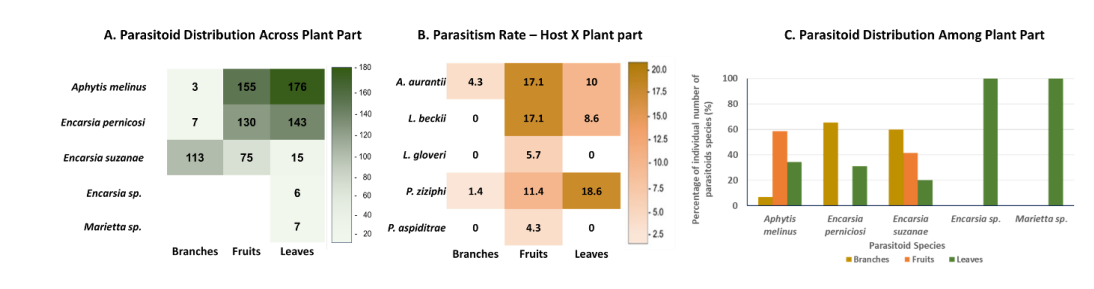
Fig. 5: Spatial distribution of parasitoid-host interactions across plant parts. (A) Parasitoid abundance by plant part; (B) Host parasitism rates showing parasitoids preferring patterns; (C) Parasitoid microhabitat partitioning on plant parts
Both Encarsia sp. and Marietta sp. scored below 0.20 on the composite index. Notably, in the case of Marietta sp., its presumed obligate hyperparasitoid status would fundamentally preclude its utility as a biological control agent, irrespective of its numerical score. A. melinus exhibited the broadest host range, highest abundance, and widest geographic distribution. E. perniciosi may be associated with an extended parasitism window through younger-instar preference. E. suzanae warrants targeted deployment against A. aurantii given its specialist efficiency. Effective implementation requires organ-specific targeting: fruit-focused releases are recommended for A. aurantii, L. beckii, and L. gloveri; leaf-targeted releases for P. ziziphi; and horticultural mineral oil or selective insecticides for branch populations. Drawing from comparable citrus systems, achieving meaningful biological control in this region will require a multi-faceted management framework. First, selective pesticide protocols must be implemented to preserve extant natural enemies, alongside targeted interventions to disrupt ant–scale mutualisms (Calabuig et al., 2014). Second, given the pressures of global warming, incorporating endoparasitoids with broader thermal tolerances could provide a vital, climate-resilient complement to Aphytis populations (Furlong and Zalucki, 2017; Shah et al., 2025). Ultimately, the efficacy of these combined strategies awaits definitive field validation under East Java conditions. Three findings merit particular attention. First, documentation of five Aphelinidae species in East Java citrus addresses a gap in the regional literature, an observation consistent with an extension of known distributions to a previously undocumented agroecosystem. Second, bipartite network analysis indicated moderate specialization (H2' = 0.35) with generalist resilience and specialist efficiency, a configuration consistent with community resilience against host population fluctuations, though constrained by small network size (5 × 5 taxa). Third, plant organs emerged as the primary spatial determinant of parasitism. The ten-fold fruit-to-branch gradient observed here represents one of the most pronounced microhabitat effects documented to date in Diaspididae-parasitoid systems. Future priorities include implementing molecular barcoding across all parasitoid taxa, conducting manipulative microhabitat experiments, and executing field trials for organ-targeted augmentative release programs under diverse agroecological and climatic conditions.
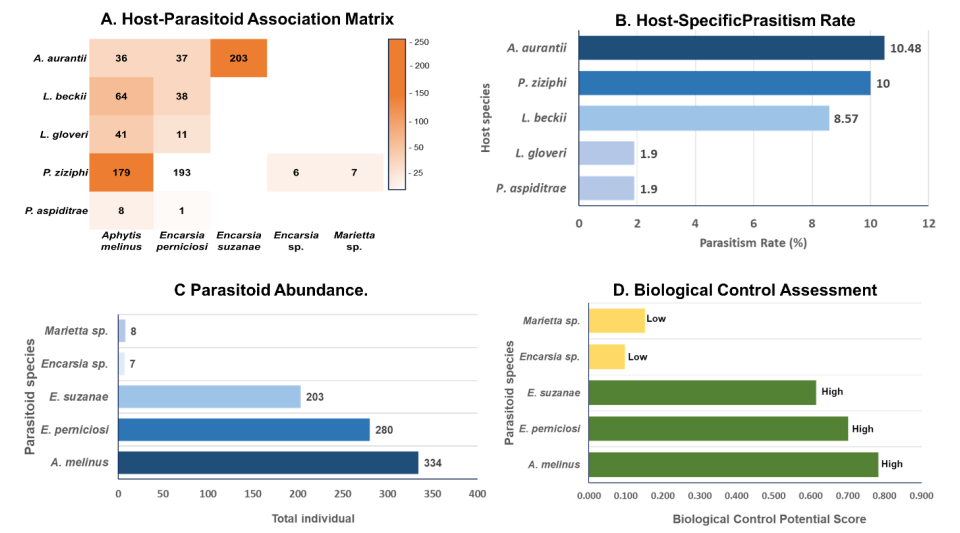
Fig. 6: Host-parasitoid associations and biological control assessment. (A) Association matrix showing parasitoid abundance per host-parasitoid pair; (B) Host-specific parasitism rates; (C) Total parasitoid abundance; (D) Biological control potential scores integrating multiple efficacy metrics
CONCLUSION
The present study provides the first systematic documentation of Aphelinidae parasitoid communities associated with Diaspididae in Indonesian citrus agroecosystems, filling a critical gap in tropical biological control knowledge and practice, where no comparable quantitative inventory existed in the regional literature. The five parasitoid species exhibited a functionally complementary community structure, with dominant generalists (A. melinus and E. perniciosi) consistent with community resilience and specialist E. suzanae associated with targeted suppression of A. aurantii. Community composition was stable across elevation zones and seasons, suggesting persistent parasitoid activity throughout the study period. This stability implies that conservation biological control strategies may be uniformly applied without season-specific management adjustments, although this approach awaits confirmation through higher-frequency temporal sampling. Plant organ emerged as the primary spatial determinant of host–parasitoid interaction structure, with parasitism differing nearly tenfold between fruits and branches — among the strongest microhabitat effects documented in any Diaspididae system. This organ-level gradient is likely driven by multiple interacting mechanisms, including microclimate variations, differential host accessibility, and organ-specific volatile profiles. Although these individual factors were not directly quantified in the present study, they provide compelling hypotheses for future mechanistic investigation. Effective biological control in structurally complex citrus canopies is therefore dependent on organ-specific rather than uniform canopy-wide release strategies. Branch-dwelling populations, experience substantially lower parasitism rates (below 5%), thereby evading effective natural regulation by parasitoids. Consequently, supplementary management interventions—utilizing either horticultural mineral oil or selective systemic insecticides—are required, irrespective of the specific parasitoid release strategy implemented. A. melinus (BPS = 0.85), E. perniciosi (BPS = 0.78), and E. suzanae (BPS = 0.75) were ranked as high-priority augmentative biological control candidates, with rankings robust through sensitivity analysis across 30 weight combinations. These three species exhibited high field abundance, extensive host utilization, and broad geographic distribution — attributes that align with the criteria for effective augmentative biological control agents. The classification of Marietta sp. as a putative hyperparasitoid necessitates strict caution; if validated, its overall impact on biological control efficacy would be detrimental. Consequently, this taxon should be excluded from management recommendations until its trophic position is verified via dissection. The 6.57 percent parasitism rate represents a natural unmanaged baseline; although relatively modest modest, improvement is biologically plausible under optimized conditions, including selective pesticide protocols and ant–scale mutualism management. Several host–parasitoid associations documented in this study, including E. perniciosi parasitizing L. gloveri, P. ziziphi, and P. aspidistrae, and the occurrence of E. suzanae and Marietta sp. in East Java, represent putative new records for Indonesia, the significance of which is contingent on molecular verification. Exclusive reliance on morphological identification is acknowledged as a limitation; all identifications constitute a recognized limitation of this study; consequently, all taxonomic designations are best considered morphospecies-level assignments pending molecular barcoding to definitive verify species boundaries. The documented occurrence of cryptic species within Aphytis and Encarsia suggests that the true diversity of interacting taxa may be higher than reported, an observation with potential implications for network specialization estimates and biological control potential assessments. Collectively, these findings establish a preliminary ecological framework for the integration of indigenous parasitoid communities into spatially targeted integrated pest management programs in East Java citrus agroecosystems. Future research initiatives should prioritize the molecular barcoding of all five parasitoid taxa, alongside manipulative microhabitat experiments to elucidate the mechanisms driving organ-level parasitism gradients. Furthermore, characterizing the thermal performance profiles of E. perniciosi and E. suzanae under East Java conditions, paired with field trials of organ-targeted augmentative release programs is essential to quantify empirical biological control efficacy. Pending independent field validation, these findings establish a scientifically rigorous baseline for the development of low-input IPM strategies within complex tropical citrus agroecosystems. Furthermore, this predictive model possesses broader utility, with potential scalability to ecologically analogous tropical citrus systems characterized by comparable host–parasitoid assemblages.
AUTHOR CONTRIBUTIONS
D.A. Sunarto developed the study concept, designed the experiment, conducted the fieldwork, interpreted the findings, and prepared the initial draft of the manuscript. Nurindah contributed to the conceptualization and design of the study, performed data analysis and interpretation, revised the manuscript, and served as the corresponding author. B.T. Raharjo supervised the work and contributed to writing and editing the manuscript. H. Tarno assisted in the interpretation of data analysis, manuscript revision, and supervision. A. Afandhi contributed to writing and editing the manuscript. All authors reviewed and approved the final version of the manuscript prior to submission.
ACKNOWLEDGEMENT
This work was supported by the Indonesia Endowment Fund for Education Agency (Ministry of Finance of the Republic of Indonesia) and the National Research and Innovation Agency of Indonesia under contract numbers [B-846/II.7.5/FR.06/5/2023] and [B-861/111.11/FR.06/5/2023]. Authors also extend our sincere appreciation to Dr. Rosichon Ubaidilah (Research Center for Biosystematics and Evolution, National Research and Innovation Agency) for his expert support in the morphological identification of parasitoid specimens associated with armored scale insects. Furthermore, Authors thank the Research Organization of Agriculture and Food and the Research Center for Estate Crops, National Research and Innovation Agency (BRIN), for their support in facilitating this research.
CONFLICT OF INTEREST
The authors declare that there is no conflict of interests regarding the publication of this manuscript. In addition, the ethical issues, including plagiarism, informed consent, misconduct, data fabrication and/or falsification, double publication and/or submission, and redundancy have been completely observed by the authors. Ethical clearance for field collection was obtained through the institutional review process under the RIIM Competitive Research Scheme Batch 3 (LPDP). Field sampling was conducted with permission from orchard owners at all sites.
OPEN ACCESS
©2026 The author(s). This article is licensed under a Creative Commons Attribution 4.0 International License, which permits use, sharing, adaptation, distribution and reproduction in any medium or format, as long as you give appropriate credit to the original author(s) and the source, provide a link to the Creative Commons license, and indicate if changes were made. The images or other third-party material in this article are included in the article’s Creative Commons license, unless indicated otherwise in a credit line to the material. If material is not included in the article’s Creative Commons license and your intended use is not permitted by statutory regulation or exceeds the permitted use, you will need to obtain permission directly from the copyright holder. To view a copy of this license, visit: http://creativecommons.org/licenses/by/4.0/
PUBLISHER’S NOTE
GJESM Publisher remains neutral with regard to jurisdictional claims in published maps and institutional afflictions.
R Positive AI Statement
During the preparation of this work the author(s) have used Artificial Intelligence (AI) Claude AI (Anthropic) in order to assist with language expression, including sentence restructuring, grammatical refinement, and terminology consistency. After using this tool/service, the authors reviewed and edited the content as needed and take full responsibility for the content of the publication.
ABBREVIATIONS
|
% |
Percent |
|
oC |
Degree Celsius |
|
AICc |
Akaike information criterion corrected (for small sample sizes) |
|
asl |
above sea level |
|
BPS |
Biocontrol potential score(s) |
|
BRIN |
Badan Riset dan Inovasi Nasional (National Research and Innovation Agency of Indonesia) |
|
CI |
Confidence interval |
|
d' |
species-level specialization index (bipartite network) |
|
DHARMa |
Residual diagnostics for hierarchical models |
|
DNA |
Deoxyribonucleic acid |
|
GLMMs |
Generalized linear mixed models |
|
GPS |
Global positioning system |
|
H' |
Shannon Diversity Index |
|
H2' |
network-level specialization index (bipartite networks) |
|
HIPVs |
Herbivore-induced plant volatiles |
|
iNEXT |
Interpolation and EXTrapolation |
|
IPB |
Institut Pertanian Bogor (Bogor Agricultural University) |
|
IPM |
Integrated pest management |
|
J' |
Pielou's Evenness Index |
|
KOH |
Potassium hydroxide |
|
MCDA |
Multi-criteria decision analysis |
|
mm |
millimeters |
|
MZB |
Museum Zoologicum Bogoriense |
|
RH |
Relative humidity |
REFERENCES
Abdala-Roberts, L.; Puentes, A.; Finke, D.L.; Marquis, R.J.; Montserrat, M.; Poelman, E.H.; Rasmann, S.; Sentis, A.; van Dam, N.M.; Wimp, G.; Mooney, K.; Björkman, C., (2019). Tri-trophic interactions: bridging species, communities and ecosystems. Ecol. Lett., 22(12): 2151-2167 (17 pages).
Basheer, A.; Asslan, L.; Rachhed, A.; Abd Alrazaq, F.; Saleh, A.; Alshadidi, B.; Assad, R., (2014). Primary and secondary Hymenopteran parasitoids of scale insects (Homoptera: Coccoidea) in fruit orchards in Syria. EPPO Bull., 44(1): 47-56 (10 pages).
Boyero, J.; Vela, J.; Wong, M.; Ripoll, C.; Pérez, M.; Urbaneja, A.; Vanaclocha, P., (2014). Displacement of Aphytis chrysomphali by Aphytis melinus, parasitoids of the California red scale, in the Iberian Peninsula. Span. J. Agric. Res., 12(1): 244-251 (8 pages).
Brooks, M.E., Kristensen, K., Van Benthem, K.J., Magnusson, A., Berg, C.W., Nielsen, A., Skaug, H.J., Mächler, M. and Bolker, B.M., (2017). glmmTMB balances speed and flexibility among packages for zero-inflated count data. R.J., 9(2), pp. 378–400. (23 Pages).
Calabuig, A.; Garcia-Marí, F.; Pekas, A., (2014). Ants affect the infestation levels but not the parasitism of honeydew and non-honeydew producing pests in citrus. Bull. Entomol. Res., 104(4): 405-417 (13 pages).
Cebolla, R.; Urbaneja, A.; van Baaren, J.; Tena, A., (2018). Negative effect of global warming on biological control is mitigated by direct competition between sympatric parasitoids. Biol. Control. 122: 60-66 (7 pages).
Correa, M.C.G.; Palero, F.; Dubreuil, N.; Etienne, L.; Hulak, M.; Tison, G.; Warot, S.; Crochard, D.; Ris, N.; Kreiter, P., (2016). Molecular characterization of parasitoids from armored scales infesting citrus orchards in Corsica, France. BioControl. 61(6): 639-647 (9 pages).
Cusumano, A.; Peri, E.; Colazza, S., (2016). Interspecific competition/facilitation among insect parasitoids. Curr. Opin. Insect Sci., 14: 12-16 (5 pages).
Dao, H.T.; Beattie, G.A.C.; Watson, G.W.; Pham, V.L.; Nguyen, V.L.; Le, D.K.; Nguyen, T.H.; Nguyen, D.V.; Holford, P., (2018). Citrus diaspidids in Viet Nam: new, and confirmation of previous, records based on morphological and molecular verification of taxa. J. Asia-Pac. Entomol., 21(1): 81-96 (16 pages).
DeBach, P.; Rosen, D., (1991). Biological control by natural enemies. Cambridge University Press, Cambridge. (440 pages).
Derocles, S.A.P.; Navasse, Y.; Buchard, C.; Plantegenest, M.; Le Ralec, A., (2020). 'Generalist' aphid parasitoids behave as specialists at the agroecosystem scale. Insects. 11(1): 6 (14 pages).
Dormann, C.F.; Fründ, J.; Blüthgen, N.; Gruber, B., (2009). Indices, graphs and null models: analyzing bipartite ecological networks. Open Ecol. J., 2: 7-24 (18 pages).
Feala J.D.; Cortes J.; Duxbury P.M.; McCulloch A.D.; Piermarocchi C.; Paternostro G. (2012). Statistical Properties and Robustness of Biological Controller-Target Networks. PLoS ONE. 7(1): e29374 (11 pages).
Furlong, M.J.; Zalucki, M.P., (2017). Climate change and biological control: the consequences of increasing temperatures on host-parasitoid interactions. Curr. Opin. Insect Sci., 20: 39-44 (6 pages).
García Morales, M.; Denno, B.D.; Miller, D.R.; Miller, G.L.; Ben-Dov, Y.; Hardy, N.B., (2016). ScaleNet: a literature-based model of scale insect biology and systematics. Database. 2016: bav118 (5 pages).
Hartig, F., (2022). DHARMa: Residual diagnostics for hierarchical (multi-level/mixed) regression models. R package version 0.4.6.url: https://cran.r-project.org/package=DHARMa.
Hayat, M., (1998). Aphelinidae of India (Hymenoptera: Chalcidoidea): a taxonomic revision. Associated Publishers, New Delhi. (416 pages).
Hoddle, C.D.; Hoddle, M.S.; Triapitsyn, S.V., (2013). Marietta leopardina (Hymenoptera: Aphelinidae) and Aprostocetus (Aprostocetus) sp. (Hymenoptera: Eulophidae) are obligate hyperparasitoids of Tamarixia radiata (Eulophidae) and Diaphorencyrtus aligarhensis (Hymenoptera: Encyrtidae). Fla. Entomol., 96(2): 643-646 (4 pages).
Hoffmann, M.P.; Frodsham, A., (1993). Natural enemies of vegetable insect pests. Cornell University, Ithaca, NY. (63 pages).
Hsieh, T.C.; Ma, K.H.; Chao, A., (2016). iNEXT: an R package for rarefaction and extrapolation of species diversity (Hill numbers). Methods Ecol. Evol., 7(12): 1451-1456 (6 pages).
Jangir, L.; Mahur, M.; Rathore, A., (2025). Insect pest fauna of soybean: a review of major insect pest identification, diversity, meteorological factor, and biocontrol agents. Int. J. Entomol. Res., 10(2): 168-172 (5 pages).
Kondo, T.; Watson, G.W., (2022). Collection, preservation, slide-mounting, labelling and vouchering of scale insects. In: Watson, G.W.; Kondo, T. (Eds.), Encyclopedia of scale insect pests. CABI, Wallingford. 548-558 (11 pages).
Mansour, R.; Grissa-Lebdi, K.; Suma, P.; Mazzeo, G.; Russo, A., (2017). Key scale insects (Hemiptera: Coccoidea) of high economic importance in a Mediterranean area: host plants, bio-ecological characteristics, natural enemies and pest management strategies — a review. Plant Prot. Sci., 53(1): 1-14 (14 pages).
Miller, D.R.; Davidson, J.A., (2005). Armored scale insect pests of trees and shrubs (Hemiptera: Diaspididae). Cornell University Press, Ithaca, NY. (442 pages).
Mohammed, K.; Karaca, İ.; Agarwal, M.; Newman, J.; Ren, Y., (2020). Age-specific life tables of Aonidiella aurantii (Maskell) (Hemiptera: Diaspididae) and its parasitoid Aphytis melinus DeBach (Hymenoptera: Aphelinidae). Turk. J. Agric. For., 44(2): 180-188 (9 pages).
Nakagawa, S.; Schielzeth, H., (2013). A general and simple method for obtaining R² from generalized linear mixed-effects models. Methods Ecol. Evol., 4(2): 133-142 (10 pages).
Parra, J.R.P.; Garcia, A.G.; Diniz, A.J.F.; Bento, J.M.S., (2022). Sustainability in Brazilian citriculture: three decades of successful biological control of insect pests. Front. Agron., 4: 874188 (12 pages).
Polaszek, A.; Abd-Rabou, S.M.; Huang, J., (1999). The Egyptian species of Encarsia (Hymenoptera: Aphelinidae): a preliminary review. Zool. Med. Leiden. 73(1-15): 131-163 (33 pages).
Qin, J.; Yek, S.H.; Wang, Y.; Holford, P.; Beattie, G.A.C.; Wang, Z., (2018). Host specificity of parasitoids (Encyrtidae) toward armored scale insects (Diaspididae): untangling the effect of cryptic species on quantitative food webs. Ecol. Evol., 8(18): 9479-9494 (16 pages).
Quesada, C.R.; Witte, A.; Sadof, C.S., (2018). Factors influencing insecticide efficacy against armored and soft scales. HortTechnology. 28(3): 267-275 (9 pages).
Ramos Aguila, L.C.; Li, X.; Akutse, K.S.; Bamisile, B.S.; Sánchez Moreano, J.P.; Lie, Z.; Liu, J., (2023). Host-parasitoid phenology, distribution, and biological control under climate change. Life. 13(12): 2290 (19 pages).
Rappa, N.J.; Staab, M.; Ruppert, L.S.; Frey, J.; Mello, M.A.R.; Klein, A.M., (2024). Forest structure and heterogeneity increase diversity and alter composition of host-parasitoid networks. Ecol. Entomol., 49(2): 257-271 (15 pages).
Rosen, D.; DeBach, P., (2011). Species of Aphytis of the world (Hymenoptera: Aphelinidae). Series Entomologica, Springer, Dordrecht. (801 pages).
Rossinelli, S.; Bacher, S., (2015). Higher establishment success in specialized parasitoids: support for the existence of trade-offs in the evolution of specialization. Funct. Ecol., 29(8): 1104-1110 (7 pages).
Shah, A.A.; Hamant, E.; Rubalcaba, J.G.; Larkin, B.; Forbes, A.A.; Woods, H.A., (2025). Contrasting effects of climate warming on hosts and parasitoids: insights from Rocky Mountain aspen leaf miners and their parasitoids. Proc. R. Soc. B, 292(2043): 20242679 (10 pages).
Tena, A.; Kapranas, A.; García-Marí, F.; Luck, R.F., (2011a). Influence of host size on parasitism by Aphytis chrysomphali and A. melinus (Hymenoptera: Aphelinidae) in Mediterranean populations of California red scale Aonidiella aurantii (Hemiptera: Diaspididae). Biol. Control. 59(1): 72-79 (8 pages).
Tougeron, K.; Brodeur, J.; Le Lann, C.; van Baaren, J., (2020). How climate change affects the seasonal ecology of insect parasitoids. Ecol. Entomol., 45(2): 167-181 (15 pages).
van Lenteren, J.C.; Bolckmans, K.; Köhl, J.; Ravensberg, W.J.; Urbaneja, A., (2018). Biological control using invertebrates and microorganisms: plenty of new opportunities. BioControl, 63(1): 39-59 (21 pages).
Xi, J.; Ge, J.; Huang, J.; Polaszek, A.; Wang, Z., (2025). The parasitoids of Parlatoria ziziphi (Lucas) (Hemiptera: Diaspididae): with descriptions of two new species of Aphytis (Hymenoptera: Aphelinidae) from China. Insects. 16(10): 1070 (18 pages).
OPEN ACCESS
©2026 The author(s). This article is licensed under a Creative Commons Attribution 4.0 International License, which permits use, sharing, adaptation, distribution and reproduction in any medium or format, as long as you give appropriate credit to the original author(s) and the source, provide a link to the Creative Commons license, and indicate if changes were made. The images or other third party material in this article are included in the article’s Creative Commons license, unless indicated otherwise in a credit line to the material. If material is not included in the article’s Creative Commons license and your intended use is not permitted by statutory regulation or exceeds the permitted use, you will need to obtain permission directly from the copyright holder. To view a copy of this license, visit: http://creativecommons.org/licenses/by/4.0/
PUBLISHER NOTE
GJESM Publisher remains neutral concerning jurisdictional claims in published maps and institutional affiliations.
MAJOR DATABASES, CITATION METRICS & CAPTURES
Google Scholar | Scopus - SJR | Web of Science | Biological Abstracts: Clarivate | Biosis Preview: Clarivate | PlumX Metrics | Altmetrics | Mendeley |
CURRENT PUBLISHER

| Article View | 1,033 |
| PDF Download | 469 |

Letters to Editor
[1] Letters that include statements of statistics, facts, research, or theories should include appropriate references, although more than three are discouraged.
[2] Letters that are personal attacks on an author rather than thoughtful criticism of the author’s ideas will not be considered for publication.
[3] Letters can be no more than 300 words in length.
[4] Letter writers should include a statement at the beginning of the letter stating that it is being submitted either for publication or not.
[5] Anonymous letters will not be considered.
[6] Letter writers must include their city and state of residence or work.
[7] Letters will be edited for clarity and length.