
5.2
CiteScore
2.9
Impact Factor
Document Type : CASE STUDY
Authors
1 College of Arts and Sciences, Nueva Vizcaya State University, Philippines
2 College of Teacher Education, Nueva Vizcaya State University, Philippines
Graphical Abstract
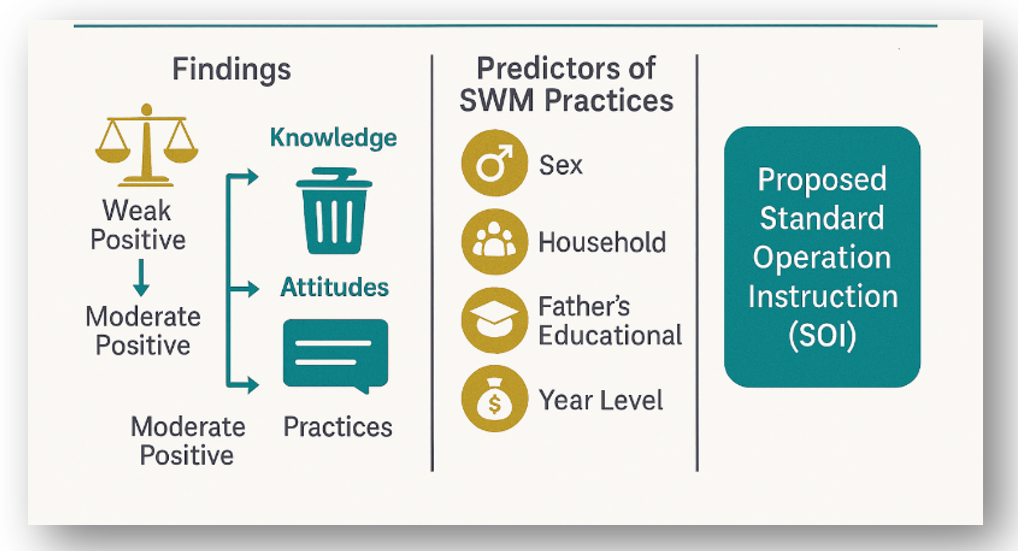
Highlights
⮚ Knowledge showed weak correlation with pro-environmental practices and a negative association with attitudes, indicating that awareness alone did not lead to proper waste management behavior;
⮚ Values-based and experiential educational strategies are critical for translating knowledge into action, improving students’ efficacy, commitment, and sustained participation in waste management;
⮚ Sociodemographic and family background factors significantly influenced waste management practices, demonstrating that behaviors extend beyond campus-level institutional factors.
Keywords
INTRODUCTION
Solid waste management (SWM) is a fundamental component of environmental science and environmental management, directly influencing ecosystem integrity, public health, and sustainable urban development. Over the past few decades, SWM has emerged as a significantly more complicated challenge in both developing and developed contexts (Derdera and Ogato, 2023; Muheirwe et al., 2021; Isak, 2022). The swift rate of urban development, coupled with rising population numbers and shifting consumption trends, has markedly heightened waste production rates, often outstripping the capacity of local management systems (Khan et al., 2021; Emara, 2022; Sondh et al., 2023). These pressures are compounded by weak institutional enforcement, inadequate waste infrastructure, limited access to sanitary landfills, and persistent reliance on environmentally unsound disposal practices such as open dumping and uncontrolled landfilling (Coracero et al., 2021). Globally, solid waste generation is projected to reach approximately 3.40 billion tones by 2050, posing serious risks to environmental quality and resource sustainability if current management trajectories remain unchanged (Cook, 2026). Tackling this issue necessitates comprehensive management strategies that merge regulatory enforcement, infrastructure enhancement, and behavior-focused interventions, grounded in environmental psychology and social norms theory (Ajzen, 1991). In the Philippines, SWM is a broad environmental governance challenge. As of 2018, the country generated approximately 16.6 million tons of solid waste annually, ranking among the highest waste generators in Southeast Asia. Forecasts imply that this figure may rise to 20.51 million metric tons by 2030, if prevailing trends remain unchanged (Romero, 2020). To strengthen the national SWM framework, Republic Act (RA) No. 9003, otherwise known as the ecological solid waste management act of 2000, was enacted. This establishes a detailed policy framework for waste reduction, segregating materials, recycling, and environmentally responsible disposal, highlighting the importance of decentralized execution at the community level. Two decades after its enactment, effective implementation remains uneven. The continued operation of open and controlled dumpsites reflects persistent weaknesses in enforcement mechanisms, monitoring capacity, and institutional accountability. Higher Education Institutions (HEIs), being viewed as “living laboratories” play a key role in environmental management by promoting knowledge, policy innovation, and behavioral change and by implementing effective SWM practices while shaping environmentally responsible behaviors among students. Through RA No. 9512, environmental education is integrated across all levels of instruction. Consequently, HEIs function as significant platforms for integrating environmental knowledge with real-world sustainability initiatives. At Nueva Vizcaya State University (NVSU), SWM policies are aligned with RA 9003. This includes waste segregation, provision of labeled bins, and coordination with the barangays for waste disposal. While these policies are implemented, their effectiveness in shaping the Knowledge, Attitude and Practices (KAP) of students have not been assessed, which this study seeks to address. The university administration continuously implements SWM initiatives such as cleanliness drive, poster and slogan competitions, and provision of facilities. It is assumed that these mechanisms contribute to the development of students' knowledge and attitudes. Despite these educational interventions, evidence suggests that environmental awareness alone is insufficient to ensure consistent adoption of sustainable SWM practices. Limited engagement from stakeholders, poor communication tactics, and insufficient behavioral reinforcement are key obstacles to the successful implementation of SWM systems (Nolasco et al., 2019; Salinas, 2022). Gaps in public awareness, social engagement, and institutional support result in its moderate effectiveness (Valladolid and Blasé, 2023). While there exist positive attitudes toward recycling, substantial gaps persist in technical knowledge and correct waste-handling practices (Owojori et al., 2022) highlighting a recurring challenge in environmental management: the disconnect between cognitive awareness and behavioral execution. Despite the reported high levels of knowledge regarding SWM and the overwhelmingly favorable attitudes among respondents (Acollador and Ortiz, 2026), the actual practices exhibited significant variation. Crowley (2024) found that among 968 university students, 90.2 percent (%) exhibited positive attitudes toward waste management, yet only 56.0% demonstrated good waste management practices. Behavioral theories suggest that attitudes are shaped not only by knowledge but also by social norms, peer influence, and institutional culture. Subjective norms and collective dynamics have been proven to considerably affect students' environmental behaviors, especially in shared social settings such as university campuses (Raghu and Rodrigues, 2021). Peer modeling, social approval, and collective identity can either reinforce or undermine responsible waste management practices, highlighting the importance of examining social dynamics in campus SWM systems. Furthermore, environmental concern has been identified as a key mediating variable between attitudes and behavior, influencing whether favorable attitudes are translated into concrete actions (Kollmuss and Agyeman, 2002). Individuals who regard environmental matters as personally pertinent and actionable tend to engage more in sustainable behaviors, especially when bolstered by facilitating institutional arrangements. Paigalan et al. (2025) identified strong correlations among KAP, suggesting that improvements in environmental literacy may enhance behavioral outcomes, but only when supported by enabling institutional and social conditions. Sociocultural factors also play a substantial role. Gequinto (2017) found that while students actively supported waste collection and the promotion of the Reduce, Reuse, Recycle (3Rs), their participation in recycling and waste treatment activities remained limited. Molina and Catan (2021) reported that senior high school students exhibited adequate awareness of SWM concepts and school-based initiatives; however, they showed a lack of thorough understanding regarding environmental laws, which points to shortcomings in policy-oriented environmental education. Cultural beliefs, family upbringing, and prior household waste management practices shape early environmental socialization and continue to influence students’ waste‑related behaviors in campus settings (Keizer and Schultz, 2018). These influences underscore the need to account for students’ sociocultural backgrounds when designing institutional SWM interventions. Consequently, this study sought to evaluate the KAP of university students regarding SWM, investigate their interrelations, and identify significant socio-demographic factors influencing behavior. The study provides evidence to support improvements in campus-based waste management systems and environmental management in higher education. This study s been conducted at NVSU in 2026.
MATERIALS AND METHODS
Study site
The study was conducted at NVSU, Bambang Campus in the province of Nueva Vizcaya, Philippines. NVSU offers various degree programs from undergraduate to graduate in its four colleges namely College of Arts and Sciences (CAS), College of Engineering (COE), College of Industrial Technology (CIT), and College of Teacher Education (CTE). As a public university hosting a diverse array of students across different academic disciplines and year levels, it offered a suitable environment to investigate the KAP of university students concerning SWM. This is because NVSU implements the provisions of RA No. 9003 (Ecological Solid Waste Management Act of 2000) through campus waste segregation policies, designated collection areas, and periodic environmental campaigns. Nonetheless, even with these initiatives, SWM persists as an institutional matter. Hence, it was selected as the site of the study due to its strategic relevance to the research objectives.
Research design
The quantitative descriptive research design, employing a survey questionnaire to determine the levels of KAP of university students on SWM was utilized in this study. This design was deemed appropriate since it enabled an objective evaluation and statistical examination of the students' KAP, delivering a distinct representation of their present understanding and behaviors in relation to waste management.
Respondents
The respondents of the study were students from all year levels of the CAS, CTE, COE, and CIT representing diverse academic disciplines and perspectives on SWM. They were also significant contributors to the solid waste generated on campus, which includes biodegradable, non-biodegradable, recyclable, and electronic materials. Nonetheless, they possessed the potential to apply and promote effective waste management practices beyond the school environment and into their respective communities. To ensure adequate representation from each college, stratified sampling was employed. The entire student body was initially categorized into strata according to their year level. Since students from different year levels varied in their KAP toward SWM, stratification enhanced the representativeness and precision of the sample. The number of participants per stratum were determined using proportional allocation based on the total enrollment in each group. Using the Raosoft sample size calculator, a total of 1,148 students were selected from a population of 5,337 (Table 1). Respondents were limited to students who were officially enrolled during the second semester of the School Year 2025–2026. Likewise, the students with ages of 18 and above at the time of data collection, and willing to participate voluntarily were included. Conversely, students were not included in the study if they did not meet the age requirement of 18 years, were not registered for the specified academic year and term, or if they refused to submit informed consent. To avoid conflict of interest, students enrolled in the classes of the researchers were excluded in the study. Given that the researchers were affiliated with the same university, measures were implemented to ensure ethical integrity, minimize bias, and protect both participants and researchers. Participation in the study was strictly voluntary, and no coercion or undue influence was exerted, regardless of institutional affiliation. Participants were informed that their decision to participate or decline would not affect their academic standing, grades, or relationship with the university. For the researchers, adherence to institutional research ethics guidelines ensured professional boundaries and objectivity throughout the study. Effective collaboration with university officials was established to ensure transparency and adherence to ethical standards.
Research instrument
A validated questionnaire composed of two major sections was utilized as the primary data-gathering instrument in this study. The initial section emphasized the assessment of the socio-demographic profiles of the participants, which encompassed school attributes (age, gender, marital status, year level, college, duration of attendance at the university) and family attributes (educational attainment of parents, household size, family income). These socio-demographic variability were explicitly incorporated as independent variables to examine differences in KAP across colleges and socio-economic contexts, consistent with sustainability behavior research and environmental education studies (Kollmuss and Agyeman, 2002; Keizer and Schultz, 2018). The second section evaluated the students' KAP in relation to SWM. To assess the respondents' level of understanding, ten statements pertaining to SWM legislation, guiding principles, waste categorization, and health implications were introduced. Respondents rated their perceived knowledge by identifying the statements as True or False. Though the use of true or false items for knowledge assessment may introduce guessing bias, this format is widely applied in environmental KAP studies where factual comprehension is examined (Owojori et al., 2022). The attitude component consisted of ten statements assessing the students’ disposition toward SWM. Respondents rated their attitudes using a four-point Likert scale: Never, Sometimes, Often, and Always. For the practical aspect, ten statements were created to assess the level of respondents' involvement in SWM activities, with a particular emphasis on the principles of the 3Rs, segregation, and appropriate disposal. A four-point Likert scale was used, consisting of Never, Seldom, Often, and Always. The questionnaire underwent content validation by three experts in the fields of social science and science education. Revisions were made based on their recommendations to improve clarity, relevance, and construct alignment. Subsequently, the instrument was pilot tested on a sample of 30 university students who were not part of the actual study population. The reliability of the questionnaire's internal consistency was evaluated through Cronbach’s alpha, resulting in a coefficient of 0.920, which signifies that the instrument is highly dependable for assessing KAP on SWM. Likewise, beyond internal consistency reliability, the construct validity of the instrument was examined using exploratory factor analysis (EFA). Principal component extraction with varimax rotation was applied to the attitude and practice scales. Items with factor loadings below 0.50 or cross‑loadings above 0.40 were carefully reviewed. The resulting factor structure corroborated the theoretical dimensions of attitudes and practices related to SWM, consistent with prior studies. Hence, the questionnaire was deemed both valid and reliable for the purposes of this study.
Table 1: Sociodemographic profile of the respondents
|
Variables |
Groups |
Frequency |
% |
|
Sex |
Male |
531 |
46.3 |
|
Female |
617 |
53.7 |
|
|
Total |
1148 |
100 |
|
|
Civil status |
Single |
1133 |
98.7 |
|
Married |
15 |
1.3 |
|
|
Total |
1148 |
100 |
|
|
Age |
18-20 years old |
452 |
39.4 |
|
21-25 years old |
683 |
59.5 |
|
|
26 years old and above |
13 |
1.2 |
|
|
Total |
1148 |
100 |
|
|
College |
College of Engineering |
272 |
23.7 |
|
College of Industrial Technology |
334 |
29.1 |
|
|
College of Arts and Sciences |
287 |
25 |
|
|
College of Teacher Education |
255 |
22.2 |
|
|
Total |
1148 |
100 |
|
|
Year level |
First year |
293 |
25.5 |
|
Second year |
290 |
25.3 |
|
|
Third year |
289 |
25.2 |
|
|
Fourth year |
276 |
24 |
|
|
Total |
1148 |
100 |
|
|
Household size |
Small (1-4 members) |
491 |
42.8 |
|
Medium (5-9 members) |
572 |
49.8 |
|
|
Large (More than 10 members) |
85 |
7.4 |
|
|
Total |
1148 |
100 |
|
|
Mother’s educational attainment |
Elementary |
239 |
20.8 |
|
High School |
604 |
52.6 |
|
|
College/masters/doctorate |
305 |
26.6 |
|
|
Total |
1148 |
100 |
|
|
Father’s educational attainment |
Elementary |
374 |
32.6 |
|
High school |
498 |
43.4 |
|
|
College/masters/doctorate |
276 |
24 |
|
|
Total |
1148 |
100 |
|
|
Family income |
Less than 5,000 |
524 |
45.6 |
|
5,000-10,000 |
433 |
37.7 |
|
|
More than 10,000 |
191 |
16.6 |
|
|
Total |
1148 |
100 |
|
|
Number of years in the university |
1 year |
280 |
24.4 |
|
2 years |
292 |
25.4 |
|
|
3 years |
268 |
23.3 |
|
|
4 years |
283 |
24.7 |
|
|
5 years |
19 |
1.7 |
|
|
More than 5 years |
6 |
0.5 |
|
|
Total |
1148 |
100 |
Data gathering procedure
The data collection began upon the approval of the study by the University President, as endorsed by the Research, Extension, and Training (RET) Office. Following this, the researchers obtained written permission from the College Deans and College Research Coordinators of the four participating colleges—CAS, CIT, CTE, and COE. After securing the acquisition of the required approvals, a letter of consent was given to the respondents along with the survey questionnaires. The letter of consent included the purpose of the study, the procedures in their participation, the estimated duration of involvement, a declaration emphasizing that participation was voluntary, assurance of the participant’s right to withdraw at any time without facing penalty, that withdrawal did not affect their academic standing, class participation and grades, and a commitment to maintaining anonymity and confidentiality. They were given sufficient time to read and understand the consent form before signing. The distribution process was carried out with the support of appointed college focal persons to guarantee systematic management and compliance with adherence to ethical research standards. They were given one week to accomplish the questionnaire although it took them 15-30 minutes to complete. Upon the completion of the period, the researchers assembled the finalized instruments for data encoding and analysis. All collected information was treated with the highest level of confidentiality and was utilized solely for the objectives of this study.
Ethical considerations
All participants were informed of the voluntary nature of their involvement in the study. Informed consent was obtained, clearly stating the purpose of the research, the procedures involved, the expected duration of participation, and the assurance of confidentiality. Respondents were informed of their right to decline or withdraw from participation at any time without penalty, and it did not affect their academic standing, class performance, and grades. To ensure anonymity and privacy, no personally identifiable information was collected. All responses were coded and analyzed in aggregate form. Data collected were stored securely and will be permanently destroyed after five years. In accordance with institutional research guidelines, printed materials will be shredded to prevent unauthorized access and ensure total data elimination. Results of the study were shared with the university office responsible for environment and sustainability initiatives for the crafting of policy through a written report. Only the aggregate results were reported, and no individual identification was disclosed to protect the privacy and anonymity of the participants. To maintain the highest standards of research objectivity, independence, and integrity, any potential conflicts of interest were strictly avoided during this study. The researchers affirm that no financial or non-financial incentives were received that could influence the neutrality of the research process. Likewise, no personal relationships or affiliations influenced the selection of participants, data collection, analysis, or interpretation of findings. Also, to prevent potential power imbalance or undue influence, students who were currently enrolled in the researcher’s classes were not included as participants during the data collection period. This protocol was implemented to guarantee that participation remained strictly voluntary, thereby eliminating any potential for perceived coercion or academic influence.
Data analysis
Data analysis was conducted using both descriptive and inferential statistics. Specifically, descriptive statistics—including frequency counts and percentages—were employed to characterize the socio-demographic profiles of the participants. Likewise, mean and Standard Deviation (SD) were utilized to describe the KAP of the students on SWM. The knowledge scores from true or false questions were categorized into adequate, moderate, and inadequate. Both attitudes and practices were gathered through a four-point Likert scale. Moreover, attitude was classified into highly negative (1.00-1.50); negative (1.51-2.50); positive (2.51-3.50); and highly positive (3.51-4.00). Furthermore, the practices were interpreted as never (1.00-1.50); seldom (1.51-2.50); often (2.51-3.50); and always (3.51-4.00). Inferential statistics were used. Pearson’s correlation coefficient (r) was employed to examine the relationship between students’ KAP. The strength of the correlation was interpreted as follows: weak (0.10-0.29); moderate (0.30-0.49); and strong (0.50-1.00). To identify significant predictors, multiple linear regression was used to model the relationship between socio-demographic variables and students’ SWM practices. The model’s fitness was assessed using R² (Coefficient of determination) and Adjusted R², while the F-test determined the overall significance of the model. Individual predictors were evaluated using t-values and p-values, with statistical significance set at α = 0.05. All statistical tests were analyzed using the Statistical Package for the Social Sciences (SPSS) version 22. This study, however, did not consider relevant contextual and behavioral factors that may influence the students’ KAP regarding solid waste management. Future studies should consider these underlying factors to provide a more holistic understanding of student engagement. Institutional enforcement such as monitoring and penalties among others, was not directly measured, but its influence is reflected indirectly through existing practices in the campus and considered in the interpretation of results. The availability and accessibility of waste segregation facilities were not measured as variables but are acknowledged as contextual factors influencing students’ KAP. While the research instrument did not explicitly account for behavioral barriers such as inconvenience and time constraints, these elements were acknowledged as significant factors that may impede the translation of knowledge into practical application. Various educational interventions undertaken by the university were not directly assessed in this study. The effects of curriculum-based sustainability courses, digital tools, and social media platforms were not measured and are recommended for future research. Differences in KAP between and among students from different backgrounds were partially examined using socio-demographic variables such as family income, parental education, and household size. Specific categories of solid waste were included as conceptual variables in the segregation assessment rather than being measured quantitatively.
Theoretical framework
This study was anchored on the KAP Model Framework. This framework was widely used in behavioral and social science research (Ling et al., 2025). Originally designed for public health studies, it was developed to evaluate KAP particularly to examine how health education influenced health-related behaviors within populations (Li et al., 2020; Ling et al., 2025). The KAP model was built on three core components: knowledge, attitude, and practice (Ahmad et al., 2020). As the primary component, knowledge provides the foundational framework for self-awareness and environmental comprehension, facilitating the analysis, evaluation, and interpretation of identity, nature, and social interactions (Ahmad et al., 2020). The second component, attitude, refers to an individual’s perspective and evaluation of a person, object, idea, or situation, reflecting a tendency to respond either favorably or unfavorably. It consisted of three components: cognitive (thoughts and beliefs), affective (emotions, preferences, and feelings), and behavioral (actions or intentions influenced by the cognitive and emotional responses) (Vargas-Sánchez et al., 2016). The third component, practice, refers to the phenomena or processes which occurs in the individual when an act is repeated, a certain kind of consciousness, the act of repeating when repetition was accompanied by gain in efficiency, or mere repetition whether accompanied by improvement (Vargas-Sánchez et al., 2016). It was the actionable outcome of knowledge and attitudes (Ling et al., 2025). Applying the KAP model supported the creation of effective environmental policies by uncovering the complex relationships between stakeholders' knowledge and actions (Ahmad et al., 2020). Additionally, it provided data-driven insights that helped policymakers design improved strategies for waste management (Owojori et al., 2022). Although the foundation of behavioral formation is explained in the KAP model, it does not fully explain the gap between knowledge and actual behavior. For this reason, this study is further anchored on the Theory of Planned Behavior (TBP). TBP explains that behavior is directly influenced by behavioral intention—shaped by attitudes, subjective norms, and perceived behavioral control.
RESULTS AND DISCUSSION
Extent of knowledge regarding solid waste management
Table 2 presents the distribution of responses to ten knowledge statements on SWM. Respondents achieved an aggregate score of 69.08%, which signifies a moderate knowledge level according to the assessment criteria. The findings indicate that the respondents obtained a grand percentage score of 69.08%, which falls under the moderate level of knowledge category. This outcome points toward a generalized proficiency in SWM concepts, though it reveals evident limitations in the respondents' ability to apply or accurately interpret more advanced frameworks. The majority of students demonstrated adequate (high level of understanding) on key SWM concepts, including the definition of solid wastes (94.6%), composting as a method of recycling organic waste (89.5%), the “3 Rs” principle (92.0%), the reusability of plastic bottles, used papers, and plastics (85.8%), the role of waste segregation in improving recycling efficiency (84.6%), and the purpose of “zero waste” policies (83.8%). While the results indicate a generally strong grasp of fundamental SWM principles and policies, specific knowledge gaps persist. Notably, a substantial proportion of respondents held misconceptions regarding material properties; for instance, 71.3% incorrectly believed all plastics are recyclable, and over half (55.5%) identified plastic waste as biodegradable. Furthermore, confusion regarding waste processing was evident, with 60.3% erroneously stating that non-biodegradable waste cannot be recycled. These misconceptions reflect a gap between knowledge and practice, which may affect the effectiveness of waste reduction initiatives. Addressing them through targeted awareness campaigns, curriculum integration, and hands-on waste management programs can reinforce responsible consumption patterns, improve recycling efficiency, and contribute to the achievement of SDG 12 within the university context. It should be noted that the classification of “adequate” knowledge of solid waste management is based on the overall aggregate score, which reflects correct understanding of fundamental SWM concepts among most respondents. Consequently, the fallacies imply that such knowledge is fundamental and necessitates comprehension of essential concepts. This finding is consistent with the study of Liu et al. (2024), which identified environmental knowledge shortcomings as a major obstacle to implementing environmental education and that of Owojori et al. (2022) which stated that while knowledge on SWM was low, students showed readiness to participate in recycling when provided with incentives. Several Philippine studies provide evidence of moderate to average levels of awareness and understanding of SWM among university students. Usman et al. (2025) explicitly reported a moderate level of awareness among 100 students. These findings align with Dolipas et al. (2020), who observed an average level of awareness regarding biodegradable waste among university students, alongside a notable deficit in general waste classification. In contrast, Barloa et al. (2016) reported higher proficiency in a larger cohort of 2,528 undergraduates, where 73.4% of respondents achieved satisfactory knowledge levels and a superior overall KAP rating of 82.3%. However, notable inconsistencies between knowledge and actual waste management practices were observed. Balaba et al. (2024) also documented moderate awareness levels among students enrolled in specific academic programs, such as BS criminology and BS hospitality management, suggesting that SWM awareness differs across academic disciplines and specific domains of waste management within Philippine higher education institutions.
Table 2: Extent of knowledge on solid waste management (N=1148)
|
Knowledge Statement |
True |
False |
Interpretation |
||
|
F |
% |
F |
% |
||
|
1. Solid wastes include wastes from agricultural, commercial, industrial, institutional, street sweeping, and non-hazardous industrial wastes. |
1086 |
94.6 |
62 |
5.4 |
Adequate |
|
2. All plastics can be recycled. |
818 |
71.3 |
330 |
28.7 |
Inadequate |
|
3. Composting is a method of recycling organic waste. |
1028 |
89.5 |
120 |
10.5 |
Adequate |
|
4. The "3 Rs" in waste management stands for Reduce, Reuse, and Recycle. |
1056 |
92.0 |
92 |
8.0 |
Adequate |
|
5. Plastic bottles, used papers, and plastics can be reused. |
985 |
85.8 |
163 |
14.2 |
Adequate |
|
6. Paper is non-biodegradable because it does not decompose quickly. |
601 |
52.3 |
547 |
47.6 |
Inadequate |
|
7. Waste segregation improves recycling efficiency. |
971 |
84.6 |
117 |
15.4 |
Adequate |
|
8. Plastic waste is a type of biodegradable material. |
637 |
55.5 |
511 |
44.5 |
Inadequate |
|
9. Non-biodegradable waste cannot be recycled. |
692 |
60.3 |
456 |
39.7 |
Inadequate |
|
10. "Zero waste" policies aim to eliminate waste generation entirely by recycling all materials. |
962 |
83.8 |
186 |
16.2 |
Adequate |
|
Grand Percentage Score |
69.08% |
Moderate |
|||
Legend: <50 Inadequate (low level of understanding); 51-75 Moderate (average level of understanding); 76-100 Adequate (high level of understanding); F: Frequency; N: Total number of respondents.
Level of attitude on solid waste management
Table 3 presents the mean scores and corresponding interpretations of the respondents’ attitudes toward SWM. The computed grand mean of 2.83 reflects an overall positive attitude among respondents. The highest mean score was observed for the item regarding confidence in waste elimination via the 3Rs (mean = 2.95, SD = 0.88), suggesting that students feel highly capable of minimizing waste through reduction, reuse, and recycling. Similarly, satisfaction with the janitors’ role as partners in maintaining school cleanliness was expressed (mean = 2.88, SD = 0.96) suggesting that students recognize and value collaborative institutional efforts in maintaining campus cleanliness. Conversely, the statement concerning the utility-based recycling of PET bottles received the lowest mean score ($M = 2.74, SD = 1.00$), though it remained within the positive interpretation range. This suggests that while respondents generally have a favorable attitude toward SWM, practicing the recycling and proper disposal of PET bottles may not be as consistently observed. This lower rating may indicate limited recycling habits or a lack of emphasis on the reuse of recyclable materials within the university. Consistent with the assertions of Bernadas and Peralta (2023), this study highlights that students generally acknowledge their role in SWM; such constructive attitudes are often bolstered by institutional participation and integrated academic curricula. Taken together, these studies emphasize that while knowledge gaps exist, positive student attitudes can serve as a strong foundation for designing more effective educational and behavioral interventions in SWM. studies within the Philippine context consistently indicates that students in Catholic higher education institutions maintain positive attitudes toward SWM—a sentiment significantly correlated with their practical waste management behaviors. Similarly, attitudes toward SWM among students. Madrigal and Oracion (2018) Reyes and Madrigal (2020) found that high school students exhibited a positive attitude toward SWM, with attitude serving as a significant predictor of proper waste management practices. Supporting these findings, Barloa et al. (2016) documented that 71.0% of 2,528 undergraduate students attained satisfactory attitude levels, with an average attitude rating of 87.0%, further demonstrating the prevalence of positive SWM attitudes among Filipino students.
Extent of waste management practices
The results in Table 4 show that university students often engage in SWM practices, with a grand mean of 2.99, indicating often practiced. However, the classification of practices as “often practiced” does not imply full compliance. Data falling within the “often” frequency suggest a lack of behavioral uniformity. This indicates that while campus infrastructure supports SWM actions, it does not inherently guarantee the transition from situational participation to long-term behavioral internalization. Specifically, the highest-rated practice is waste segregation into recyclable and non-recyclable materials (mean = 3.12; SD = 0.83), followed closely by adherence to the clean-as-you-go (CLAYGO) rule (mean = 3.10; SD = 0.89) and participation in school clean-up drives (mean = 3.09; SD = 0.83) among the student responds surveyed.
Table 3: Level of attitude on solid waste management (N=1148)
|
Attitude statement |
Mean |
SD |
Interpretation |
|
1. Seeing someone properly dispose of litter encourages me to value cleanliness. |
2.78 |
1.28 |
Positive |
|
2. I believe solid waste can still be useful through proper recycling and reuse. |
2.82 |
0.28 |
Positive |
|
3. I feel motivated to help address overflowing solid waste in the school. |
2.82 |
0.94 |
Positive |
|
4. I practice proper disposal and recycling of empty PET bottles because they can still be useful. |
2.74 |
1.00 |
Positive |
|
5. I encourage my friends to dispose of waste properly. |
2.87 |
1.01 |
Positive |
|
6. I appreciate when others show concern for proper waste management. |
2.79 |
0.93 |
Positive |
|
7. I take initiative in addressing solid waste seen in the corridors by disposing of it properly or reporting it. |
2.83 |
0.99 |
Positive |
|
8. I value the janitors as important partners in keeping the school clean. |
2.88 |
0.96 |
Positive |
|
9. I support and appreciate the school’s waste management system. |
2.84 |
0.89 |
Positive |
|
10. I am confident that waste can be significantly reduced through the 3Rs (Reduce, Reuse, Recycle). |
2.95 |
0.88 |
Positive |
|
Grand mean |
2.83 |
|
Positive |
Legend: 1.00-1.50 Highly negative; 1.51-2.50 Negative; 2.51-3.50 Positive; 3.51-4.00 Highly positive
Table 4: Extent of waste management practices (N=1148)
|
Practices statement |
Mean |
SD |
Interpretation |
|
1. After eating, I throw the food residue into the kitchen waste bin and the packaging box into the corresponding bin. |
3.08 |
0.93 |
Often |
|
2. If the garbage in the trash bin is not sorted, I still insist on garbage classification. |
2.82 |
0.89 |
Often |
|
3. I segregate waste into biodegradable (e.g. papers, leaves) and non-biodegradable (e.g. plastics, cans). |
3.03 |
0.89 |
Often |
|
4. I separate wastes into recyclable (e.g. papers, plastics, bottles, cans) and non-recyclable (e.g. food wastes). |
3.12 |
0.83 |
Often |
|
5. I reduce solid waste by using Eco bags. |
2.91 |
0.86 |
Often |
|
6. I use reusable containers like plates, lunch boxes, etc. |
2.98 |
0.84 |
Often |
|
7. I reuse items such as scrap papers as memos or scratch for solving. |
2.97 |
0.89 |
Often |
|
8. I recycle items by converting old items into new products. |
2.89 |
0.85 |
Often |
|
9. I follow the clean-as-you-go or CLAYGO rule. |
3.10 |
0.89 |
Often |
|
10. I join clean up drive at school. |
3.09 |
0.83 |
Often |
|
Grand mean |
2.99 |
|
Often |
Legend: 1.00-1.50 Never; 1.51-2.50 Seldom; 2.51-3.50 Often; 3.51-4.00 Always
Students’ pro-environmental attitudes appear to mitigate ecological impacts by driving behavioral compliance, effectively compensating for identified weaknesses in technical knowledge. The findings correspond to Molina and Catan (2021), who found that Filipino students exhibit positive SWM behaviors, especially in segregation, minimization, and proper disposal. The recurring “Often” interpretation across the practices suggests a developing culture of environmental responsibility, which, if further supported by school-based policies and community initiatives, can significantly advance the realization of SDGs 11 and 12. Consistent with broader academic trends in the Philippines, waste segregation emerges as the primary SWM behavior practiced by university students. Dolipas et al. (2018) reported that students of Benguet State University “always practice waste segregation,” indicating a high level of behavioral compliance. Similarly, Paghasian (2017) found that 253 students at Mindanao State University demonstrated “good” segregation practices, reflecting generally favorable implementation of SWM at the institutional level. In a comprehensive study of 2,528 undergraduates, Barloa et al. (2016) reported a disparity between high levels of SWM knowledge (87.8%) and attitudes (87.0%) versus actual implementation (72.5%), though waste segregation remained the most consistent behavior.
Correlation of knowledge, attitude, and practices
The Pearson correlation analysis was conducted to examine the relationships among the three core components of the KAP model: Knowledge, Attitude, and Practices (Table 5). A moderate positive correlation was found between attitude and practices (r = 0.504, p < 0.01), indicating that individuals with more favorable attitudes are more likely to engage in positive practices. This significant correlation provides empirical support for the notion that individual attitudes play a pivotal role in mediating behavioral responses. Canlas and Mendoza (2025) suggested that cultivating key concepts on SWM is necessary as it increases the likelihood of influencing their attitude. According to Pacini et al. (2025), didactic interventions focus on fostering knowledge and positive attitudes, which in turn facilitates student engagement in pro-environmental actions. Lastly, a very weak positive correlation was found between knowledge and practices (r = 0.088), indicating a negligible relationship. This finding suggests that knowledge alone does not necessarily translate into behavioral change, particularly in the absence of enabling conditions and behavioral reinforcement. The inverse relationship between knowledge and attitude suggests that heightened awareness, when decoupled from institutional support or actionable opportunities, may paradoxically diminish motivation or result in less favorable evaluations. This suggests that knowledge alone may not be a strong predictor of behavioral practices in this context. This finding may reflect reduced motivation when awareness is not supported by enabling conditions and social reinforcement. Future analysis might incorporate additional mediating variables to provide a more nuanced perspective. These include socio-demographic indicators—such as age, sex, and household income—alongside institutional factors like the availability of SWM workshops, involvement in environmental programs, and the perceived convenience of campus recycling facilities, parents’ education, household size, and family income.
Influence of sociodemographic profiles on practices
The regression model in Table 6 demonstrates statistically significant predictors of SWM practices among university students, with socioeconomic and family factors emerging as primary determinants, though the overall explanatory power remains modest. The multivariate regression model achieved statistical significance (F(10, 1137) = 9.124, p < .001), identifying five significant predictors of solid waste practices. However, the model explains only a small proportion of the variance in SWM behavior (R²=.074; Adjusted R²= .066), meaning that about 6.66% of the behavior is accounted for by sociodemographic factors, while the remaining variation may be influenced by other determinants. Among the variables, sex (p = .006), year level (p = .045), household size (p = .007), father’s educational attainment (p = .004), and family income (p < .001) significantly influence SWM. The data identifies household income as a critical determinant, with elevated income levels correlating to more robust waste management practices. This finding corroborates prior research emphasizing the influence of economic standing and parental educational attainment on pro-environmental habits (Seng et al., 2018). Household size (β = .079, p = .007) and sex (β = .086, p = .006) also significantly predicted practices which in other research says that females have higher knowledge and attitudes on SWM than males (Cimene et al., 2024). However, year level showed a negative association (β = -.118, p = .045), suggesting declining engagement in higher academic years. The noted decrement in reported SWM practices among senior students may be attributable to heightened academic workloads, a diminishing sense of novelty regarding institutional mandates, or a gradual desensitization to environmental messaging; however, such conclusions remain speculative in the absence of longitudinal data. Although year level was included in the regression model, the cross-sectional data do not allow conclusions about how students’ KAP evolve over time. Differences between year levels represent cohort variation rather than longitudinal change. Generally, the model’s explanatory capacity was limited (R² = .066), indicating that 6.6% of variance in practices was explained by these demographic variables. To achieve a more comprehensive understanding of the variations in waste management practices, future research should incorporate mediating variables such as peer influence, facility accessibility, and participation in environmental programming. These elements may provide the necessary context to bridge the gap between student attitudes and actual compliance. Non-significant predictors included mother’s education, age, civil status, and years at university (p>.05), suggesting that individual and institutional factors beyond demographics warrant investigation for comprehensive campus waste management interventions. Multisectoral collaboration—involving universities, local government units (LGUs), and non-governmental organizations—is essential to enhance students' KAP. By aligning institutional policies with waste management infrastructure and environmental education, stakeholders can create a more cohesive framework for sustainable behavior.
Table 5: Pearson correlation among attitude, practices, and knowledge (N=1148)
|
Variable |
1. Attitude |
2. Practices |
3. Knowledge |
|
1. Attitude |
1.00 |
0.504** (p=0.000) |
-0.501 (p=0.086) |
|
2. Practices |
0.504** (p=0.000) |
1.00 |
0.008 (p=0.776) |
|
3. Knowledge |
-0.501 (p=0.86) |
0.008 (p=0.776) |
1.00 |
p<0.05 (2-tailed); **Correlation is significant at the 0.05 level
Table 6: Influence of socio-demographic profiles in solid waste management
|
Model |
Unstandardized coefficients |
Standardized coefficients (β) |
Test Statistic (t) |
Significance (Sig.) |
|
|
β (Beta) |
Standard error (SE) |
||||
|
(Constant) |
2.345 |
0.180 |
- |
13.064 |
0.000 |
|
Sex |
0.097 |
0.035 |
0.086 |
2.775 |
0.006 |
|
Civil |
0.177 |
0.143 |
0.036 |
1.233 |
0.218 |
|
Age |
-0.036 |
0.038 |
-0.033 |
-0.949 |
0.343 |
|
Course |
0.029 |
0.017 |
0.056 |
1.752 |
0.080 |
|
Year level |
-0.059 |
0.029 |
-0.118 |
-2.008 |
0.045 |
|
Household size |
0.072 |
0.027 |
0.079 |
2.686 |
0.007 |
|
Mother’s educational attainment |
0.013 |
0.027 |
0.016 |
0.481 |
0.631 |
|
Father’s educational attainment |
0.073 |
0.026 |
0.098 |
2.857 |
0.004 |
|
Family income |
0.092 |
0.024 |
0.122 |
3.811 |
0.000 |
|
No. of years in the university |
0.007 |
0.028 |
0.014 |
0.245 |
0.807 |
|
F (10, 1137) = 9.124, p < .000. |
R² = 0.074; Adjusted R² =0 .066 |
||||
Legend: F Overall model significance; R²- Coefficient of determination statistic
Recommended standard operation instruction
Based on the result of the study, a Standard Operation Instruction (SOI) for SWM of the NVSU is proposed for the effective implementation of SWM. SOI is an operational guideline used in the University. This proposed SOI on SWM is drawn from the findings of the study on gaps in KAP including the role of institutional factors in shaping behavior. Integrating this element into the study underscores the transition from empirical analysis to actionable, practice-oriented recommendations within applied research for sustainable policy development and long-term institutional implementation strategies. The effectiveness of the proposed SOI was not empirically tested. The ultimate value of this construct lies in its operationalization; if properly implemented, it has the potential to significantly enhance waste management practices and should be rigorously evaluated in future adoption scenarios. Its implementation may however be constrained by limited resources, weak enforcement, and availability of infrastructure, even though it will be facilitated by strong leadership, clear policies, and active stakeholder engagement, which are critical factors in university-based waste management initiatives (Shaherani et al., 2026). Its effectiveness across universities depends on the university’s resource capacity, management structures, and adaptability to institutional context, reflecting the importance of environmental management behaviors and institutional sustainability frameworks in higher education (Kamolteeravit et al., 2026).
CONCLUSION
This study contributes to environmental science and management research by elucidating insights into the interactions among KAP toward SWM within a higher education setting. Empirical evidence suggests that attitudes are a more potent predictor of SWM practices than knowledge alone; this is demonstrated by the moderate positive correlation identifying a significant link between student mindsets and their actual practices. This result indicates that behavioral outcomes in environmental management are partly shaped by affective and motivational factors, highlighting attitudes as a critical leverage point for improving compliance with SWM systems. In contrast, the weak relationship between knowledge and practice suggests that awareness alone may be insufficient to produce consistent behavioral change. Additionally, this negative correlation implies that current methods of delivering environmental information may be poorly framed, failing to foster the intended pro-environmental attitudes. Exposure to environmental issues without adequate opportunities for engagement, empowerment, or institutional support may contribute to reduced motivation. This finding emphasizes the critical need for integrated frameworks that bridge the gap between institutional support and individual behavior, specifically by fostering perceived efficacy and a sense of shared responsibility. The results further emphasize the importance of supportive management environments in HEIs. Effective SWM implementation appears to require not only informed individuals but also enables infrastructure and institutional coherence. The availability, accessibility, and clearly defined operation of waste segregation and collection systems are likely important in minimizing behavioral barriers and translating pro-environmental intentions into routine practices. Such ystemic conditions are instrumental in reinforcing pro-environmental behaviors across organizational environments, ensuring that individual actions align with institutional goals. Analysis of socio-demographic factors suggests that sex, year level, household size, parental education, and family income are associated with SWM practices. The data suggest that student SWM practices are situated within a complex web of social and domestic influences, indicating that behavioral outcomes are not solely a product of individual cognitive processes. Consequently, SWM strategies may benefit from inclusive, context-sensitive approaches that consider socio-demographic variability. Campus engagement linked with families and communities may further strengthen the long-term effectiveness of institutional SWM programs. Ultimately, optimizing SWM in HEIs requires an integrated environmental framework that supports behavioral motivation through robust infrastructure and transparent governance. The findings support attitude-focused, participatory, and system-oriented interventions to narrow the knowledge–practice gap. While the study provides valuable insights, the single-campus scope may limit broader applicability. The manuscript acknowledges this limitation and potential institutional bias. Future research should incorporate longitudinal designs and evaluate institutional interventions to better inform sustainable management policies in academic environments. Comparative multi-institutional studies may further enhance the generalizability and policy relevance of the findings.
AUTHOR CONTRIBUTIONS
F. Alicante, the corresponding author, has contributed in conception and design, acquisition of data, analysis and interpretation of data, drafting of the manuscript, critical revision of the manuscript for important intellectual content, and statistical analysis of data throughout the entire research process. M. Balonquita has contributed in conception and design, acquisition of data, analysis and interpretation of data, drafting of the manuscript, and statistical analysis of data for publication preparation purposes. E. Apostol participated in critical revision of the manuscript for important intellectual content.
ACKNOWLEDGEMENT
The study was approved by the Board of Regents during the 80th Regular Meeting of Nueva Vizcaya State University at Commission on Higher Education, Higher Education Development Center, Quezon City, Philippines, with Resolution No. [05-30-056 series of 2024]. Technical Service was facilitated by the Nueva Vizcaya State University through the RET Program.
CONFLICT OF INTEREST
The authors declare that there is no conflict of interests regarding the publication of this manuscript. In addition, the ethical issues, including plagiarism, informed consent, misconduct, data fabrication and/or falsification, double publication and/or submission, and redundancy have been completely observed by the authors.
OPEN ACCESS
©2026 The author(s). This article is licensed under a Creative Commons Attribution 4.0 International License, which permits use, sharing, adaptation, distribution and reproduction in any medium or format, as long as you give appropriate credit to the original author(s) and the source, provide a link to the Creative Commons license, and indicate if changes were made. The images or other third-party material in this article are included in the article’s Creative Commons license, unless indicated otherwise in a credit line to the material. If material is not included in the article’s Creative Commons license and your intended use is not permitted by statutory regulation or exceeds the permitted use, you will need to obtain permission directly from the copyright holder. To view a copy of this license, visit: http://creativecommons.org/licenses/by/4.0/
PUBLISHER’S NOTE
GJESM Publisher remains neutral regarding jurisdictional claims in published maps and institutional afflictions.
Negative AI Statement
The author(s) declared that no AI tools or services were used or not highly applied during the preparation of this work.
ABBREVIATIONS
|
% 3Rs |
Percent Reduce, reuse, recycle |
|
B |
Beta |
|
CA |
Campus administrator |
|
CAS |
College of arts and sciences |
|
CIT |
College of industrial technology |
|
CLAYGO |
Clean-as-you-go |
|
COE |
College of engineering |
|
CTE EFA |
College of teacher education Exploratory factor analysis |
|
e.g. |
Example |
|
F |
F-value (overall model significance) |
|
HEIs |
Higher education institutions |
|
KAP |
Knowledge, attitude, and practices |
|
LGU |
Local government unit |
|
MRF |
Material recovery facility |
|
N |
Total number of respondents |
|
NVSU |
Nueva vizcaya state university |
|
p |
P-value of significance |
|
r |
Pearson’s correlation coefficient |
|
R2 |
Coefficient of determination |
|
RA |
Republic act |
|
RET |
Research, extension, and training |
|
SD |
Standard deviation |
|
SDG |
Sustainable development goal |
|
SE |
Standard error |
|
Sig. |
Significance |
|
SOI |
Standard operation instruction |
|
SPSS |
Statistical package for the social sciences |
|
SSC |
Supreme student council |
|
SWM |
Solid waste management |
|
t |
T-statistic |
|
TBP |
Theory of planned behavior |
REFERENCES
Acollador, J.P.; Ortiz, M.K.C., (2026). Knowledge, attitude, and practices of waste management. Int. J. Res. Innov. Soc. Sci., 9(12) (6 pages).
Ahmad, A.; Madi, Y.; Abuhashesh, M.; Nusairat, N.; Masa’deh, R., (2020). The knowledge, attitude, and practice of the adoption of green fashion innovation. J. Open Innov.: Technol. Mark. Complex., 6(4): 107 (21 pages).
Balaba, S.J.G.; Entia, A.C.; Echavez, L.F.J.; Vedra, S.A., (2024). Level of awareness and practices on solid waste management at Initao College, Misamis Oriental, Philippines. Int. J. Sci. Manage. Stud., 7(4): 208-215 (8 pages).
Barloa, E.P; Lapie, L.P.; Cruz, C.P., (2016). Knowledge, attitudes, and practices on solid waste management among undergraduate students in a Philippine State University. J. Environ. Earth Sci, 6: 146-153 (8 pages).
Bernadas, C.N., Jr.; Peralta, M.D., (2023). Belief and attitude among university students towards solid waste management (SWM): its implications to revisiting the curriculum. Eur. Mod Stud. J., 7(2): 108–114 (7 pages).
Canlas, I.P.; Mendoza, E., (2025). Explaining solid waste management behaviours among public high-school students: extending knowledge-attitude-practice model. Int. J. Environ. Stud., (82(1): 1–18 (18 pages).
Cimene, F.T.A.; Abug, A.N.; Gonzaga, A.B.; Jr., (2024). Gender-based Analysis of knowledge, attitudes, and practices of USTP system faculty, staff, and students on solid waste management. Int. J. Biosci., 25(4): 129-144 (16 pages).
Cook, E.; Ionkova, K.; Bhada-Tata, P.; Yadav, S.; Van Woerden, F., (2026). What a waste 3.0: global snapshot of solid waste management toward circularity until 2050. World Bank, Washington, DC (32 pages).
Coracero, E.E.; Gallego, R.J.; Frago, K.J.M.; Gonzales, R.J.R., (2021). A long-standing problem: a review on the solid waste management in the Philippines. Indones. J. Soc. Environ. Issues. 2(3): 213–220 (8 pages).
Crowley, J.C., (2024). Knowledge, attitudes, and practices of single-use plastics among university students in Ilocos Norte, Philippines. J. Solid Waste Technol. Manage., 50(5): 806–821 (16 pages).
Derdera, S.E.; Ogato, G.S., (2023). Towards integrated, and sustainable municipal solid waste management system in Shashemane City administration, Ethiopia. Heliyon, 9(11): e21865 (15 pages).
Dolipas, B.B.; Ramos, J.L.S.; Alimondo, M.S.; Ocampo, P.S.; Fulwani, D.L.A., (2020). Awareness and compliance on waste segregation: implication to a waste management program in a university. Athens J. Sci., 7(2): 67–76 (10 pages).
Emara, K., (2022). Sustainable solid waste management in rural areas: a case study of fayoum governorate, Egypt. Energy Nexus, 9: 100168 (14 pages).
Gequinto, A., (2017). Solid waste management practices of select state universities in CALABARZON, Philippines. Asia-Pac. J. Multidiscip. Res., 5(1): 1-8 (8 pages).
Isak, M.A., (2022). The knowledge, attitude and practice towards solid waste management among Mogadishu residents - Somalia. Int. J. Sci. Eng. Res., 13(07): 711–721 (11 pages).
Khan, S.; Anjum, R.; Raza, S.T.; Bazai, N.A.; Ihtisham, M., (2021). Technologies for municipal solid waste management: current status, challenges, and future perspectives. Chemosphere, 288: 132403 (15 pages).
Keizer, K.; Schultz, P.W., (2018). Social norms and pro-environmental behaviour. In L. Steg, and J.I. M. de Groot (Eds.), Environmental Psychology: An Introduction (2 Ed), Wiley: 179-188 (10 pages).
Kollmuss, A.; Agyeman, J., (2002). Mind the gap: why do people act environmentally and what are the barriers to pro-environmental behavior? Environ. Educ. Res., 8(3): 239–260 (21 pages).
Li, Z.; Zhang, X.; Zhong, W.; Song, W.; Wang, Z.; Chen, Q.; Liu, D.; Huang, Q.; Shen, D.; Chen, P.; Mao, A.; Zhang, D.; Yang, X.; Wu, X.; Mao, C., (2020). Knowledge, attitudes, and practices related to coronavirus disease 2019 during the outbreak among workers in China: a large cross-sectional study. PLoS Negl. Trop. Dis., 14(9): e0008584 (7 pages).
Ling, Z.S.; Jaafar, M.H.; Ismail, N., (2025). The knowledge, attitudes and practices in circular economy: a review of industrial waste management in China. Cleaner Waste Syst., 11: 100276 (14 pages).
Liu, S.; Liu, X.; Li, Y.; Yang, D.; Li, F.; Yang, J., (2024). College students’ knowledge, attitudes, and practices of garbage sorting and their associations: a cross-sectional study of several universities in Beijing, China. Front. Public Health. 12: 1-16. (16 pages).
Madrigal, D.V.; Oracion, E.G., (2017). Solid waste management awareness, attitude, and practices in a Philippine Catholic higher education institution. Recoletos Multidiscip. Research J., 5(2): 43-57 (15 pages).
Molina, R.A.; Catan, I., (2021). Solid waste management awareness and practices among senior high school students in a state college in Zamboanga City, Philippines. Aquademia, 5(1): ep21001 (8 pages).
Muheirwe, F.; Kombe, W.; Kihila, J.M., (2021). The paradox of solid waste management: a regulatory discourse from Sub-Saharan Africa. Habitat Int., 119: 102491 (20 pages).
Nolasco, M.; Beguia, Y.; Padua, M.L., (2019). Solid waste management in Naga City: its culture of information dissemination. Asia-Pac. J. Multidiscip. Res., 7(4): 12-17 (6 pages).
Owojori, O.M.; Mulaudzi, R.; Edokpayi, J.N., (2022). Student’s knowledge, attitude, and perception (KAP) to solid waste management: a survey towards a more circular economy from a rural-based tertiary institution in South Africa. Sustainability. 14(3): 1310 (23 pages).
Pacini, A.; Brüggemann, M.; Flottmann, M., Großschedl, J.; Schlüter, K., (2024). Sustainability education through green facades: effects of a short-term intervention on environmental knowledge, attitude, and practices. Sustainability, 17(6): 2609 (20 pages).
Paigalan, S.J.L.; Paigalan, D.M.; Zoleta, J.M.R., (2025). Knowledge, attitude, and practices on solid waste management among residents of a riverside barangay: basis for sustainable policies and programs. Sci. Technol., Sci. Soc., 2(5): 3-14 (12 pages).
Paghasian, M. C. (2017). Awareness and practices on solid waste management among college students in Mindanao State University Maigo School of Arts and Trades. Adv. Soc. Sci. Educ. Hum. Res., 128: 5–12 (8 pages).
Raghu, S.J.; Rodrigues, L.L.R., (2021). Solid waste management behavior among the student community: integrating environmental knowledge and situational factors into the theories of planned behavior and value belief norm. J. Environ. Plan. Manage., 65(10): 1842–1874 (33 pages).
Reyes, M. J. T., & Madrigal, D. V. (2020). Assessing students’ awareness, attitude, and practices on solid waste management in a Philippine Catholic school. Philippine Soc. Sci. J., 3(1): 9–20 (12 pages).
Romero, P., (2020). Philippines facing garbage crisis; 16.6 million metric tons of waste this year can fill 99 philippine arenas | OneNews. PH, Manila Philippines (1 page).
Salinas, E.H., (2022). Solid waste management act in Nueva Vizcaya: setting lenses on implementation and community participation. Int. J. Res. Stud. Educ., 11(9): 1-12 (12 pages).
Seng, B.; Fujiwara, T.; Spoann, V., (2018). Households' knowledge, attitudes, and practices toward solid waste management in suburbs of Phnom Penh, Cambodia. Waste Manage. Res., 36(10): 993–1000 (8 pages).
Sondh, S.; Upadhyay, D.S.; Patel, S.; Patel, R.N., (2023). Strategic approach towards sustainability by promoting circular economy-based municipal solid waste management system – a review. Sustainable Chemi. and Pharm., 37: 101337 (10 pages).
Usman, R.C., Pizzaras, D.P.A., Malali, E.S., Panistante, Y.C., Baruela, A.M.S., Camposo, M., Damasing, S.F., Canete, J.D.C., Abao, D.M.D.; Benitez, K., (2025). Awareness and practices of solid waste management among Grade 12 HUMSS students of Ipil Shepherd Montessori Center, Zamboanga Sibugay. PAEDAGOGIA: J. Pendidikan, 14(2): 193-206 (14 pages).
Valladolid, K.; Blasé, E., (2023). Involvement of stakeholders in solid waste management practices by category among the public elementary schools in the Division of Quezon. Psychol. Educ.: Multidiscip. J., 9(6): 714-735 (22 pages).
Vargas-Sánchez, A., Plaza-Mejía, M.Á., Porras-Bueno, N., (2016). Attitude. In: Jafari, J., Xiao, H. (eds) Encyclopedia of Tourism. Springer, Cham. (5 pages).
OPEN ACCESS
©2026 The author(s). This article is licensed under a Creative Commons Attribution 4.0 International License, which permits use, sharing, adaptation, distribution and reproduction in any medium or format, as long as you give appropriate credit to the original author(s) and the source, provide a link to the Creative Commons license, and indicate if changes were made. The images or other third party material in this article are included in the article’s Creative Commons license, unless indicated otherwise in a credit line to the material. If material is not included in the article’s Creative Commons license and your intended use is not permitted by statutory regulation or exceeds the permitted use, you will need to obtain permission directly from the copyright holder. To view a copy of this license, visit: http://creativecommons.org/licenses/by/4.0/
PUBLISHER NOTE
GJESM Publisher remains neutral concerning jurisdictional claims in published maps and institutional affiliations.
MAJOR DATABASES, CITATION METRICS & CAPTURES
Google Scholar | Scopus - SJR | Web of Science | Biological Abstracts: Clarivate | Biosis Preview: Clarivate | PlumX Metrics | Altmetrics | Mendeley |
CURRENT PUBLISHER

| Article View | 10,966 |
| PDF Download | 3,713 |


Letters to Editor
[1] Letters that include statements of statistics, facts, research, or theories should include appropriate references, although more than three are discouraged.
[2] Letters that are personal attacks on an author rather than thoughtful criticism of the author’s ideas will not be considered for publication.
[3] Letters can be no more than 300 words in length.
[4] Letter writers should include a statement at the beginning of the letter stating that it is being submitted either for publication or not.
[5] Anonymous letters will not be considered.
[6] Letter writers must include their city and state of residence or work.
[7] Letters will be edited for clarity and length.