
5.2
CiteScore
2.9
Impact Factor
Document Type : RESEARCH ARTICLE
Authors
1 Faculty of Vocational, Hasanuddin University, Makassar, Indonesia, Jalan Perintis Kemerdekaan, Makassar, Indonesia
2 Research Collaboration Center for Karst Microbe, National Research and Innovation Agency and Hasanuddin University, Jalan Perintis Kemerdekaan, Makassar 90245 Indonesia
3 Karst Bioprospecting and Society Thematic Research Group, Perintis Kemerdekaan, Makassar 90245 Indonesia
4 Department of Forestry, Faculty of Agriculture, Animal Husbandry and Forestry, Maros Muslim University, Jalan Samratulangi Nomor 62, Maros, South Sulawesi, Indonesia
5 Research Center for Applied Microbiology, Research and Innovation Agency, Jalan Raya Bogor, Cibinong, Bogor, West Java, Indonesia
6 Faculty of Forestry, Hasanuddin University, Makassar, Indonesia. Jalan Perintis Kemerdekaan, Makassar, Indonesia
7 Doctoral Program of Forestry, Faculty of Forestry, Hasanuddin University. Jl. Perintis Kemerdekaan, Makassar, 90245, South Sulawesi, Indonesia
8 Faculty of Forestry, Hasanuddin University, Makassar, Jalan Perintis Kemerdekaan, Makassar, Indonesia
9 Faculty of Agriculture, Universitas Muhammadiyah Pare-Pare, Jalan Jenderal Ahmad Yani, Pare-Pare, South Sulawesi, Indonesia
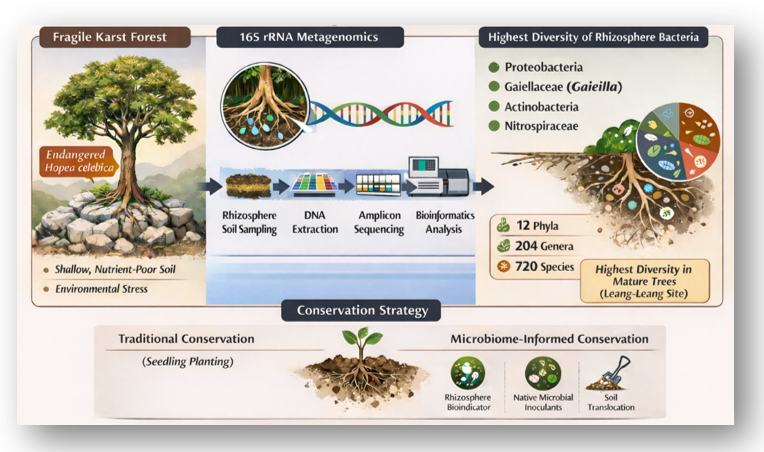
Graphical Abstract
Highlights
Ø The rhizosphere microbiome of endangered Hopea celebica was characterized using 16S rRNA metagenomics in a fragile karst forest ecosystem;
Ø A total of 12 phyla, 204 genera, and 720 species were identified, dominated by Proteobacteria and Gaiellaceae;
Ø Mature trees at the Leang-Leang site showed the highest bacterial richness and diversity, with phylogenetic analysis revealing structured microbial clusters related to nutrient cycling and stress tolerance;
Ø Microbiome-informed conservation strategies are proposed to support restoration and long-term sustainability in karst ecosystems.
Keywords
OPEN ACCESS
©2026 The author(s). This article is licensed under a Creative Commons Attribution 4.0 International License, which permits use, sharing, adaptation, distribution and reproduction in any medium or format, as long as you give appropriate credit to the original author(s) and the source, provide a link to the Creative Commons license, and indicate if changes were made. The images or other third party material in this article are included in the article’s Creative Commons license, unless indicated otherwise in a credit line to the material. If material is not included in the article’s Creative Commons license and your intended use is not permitted by statutory regulation or exceeds the permitted use, you will need to obtain permission directly from the copyright holder. To view a copy of this license, visit: http://creativecommons.org/licenses/by/4.0/
PUBLISHER NOTE
GJESM Publisher remains neutral concerning jurisdictional claims in published maps and institutional affiliations.
MAJOR DATABASES, CITATION METRICS & CAPTURES
Google Scholar | Scopus - SJR | Web of Science | Biological Abstracts: Clarivate | Biosis Preview: Clarivate | PlumX Metrics | Altmetrics | Mendeley |
CURRENT PUBLISHER

| Article View | 2,638 |
| PDF Download | 656 |

Letters to Editor
[1] Letters that include statements of statistics, facts, research, or theories should include appropriate references, although more than three are discouraged.
[2] Letters that are personal attacks on an author rather than thoughtful criticism of the author’s ideas will not be considered for publication.
[3] Letters can be no more than 300 words in length.
[4] Letter writers should include a statement at the beginning of the letter stating that it is being submitted either for publication or not.
[5] Anonymous letters will not be considered.
[6] Letter writers must include their city and state of residence or work.
[7] Letters will be edited for clarity and length.