Document Type : REVIEW PAPER
Authors
Research Center for Horticulture, National Research and Innovation Agency, Jl. Raya Jakarta-Bogor, Cibinong, Indonesia
Abstract
Chili (Capsicum spp.) is a high-value crop in Indonesia constrained by a diverse insect pest complex, fragmented smallholder systems and intensive use of synthetic insecticides that cause environmental contamination, non-target impacts and resistance. This study synthesizes ecological and socio-economic evidence to 1) identify and quantify major pest constraints; 2) evaluate environmental and health costs of pesticide-centric management; and 3) assess eco-friendly Integrated Pest Management strategies and scale-up options. A systematic literature synthesis of peer-reviewed articles and grey literature published between 2010 and 2025 were investigated. Searches were run in Scopus, Web of Science, PubMed, AGRICOLA and Google Scholar and supplemented by Indonesian repositories and conference proceedings. Queries combined crop descriptors (chili, Capsicum), pest taxa (Bactrocera, Helicoverpa, Spodoptera, Bemisia tabaci, thrips, aphids, Liriomyza) and intervention types (biocontrol, biopesticide, botanical, Integrated Pest Management, nano-delivery). Preferred reporting items for systematic reviews and meta-analyses style screening, assessed study quality, extracted quantitative metrics on yield loss, application, non-target effects, and adoption rates were extracted. Furthermore, results were synthesized in both narrative form and as tabulated evidence by pest and intervention. The dominant pest complex comprises fruit flies (Bactrocera spp.), lepidopteran borers (Helicoverpa, Spodoptera), Bemisia tabaci, thrips, aphids and leafminers. Yield losses average 30 percent under poor management and exceed 70 percent in severe outbreaks. Utilizing insecticides on a calendar basis encourages resistance, diminishes beneficial insect populations, leads to pesticide residues, and causes water contamination. Integrated strategies—such as sanitation, resistant varieties, biological control, biopesticides, and selective pesticides—minimize inputs while maintaining yields. Emerging precision tools (AI detection, IoT traps, mass trapping, ribonucleic acid interference, nano-formulations) improve targeting but need regulation, lower costs, and field validation. The adoption of new practices is constrained by inadequate extension systems, concerns regarding product quality, disjointed supply chains, and the risk aversion exhibited by farmers. A four-pillar roadmap is proposed: ecological monitoring with thresholds, validated bio/botanical tools, farmer training with incentives, and supportive policy frameworks.
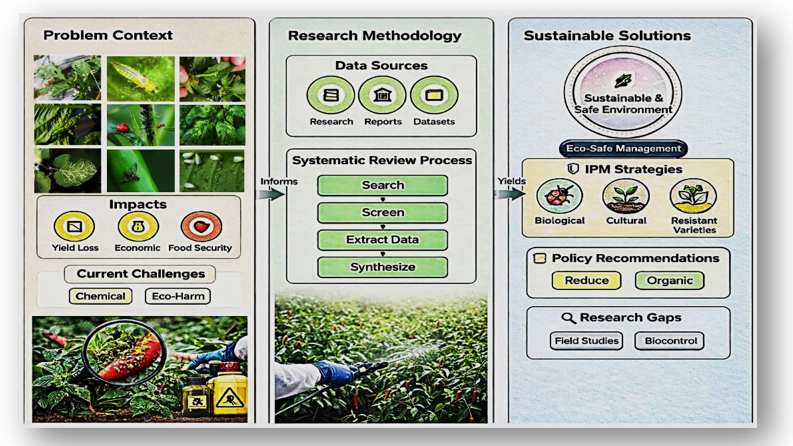
Graphical Abstract
Highlights
Ø First comprehensive evidence synthesis linking pest impact, pesticide residues, and ecological endpoints (pollinators, soil, water) specifically for Indonesian chili systems;
Ø Introduction of an Environmental Risk–Oriented Framework that translates monitoring data into explicit decision criteria;
Ø Key recommendations for sustainable management of chili pest in Indonesia and globally were comprehensive approach in IPM systems;
Ø Ranked, field-validated portfolio of eco-friendly tactics (biocontrol, botanicals, microbial products, cultural measures) evaluated by combined efficacy, ecological safety and cost–benefit;
Ø A practical four-pillar roadmap for scaling sustainable IPM, together with pilot-level success metrics for environmental and economic outcomes.
Keywords
Subjects
OPEN ACCESS
©2026 The author(s). This article is licensed under a Creative Commons Attribution 4.0 International License, which permits use, sharing, adaptation, distribution and reproduction in any medium or format, as long as you give appropriate credit to the original author(s) and the source, provide a link to the Creative Commons license, and indicate if changes were made. The images or other third party material in this article are included in the article’s Creative Commons license, unless indicated otherwise in a credit line to the material. If material is not included in the article’s Creative Commons license and your intended use is not permitted by statutory regulation or exceeds the permitted use, you will need to obtain permission directly from the copyright holder. To view a copy of this license, visit: http://creativecommons.org/licenses/by/4.0/
PUBLISHER NOTE
GJESM Publisher remains neutral concerning jurisdictional claims in published maps and institutional affiliations.
MAJOR DATABASES, CITATION METRICS & CAPTURES
Google Scholar | Scopus - SJR | Web of Science | Biological Abstracts: Clarivate | Biosis Preview: Clarivate | PlumX Metrics | Altmetrics | Mendeley |
CURRENT PUBLISHER
GJESM Publisher




Letters to Editor
[1] Letters that include statements of statistics, facts, research, or theories should include appropriate references, although more than three are discouraged.
[2] Letters that are personal attacks on an author rather than thoughtful criticism of the author’s ideas will not be considered for publication.
[3] Letters can be no more than 300 words in length.
[4] Letter writers should include a statement at the beginning of the letter stating that it is being submitted either for publication or not.
[5] Anonymous letters will not be considered.
[6] Letter writers must include their city and state of residence or work.
[7] Letters will be edited for clarity and length.