
5.2
CiteScore
2.9
Impact Factor
Document Type : RESEARCH ARTICLE
Authors
1 Digital Marketing, University of Tunis El Manar, Tunis, Tunisia
2 Computerized Financing and Banking, Palestine Technical University, Kadoorie, Tulkarm, Palestine
3 Electronic Marketing and Social Media Department, College of Economics and Administrative Sciences, Zarqa University, Jordan
4 Marketing Department, College of Business Administration, Prince Sattam bin Abdulaziz University, Al-Kharj, Saudi Arabia
5 Management Department, College of Business Administration, King Faisal University, Al-Ahsa 31982, Saudi Arabia
6 Social Studies Department, Faculty of Arts, King Faisal University, Al-Ahsa 31982, Saudi Arabia
Graphical Abstract
Highlights
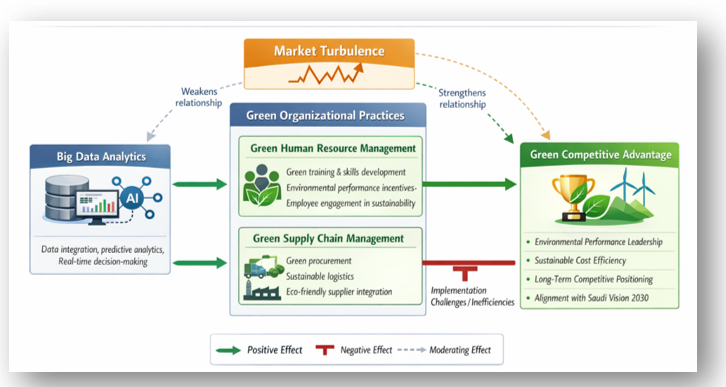
Ø Big data analytics directly and positively drives green competitive advantage in Saudi Arabia's renewable energy sector (β=0.332, p<0.001);
Ø Green human resource management successfully acts as a positive bridge, translating BDA capabilities into enhanced GCA (β=0.193, p<0.001 for mediation);
Ø Green supply chain management shows a significant negative mediating effect between BDA and GCA (β=-0.089, p=0.051 for mediation), signaling critical implementation challenges;
Ø Market turbulence acts as a double-edged sword: it strengthens the GSCM-GCA link (β=0.151, p=0.003 for moderation) but weakens the positive effect of GHRM on GCA (β=-0.111, p=0.007 for moderation).
Keywords
INTRODUCTION
Big data has become a reality that must be addressed as one of the most important resources for companies today. If handled appropriately and without bias, it greatly enhances both economic and social progress (Sangpetch and Ueasangkomsate 2023; Guilhem and Klein, 2024; Singh et al., 2025). Leveraging big data can bolster and improve decision-making by elevating the quality of the data gathered, which subsequently enhances the decisions made by managers, ultimately supporting and improving the financial performance of business organizations (Du and Lv, 2024; Rashid et al., 2024; Tetteh et al., 2025). Furthermore, it tracks all changes that take place, providing a precise representation of the physical world and fostering competition based on innovation rather than solely on products (Mousa et al., 2025a). Today, data is considered a key asset of companies through which they seek to achieve increased operational efficiency, risk management, and investment efficiency to achieve a green competitive advantage (GCA) (Mehmood et al., 2025; Mousa et al., 2025a). Since big data holds great potential to generate useful insights regarding the production and consumption aspects of the entire business cycle (Riggs et al., 2023; Mehmooda et al., 2025), it can be leveraged to understand the requirements and processes of each stage in this cycle, thus streamlining and creating sustainable business systems to achieve GCA for organizations, becoming more vital in daily lives (Awan et al., 2021; Guilhem and Klein, 2024). Consequently, this study intends to evaluate the influence of big data analysis (BDA) on green supply chain management (GSCM) and green human resource management (GHRM) in the pursuit of achieving GCA. Studying big data in green fields is gaining increasing importance due to the potential it provides for understanding environmental patterns, making more sustainable decisions, and enhancing commitment to environmentally friendly practices. The COVID-19 pandemic has resulted in the most significant global catastrophe in recent decades, adversely affecting health systems and the economies of societies globally (Das et al., 2024; Gupta et al., 2024). Amid the COVID-19 pandemic, the industrial sector witnessed disruptions in GSCM worldwide (Jalil et al., 2024). The study by Belhadi et al. (2023) recommended guiding companies to effectively adopt big data analytics (BDA) to enhance their environmental performance considering the global shift towards sustainability and a green economy (Song et al., 2023). The Saudi Vision 2030 outlines a strategic plan aimed at diversifying the national economy beyond oil, clearly recognizing the existing lack of development in a competitive renewable energy sector. This context offers a critical and unique research setting for analyzing the rapid, policy-driven development of a green energy sector within an economy historically centered on oil. Investigating the link between sophisticated technological capabilities, including BDA, and innovative green operational practices, specifically GSCM and GHRM, yields new insights for developing economies experiencing sustainable transitions (Mehmood et al., 2025; Mousa et al., 2025a). Despite growing recognition of the "green transformation," empirical evidence indicates that the adoption of BDA technologies to specifically enhance GSCM and GHRM remains limited and insufficiently studied, particularly within this high-priority sector (Al-Khatib, 2023; Rashid et al., 2024). In order to fill this gap, the study formulates a comprehensive conceptual framework based on dynamic capabilities (DC) Theory and the resource-based view (RBV). It positions BDA not merely as a tool but as a higher-order dynamic capability (Teece et al., 2016) essential for configuring green resources. The study specifically investigates the unresolved question of how BDA translates into GCA through the concurrent, yet distinct, mediating pathways of GHRM and GSCM (Yoshikuni et al., 2025). Furthermore, it highlights market turbulence (MT) as a significant moderating factor, investigating a boundary condition that is often disregarded in the green management literature within developing economic environments (Alghamdi et al., 2024; Pratono, 2024; Wu et al., 2024). This approach theoretically advances green transformation understanding by examining how the efficacy of dynamically configuring BDA with green practices is externally influenced by market conditions, thereby extending the RBV and DC frameworks into the green domain (Dubey et al., 2021). Therefore, this study aims to identify the importance of big data analysis in green human resource management (Sobaih, 2019), green supply chain management, and Green competitive advantage by confronting market disruptions. Thus, the study problem can be solved by answering the question: Is there an impact of big data analysis on green supply chain management, green human resource management, and green competitive advantage? Do green supply chain management and green human resource management mediate the relationship between big data analysis, green supply chain management), and green competitive advantage? Does market turbulence modify the relationship between green human resource management and green supply chain management on green competitive advantage? This study was conducted in Kingdom of Saudi Arabia, in 2025.
MATERIALS AND METHODS
General theoretical design
Theory of dynamic capabilities
Theory of DC provides a robust framework for understanding how organizations respond to environmental uncertainty and MT (Teece, 2018a; Wu et al., 2024). Differing from static perspectives that stress the importance of resource ownership, this theory centers on the capabilities of firms to detect opportunities and threats, take advantage of strategic options, and adjust resources in light of environmental change (Teece, 2018b; Warner et al., 2019). In contemporary business environments characterized by rapid technological change, intensified competition, and increasing regulatory pressure, DC play a critical role in enabling long-term sustainability and strategic adaptation (Wang and Ahmed, 2007). In environments characterized by elevated MT companies that do not possess these capabilities face the dangers of strategic inflexibility, diminishing performance, or potentially exiting the market (Wang et al., 2024; Mousa et al., 2025a). Recent studies suggest that analytics-driven capabilities enhance firms’ capacity to transform environmental disruptions into opportunities for innovation and growth, thereby sustaining competitive advantage despite uncertainty (Teece et al., 2016). In this study, BDA is conceptualized as a dynamic capability that supports organizational learning, real-time decision-making, and adaptive responses to MT, particularly in sustainability-oriented contexts.
Theory of resource-based view (RBV)
The RBV posits that firms achieve competitive advantage by possessing valuable, rare, inimitable, and organizationally embedded resources. From this perspective, BDA represents a strategic resource that enhances firms’ ability to deploy and amplify other internal capabilities, including GSCM and GHRM (Atobishi and Podruzsik, 2025). By leveraging BDA, organizations can improve environmental operational efficiency, forecast demand fluctuations, support real-time decision-making, and enhance coordination across green initiatives (Yu et al., 2021). Importantly, RBV suggests that analytics capabilities do not generate competitive advantage in isolation; rather, they enhance the value of complementary organizational resources. This study broadens the scope of RBV by merging it with DC theory, contending that enhanced analytical competencies, such as BDA, are required but not adequate for securing a green competitive advantage. In turbulent and regulation-intensive environments, firms must not only possess analytics resources but also effectively align them with organizational practices such as GSCM and GHRM to translate data into sustainable strategic outcomes (Chen et al., 2023; Dubey et al., 2021; Mousa et al., 2025b; Wamba et al., 2017).
Green competitive advantage
GCA refers to a firm’s ability to achieve superior market performance through environmentally responsible strategies that are difficult for competitors to imitate (He and Wang, 2023; Vehbi et al., 2025). Organizations that adeptly incorporate environmental innovation with their strategic positioning can bolster their corporate image, reach new markets, and secure enduring competitive benefits (Zameer et al., 2022; Astuti and Datrini, 2021). In the contemporary business environment, environmental regulation has evolved from a compliance mechanism into a strategic driver of innovation and competitiveness. Companies that actively embrace environmentally friendly technologies and practices are in a stronger position to reap the rewards of regulatory backing, stakeholder confidence, and new prospects in clean and sustainable sectors (Ali et al., 2020; Soto et al., 2025; Rahman et al., 2026).
Hypothesis development
The impact of BDA on GCA
BDA refers to an organization’s capability to process large volumes of diverse and high-velocity data and transform them into valuable insights that support strategic decision-making (Gupta et al., 2019; Zhu, and Yang, 2021). In contexts focused on sustainability, BDA empowers companies to oversee resource usage, monitor environmental emissions, and enhance operational processes in real time, thereby supporting environmentally responsible strategies and cost efficiencies (Dubey et al., 2021; Bag et al., 2020). Prior studies suggest that BDA enhances firms’ ability to identify green market opportunities, understand environmentally conscious customer preferences, and develop sustainable products and services that strengthen competitive positioning (Wamba et al., 2020). Empirical evidence further suggests that analytics-based insights encourage green innovation, which is a vital route to sustainable performance and long-term competitiveness (Cui et al., 2021; Dubey et al., 2023; Nilashi et al., 2025; Haylemariam et al., 2025). Therefore, the following hypothesis was derived.
H1: BDA has a positive impact on GCA
The impact of BDA on GHRM
BDA plays an increasingly important role in supporting GHRM by enabling organizations to collect, integrate, and analyze employee-related and organizational behavior data to support sustainability-oriented decision-making (Awan et al., 2021; Khan et al., 2024). Organizations can utilize workforce analytics to enhance green training, performance assessments, employee engagement, and motivation in accordance with environmental objectives (Renwick et al., 2013; Yong et al., 2020). Prior empirical studies demonstrate that BDA significantly supports the implementation of GHRM practices by improving information transparency, managerial control, and evidence-based human capital development (Mahmood et al. 2023; Gallo et al., 2023; Teece et al., 2016). In light of this, the subsequent hypothesis was formulated.
H2: BDA has a positive impact on GHRM
The impact of BDA on GSCM
BDA has been widely recognized as an important enabler of GSCM. It enhances firms’ information-processing capacity by integrating environmental data across procurement, logistics, production, and supplier networks (Shi et al., 2023). By minimizing information asymmetry and enhancing forecasting precision, analytics-based systems facilitate environmental monitoring, energy efficiency, and waste reduction throughout the supply chain (Belhadi et al., 2023; Gallo et al., 2023). Empirical studies consistently indicate a favorable correlation between BDA and green supply chain practices, including green integration, supplier collaboration, and environmental performance (Al-Khatib, 2023; Benzidia et al., 2021; Gallo et al., 2023; Mehmooda et al., 2025; Rashid et al., 2024). Taking this into account, the ensuing hypothesis was established.
H3: BDA has a positive impact on GSCM
The impact of GHRM on GCA
GHRM represents a collection of organizational policies and practices that strive to enhance employees' awareness of environmental matters, their skills, motivation, and participation in sustainability initiatives (Mustafa et al., 2024; Soto et al., 2025). From a DC’ perspective, human capital represents a critical micro-foundation through which firms transform strategic resources into competitive outcomes. Prior studies present substantial evidence indicating that GHRM positively impact GCA by promoting environmental innovation, the strengthening of employee commitment, and the advancement of organizational learning (Ayyash and Mousa, 2025; Mustafa et al., 2025; He and Wang, 2023; Shaikh et al., 2026). Considering this, the next hypothesis was derived.
H4: GHRM has a positive impact on GCA
The Impact of GSCM on GCA
GSCM refers to the integration of environmental considerations into supply chain processes, including sourcing, logistics, and collaboration with suppliers (Theeraworawit et al., 2022). The literature generally suggests that GSCM enhances competitive advantage by reducing resource consumption, improving efficiency, and strengthening environmental reputation (Abdallah et al., 2024; Theeraworawit et al., 2022; Gelmez et al., 2024). Nonetheless, the efficacy of GSCM might be influenced by contextual elements including sector maturity, supplier preparedness, and regulatory demands. In emerging or highly regulated contexts, green supply chain initiatives may initially increase operational complexity and costs, potentially limiting their immediate contribution to competitive advantage (Zhu et al., 2023). Thus, the following hypothesis was derived.
H5: GSCM has a significant impact on GCA
The role of MT in moderating the link between GSCM and GCA
MT reflects the degree of unpredictability and rapid change in customer preferences, technologies, and competitive conditions (Dubey et al., 2021). In challenging circumstances, organizations encounter heightened demands to modify their supply chain frameworks, sourcing approaches, and coordination systems. Prior research suggests that the effectiveness of green supply chain practices is contingent upon environmental dynamism, as turbulence amplifies the importance of flexibility, responsiveness, and real-time coordination (Singh et al., 2025; Khan et al., 2024). This emphasizes the crucial function of flexible sourcing strategies that facilitate the reorganization of operations. Therefore, MT is expected to influence the strength of the relationship between GSCM and green competitive advantage. Considering this, the next hypothesis was derived.
H6: MT moderates the positive link between GSCM and GCA.
The role of MT in modifying the link between GHRM and GCA
MT also shapes the effectiveness of human-centered organizational practices. While GHRM supports sustainability through employee development and engagement, highly turbulent environments may disrupt long-term human resource initiatives due to uncertainty, job insecurity, and rapid operational changes (Islam et al., 2025; Raouf and Esmaeel, 2025). Although some studies suggest that turbulence enhances the strategic value of adaptive human capital (Zhou et al., 2024; Shaikh et al., 2026). Some suggest that high levels of volatility could diminish the effectiveness of HR-related practices on performance outcomes. Accordingly, this study examines the moderating role of MT without assuming its direction. Considering this, the following hypothesis was derived.
H7: MT moderates the link between GHRM and GCA.
GSCM as a Mediating Variable between BDA and GCA
Previous studies (Dubey et al., 2021; Yoshikuni et al. 2025) propose that GSCM may mediate the relationship between BDA and GCA by translating analytics-driven insights into operational sustainability outcomes. However, this mediation assumes sufficient maturity and integration of green supply chain practices. In scenarios where the implementation of GSCM is largely motivated by compliance requirements or where operational capabilities are underdeveloped, its role as a mediator may be constrained. Therefore, this study empirically examines the mediating role of GSCM without presuming a positive mediation effect Considering this, the following hypothesis was derived.
H8: GSCM mediates the link between BDA and GCA.
GHRM as a mediating variable between BDA and GCA
GHRM is expected to serve as an important internal mechanism through which BDA capabilities are converted into green competitive advantage. Moreover, the successful integration of data-driven insights provided by BDA is significantly dependent on the skills, awareness, and motivation of employees to foster sustainable decision-making and practices (AlNuaimi et al., 2021; Liu et al., 2025). Empirical evidence suggests that organizations with strong GHRM practices are better able to leverage analytics capabilities to enhance environmental performance and competitive outcomes (Yong et al. 2020; Dubey et al., 2021). Considering this, the following hypothesis was derived.
H9: GHRM mediates a positive link between BDA and GCA.
The proposed research model depicted in Fig. 1 reveals the direct impact of BDA on green competitive advantage, the mediating roles of GHRM and GSCM, along with the moderating role of MT.
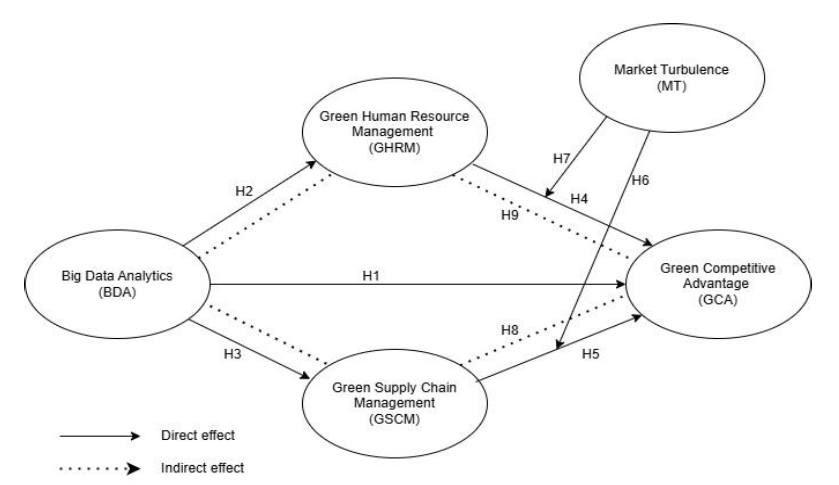
Fig. 1: The research model
Research design
This study utilizes a quantitative, cross-sectional research framework to investigate the aforementioned relationships. A structured questionnaire was used as the primary data collection instrument. The measurement adopted Likert’s’ Scale, where 1 = strongly disagree and 5 = strongly agree. Fig. 1 depicts the conceptual framework of this study, which includes an independent variable (BDA), a dependent variable (GCA), a mediating variable (GSM and GHRM), and a moderating variable (MT).
Study sample
To ensure representativeness, respondents with various organizational profiles were invited from Saudi Arabian renewable energy companies, including senior, middle, and junior levels as detailed in Table 1. In aiming to engage employees possessing operational insight, the sample encompasses a variety of viewpoints across organizational hierarchies. From 430 initial responses, 420 valid questionnaires were retained for analysis after removing 10 due to incompleteness or inconsistency (97.7% validity rate). The final sample of 420 exceeds the minimum requirement for partial least squares structural equation modeling (PLS-SEM) analysis (Hair et al., 2019), and its demographic composition across age, gender, education, and job level supports broad representativeness within the sector.
Table 1: Demographic backgrounds of the participants
|
Demographic data |
Frequency |
Percent (%) |
|
Gender |
||
|
Male |
289 |
68.8 |
|
Female |
131 |
31.2 |
|
Total |
420 |
100.0 |
|
Age |
||
|
From 18 to below 28 years |
63 |
15.0 |
|
From 28 to below 38 years |
105 |
25.0 |
|
From 38 to below 48 years |
147 |
35.0 |
|
Above 48 years |
105 |
25.0 |
|
Total |
420 |
100.0 |
|
Working years |
||
|
1 to Less than 4 years |
101 |
24.0 |
|
4 to less than 8 years |
167 |
39.8 |
|
8 to less than 12 years |
102 |
24.3 |
|
12 years and above |
50 |
11.9 |
|
Total |
420 |
100.0 |
|
Education |
||
|
High School and less |
88 |
21.0 |
|
Diploma |
70 |
16.7 |
|
Bachelor’s degree |
202 |
48.1 |
|
Higher studies |
60 |
14.3 |
|
Total |
420 |
100.0 |
|
Job Level in the company |
||
|
Senior Level |
72 |
17.1 |
|
Middle Level |
240 |
57.1 |
|
Junior Level |
108 |
25.7 |
|
Total |
420 |
100.0 |
Note: Percentages may not be exactly 100% due to rounding.
RESULTS AND DISCUSSION
Assessment of measurement model
Structural equation modeling using SmartPLS-4 was adopted to assess the model. T PLS-SEM was selected due to its suitability for complex research models involving mediation and moderation effects, its robustness to non-normal data distributions, and its predictive orientation (Hair et al., 2019). The measurement model was evaluated by examining indicator reliability, internal consistency reliability, and convergent and discriminant validity. The confirmation of indicator reliability was achieved by ensuring that factor loadings surpassed the suggested threshold of 0.70. Internal consistency reliability was assessed using Cronbach’s alpha and composite reliability (CR), with all values exceeding 0.70, indicating satisfactory reliability. Convergent validity was established by evaluating the average variance extracted (AVE), with all constructs demonstrating AVE values above 0.50. As shown in Table 2, the criteria were met with alpha coefficients above 0.70, CR values more than 0.70, and AVE values above 0.50, demonstrating convergent validity (Hair et al., 2019). Table 2 demonstrates that the CR values spanned from 0.872 to 0.909, whereas the AVE values extended from 0.634 to 0.693, which confirms the presence of adequate convergent validity. Discriminant validity was assessed using the Fornell–Larcker criterion, which compares the square root of each construct’s AVE with its correlations with other constructs. The findings demonstrate that the square roots of the AVE for each construct surpassed their inter-construct correlations, thereby affirming adequate discriminant validity. The results are presented in Table 2 and Fig. 2. In order to examine the potential influence of common method bias, various procedural strategies were employed during the data collection phase, such as guaranteeing respondent anonymity and alleviating evaluation apprehension. In addition, Harman’s single-factor test indicated that no single factor accounted for the majority of variance, suggesting that common method bias is unlikely to significantly affect the study results. Discriminate validity was further assessed using the heterotopic-to-monotypic (HTMT) ratio, as recommended by Henseler et al., (2015). As illustrated in Table 3, all HTMT values fell below the conservative threshold of 0.90, which signifies satisfactory discriminant validity among the constructs. In addition, discriminant validity was also confirmed using the Fornell–Larcker criterion, where the square root of each construct’s AVE exceeded its correlations with other constructs. The low HTMT values associated with the interaction terms further suggest that there are no multicollinearity concerns in the moderation analysis. Together, these results provide strong evidence of discriminant validity for the measurement model.
Table 2: Results of the measurement model
|
Variable/ sources |
Items and Questionnaire questions |
Outer loading |
VIF |
α |
CR |
AVE |
|
BDA |
1. “The renewable energy sector provides appropriate training for employees to use data analysis tools”. |
0.879 |
1.687 |
0.868 |
0.872 |
0.656 |
|
2. “The renewable energy sector uses advanced analytics techniques to enhance decision making”. |
0.840 |
1.430 |
||||
|
3. “In the renewable energy sector, the importance of big data and its analysis enhances the value of the business”. |
0.738 |
2.079 |
||||
|
4. “Managers in the renewable energy sector understand the importance of big data and its analysis in enhancing the value of the business”. |
0.792 |
1.926 |
||||
|
5. “The renewable energy sector provides us with the ability to drill down into information to support root cause analysis and continuous improvement”. |
0.795 |
1.490 |
||||
|
GCA
|
1. “An environmentally conscious renewable energy sector can achieve cost advantages” |
0.807 |
1.142 |
0.889 |
0.892 |
0.693 |
|
2.” By investing in the development of environmentally friendly products, the renewable energy sector can become a market leader”. |
0.842 |
2.140 |
||||
|
3.” The renewable energy sector can enter profitable new markets by adopting an environmentally friendly strategy”. |
0.818 |
1.442 |
||||
|
4. “The renewable energy sector can penetrate the market by making existing products more environmentally friendly”. |
0.893 |
1.998 |
||||
|
5. “By reducing the environmental impact of business activities, the quality of products will improve”. |
0.799 |
|
||||
|
GHRM |
1. “The renewable energy sector provides sufficient training to promote environmental management as a core value in the organization”. |
0.728 |
1.888 |
0.897 |
0.903 |
0.661 |
|
2. “The renewable energy sector considers employees' commitment to environmental conservation as part of their performance evaluations”. |
0.793 |
1.857 |
||||
|
3.” The renewable energy sector links employees environmentally friendly behavior to rewards and compensation”. |
0.831 |
1.896 |
||||
|
4. “The renewable energy sector encourages employees to submit suggestions for improving the environment”. |
0.844 |
1.896 |
||||
|
5. “Employees are fully aware of the renewable energy sector's commitment to environmental policy”. |
0.844 |
1.567 |
||||
|
6. “The renewable energy sector considers the compatibility between personal identity and environmental management in the recruitment and selection process.” |
0.818 |
|
||||
|
GSCM |
1. “The renewable energy sector is implementing green procurement practices”. |
0.792 |
2.532 |
0.885 |
0.897 |
0.634 |
|
2. “The renewable energy sector is implementing cross-functional collaboration practices to improve environmental performance”. |
0.886 |
2.236 |
||||
|
3.” The renewable energy sector is implementing information systems for the green supply chain”. |
0.886 |
1.577 |
||||
|
4. “The renewable energy sector is implementing green distribution practices”. |
0.762 |
2.179 |
||||
|
5. “The renewable energy sector benefits from reverse logistics systems”. |
0.721 |
1.924 |
||||
|
6. “The renewable energy sector has environmental audit and complaint management programs”. |
0.776 |
|
||||
|
MT |
1. “Renewable energy markets are experiencing high and unpredictable price fluctuations”. |
0.823 |
2.337 |
0.890 |
0.909 |
0.693 |
|
2. “Competition in the renewable energy sector has become more intense in recent years”. |
0.899 |
3.516 |
||||
|
3. “Market turmoil motivates us to acquire new skills to deal with the ever-changing environment in the renewable energy sector”. |
0.866 |
3.024 |
|
|||
|
4. “The level of demand for renewable energy products changes suddenly”. |
0.798 |
2.025 |
||||
|
5. “I feel anxious about the ongoing instability in the renewable energy sector”. |
0.772 |
1.940 |
Note: All constructions were specified as reflective. CR = composite reliability; AVE = average variance extracted.
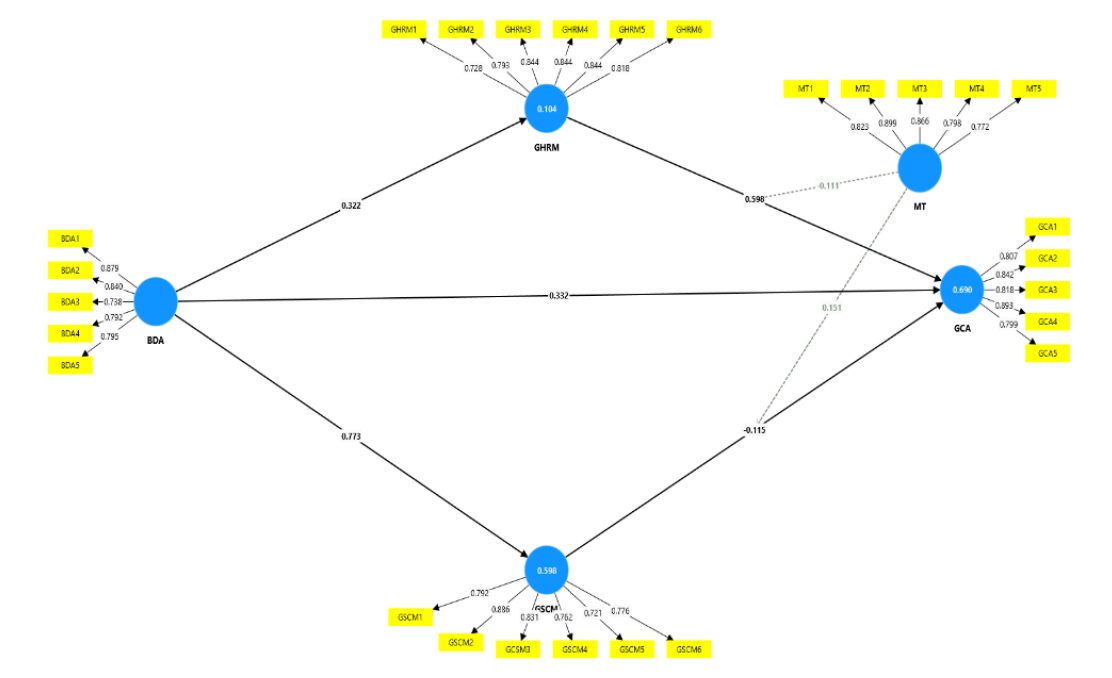
Fig. 2: Measurement model
Table 3: Heterotrait-monotrait ratio (HTMT) and discriminant validity (Fornell- Larcker criterion)
|
HTMT |
BDA |
GCA |
GHRM |
GSCM |
MT |
MT x GSCM |
MT x GHRM |
|
BDA |
---- |
||||||
|
GCA |
0.495 |
---- |
|||||
|
GHRM |
0.363 |
0.871 |
---- |
||||
|
GSCM |
0.866 |
0.391 |
0.385 |
---- |
|||
|
MT |
0.072 |
0.430 |
0.501 |
0.081 |
----- |
||
|
MT x GSCM |
0.074 |
0.162 |
0.059 |
0.142 |
0.013 |
---- |
|
|
MT x GHRM |
0.052 |
0.429 |
0.512 |
0.047 |
0.255 |
0.233 |
----- |
|
Fornell- Larcker criterion |
BDA |
GCA |
GHRM |
GSCM |
MT |
||
|
BDA |
0.810 |
----- |
|||||
|
GCA |
0.433 |
0.833 |
----- |
||||
|
GHRM |
0.322 |
0.786 |
0.813 |
---- |
|||
|
GSCM |
0.773 |
0.352 |
0.334 |
0.796 |
----- |
||
|
MT |
-0.050 |
0.390 |
0.459 |
-0.045 |
0.833 |
||
Note: Diagonal values in panel B represent the square root of AVE
Assessment of structural model
The structural model was evaluated using effect size (f²), coefficient of determination (R²), and predictive relevance (Q²), following the guidelines of Hair et al.,) 2019). The f² (Table 4) results indicate that BDA has a moderate effect on GHRM (f² = 0.137) and a small effect on GSCM (f² = 0.116). In addition, GHRM exhibits a large effect on GCA (f² = 0.552), whereas GSCM shows a small effect on GCA (f² = 0.016). The R² (Table 5) indicates that the model accounts for a significant proportion of variance in GCA (R² = 0.690), signifying robust explanatory strength. The explained variance for GSCM is also high (R² = 0.598), while the explanatory power for GHRM is relatively modest (R² = 0.104). The evaluation of Q² (Table 6) was conducted through the blindfolding method. The results show strong predictive relevance for GCA (Q² = 0.466) and good predictive relevance for GSCM (Q² = 0.366). However, the predictive relevance for GHRM is relatively weak (Q² = 0.067), suggesting that while the model explains variance in GHRM, its out-of-sample predictive capability for this construct is limited. Overall, the model demonstrates satisfactory predictive validity, especially concerning the primary outcome variable, GCA (Hair et al., 2019).
Table 4: Effect size (f²)
|
Predictor |
GCA |
GHRM |
GSCM |
|
BDA |
1.489 |
0.137 |
0.116 |
|
GHRM |
0.552 |
— |
— |
|
GSCM |
0.016 |
— |
— |
|
MT |
0.021 |
— |
— |
Table 5: Coefficient of determination (R²)
|
F2 |
GHRM |
GSCM |
Construct |
R-square |
R-square adjusted |
Construct |
Q2 |
|
|
Construct |
GCA |
|||||||
|
BDA |
0.137 |
0.116 |
1.489 |
GCA |
0.690 |
0.684 |
BDA |
0.000 |
|
GCA |
- |
- |
GHRM |
0.104 |
0.101 |
GCA |
0.466 |
|
|
GHRM |
0.552 |
- |
- |
GSCM |
0.598 |
0.597 |
GHRM |
0.067 |
|
GSCM |
0.016 |
- |
- |
- |
- |
- |
GSCM |
0.366 |
|
MT |
0.021 |
- |
- |
- |
- |
- |
MT |
0.000 |
Table 6: Predictive relevance (Q²)
|
Construct |
Q² |
|
GCA |
0.466 |
|
GSCM |
0.366 |
|
GHRM |
0.067 |
|
BDA |
0.000 |
|
MT |
0.000 |
Note: Values of Q² greater than zero indicate predictive relevance
Hypothesis testing results
The hypothesis testing results obtained using SmartPLS are presented in Table 7 and Fig. 3. The results indicate that BDA has a positive and significant effect on GCA (H1: β = 0.332, t = 4.719, p < 0.001). BDA also positively influences GHRM (H2: β = 0.322, t = 5.213, p < 0.001) and GSCM (H3: β = 0.773, t = 29.721, p < 0.001). Furthermore, GHRM has a positive and significant effect on GCA (H4: β = 0.599, t = 10.374, p < 0.001). In contrast, GSCM exhibits a negative but statistically significant effect on GCA (H5: β = −0.116, t = 1.975, p = 0.048). Regarding moderation effects, the interaction between MT and GSCM is positive and significant (H6: β = 0.151, t = 2.935, p = 0.003), indicating that MT strengthens the GSCM–GCA relationship. Conversely, the interaction between MT and GHRM is negative and significant (H7: β = −0.111, t = 2.678, p = 0.007), suggesting that MT weakens the GHRM–GCA relationship. With respect to mediation effects, GSCM does not mediate the relationship between BDA and GCA (H8: β = −0.089, t = 1.953, p = 0.051). However, GHRM significantly mediates the relationship between BDA and GCA (H9: β = 0.193, t = 4.672, p < 0.001). The hypothesis testing results obtained using SmartPLS are presented in Table 7 and Figure 3. The results indicate that BDA have a positive and significant effect on GCA (H1: β = 0.332, t = 4.719, p < 0.001). BDA also positively influences GHRM (H2: β = 0.322, t = 5.213, p < 0.001) and GSCM (H3: β = 0.773, t = 29.721, p < 0.001). Furthermore, GHRM has a positive and significant effect on GCA (H4: β = 0.599, t = 10.374, p < 0.001). In contrast, GSCM exhibits a negative but statistically significant effect on GCA (H5: β = −0.116, t = 1.975, p = 0.048). Regarding moderation effects, the interaction between MT and GSCM is positive and significant (H6: β = 0.151, t = 2.935, p = 0.003), indicating that MT strengthens the GSCM–GCA relationship. Conversely, the interaction between MT and GHRM is negative and significant (H7: β = −0.111, t = 2.678, p = 0.007), suggesting that MT weakens the GHRM–GCA relationship. With respect to mediation effects, GSCM does not mediate the relationship between BDA and GCA (H8: β = −0.089, t = 1.953, p = 0.051). However, GHRM significantly mediates the relationship between BDA and GCA (H9: β = 0.193, t = 4.672, p < 0.001) (Table 7 and Fig. 3). Fig. 3 illustrates the estimated structural model with standardized path coefficients and significance levels. The structural equation modeling results provide strong support for the hypothesized model. The results of H1 confirm that BDA has a significant positive direct effect on GCA (β = 0.332, p < 0.001), confirming its key role as a strategic asset. The result is consistent with prior literature (Wamba et al., 2017; Haylemariam et al., 2025; Nilashi et al., 2025). Furthermore, the results of H2 reveal that BDA has a strong positive effect on GHRM (β = 0.322, p < 0.001). Similarly, the results of H3 show that BDA has a strong positive effect on GSCM (β = 0.773, p < 0.001). These results affirm BDA's role as an essential facilitator in establishing vital green organizational capabilities, as corroborated by previous studies (Renwick et al., 2013; Gallo et al., 2023; Mahmood et al., 2023; Yong et al., 2020; Das et al., 2024; Mishra et al., 2021; Belhadi et al., 2023; Benzidia et al., 2021; Rashid et al., 2024; Al-Khatib, 2023; Mousa et al., 2025b; Mehmood et al., 2025; Zhu and Yang, 2021). The study reveals divergent mediating pathways of GHRM and GSCM. GHRM demonstrated a strong positive direct effect on GCA (β = 0.599, p < 0.001, H4) and served as a significant positive mediator between BDA and GCA (β = 0.193, p < 0.001, H9). This conclusion is in agreement with prior studies and clarifies how BDA results in a benefit. Specifically, BDA empowers GHRM practices like data-informed green training, performance management, and culture-building. This fosters the development of human capital required to carry out data-driven sustainability strategies, consequently transforming technological capability into a competitive edge (He and Wang, 2023; Shaikh et al., 2026; Mustafa et al., 2024; Yong et al., 2020; Abdallah et al., 2024; Theeraworawit et al., 2022; Gelmez et al., 2024; Zhu et al., 2023). In contrast, GSCM shows a significant negative direct effect on GCA (β = -0.116, p = 0.048, H5) and a negative mediating role (β = -0.089, p = 0.051, H8). This unanticipated result challenges the prevailing opinion from research in mature industries, which typically suggests that GSCM is a positive factor in achieving competitive advantage (Abdallah et al., 2024; Gelmez et al., 2024; Zhu et al., 2023; Yu et al., 2021). Within the burgeoning renewable energy sector in Saudi Arabia, GSCM initiatives discerned through BDA (for instance, green procurement and supplier environmental integration) may function as "rigid" capabilities. Their high initial costs and operational complexity can create a short-term resource drain, offsetting competitive benefits, especially if BDA is deployed primarily for operational efficiency rather than strategic green transformation (Dubey et al., 2021; Awan et al., 2021; Queiroz et al., 2020). This result diverges from research that supports a positive GSCM-GCA link (Chen et al., 2023) and contrasts with findings from other studies (Zhu and Yang, 2021; Al-Khatib, 2023). The moderating role of MT further clarifies this framework. MT significantly strengthened the GSCM-GCA relationship (β = 0.151, p = 0.003, H6) but weakened the GHRM-GCA relationship (β = -0.111, p = 0.007, H7). This dual effect is theoretically consistent, as under turbulence, the dynamic capability of an agile, data-responsive supply chain becomes paramount for resilience, thus enhancing GSCM's value (Pratono, 2024; Singh et al., 2025; Rahman et al., 2026). Conversely, turbulent conditions push companies to focus on short-term operations. This often leads them to deprioritize long-term green HR investments, which weakens the impact of GHRM on GCA. This finding provides a contrasting perspective to some existing studies (Zhou et al., 2024; Jabbour et al., 2015). Consequently, the results of the study are particularly tailored to the context of renewable energy in Saudi Arabia. The outcomes align with worldwide studies regarding BDA and GHRM, but they markedly differ concerning the function of GSCM. This suggests that the connection between technology and competitive advantage is greatly contingent upon the stage of development of the industry and the strategic aims of the organization. The results demonstrated that MT moderates the link between GSCM and GCA and does not affect the relationship of GHRM. The findings highlight the significance of employing BDA in alignment with the goals of Saudi Vision 2030 to secure growth and achieve a competitive edge that promotes both environmental and economic advancement. The results indicate the availability of changes that affect organizational and technical issues related to the organizations’ adoption to these challenges efficiently, which assure the necessity to the need of developing digital infrastructure and enhance human capabilities to assure the competitive advantages (Amin et al., 2025).
Table 7: Hypothesis testing results: Path coefficients and significance levels
|
Direct hypothesis |
ß-value |
SD |
T values |
P values |
2.5% |
97.5% |
Decision |
|
H1. BDA -> GCA |
0.332 |
0.070 |
4.719 |
0.000 |
0.190 |
0.466 |
Supported |
|
H2. BDA -> GHRM |
0.322 |
0.062 |
5.213 |
0.000 |
0.202 |
0.440 |
Supported |
|
H3. BDA -> GSCM |
0.773 |
0.026 |
29.721 |
0.000 |
0.721 |
0.822 |
Supported |
|
H4. GHRM -> GCA |
0.599 |
0.058 |
10.374 |
0.000 |
0.482 |
0.708 |
Supported |
|
H5. GSCM -> GCA |
-0.116 |
0.059 |
1.975 |
0.048 |
-0.225 |
0.002 |
Supported (Negative) |
|
H6. MT x GSCM -> GCA |
0.151 |
0.051 |
2.935 |
0.003 |
0.047 |
0.250 |
Supported |
|
H7. MT x GHRM -> GCA |
-0.111 |
0.041 |
2.678 |
0.007 |
-0.192 |
-0.031 |
Supported (Negative) |
|
Indirect hypothesis |
ß-value |
SD |
T values |
P values |
2.5% |
97.5% |
Decision |
|
H8. BDA -> GSCM -> GCA |
-0.089 |
0.046 |
1.953 |
0.051 |
-0.177 |
0.002 |
Not supported |
|
H9. BDA -> GHRM -> GCA |
0.193 |
0.041 |
4.672 |
0.000 |
0.117 |
0.278 |
Supported |
Note: Negative coefficients indicate inverse relationships
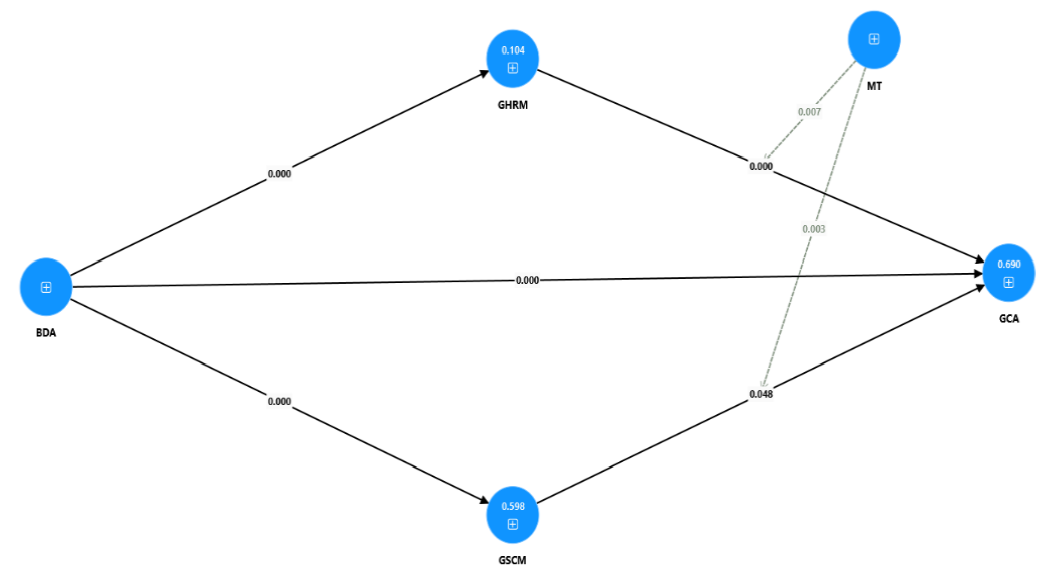
Fig. 3: Structure model
Limitations and future research opportunities
Despite its contributions, this study has several limitations. First, the study utilized a cross-sectional design based on questionnaires, which restricts the capacity to identify causal relationships and temporal changes. Future studies are encouraged to adopt longitudinal designs to examine the evolution of analytics-driven green practices. Second, the empirical context was confined to renewable energy firms operating in Saudi Arabia, which may limit the generalizability of the findings to other sectors or geographic regions. Future studies may broaden this framework to encompass additional sectors, including manufacturing, logistics, or oil and gas, along with various Middle Eastern or emerging economy settings, facilitating comparative analysis. In the third instance, the utilization of a composite measure for GSCM obstructs the investigation into how its particular dimensions (such as, green procurement and logistics) uniquely associate with BDA and GCA. Fourth, future studies may incorporate qualitative methods to gain deeper insights into organizational processes and decision-making mechanisms. Fifth, this study did not explore how factors such as firm size or ownership structure (for instance., state-owned compared to private) might affect the BDA-GSCM relationship, highlighting a significant opportunity for future research. Finally, examining additional mediating or moderating variables such as green innovation, green organizational culture, green governance, leadership styles, or green artificial intelligence (AI) applications could further enrich understanding of how digital technologies contribute to sustainable competitive advantage. Another opportunity of research is to assess how firm size and ownership structure, for example, state-owned versus private, influence the effectiveness of BDAs in GSCM and GCA.
CONCLUSION
The most prominent theoretical contributions are the introduction of a new conceptual model that links the BDA with green practices and demonstrates how technology can support sustainability and competitive advantage, especially the GCA. As previously mentioned in the literature, these factors were not analyzed in conjunction with the moderation role of MT. Additionally, this research expands the scope of RBV theory and the DC Theory by demonstrating how BDA capabilities, as an intangible resource, can enhance green practices and support the achievement of sustainable competitive advantage. It addresses a deficiency in the existing literature concerning the sustainability of Arab startup economies and environments, which currently lacks thorough studies that link BDA with environmentally friendly practices. The findings highlight the differential roles of GHRM and GSCM as underlying mechanisms linking analytics capabilities to green competitive advantage. In particular, the positive mediating role of GHRM and the non-significant mediating role of GSCM suggest that organizational capability maturity represents an important boundary condition in sustainability-oriented research. These findings enhance the expanding body of literature on green management by elucidating the circumstances and mechanisms through which analytics-driven capabilities lead to competitive advantages. From a managerial perspective, the results suggest that investments in BDA should be accompanied by strong GHRM practices to fully realize green competitive benefits. Managers in the renewable energy sector should prioritize green training, performance evaluation, and incentive systems that enable employees to effectively utilize data-driven insights for environmental decision-making. The detrimental direct influence of GSCM on GCA implies that an early or compliance-driven adoption of green supply chain practices may lead to short-term costs without yielding immediate strategic benefits. Managers should therefore adopt a phased approach to green supply chain transformation, supported by analytics-enabled coordination and supplier capability development, particularly under turbulent market conditions. The current study provides a collection of methodological contributions that aid in the formation of integrated research samples. This includes the design and application of a multidimensional sample that includes mediating variables GHRM and GSCM to understand the mechanisms of the effectiveness of BDA on achieving GCA. It also employs PLS-SEM as an advanced analytical methodology to achieve sounding hypothesized causal connections among variables which enhances trust in results. It additionally fosters further research in applied real context of the Saudi renewable energy sector, which is a burgeoning and lively sector. The findings indicate important policy implications, as they bolster the importance of BDA in GHRM and GSCM for achieving GCA. It is essential for policymakers to increase their focus on digital transformation in the energy sector, particularly on BDA, which has the ability to promote GHRM, GSCM, and GCA, even alongside MT. Investing in BDAs could enable energy sector to achieve competitiveness and ensure business sustainability. Policymakers are encouraged to support digital infrastructure development, analytics capability building, and human capital development within the renewable energy sector. Such assistance has the potential to hasten the effective merging of advanced analytics with sustainability initiatives, which in turn enhances environmental performance and long-term competitiveness. This study examined the role of BDA in achieving GCA through GHRM and GSCM, with MT as a contextual moderator, within the Saudi renewable energy sector. Grounded in the RBV and DC theory, the findings demonstrate that BDA constitute a critical organizational capability that directly enhances GCA and indirectly contributes through GHRM. The outcomes demonstrate that although GHRM successfully converts analytics capabilities into enduring competitive results, GSCM fails to fulfill a positive mediating role in the investigated scenario. This finding suggests that green supply chain practices in the Saudi renewable energy sector may still be in an early or compliance-driven stage, limiting their immediate contribution to competitive advantage. Moreover, MT was found to strengthen the relationship between GSCM and green competitive advantage, while weakening the effect of GHRM, highlighting the contingent nature of sustainability-oriented practices under volatile market conditions. In summary, the study highlights the significance of synchronizing digital transformation efforts with both organizational and human capabilities to attain lasting competitiveness. By providing empirical evidence from a rapidly developing renewable energy market, the research offers valuable insights for organizations and policymakers seeking to integrate advanced analytics with sustainability strategies in line with national development objectives.
AUTHOR CONTRIBUTIONS
M.M. Mousa conceptualized, designed, and conducted the study, performed the formal analysis, and prepared the manuscript draft. I.N. Ayyash contributed to the theoretical framework, data interpretation, and manuscript review. Z. Azzam contributed to survey design, data curation, and manuscript review. A.M. Zamil contributed to research design, hypothesis development, and manuscript review. A.E. Abuelnasr, the corresponding author, supervised the project, acquired funding, interpreted results, and finalized the manuscript. A.E. Sobaih supervised the study, interpreted results, and revised the manuscript. M.D. AlQahtany coordinated data collection and assisted in analysis. M. Algezawy assisted in literature review and manuscript preparation.
ACKNOWLEDGEMENT
The authors extend their sincere appreciation to the Deanship of Scientific Research, Vice Presidency for Graduate Studies and Scientific Research, at King Faisal University for funding this research work through the annual research grant Number [KFU253752]. The authors also gratefully acknowledge the management and employees of the renewable energy companies in Riyadh for their valuable time and participation in this study.
CONFLICT OF INTEREST
The authors declare that there is no conflict of interest regarding the publication of this manuscript. In addition, ethical issues, including plagiarism, informed consent, misconduct, data fabrication and/or falsification, double publication and/or submission, and redundancy have been completely observed by the authors.
OPEN ACCESS
©2026 The author(s). This article is licensed under a Creative Commons Attribution 4.0 International License, which permits use, sharing, adaptation, distribution and reproduction in any medium or format, if you give appropriate credit to the original author(s) and the source, provide a link to the Creative Commons license, and indicate if changes were made. The images or other third-party material in this article are included in the article’s Creative Commons license, unless indicated otherwise in a credit line to the material. If material is not included in the article’s Creative Commons license and your intended use is not permitted by statutory regulation or exceeds the permitted use, you will need to obtain permission directly from the copyright holder. To view a copy of this license, visit: http://creativecommons.org/licenses/by/4.0/
PUBLISHER’S NOTE
GJESM Publisher remains neutral regarding jurisdictional claims in published maps and institutional afflictions.
Positive AI Statement
During the preparation of this work, the authors used DeepSeek AI to improve the language and clarity of some specific sentences of the manuscript draft. After using this tool, the authors thoroughly reviewed, edited, and fact-checked the AI-assisted content and took full responsibility for the final publication's content, analysis, and conclusions.
ABBREVIATIONS
|
% |
Percent |
|
ß-value |
Beta coefficient (Standardized path coefficient) |
|
AI |
Artificial intelligence |
|
AVE |
Average variance extracted |
|
BDA |
Big data analytics |
|
COVID-19 |
Coronavirus disease 2019 |
|
CR |
Composite reliability |
|
DC |
Dynamic capabilities |
|
f² |
Effect size (Cohen's f-squared) |
|
GCA |
Green competitive advantage |
|
GHRM |
Green human resource management |
|
GSCM |
Green supply chain management |
|
HTMT |
Heterotrait-monotrait ratio |
|
MT |
Market turbulence |
|
PLS-SEM |
Partial least squares structural equation modeling |
|
P values |
Probability values |
|
Q² |
Predictive relevance (Stone-Geisser Q-squared) |
|
R² |
Coefficient of determination |
|
RBV |
Resource-based view |
|
SD |
Standard deviation |
|
T values |
T-statistic values |
|
VIF |
Variance inflation factor |
OPEN ACCESS
©2026 The author(s). This article is licensed under a Creative Commons Attribution 4.0 International License, which permits use, sharing, adaptation, distribution and reproduction in any medium or format, as long as you give appropriate credit to the original author(s) and the source, provide a link to the Creative Commons license, and indicate if changes were made. The images or other third party material in this article are included in the article’s Creative Commons license, unless indicated otherwise in a credit line to the material. If material is not included in the article’s Creative Commons license and your intended use is not permitted by statutory regulation or exceeds the permitted use, you will need to obtain permission directly from the copyright holder. To view a copy of this license, visit: http://creativecommons.org/licenses/by/4.0/
PUBLISHER NOTE
GJESM Publisher remains neutral concerning jurisdictional claims in published maps and institutional affiliations.
MAJOR DATABASES, CITATION METRICS & CAPTURES
Google Scholar | Scopus - SJR | Web of Science | Biological Abstracts: Clarivate | Biosis Preview: Clarivate | PlumX Metrics | Altmetrics | Mendeley |
CURRENT PUBLISHER

| Article View | 3,442 |
| PDF Download | 1,087 |


Letters to Editor
[1] Letters that include statements of statistics, facts, research, or theories should include appropriate references, although more than three are discouraged.
[2] Letters that are personal attacks on an author rather than thoughtful criticism of the author’s ideas will not be considered for publication.
[3] Letters can be no more than 300 words in length.
[4] Letter writers should include a statement at the beginning of the letter stating that it is being submitted either for publication or not.
[5] Anonymous letters will not be considered.
[6] Letter writers must include their city and state of residence or work.
[7] Letters will be edited for clarity and length.