Document Type : RESEARCH ARTICLE
Authors
1
Faculty of Economics and Business Education, Universitas Pendidikan Indonesia, Bandung, West Java, Indonesia
2
Faculty of Economics, Universitas Sriwijaya , Palembang, South Sumatra, Indonesia
3
Faculty of Economics, Universitas Islam Nusantara, Bandung, West Java, Indonesia
Abstract
BACKGROUND AND OBJECTIVES: The fashion industry contributes ten percent of global carbon emissions and consumes 93 billion cubic meters of water annually. Textile waste is projected to reach 148 million tonnes by 2030. Despite growing environmental awareness, a significant attitude-behavior gap persists in sustainable fashion consumption. The study objectives were to examine how green word-of-mouth and perceived product value shape green trust and green purchase intention.
METHODS: A quantitative survey was employed with 358 Indonesian consumers who had purchased or considered sustainable fashion products within twelve months. Standardized scales measured all four constructs. Data were analysed using partial least squares structural equation modelling.
FINDINGS: Respondents were predominantly middle-aged (25–54 years), highly educated, and in stable employment. All seven hypotheses were supported. Perceived product value had the strongest positive effect on green trust, exceeding the effect of green word-of-mouth. Green trust showed the strongest direct effect on green purchase intention. Both green word-of-mouth and perceived product value also directly increased green purchase intention, while green trust acted as a dual mediator linking green word-of-mouth and perceived product value to purchase intention. Emotional and aesthetic value, reflected in pride in wearing sustainable fashion, and transparency in sustainability practices emerged as the most influential components of perceived product value and green trust, respectively. The model explained 64.3 percent of the variance in green purchase intention and 57.0 percent of the variance in green trust.
CONCLUSION: Green trust functions as a critical dual mediating mechanism, with perceived product value exerting substantially stronger influence than green word-of-mouth in trust formation. Sustainable fashion brands must prioritize tangible value creation including superior material quality, sophisticated design, and product durability while maintaining transparent sustainability communications. Policy interventions should include mandatory supply chain disclosure regulations and standardized eco-labeling requirements. Product development strategies emphasizing longevity support circular economy implementation through reduced resource extraction and landfill accumulation. These consumer-side mechanisms support environmental governance efforts to reduce carbon emissions, conserve water resources, and minimize textile waste in the fashion industry.
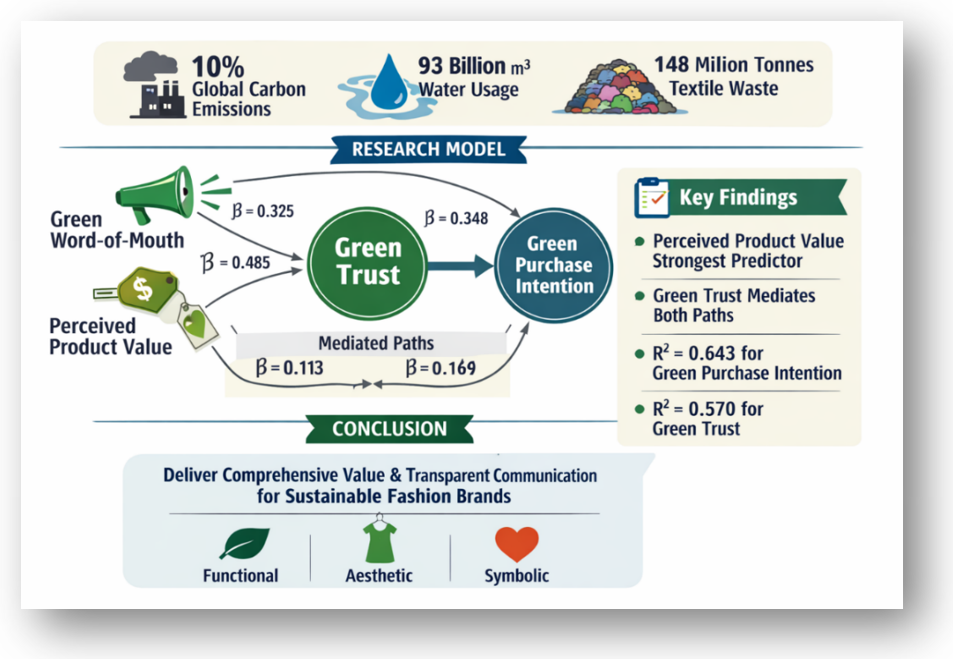
Graphical Abstract
Highlights
Ø Perceived product value exerted the strongest influence on green trust (β = 0.485), exceeding the effect of green word-of-mouth (β = 0.325);
Ø Green trust showed the strongest direct effect on green purchase intention (β = 0.348);
Ø Green trust significantly mediated the relationship between green word-of-mouth and green purchase intention (β = 0.113), and also mediated the relationship between perceived product value and green purchase intention (β = 0.169);
Ø The model demonstrated strong explanatory power, accounting for substantial variance in green purchase intention (R² = 0.643) and green trust (R² = 0.570).
Keywords
Subjects
OPEN ACCESS
©2026 The author(s). This article is licensed under a Creative Commons Attribution 4.0 International License, which permits use, sharing, adaptation, distribution and reproduction in any medium or format, as long as you give appropriate credit to the original author(s) and the source, provide a link to the Creative Commons license, and indicate if changes were made. The images or other third party material in this article are included in the article’s Creative Commons license, unless indicated otherwise in a credit line to the material. If material is not included in the article’s Creative Commons license and your intended use is not permitted by statutory regulation or exceeds the permitted use, you will need to obtain permission directly from the copyright holder. To view a copy of this license, visit: http://creativecommons.org/licenses/by/4.0/
PUBLISHER NOTE
GJESM Publisher remains neutral concerning jurisdictional claims in published maps and institutional affiliations.
MAJOR DATABASES, CITATION METRICS & CAPTURES
Google Scholar | Scopus - SJR | Web of Science | Biological Abstracts: Clarivate | Biosis Preview: Clarivate | PlumX Metrics | Altmetrics | Mendeley |
CURRENT PUBLISHER
GJESM Publisher



Letters to Editor
[1] Letters that include statements of statistics, facts, research, or theories should include appropriate references, although more than three are discouraged.
[2] Letters that are personal attacks on an author rather than thoughtful criticism of the author’s ideas will not be considered for publication.
[3] Letters can be no more than 300 words in length.
[4] Letter writers should include a statement at the beginning of the letter stating that it is being submitted either for publication or not.
[5] Anonymous letters will not be considered.
[6] Letter writers must include their city and state of residence or work.
[7] Letters will be edited for clarity and length.