Phylogenetic and conservation insights on local adaptations of Argiope modesta concerning ecological consequences

Document Type : RESEARCH ARTICLE

Authors

1 Research Center for Applied Zoology, National Research and Innovation Agency. Jl., Cibinong 16911, West Java, Indonesia

2 Research Center for Horticulture, National Research and Innovation Agency. Jl., Cibinong 16911, West Java, Indonesia

3 Research Center for Ecology, National Research and Innovation Agency. Jl., Cibinong 16911, West Java, Indonesia

4 Research Center for Geological Disaster, National Research and Innovation Agency. Jalan Sangkuriang, Dago, Kecamatan Coblong, Kota Bandung 40135, West Java, Indonesia

5 Research Center for Biota Systems, National Research and Innovation Agency. Jl., Cibinong 16911, West Java, Indonesia

6 Department of Biology, Faculty of Science, Institut Teknologi of Sumatra, South Lampung, Lampung 35365, Indonesia

Abstract
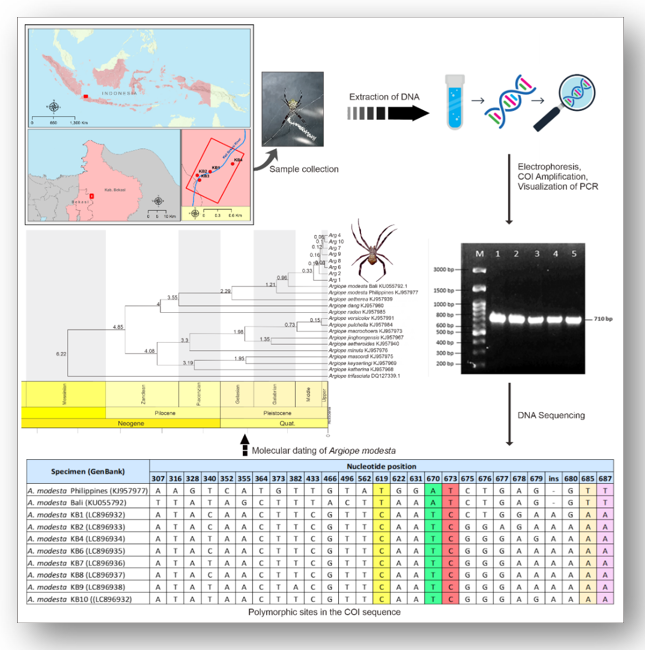
BACKGROUND AND OBJECTIVES: Argiope modesta is  an ecologically important predatory spider that contributes to natural pest suppression in agricultural ecosystems. The global agricultural system is under mounting pressure as food demand continues to rise. Meeting this demand requires increasing crop productivity while minimizing environmental impacts and preserving ecosystem integrity to support long-term sustainability. The study objectives were to investigate the phylogenetic position of A. modesta using cytochrome c oxidase subunit I sequences, estimate divergence times and identify genetically distinct lineages within and among geographic populations.
METHODS: Eight specimens were collected from shrubland habitats in Kebon Bambu  Village, Bekasi Regency, West Java, Indonesia. Basic local alignment search tool analysis confirmed that 97 percent of the collected individuals matched A. modesta.
FINDINGS: Seven polymorphic sites were detected within the Kebon Bambu population. Phylogenetic reconstruction placed A. modesta in a clade closely related to A. aetherea. Comparison with sequences from Bali (Indonesia) and the Philippines revealed 27 polymorphic sites, indicating substantial geographic differentiation. Molecular dating suggests that the Kebon Bambu, Balinese, and Philippine populations diverged approximately 1.21 million years ago during the early Pleistocene (Calabrian stage), with the Kebon Bambu lineage undergoing subsequent independent evolutionary development during the Holocene. These results suggest potential genetic distinctiveness of the Kebon Bambu population. However, the small sample size (n = 8) from a single locality limits robust conclusions about population-level genetic diversity and lineage distinctiveness. Preservation of intraspecific genetic diversity remains critical for ecosystem resilience and biological pest control. The validated COI sequences provide a basis for long-term molecular monitoring using deoxyribonucleic acid barcoding.
CONCLUSION: The study reveals significant genetic differentiation in A. modesta, with the Kebon Bambu population forming a distinct cytochrome c oxidase subunit I -based lineage defined by unique polymorphic markers. This genetic uniqueness provides a foundation for investigating potential local adaptation. However, whether such variation translates into enhanced biological control or pest suppression remains unresolved. Integrative studies combining genomics with functional phenotyping and field experiments are essential to justify conservation prioritization.

Graphical Abstract

Phylogenetic and conservation insights on local adaptations of Argiope modesta concerning ecological consequences

Highlights

Ø  The unique polymorphic location of the COI gene confirms the population of Argiope modesta in West Java as a new evolutionarily distinct genetic clade;

Ø  Molecular dating indicates the divergence of the Javanese population in the Holocene era (~3,300 years ago) and its separation from the Philippine lineage in the Pleistocene era (~1.21 million years ago);

Ø  This genetic diversity that is typical of locally adapted populations enhances its function as a biological control agent and strengthens the resilience of agroecosystems;

Ø  The integration of phylogenetic data in landscape management is crucial to protect unique lineages for the sustainability of ecosystem services in the tropical agricultural sector.

Keywords

Subjects

OPEN ACCESS

©2026 The author(s). This article is licensed under a Creative Commons Attribution 4.0 International License, which permits use, sharing, adaptation, distribution and reproduction in any medium or format, as long as you give appropriate credit to the original author(s) and the source, provide a link to the Creative Commons license, and indicate if changes were made. The images or other third party material in this article are included in the article’s Creative Commons license, unless indicated otherwise in a credit line to the material. If material is not included in the article’s Creative Commons license and your intended use is not permitted by statutory regulation or exceeds the permitted use, you will need to obtain permission directly from the copyright holder. To view a copy of this license, visit: http://creativecommons.org/licenses/by/4.0/

PUBLISHER NOTE

GJESM Publisher remains neutral concerning jurisdictional claims in published maps and institutional affiliations.

MAJOR DATABASES, CITATION METRICS & CAPTURES

Google Scholar | Scopus - SJR | Web of Science | Biological Abstracts: Clarivate | Biosis Preview: Clarivate | PlumX Metrics | Altmetrics | Mendeley |

CURRENT PUBLISHER

GJESM Publisher

Letters to Editor

GJESM Journal welcomes letters to the editor for the post-publication discussions and corrections which allows debate post publication on its site, through the Letters to Editor. Letters pertaining to manuscript published in GJESM should be sent to the editorial office of GJESM within three months of either online publication or before printed publication, except for critiques of original research. Following points are to be considering before sending the letters (comments) to the editor.

[1] Letters that include statements of statistics, facts, research, or theories should include appropriate references, although more than three are discouraged.
[2] Letters that are personal attacks on an author rather than thoughtful criticism of the author’s ideas will not be considered for publication.
[3] Letters can be no more than 300 words in length.
[4] Letter writers should include a statement at the beginning of the letter stating that it is being submitted either for publication or not.
[5] Anonymous letters will not be considered.
[6] Letter writers must include their city and state of residence or work.
[7] Letters will be edited for clarity and length.

Send comment about this article
Enter Name.
Enter a valid email address.
Enter a vaid affiliation.
Enter comments (At leaset 10 words)
CAPTCHA Image
Enter Security Code Correctly.

Article Podcasts

  • Receive Date 19 August 2025
  • Revise Date 22 November 2025
  • Accept Date 29 December 2025