Environmental stability and ultraviolet protection of Spodoptera litura nucleopolyhedrovirus encapsulated in chitosan nanoparticles

Document Type : RESEARCH ARTICLE

Authors

Department of Agrotechnology, Faculty of Agriculture, University of Jember, Jember, East Java 68121 Indonesia

Abstract
BACKGROUND AND OBJECTIVES: Spodoptera litura nuclear polyhedrosis virus is a potent biological control agent against the tobacco cutworm, Spodoptera litura. However, its field efficacy is severely limited by rapid inactivation due to solar ultraviolet radiation and environmental instability. The study objectives were to synthesize a novel nano-biopesticide formulation by encapsulating Spodoptera litura nuclear polyhedrosis virus within a chitosan matrix and to evaluate its physicochemical properties and protective efficacy against critical environmental stressors.
METHODS: Spodoptera litura nuclear polyhedrosis virus-loaded nanoparticles were synthesized via the ionic gelation method using chitosan and sodium tripolyphosphate. The physicochemical characteristics were elucidated using scanning electron microscopy, transmission electron microscopy, and zeta potential measurements. Encapsulation efficiency was quantified via the standard Bradford protein assay. The formulation’s stability and residual infectivity were assessed through bioassays against third-instar Spodoptera litura larvae following exposure to ultraviolet-A with 365 nanometers and ultraviolet-B with 312 nanometers irradiation (1–4 hours), varying potential of hydrogen conditions: 3–6, and thermal stress: 4, 25, and 40 degrees Celsius.
FINDINGS: Transmission electron microscopy analysis revealed the formation of discrete, spherical primary nanoparticles with an ultra-small average diameter of approximately 48 nanometers, although scanning electron microscopy indicated a tendency for agglomeration in the freeze-dried state. The formulation exhibited a moderate encapsulation efficiency of 50.25 percent and a zeta potential of -29.6 millivolt, indicating sufficient colloidal stability. Crucially, bioassays demonstrated that the chitosan encapsulation significantly preserved viral infectivity under harsh conditions; the virus remained active after 4 hours of continuous ultraviolet irradiation and survived incubation in acidic environments with a potential of hydrogen: 3–6, conditions that typically inactivate unprotected or naked baculoviruses.
CONCLUSION: The synthesized chitosan nanoparticles successfully encapsulate Spodoptera litura nuclear polyhedrosis virus and provide a robust physical shield against ultraviolet radiation and extreme potential of hydrogen. The achievement of a sub-100-nanometer particle size offers potential advantages for cellular uptake and tissue penetration. This formulation represents a promising, environmentally stable delivery system for viral biopesticides, warranting further optimization and open-field trials.

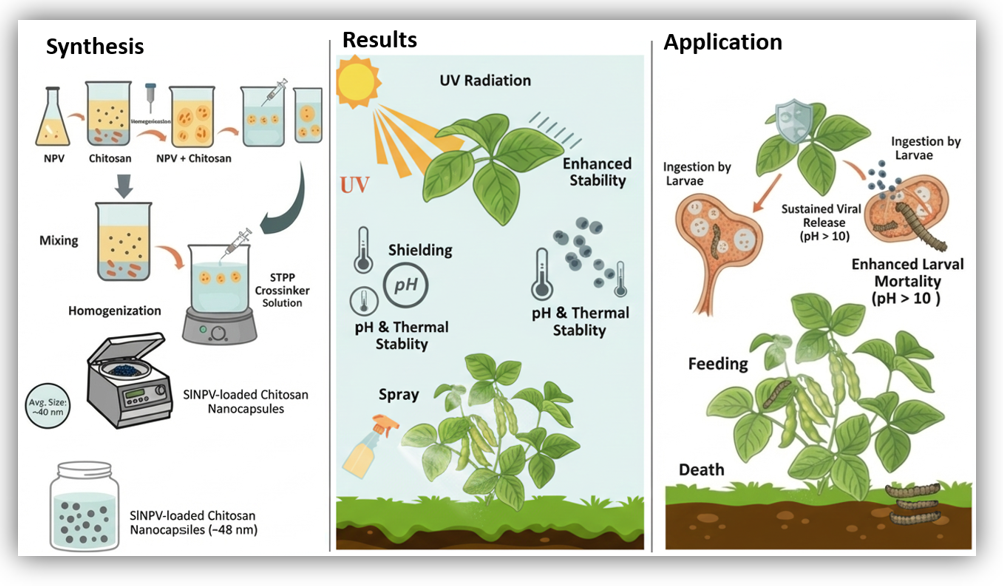
Graphical Abstract

Environmental stability and ultraviolet protection of Spodoptera litura nucleopolyhedrovirus encapsulated in chitosan nanoparticles

Highlights

Ø  Spherical chitosan nanoparticles with an ultra-small average core diameter of ~48 nm were successfully synthesized via ionic gelation.

Ø  The formulation exhibited moderate encapsulation efficiency (~50%) and sufficient colloidal stability with a zeta potential of -29.6 mV.

Ø  Bioassays confirmed that the encapsulated SlNPV retained infectivity even after 4 hours of continuous exposure to UV-A and UV-B irradiation.

Ø  The chitosan matrix effectively protected the viral cargo against degradation in acidic environments (pH 3–6) and fluctuating thermal stress.

Keywords

Subjects

OPEN ACCESS

©2026 The author(s). This article is licensed under a Creative Commons Attribution 4.0 International License, which permits use, sharing, adaptation, distribution and reproduction in any medium or format, as long as you give appropriate credit to the original author(s) and the source, provide a link to the Creative Commons license, and indicate if changes were made. The images or other third party material in this article are included in the article’s Creative Commons license, unless indicated otherwise in a credit line to the material. If material is not included in the article’s Creative Commons license and your intended use is not permitted by statutory regulation or exceeds the permitted use, you will need to obtain permission directly from the copyright holder. To view a copy of this license, visit: http://creativecommons.org/licenses/by/4.0/

PUBLISHER NOTE

GJESM Publisher remains neutral concerning jurisdictional claims in published maps and institutional affiliations.

MAJOR DATABASES, CITATION METRICS & CAPTURES

Google Scholar | Scopus - SJR | Web of Science | Biological Abstracts: Clarivate | Biosis Preview: Clarivate | PlumX Metrics | Altmetrics | Mendeley |

CURRENT PUBLISHER

GJESM Publisher

Letters to Editor

GJESM Journal welcomes letters to the editor for the post-publication discussions and corrections which allows debate post publication on its site, through the Letters to Editor. Letters pertaining to manuscript published in GJESM should be sent to the editorial office of GJESM within three months of either online publication or before printed publication, except for critiques of original research. Following points are to be considering before sending the letters (comments) to the editor.

[1] Letters that include statements of statistics, facts, research, or theories should include appropriate references, although more than three are discouraged.
[2] Letters that are personal attacks on an author rather than thoughtful criticism of the author’s ideas will not be considered for publication.
[3] Letters can be no more than 300 words in length.
[4] Letter writers should include a statement at the beginning of the letter stating that it is being submitted either for publication or not.
[5] Anonymous letters will not be considered.
[6] Letter writers must include their city and state of residence or work.
[7] Letters will be edited for clarity and length.

Send comment about this article
Enter Name.
Enter a valid email address.
Enter a vaid affiliation.
Enter comments (At leaset 10 words)
CAPTCHA Image
Enter Security Code Correctly.

Article Podcasts

  • Receive Date 14 August 2025
  • Revise Date 22 November 2025
  • Accept Date 24 December 2025