Tropical peat soil variability along landscape and depth gradient using mid-infrared spectroscopy

Document Type : CASE STUDY

Authors

1 Research Center for Ecology, National Research and Innovation Agency, KST Soekarno, Cibinong, Indonesia

2 Faculty of Forestry, Gadjah Mada University, Yogyakarta, Indonesia

3 Faculty of Agriculture, University of Palangkaraya, Palangkaraya, Indonesia

4 Center for Watershed Management of Solo, Ministry of Forestry, Surakarta, Indonesia

5 Research Center for Food Crops, National Research and Innovation Agency, KST Soekarno, Cibinong, Indonesia

Abstract
BACKGROUND AND OBJECTIVES: Tropical peatlands, recognized as vital carbon sinks, remain vulnerable to drainage, canal and road construction, as well as frequent seasonal fires. These disturbances modify peat hydrodynamics and stimulate organic matter decay. Understanding chemical peat soil properties such as degree of decomposition provides support for landscape-based peatland management. The goals of this study were to analyze soil organic matter and its fluctuations with depth and location concerning hydrological features in a disturbed tropical peatland.
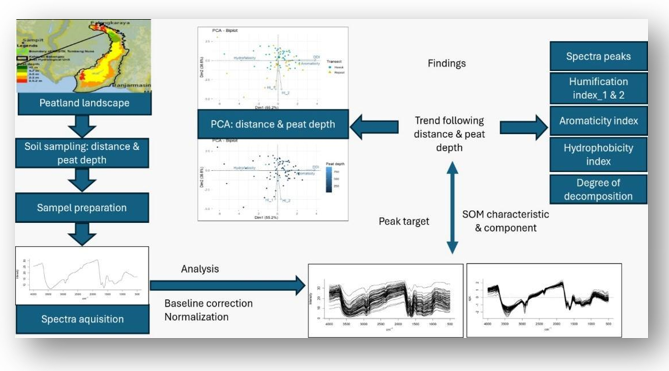
METHODS: Peat samples were collected every 500 meters along two transects representing different landscape and depth gradients. At every sampling location, samples were collected at every 50 centimeters section, starting from the surface and continuing downwards until the mineral layer. Fourier transform infrared spectroscopy was used to characterize chemical functional groups of peat soil and to quantify the indices of humification, hydrophobicity, aromaticity, and decomposition. To analyze the trends between landscape and depths, principal component analysis was utilized.
FINDINGS: Spectral analysis showed variation of functional groups between landscape and depth. The upper layer of peat exhibited a comparatively greater amount of aliphatic and oxidized substances than the lower layers, whereas the concentration of aromatic and humified structures generally rose with depth. Areas near the river or canal tended to have a lower hydrophobicity and higher decomposition pattern, which suggests a more active aerobic breakdown. Principal component analysis revealed that depth is the main variable that controls the pattern of functional group composition of the soil organic matter, while disturbance and hydrology contribute additional dimensions of spatial variability.
CONCLUSION: Fourier transform infrared spectroscopy is useful for characterizing chemical properties of tropical peat soil. It demonstrates how drainage, hydrological matrix, and fire affect the composition of soil organic matter throughout different landscape and depth. The technique is useful and effective as a diagnostic tool for peat degradation detection to support peatland restoration efforts.

Graphical Abstract

Tropical peat soil variability along landscape and depth gradient using mid-infrared spectroscopy

Highlights

⮚     FTIR spectroscopy was an effective analytical method for characterizing the chemical properties of tropical peat soils, considering both vertical profiles and landscape gradients;

⮚     Peat depth is the main factor influencing soil organic matter composition, as deeper layers consistently show higher levels of aromatic, humified, and chemically stable material;

⮚     The observed patterns indicate that disturbance events can disrupt the natural acrotelm–catotelm structure, resulting in chemically diverse peat profiles.

Keywords

Subjects

OPEN ACCESS

©2026 The author(s). This article is licensed under a Creative Commons Attribution 4.0 International License, which permits use, sharing, adaptation, distribution and reproduction in any medium or format, as long as you give appropriate credit to the original author(s) and the source, provide a link to the Creative Commons license, and indicate if changes were made. The images or other third party material in this article are included in the article’s Creative Commons license, unless indicated otherwise in a credit line to the material. If material is not included in the article’s Creative Commons license and your intended use is not permitted by statutory regulation or exceeds the permitted use, you will need to obtain permission directly from the copyright holder. To view a copy of this license, visit: http://creativecommons.org/licenses/by/4.0/

PUBLISHER NOTE

GJESM Publisher remains neutral concerning jurisdictional claims in published maps and institutional affiliations.

MAJOR DATABASES, CITATION METRICS & CAPTURES

Google Scholar | Scopus - SJR | Web of Science | Biological Abstracts: Clarivate | Biosis Preview: Clarivate | PlumX Metrics | Altmetrics | Mendeley |

CURRENT PUBLISHER

GJESM Publisher

Letters to Editor

GJESM Journal welcomes letters to the editor for the post-publication discussions and corrections which allows debate post publication on its site, through the Letters to Editor. Letters pertaining to manuscript published in GJESM should be sent to the editorial office of GJESM within three months of either online publication or before printed publication, except for critiques of original research. Following points are to be considering before sending the letters (comments) to the editor.

[1] Letters that include statements of statistics, facts, research, or theories should include appropriate references, although more than three are discouraged.
[2] Letters that are personal attacks on an author rather than thoughtful criticism of the author’s ideas will not be considered for publication.
[3] Letters can be no more than 300 words in length.
[4] Letter writers should include a statement at the beginning of the letter stating that it is being submitted either for publication or not.
[5] Anonymous letters will not be considered.
[6] Letter writers must include their city and state of residence or work.
[7] Letters will be edited for clarity and length.

Send comment about this article
Enter Name.
Enter a valid email address.
Enter a vaid affiliation.
Enter comments (At leaset 10 words)
CAPTCHA Image
Enter Security Code Correctly.

Article Podcasts

  • Receive Date 15 August 2025
  • Revise Date 21 November 2025
  • Accept Date 24 December 2025