Sustainable strategies for durum wheat production under water scarcity and climate stress

Document Type : REVIEW PAPER

Authors

1 Department of Environmental Engineering and Management, Faculty of atural Sciences, L.N. Gumilyov Eurasian National University, Astana, Kazakhstan

2 Department of Morphology, NCJSC Karaganda Medical University, Karaganda, Kazakhstan

3 Department of Ecology and Geography, Sarsen Amanzholov University of East Kazakhstan, Ust-Kamenogorsk, Kazakhstan

4 Department of Ecology and life safety, Faculty of engineering, Yessenov University, Aktau, Kazakhstan

5 Fluid Analysis Directorate of the Laboratory Research Department, Branch of KazMunayGas Engineering LLP "Kazakh Scientific and Design Institute of Oil and Gas" Aktau, Kazakhstan

Abstract
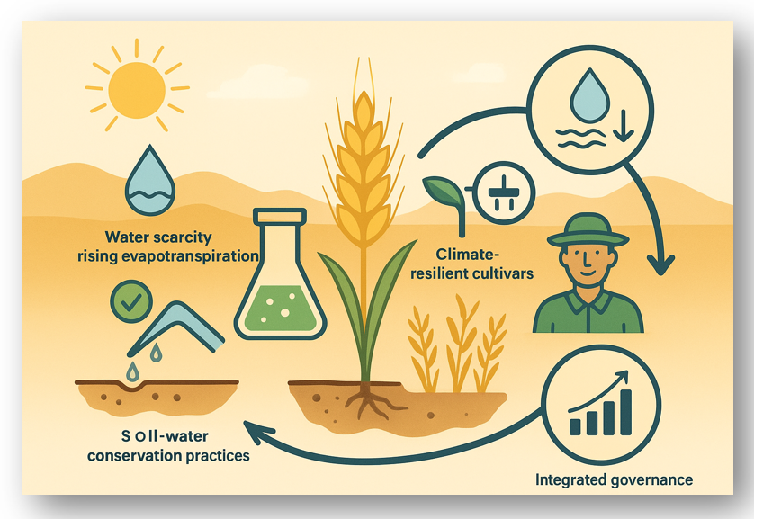
Water scarcity, rising evapotranspiration, and increasing climate variability pose substantial challenges to cereal production, particularly in semi-arid regions where durum wheat (Triticum durum) is a critical crop for food security. This study synthesizes research on strategies to enhance durum wheat resilience under water-limited conditions and highlights emerging opportunities for adaptation under intensifying climate stress. Key approaches include the development and deployment of drought-tolerant and climate-resilient cultivars, precision irrigation technologies that optimize water use, and soil-water conservation practices such as conservation tillage, residue retention, mulching, crop rotation with legumes, and organic matter enhancement. These measures improve soil structure, water infiltration, and moisture retention, thereby reducing irrigation requirements and buffering crops against episodic droughts while maintaining long-term soil productivity. The study also addresses the environmental trade-offs associated with irrigation expansion, including soil salinization, groundwater depletion, and energy-related greenhouse gas emissions, which can collectively undermine farm sustainability if not properly managed. Integrated governance frameworks that align water, energy, and food priorities are essential for sustainable intensification, particularly in regions where irrigation development is constrained by hydrological or infrastructural limitations. Mechanisms such as volumetric water allocation, systematic groundwater and salinity monitoring, and the incorporation of renewable-energy-powered irrigation systems provide the regulatory and operational tools necessary to prevent resource overexploitation and ensure equitable access across farming communities. An illustrative example from continental semi-arid basins demonstrates how supplemental irrigation during critical growth stages, combined with basin-level water planning and rational groundwater use, can stabilize wheat yields without compromising environmental integrity. The case highlights the potential for integrating multiple water sources, including surface water, groundwater, and collector-drainage water, with climate-resilient cultivars to enhance productivity while maintaining ecosystem health. Sustainable durum wheat systems require simultaneous advances in agronomy, technological innovation, resource governance, and farmer capacity-building to ensure successful implementation. Advancing semi-arid agriculture will ultimately depend on integrating drought-tolerant varieties, efficient irrigation, soil–water conservation, and Water–Energy–Food–aligned planning into cohesive strategies that can guide future innovation and policy toward resilient, climate-ready production systems.

Graphical Abstract

Sustainable strategies for durum wheat production under water scarcity and climate stress

Highlights

Ø  Integrating drought-tolerant durum wheat genotypes with precision irrigation consistently improves water-use efficiency and stabilizes yield under semi-arid climatic stressors;

Ø  Soil-water conservation practices including residue retention, mulching, and conservation tillage significantly enhance soil moisture retention and reduce irrigation demand in water-limited systems;

Ø  Irrigation expansion produces environmental trade-offs, with salinization, groundwater decline, and pumping-related emissions emerging as major constraints requiring coordinated governance;

Ø  Coupling supplemental irrigation with basin-level water planning and diversified water sources provides a viable pathway to maintain wheat productivity while safeguarding ecosystem integrity.

Keywords

Subjects

OPEN ACCESS

©2026 The author(s). This article is licensed under a Creative Commons Attribution 4.0 International License, which permits use, sharing, adaptation, distribution and reproduction in any medium or format, as long as you give appropriate credit to the original author(s) and the source, provide a link to the Creative Commons license, and indicate if changes were made. The images or other third party material in this article are included in the article’s Creative Commons license, unless indicated otherwise in a credit line to the material. If material is not included in the article’s Creative Commons license and your intended use is not permitted by statutory regulation or exceeds the permitted use, you will need to obtain permission directly from the copyright holder. To view a copy of this license, visit: http://creativecommons.org/licenses/by/4.0/

PUBLISHER NOTE

GJESM Publisher remains neutral concerning jurisdictional claims in published maps and institutional affiliations.

MAJOR DATABASES, CITATION METRICS & CAPTURES

Google Scholar | Scopus - SJR | Web of Science | Biological Abstracts: Clarivate | Biosis Preview: Clarivate | PlumX Metrics | Altmetrics | Mendeley |

CURRENT PUBLISHER

GJESM Publisher

Letters to Editor

GJESM Journal welcomes letters to the editor for the post-publication discussions and corrections which allows debate post publication on its site, through the Letters to Editor. Letters pertaining to manuscript published in GJESM should be sent to the editorial office of GJESM within three months of either online publication or before printed publication, except for critiques of original research. Following points are to be considering before sending the letters (comments) to the editor.

[1] Letters that include statements of statistics, facts, research, or theories should include appropriate references, although more than three are discouraged.
[2] Letters that are personal attacks on an author rather than thoughtful criticism of the author’s ideas will not be considered for publication.
[3] Letters can be no more than 300 words in length.
[4] Letter writers should include a statement at the beginning of the letter stating that it is being submitted either for publication or not.
[5] Anonymous letters will not be considered.
[6] Letter writers must include their city and state of residence or work.
[7] Letters will be edited for clarity and length.

Send comment about this article
Enter Name.
Enter a valid email address.
Enter a vaid affiliation.
Enter comments (At leaset 10 words)
CAPTCHA Image
Enter Security Code Correctly.

Article Podcasts

  • Receive Date 06 September 2025
  • Revise Date 08 November 2025
  • Accept Date 10 December 2025