Physical and chemical evaluation of soil-like material from landfill mining using an alternative growing medium

Document Type : RESEARCH ARTICLE

Authors

1 Research Centre for Environmental and Clean Technologies, National Research and Innovation Agency, South Tangerang, Banten, Indonesia

2 Research Centre for Geological Disaster, National Research and Innovation Agency, South Tangerang, Banten, Indonesia

3 Directorate of Laboratory Management, Research Facilities, and Science and Technology Area, National Research and Innovation Agency, South Tangerang, Banten, Indonesia

4 Faculty of Engineering, Sahid University, South Jakarta, Jakarta, Indonesia

Abstract
BACKGROUND AND OBJECTIVES: Jakarta's municipal solid waste generation is reaching landfill capacity due to rapid urbanization, metropolitan lifestyles, and industrial growth. Landfill mining increases capacity and reuses materials when landfill expansion is not feasible. At Bantargebang's integrated municipal solid waste treatment facility, the landfill mining plant produces materials akin to soil and refuse-derived fuel. This study assesses the suitability of soil-like material’s physical and chemical properties as a growing medium.
METHODS: For seven consecutive working days, fine fractions less than 50 millimeters obtained from trommel screening of landfill materials were sampled using the quartering technique. Samples were analyzed for moisture, ash, texture, cation exchange capacity, pH, total organic carbon, total Kjeldahl nitrogen, carbon-to-nitrogen ratio, phosphorus, potassium, and heavy metals. Soil-like material composition and physical properties followed American Society for Testing and Materials and International Soil Reference and Information Centre standards, chemical properties followed Natural Resources Conservation Service and United States Department of Agriculture guidelines, and heavy metals followed Environmental Protection Agency methods. In a greenhouse experiment, soil-like material and compost were mixed in proportions ranging from 100 to 60 percent soil-like material by weight, in 10 percent steps, to assess their effectiveness as a growing medium for Calliandra calothyrsus.
FINDINGS: Composition analysis showed that 40.61 percent of the landfill-mined fine fraction consisted of soil-like material particles smaller than 4.75 millimeters with high organic matter, sufficient inorganic materials, and elevated heavy metals, particularly iron, manganese, and cadmium. The organic matter was primarily undecomposed and unstable, characterized by a total organic carbon level of 57.08 percent, significant volatile solids at 78.60 percent, and a carbon-to-nitrogen ratio of 27.9, potentially resulting in microbial nitrogen immobilization. With a cation exchange capacity of only 16.39 centimoles per kilogram, moisture levels at 32.78 percent, a texture primarily consisting of coarse sand, and low levels of potassium at 598.33 milligrams per kilogram and phosphorus at 140.20 milligrams per kilogram, significantly restricted the performance of the growing medium. A greenhouse experiment showed that an 80 percent soil-like material–20 percent compost mix performed best, yielding an average final plant height of 51.67 centimeters over 127 days, exceeding other ratios (39.33–49.61 centimeters).
CONCLUSION: Plant growth initially relied on seedling nutrients, then on compost, with soil-like material gradually supplying nitrogen. Enhancing nutrient availability and minimizing metal toxicity can be achieved through stabilization via co-composting or blending with nutrient-rich amendments.

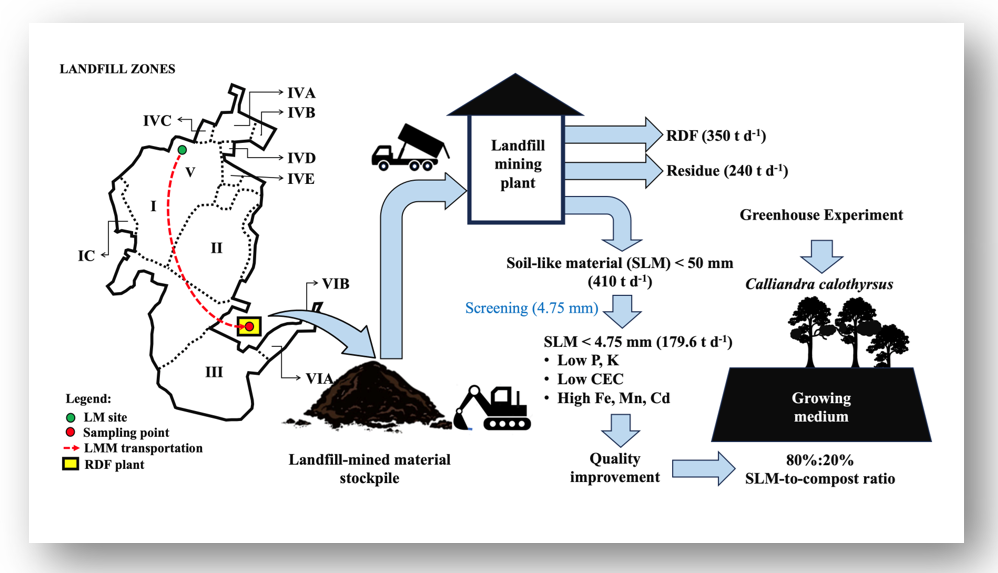
Graphical Abstract

Physical and chemical evaluation of soil-like material from landfill mining using an alternative growing medium

Highlights

Ø  Although the utilization of landfill-mined soil-like material remains suboptimal, it shows strong potential as a growing medium for non-food cultivation;

Ø  The 4.75 mm SLM fraction is the best for growing media, but its low P, K, and CEC and high levels of heavy metals need to be improved to make it safer and better;

Ø  The best plant growth occurred in a mixture of 80% SLM and 20% compost, with compost providing nutrients early and the SLM slowly releasing nitrogen and minor nutrients later;

Ø  Stabilization and organic amendment are essential for improving nutrient availability, reducing metal toxicity, and ensuring environmental safety for practical use.

Keywords

Subjects

OPEN ACCESS

©2026 The author(s). This article is licensed under a Creative Commons Attribution 4.0 International License, which permits use, sharing, adaptation, distribution and reproduction in any medium or format, as long as you give appropriate credit to the original author(s) and the source, provide a link to the Creative Commons license, and indicate if changes were made. The images or other third party material in this article are included in the article’s Creative Commons license, unless indicated otherwise in a credit line to the material. If material is not included in the article’s Creative Commons license and your intended use is not permitted by statutory regulation or exceeds the permitted use, you will need to obtain permission directly from the copyright holder. To view a copy of this license, visit: http://creativecommons.org/licenses/by/4.0/

PUBLISHER NOTE

GJESM Publisher remains neutral concerning jurisdictional claims in published maps and institutional affiliations.

MAJOR DATABASES, CITATION METRICS & CAPTURES

Google Scholar | Scopus - SJR | Web of Science | Biological Abstracts: Clarivate | Biosis Preview: Clarivate | PlumX Metrics | Altmetrics | Mendeley |

CURRENT PUBLISHER

GJESM Publisher

Letters to Editor

GJESM Journal welcomes letters to the editor for the post-publication discussions and corrections which allows debate post publication on its site, through the Letters to Editor. Letters pertaining to manuscript published in GJESM should be sent to the editorial office of GJESM within three months of either online publication or before printed publication, except for critiques of original research. Following points are to be considering before sending the letters (comments) to the editor.

[1] Letters that include statements of statistics, facts, research, or theories should include appropriate references, although more than three are discouraged.
[2] Letters that are personal attacks on an author rather than thoughtful criticism of the author’s ideas will not be considered for publication.
[3] Letters can be no more than 300 words in length.
[4] Letter writers should include a statement at the beginning of the letter stating that it is being submitted either for publication or not.
[5] Anonymous letters will not be considered.
[6] Letter writers must include their city and state of residence or work.
[7] Letters will be edited for clarity and length.

Send comment about this article
Enter Name.
Enter a valid email address.
Enter a vaid affiliation.
Enter comments (At leaset 10 words)
CAPTCHA Image
Enter Security Code Correctly.

Article Podcasts

  • Receive Date 21 August 2025
  • Revise Date 29 October 2025
  • Accept Date 02 December 2025