Document Type : CASE STUDY
Authors
1
Research Center for Horticulture, National Research and Innovation Agency, Jl. Raya Jakarta-Bogor KM 46, Cibinong, Indonesia
2
Research Center for Food Crops, National Research and Innovation Agency, Jl. Raya Jakarta-Bogor KM 46, Cibinong, Indonesia
3
Research Center for Estate Crops, National Research and Innovation Agency, Jl. Raya Jakarta-Bogor KM 46, Cibinong, Indonesia
4
Research Center for Food Technology and Processing, National Research and Innovation Agency, Cibinong-Bogor, West Java, Indonesia
Abstract
BACKGROUND AND OBJECTIVES: Excessive reliance on inorganic nitrogen–phosphorus–potassium fertilizers in shallot (Allium cepa var. aggregatum) production can degrade soil quality, increase nutrient losses, and reduce smallholder profitability. This study assessed the potential of locally sourced organic nutrients, in conjunction with a microbial biofertilizer, to maintain shallot yield and enhance soil characteristics in tropical environments
METHODS: An experimental design based on a randomized complete block with six treatments and four replicates; each replicate consists of ten plants. Treatments compared one hundred percent mineral fertilizer; fifty percent mineral fertilizer combined with poultry manure; fifty percent mineral fertilizer combined with poultry manure plus the Biosoltamax microbial biofertilizer. In addition, fifty percent mineral fertilizer combined with sheep manure plus the Biosoltamax microbial biofertilizer black soldier fly frass compost. Followed by fifty percent mineral fertilizer combined with black soldier fly frass compost (locally named ‘Kasgot’) and the commercial microbial biofertilizer Biosoltamax; and an additional treatment as specified in the methods. An evaluation was conducted on plant growth and yield parameters, soil chemical properties, urease activity, and the use of scanning electron microscopy with energy dispersive spectroscopy. Statistical analyses included analysis of variance and mean separation at a probability less than 0.05.
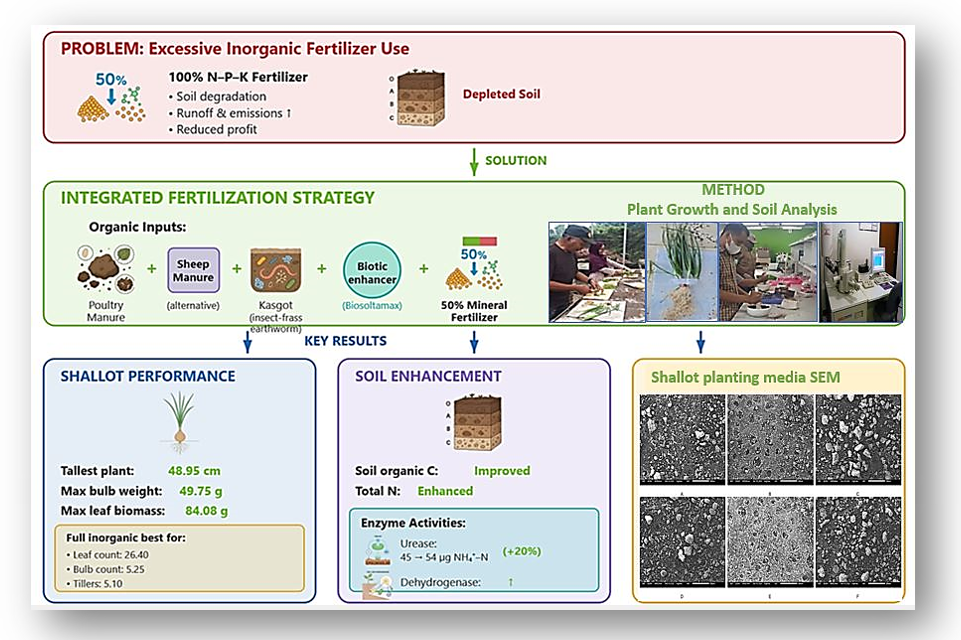
FINDINGS: The treatment combining fifty percent mineral fertilizer, black soldier fly frass compost and Biosoltamax produced strong vegetative growth (maximum plant height 48.95 centimeters; maximum fresh leaf biomass 84.08 grams per plant) and high bulb productivity (mean fresh bulb weight 49.75 grams per bulb; mean 5.25 bulbs per plant, equivalent to about 261.2 grams fresh bulb mass per plant). Under integrated organic and reduced mineral regimes, soil organic carbon increased from 1.35 percent to 1.59 percent, and total nitrogen rose from 0.14 percent to 0.175 percent; furthermore, there was also an increase in urease activity. Energy dispersive spectroscopy showed that carbon and oxygen dominated the soil particle composition (carbon: 45–55 percent; oxygen: 36–42 percent), consistent with enriched organic-matter inputs.
CONCLUSION: Using poultry manure and earthworm compost from black soldier fly frass along with a microbial biofertilizer and decreasing mineral fertilizer application, can preserve shallot yield and simultaneously improve soil organic carbon, total nitrogen, and soil properties. This combined approach supports healthier soil and offers an environmentally safer alternative to full mineral fertilizer use.
Graphical Abstract
Highlights
Ø Integrated organic + microbial strategy (poultry manure or BSF-frass vermicompost + Biosoltamax) produced strong vegetative performance: the highest fresh leaf biomass recorded was 84.08 g per plant;
Ø SEM–EDS elemental fingerprint consistent with organic amendment signatures: carbon and oxygen dominated the media (C: 45–55%, O: 36–42%), indicating high organic-matter content derived from manure and compost inputs;
Ø Soil fertility improvements after treatments: soil organic carbon increased from 1.35% to 1.59%, and total nitrogen increased from 0.14% to 0.175% under integrated organic + mineral regimes.
Keywords
Subjects
OPEN ACCESS
©2026 The author(s). This article is licensed under a Creative Commons Attribution 4.0 International License, which permits use, sharing, adaptation, distribution and reproduction in any medium or format, as long as you give appropriate credit to the original author(s) and the source, provide a link to the Creative Commons license, and indicate if changes were made. The images or other third party material in this article are included in the article’s Creative Commons license, unless indicated otherwise in a credit line to the material. If material is not included in the article’s Creative Commons license and your intended use is not permitted by statutory regulation or exceeds the permitted use, you will need to obtain permission directly from the copyright holder. To view a copy of this license, visit: http://creativecommons.org/licenses/by/4.0/
PUBLISHER NOTE
GJESM Publisher remains neutral concerning jurisdictional claims in published maps and institutional affiliations.
MAJOR DATABASES, CITATION METRICS & CAPTURES
Google Scholar | Scopus - SJR | Web of Science | Biological Abstracts: Clarivate | Biosis Preview: Clarivate | PlumX Metrics | Altmetrics | Mendeley |
CURRENT PUBLISHER
GJESM Publisher



Letters to Editor
[1] Letters that include statements of statistics, facts, research, or theories should include appropriate references, although more than three are discouraged.
[2] Letters that are personal attacks on an author rather than thoughtful criticism of the author’s ideas will not be considered for publication.
[3] Letters can be no more than 300 words in length.
[4] Letter writers should include a statement at the beginning of the letter stating that it is being submitted either for publication or not.
[5] Anonymous letters will not be considered.
[6] Letter writers must include their city and state of residence or work.
[7] Letters will be edited for clarity and length.