Document Type : CASE STUDY
Authors
1
GIS Technology Laboratory, Kozybayev Lab, Department of Science, M. Kozybayev North Kazakhstan university, Petropavlovsk, Kazakhstan
2
Department of Geography and Ecology of M.Kozybayev North Kazakhstan University, Petropavlovsk, Kazakhstan
3
Department of of Pedagogy and History A.K. Kussayinov Eurasian Humanities Institute, Astana, Kazakhstan
4
Department of Ecology and Safety, Faculty of Engineering, Yessenov University, Aktau, Kazakhstan
Abstract
BACKGROUND AND OBJECTIVES: Accurate evaluation of aquatic ecosystem suitability is critical for sustainable environmental management, particularly in regions that prioritize aquaculture and biodiversity conservation. Although Geographic Information System–based modelling is increasingly used to classify water bodies according to morphometric and ecological parameters, experimental validation across extensive lake networks remains limited. This study merged geospatial suitability modeling with on-site evaluations to develop a validated framework for evaluating the environmental quality and aquaculture potential of inland lakes in Northern Kazakhstan.
METHODS: A total of 286 lakes were evaluated using a Geographic Information System–based multi-criteria approach that incorporated surface area, water depth, pollution indicators, macrophyte cover, and algal bloom intensity to classify lakes into high, medium, and low suitability categories. Over the course of two years, thirty representative lakes, comprising ten from each category, were sampled seasonally. In six lakes identified as suitable for medium, microcosm experiments investigated the effects of nutrient enrichment and the removal of macrophytes on the water quality. Statistical analyses examined correlations between Geographic Information System–derived suitability scores and measured environmental quality indices.
FINDINGS: High-suitability lakes exhibited significantly higher dissolved oxygen concentration (7.8 ± 0.9 milligrams per liter) and water transparency (1.6 ± 0.3 meters), and lower total phosphorus (0.045 ± 0.012 milligrams per liter) and total nitrogen (0.48 ± 0.11 milligrams per liter) compared with low-suitability lakes (dissolved oxygen 3.5 ± 0.7 milligrams per liter; transparency 0.6 ± 0.2 meters; total phosphorus 0.122 ± 0.029 milligrams per liter; total nitrogen 1.21 ± 0.25 milligrams per liter). Microcosm experiments revealed that nutrient enrichment and macrophyte removal increased chlorophyll-a concentration by 41 percent and reduced dissolved oxygen concentration by 25 percent, indicating the sensitivity of medium-suitability lakes to nutrient loading and vegetation loss. The suitability scores from the geographic information system were found to correlate significantly with the measured environmental indices (coefficient of determination 0.74, p-value less than 0.01), which confirms the predictive power of the spatial model.
CONCLUSION: Integrating Geographic Information System–based modelling with empirical validation creates a reliable strategy for determining inland lake suitability and promoting sustainable management of freshwater resources.
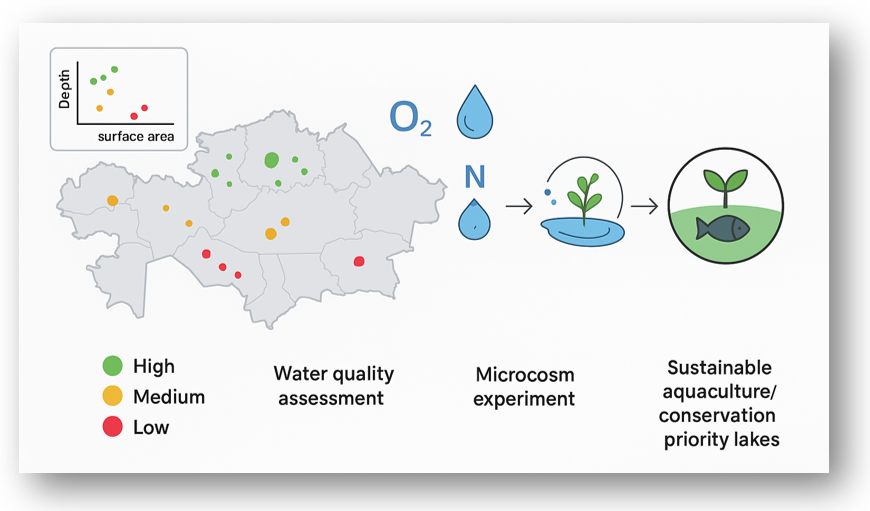
Graphical Abstract
Highlights
Ø GIS-based suitability scores correlated strongly with field indices (R² = 0.74, p < 0.01), confirming model reliability;
Ø High-suitability lakes had higher DO (7.8 mg/L) and transparency (1.6 m), lower TN (0.48 mg/L) and TP (0.045 mg/L);
Ø Nutrient enrichment increased chlorophyll-a by 41% and reduced dissolved oxygen by 25% in medium-suitability microcosms;
Ø Integrated geospatial–experimental approach supports data-driven lake prioritization for sustainable aquaculture and ecosystem management.
Keywords
Subjects



Letters to Editor
[1] Letters that include statements of statistics, facts, research, or theories should include appropriate references, although more than three are discouraged.
[2] Letters that are personal attacks on an author rather than thoughtful criticism of the author’s ideas will not be considered for publication.
[3] Letters can be no more than 300 words in length.
[4] Letter writers should include a statement at the beginning of the letter stating that it is being submitted either for publication or not.
[5] Anonymous letters will not be considered.
[6] Letter writers must include their city and state of residence or work.
[7] Letters will be edited for clarity and length.