Document Type : CASE STUDY
Authors
1
Faculty of Agricultural Sciences, Universidad Técnica de Machala, km 5,5 Pasaje, Machala, Ecuador
2
Sustainable Economic Futures, SEF-Clean Gold #2004 1225 Richards Street, Vancouver, V6B 3G3, BC Canada
3
Analytical Department, Laboratorios LASA, Juan Ignacio Pareja OE854 y Pablo Palacio, Quito, Ecuador
Abstract
BACKGROUND AND OBJECTIVES: The transition from mercury amalgamation to cyanide-based extraction in artisanal and small-scale gold mining has reshaped contaminant behavior in mining-impacted watersheds. This study integrates simultaneous measurements of cyanide, nitrogen species, sulfate, bicarbonate, and mercury to evaluate their coupled dynamics along the extraction–tailings–river continuum in the Portovelo–Zaruma district (southern Ecuador). The objectives of this study were to: i) quantify free and total cyanide and dissolved mercury in leaching tanks, tailings ponds, and river sites; ii) characterize nitrogen, sulfate, and bicarbonate formation associated with cyanide degradation and ore mineralogy; and iii) assess how these processes influence downstream mercury mobility and environmental vulnerability.
METHODS: Sampling included feed-ore mineralogy; leaching-tank solutions (n = 5); tailings-pond solutions (n = 5); and river sites (n = 12, each with three cross-sectional replicates). Free, total cyanide and mercury were measured during processing. Levels of mercury, nitrate, sulfate, bicarbonate, chemical oxygen demand, conductivity, and total dissolved were investigated in tailings solutions and river waters.
FINDINGS: Free cyanide decreased from 517 ± 135 milligram per liters in leaching tanks to ~182 milligram per liters gram per tailings ponds (~80 percent reduction) and to <0.001 milligram per liters downstream (>99.9 percent attenuation). Total cyanide declined from 695 ± 159 milligram per liters in leaching-tank effluents to <0.004 milligram per liters in river water. Mineralogy (25–35 percent pyrite; 10–15 percent calcite/dolomite) contributed sulfate up to 500 milligram per liters and bicarbonate up to 250 milligram per liters in tailings, both increasing downstream. nitrate rose from 0.49 to 2.54 milligram per liters, and chemical oxygen demand from 40–50 to 200–240 milligram per liters. Dissolved mercury remained <0.001 milligram per liters in river water, though tailings solids contained 0.50 ± 0.10 milligrams per kilogram mercury. These patterns indicate cyanide degradation, nitrogen enrichment, mineral-derived anion release, and associated shifts in mercury behavior.
CONCLUSION: The Puyango River functions as a reactive geochemical corridor where cyanide attenuation, nutrient enrichment, organic loading, and mineral-driven sulfate–bicarbonate release converge with legacy mercury to shape water quality and ecological vulnerability. Effective management requires integrated monitoring of cyanide, nitrogen, and mercury pathways supported by sediment, biota, and microbial assessments.
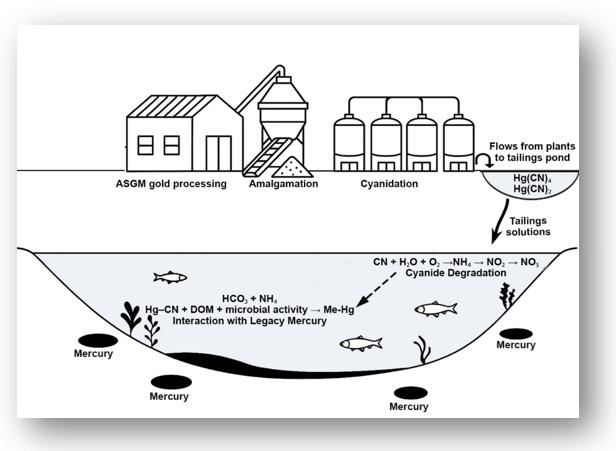
Graphical Abstract
Highlights
Ø Cyanide decreased by ~80% from discharges of leaching tanks (695 ± 159 mgL total CN‚Ū) to tailings ponds solutions (194 ± 327 mg/L) and by >99.9% along the river (<0.001 mg/L downstream);
Ø Nitrate increased by up to 85% (from ~28 mg/L at discharge zones to ~52 mg/L in downstream reaches), and COD rose by 90% (from ~20 mg/L upstream to ~240 mg/L near the Ecuador–Peru border);
Ø Tailings pond solutions contained high sulfate (up to 651 mg/L) and bicarbonate (up to 380 mg/L), reflecting ore-derived mineral dissolution and buffering reactions;
Ø Mercury in leaching pulp reached 6.33 mg/L, while dissolved Hg in river water remained below detection limits (<0.001 mg/L), consistent with dominant sediment-bound legacy pools.
Keywords
Subjects
OPEN ACCESS
©2026 The author(s). This article is licensed under a Creative Commons Attribution 4.0 International License, which permits use, sharing, adaptation, distribution and reproduction in any medium or format, as long as you give appropriate credit to the original author(s) and the source, provide a link to the Creative Commons license, and indicate if changes were made. The images or other third party material in this article are included in the article’s Creative Commons license, unless indicated otherwise in a credit line to the material. If material is not included in the article’s Creative Commons license and your intended use is not permitted by statutory regulation or exceeds the permitted use, you will need to obtain permission directly from the copyright holder. To view a copy of this license, visit: http://creativecommons.org/licenses/by/4.0/
PUBLISHER NOTE
GJESM Publisher remains neutral concerning jurisdictional claims in published maps and institutional affiliations.
MAJOR DATABASES, CITATION METRICS & CAPTURES
Google Scholar | Scopus - SJR | Web of Science | Biological Abstracts: Clarivate | Biosis Preview: Clarivate | PlumX Metrics | Altmetrics | Mendeley |
CURRENT PUBLISHER
GJESM Publisher



Letters to Editor
[1] Letters that include statements of statistics, facts, research, or theories should include appropriate references, although more than three are discouraged.
[2] Letters that are personal attacks on an author rather than thoughtful criticism of the author’s ideas will not be considered for publication.
[3] Letters can be no more than 300 words in length.
[4] Letter writers should include a statement at the beginning of the letter stating that it is being submitted either for publication or not.
[5] Anonymous letters will not be considered.
[6] Letter writers must include their city and state of residence or work.
[7] Letters will be edited for clarity and length.