Efficacy of zinc oxide chitosan hybrid nanoparticles as a nanovaccine to enhance immunity in hybrid grouper fish

Document Type : RESEARCH ARTICLE

Authors

1 Study Program of Fisheries Resources Management, Faculty of Fisheries and Marine Sciences, Universitas Brawijaya, Jl. Veteran, Malang, East Java, Indonesia

2 Borneo Marine Research Institute, Universiti Malaysia Sabah, Jalan UMS, 88400 Kota Kinabalu, Sabah, Malaysia

3 Department of Mechanical and Industrial Engineering, Faculty of Engineering, Universitas Negeri Malang, Jl. Semarang 5, Malang 65145, Indonesia

4 Study Program of Aquaculture, Faculty of Fisheries and Marine Sciences, Universitas Airlangga, Jl. Mulyorejo, Surabaya, East Java, Indonesia

5 Faculty of Fisheries Marine Science, Universitas Brawijaya, Jl. Veteran, Malang, East Java, Indonesia

Abstract
BACKGROUND AND OBJECTIVES: The cantang grouper (E. fuscoguttatus × E.lanceolatus) is an important marine cultured fish in Indonesia; however, its production has collapsed from approximately 10,208 tons in 2023 to 3,632 tons in 2024. This decrease is mainly attributed to repeated occurrences of viral nervous necrosis, leading to mortality rates approaching 100 percent. The objectives of this study are to investigate whether zinc oxide-chitosan hybrid nanoparticles can serve as an effective nanovaccine delivery system, utilizing recombinant Chlorella vulgaris protein to enhance protective immunity against viral nervous necrosis in cantang grouper.
METHODS: An in vivo assessment was conducted using 100 juvenile hybrid groupers, which were divided into five experimental groups: untreated healthy controls, viral nervous necrosis challenged controls, and three vaccinated receiving escalating nanovaccine doses (33 microliters, 66 microliters, and 112 microliters). Each treatment group consisted of 20 fish. Sampling occurred at baseline (day 0) and post-treatment (day 56), with collection of blood and target tissues (kidney) for comprehensive immune and histological assessment via flow cytometry, hematological profiling, and antioxidant enzyme. The methodology of one-way analysis of variance was employed for statistical comparisons.
FINDINGS: The lowest tested dose 33 microliters elicited the most pronounced immunoprotective response. Specifically, Interferon gamma levels increased by 11.90 percent, tumor necrosis factor-alpha levels rose by 5.34 percent, and Immunoglobulin M levels increased by 4.75 percent. Additionally, the activities of superoxide dismutase (3.213 unit per milliliter), catalase (109.7 unit per liter), and glutathione peroxidase (76.02 micromol) were significantly elevated, indicating a more robust defense against free radicals. Histopathological examination revealed negligible renal damage in T3, with edema (10.71 percent), necrosis (12.50 percent), and hemorrhage (13.45 percent), compared to more severe damage in the viral nervous necrosis challenged control group (T2).
CONCLUSION: Zinc oxide–chitosan hybrid nanoparticles effectively function as nanovaccine, enhancing the immune response and protecting cantang grouper from viral nervous necrosis. The 33 microliters dosage delivered optimal protection, bolstering immune function as well as tissue integrity. This nanovaccine provides a cost-efficient and scalable approach to bolster disease resilience in grouper aquaculture, rendering it a promising instrument for enhancing the sustainability of the industry.

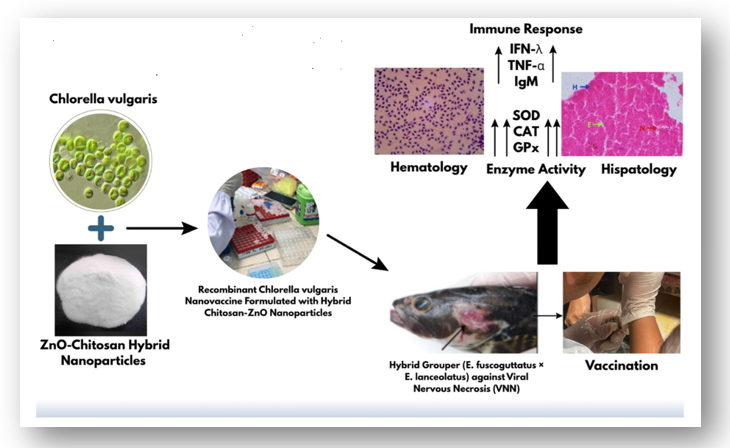
Graphical Abstract

Efficacy of zinc oxide chitosan hybrid nanoparticles as a nanovaccine to enhance immunity in hybrid grouper fish

Highlights

Ø  ZnO-Chitosan nanovaccine enhances immunity in hybrid grouper against VNN;

Ø  Recombinant Chlorella vulgaris antigen improves vaccine efficacy in aquaculture;

Ø  Optimal 33 µL dose induces robust immune responses with minimal tissue damage;

Ø  ZnO nanoparticles boost antioxidant enzyme activity and immune cell activation;

Ø  Flow cytometry shows improved adaptive immune responses post-vaccination.

Ø  ZnO-Chitosan nanovaccine enhances immunity in hybrid grouper against VNN;

Keywords

Subjects

OPEN ACCESS

©2026 The author(s). This article is licensed under a Creative Commons Attribution 4.0 International License, which permits use, sharing, adaptation, distribution and reproduction in any medium or format, as long as you give appropriate credit to the original author(s) and the source, provide a link to the Creative Commons license, and indicate if changes were made. The images or other third party material in this article are included in the article’s Creative Commons license, unless indicated otherwise in a credit line to the material. If material is not included in the article’s Creative Commons license and your intended use is not permitted by statutory regulation or exceeds the permitted use, you will need to obtain permission directly from the copyright holder. To view a copy of this license, visit: http://creativecommons.org/licenses/by/4.0/

PUBLISHER NOTE

GJESM Publisher remains neutral concerning jurisdictional claims in published maps and institutional affiliations.

MAJOR DATABASES, CITATION METRICS & CAPTURES

Google Scholar | Scopus - SJR | Web of Science | Biological Abstracts: Clarivate | Biosis Preview: Clarivate | PlumX Metrics | Altmetrics | Mendeley |

CURRENT PUBLISHER

GJESM Publisher

Letters to Editor

GJESM Journal welcomes letters to the editor for the post-publication discussions and corrections which allows debate post publication on its site, through the Letters to Editor. Letters pertaining to manuscript published in GJESM should be sent to the editorial office of GJESM within three months of either online publication or before printed publication, except for critiques of original research. Following points are to be considering before sending the letters (comments) to the editor.

[1] Letters that include statements of statistics, facts, research, or theories should include appropriate references, although more than three are discouraged.
[2] Letters that are personal attacks on an author rather than thoughtful criticism of the author’s ideas will not be considered for publication.
[3] Letters can be no more than 300 words in length.
[4] Letter writers should include a statement at the beginning of the letter stating that it is being submitted either for publication or not.
[5] Anonymous letters will not be considered.
[6] Letter writers must include their city and state of residence or work.
[7] Letters will be edited for clarity and length.

Send comment about this article
Enter Name.
Enter a valid email address.
Enter a vaid affiliation.
Enter comments (At leaset 10 words)
CAPTCHA Image
Enter Security Code Correctly.

Article Podcasts

  • Receive Date 10 August 2025
  • Revise Date 15 October 2025
  • Accept Date 18 November 2025