Document Type : CASE STUDY
Authors
1
Department of Administration, National University Micaela Bastidas of Apurímac, Victor Acosta II Etapa, Tamburco, Apurímac 03001, Perú
2
Department of Software Engineering, National University of San Marcos, Av. Carlos Germán Amezaga #375, Cercado de lima, Lima 15081, Perú
3
Department of Administration, National University San Antonio Abad of Cusco, Av. de la Cultura, Cusco, Cusco 08000, Perú
Abstract
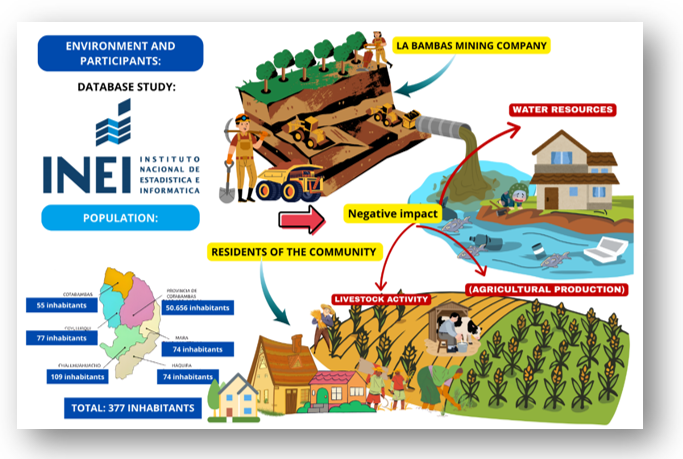
BACKGROUND AND OBJECTIVES: Mining activities generate significant economic, social, and environmental challenges that affect the sustainability of surrounding local communities. social responsibility is a fundamental mechanism for mitigating negative impacts and improving local well-being. The primary goal of this article was to investigate the ecological consequences of the Las Bambas mining company's operations on the local residents of the Cotabambas community in Peru.
METHODS: This research employed a mixed-methods design, combining qualitative and quantitative approaches. This study was conducted was characterized as a non-experimental, cross-sectional study aimed at providing explanatory insights. A five-point Likert scale questionnaire (1 = very frequently to 5 = never) was designed, validated, and administered to 377 residents living within the area of influence of a large-scale mining operation. Additionally, semi-structured interviews were conducted with 10 local authorities and political representatives, supplemented by an observation checklist adapted from previous studies. Four hypotheses were established to examine the relationship between mining operations and their social responsibility initiatives, along with their influence on the adjacent community
FINDINGS: The findings revealed strong associations between mining social responsibility and environmental variables (n = 377, p < 0.05): Rho = 0.610 for residents' perceptions, Rho = 0.575 for water resources, Rho = 0.510 for agricultural production, and Rho = 0.720 for livestock activity. These results imply that activities related to social responsibility are connected to mining, and as a result, they have not adequately addressed environmental degradation, causing detrimental effects on the water, soil, air, flora, and fauna in the surrounding communities, thereby impacting the quality of life of the population.
CONCLUSION: Mining social responsibility practices show moderate statistical associations with environmental impact indicators in Cotabambas, with Spearman’s correlation coefficients ranging from 0.489 to 0.546 (p-value < 0.05 in all cases). In spite of continuous social responsibility efforts, these measures have not successfully alleviated the perceived environmental decline, especially in agricultural production and livestock operations. The evidence underscores the need to strengthen measurable, impact-oriented social responsibility strategies focused on ecological restoration and sustainable rural livelihoods in mining areas.
Graphical Abstract
Highlights
Ø Water resource quality, agricultural productivity, and livestock activity emerge as critical variables linking corporate actions to local sustainability;
Ø The study evidences that higher levels of social responsibility practices correlate with improved community reilience and livelihood stability;
Ø Findings provide empirical support for incorporating social responsibility as a strategic axis in sustainable mining governance in developing regions.
Keywords
Subjects
OPEN ACCESS
©2026 The author(s). This article is licensed under a Creative Commons Attribution 4.0 International License, which permits use, sharing, adaptation, distribution and reproduction in any medium or format, as long as you give appropriate credit to the original author(s) and the source, provide a link to the Creative Commons license, and indicate if changes were made. The images or other third party material in this article are included in the article’s Creative Commons license, unless indicated otherwise in a credit line to the material. If material is not included in the article’s Creative Commons license and your intended use is not permitted by statutory regulation or exceeds the permitted use, you will need to obtain permission directly from the copyright holder. To view a copy of this license, visit: http://creativecommons.org/licenses/by/4.0/
PUBLISHER NOTE
GJESM Publisher remains neutral concerning jurisdictional claims in published maps and institutional affiliations.
MAJOR DATABASES, CITATION METRICS & CAPTURES
Google Scholar | Scopus - SJR | Web of Science | Biological Abstracts: Clarivate | Biosis Preview: Clarivate | PlumX Metrics | Altmetrics | Mendeley |
CURRENT PUBLISHER
GJESM Publisher




Letters to Editor
[1] Letters that include statements of statistics, facts, research, or theories should include appropriate references, although more than three are discouraged.
[2] Letters that are personal attacks on an author rather than thoughtful criticism of the author’s ideas will not be considered for publication.
[3] Letters can be no more than 300 words in length.
[4] Letter writers should include a statement at the beginning of the letter stating that it is being submitted either for publication or not.
[5] Anonymous letters will not be considered.
[6] Letter writers must include their city and state of residence or work.
[7] Letters will be edited for clarity and length.