Document Type : RESEARCH ARTICLE
Authors
1
Environmental Engineering and Management Study Program, Vocational School, IPB University, Bogor, Indonesia
2
Environmental Engineering Study Program, Faculty of Engineering, Universitas Sahid, Jakarta, Indonesia
3
Department of Environmental Engineering, Faculty of Engineering, Universitas Diponegoro, Semarang, Indonesia
4
Department of Sustainable Construction and Geodesy, Institute of Civil Engineering, Warsaw University of Life Sciences, Nowoursynowska 159, 02 776 Warsaw, Poland
Abstract
BACKGROUND AND OBJECTIVES: The consumption of beverages continues to increase and produces the generation of waste, both plastic and cardboard. Used beverage cartons, which can be recycled, contribute to packaging waste that often ends up in landfills, potentially contaminating the soil, water, and air. Consequently, there is a pressing need for an effective management strategy. The objectives of this study were to determine management strategies that can be implemented through the material flow analysis approach. This study combines socio-economic and cultural aspects within the framework of material flow analysis. The findings provide actionable insights into urban waste, circularity, and sustainability, especially Depok City, in Indonesia.
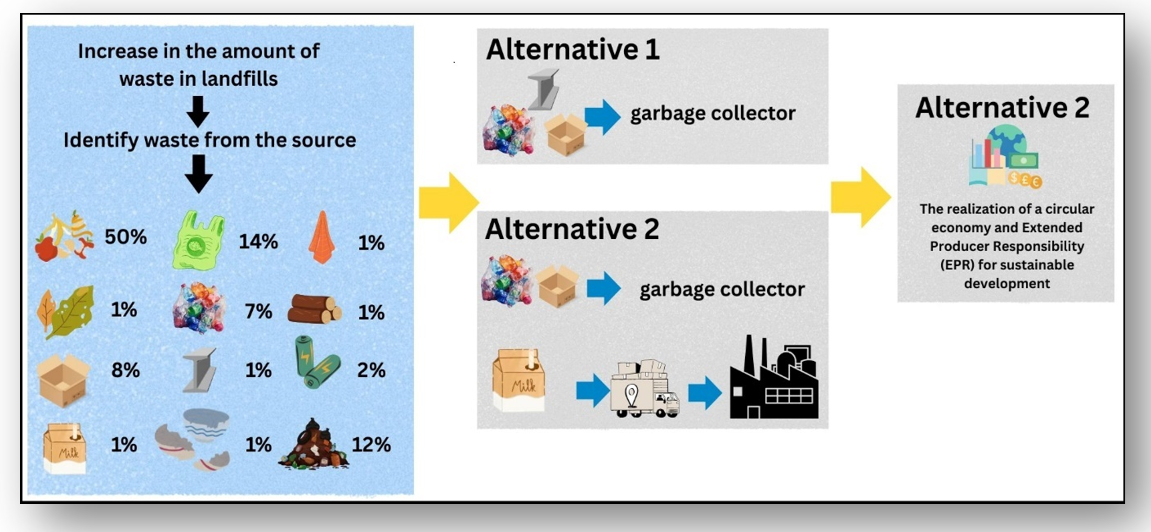
METHODS: Primary data were obtained through direct waste measurements to calculate the generation and composition of Urban Waste over 8 days. The secondary data used is in the form of data on service areas, the number of people served, and the number of means of transportation. An analysis is performed comparing the present circumstances with two alternative management approaches. The initial alternative involves the processing of used beverage cartons of waste by collectors. The second alternative involves the processing of used beverage cartons waste processed by the collector and is subsequent return to the manufacturer. A descriptive analysis was conducted of both alternatives from various aspects. This study has limitations including the lack of life cycle assessment validation, data localized to Depok City limiting wider applicability, and exclusion of post-consumer and industrial recycling stages from the system boundaries.
FINDINGS: The second waste management strategy exhibited a more significant impact on economic, social, cultural, and environmental issues. This strategy has been demonstrated to reduce the generation of waste destined for landfills.
CONCLUSION: The integration of waste treatment by collectors and reverse logistics from used beverage cartons through extended producer responsibility proved most effective, reducing 30 percent carbon dioxide emissions per day, and waste to 4.32 tons per day. The approach also generated 50 percent higher income for collectors, 15 percent cost savings for producers, and created local green jobs in the recycling and logistics sectors. Future research should integrate life cycle assessment for comprehensive environmental assessment, expand geographic scope, and incorporate additional recycling stages and indirect flows such as energy use and emissions.
Graphical Abstract
Highlights
⮚ Inorganic waste management by reverse logistics and waste processing by collectors can create new jobs in the recycling and logistics sectors;
⮚ Reverse logistics waste management can form a new culture: sorting and returning used packaging;
⮚ Reverse logistics waste management habits can create a circular economy and Extended Producer Responsibility.
Keywords
Subjects
OPEN ACCESS
©2026 The author(s). This article is licensed under a Creative Commons Attribution 4.0 International License, which permits use, sharing, adaptation, distribution and reproduction in any medium or format, as long as you give appropriate credit to the original author(s) and the source, provide a link to the Creative Commons license, and indicate if changes were made. The images or other third party material in this article are included in the article’s Creative Commons license, unless indicated otherwise in a credit line to the material. If material is not included in the article’s Creative Commons license and your intended use is not permitted by statutory regulation or exceeds the permitted use, you will need to obtain permission directly from the copyright holder. To view a copy of this license, visit: http://creativecommons.org/licenses/by/4.0/
PUBLISHER NOTE
GJESM Publisher remains neutral concerning jurisdictional claims in published maps and institutional affiliations.
MAJOR DATABASES, CITATION METRICS & CAPTURES
Google Scholar | Scopus - SJR | Web of Science | Biological Abstracts: Clarivate | Biosis Preview: Clarivate | PlumX Metrics | Altmetrics | Mendeley |
CURRENT PUBLISHER
GJESM Publisher



Letters to Editor
[1] Letters that include statements of statistics, facts, research, or theories should include appropriate references, although more than three are discouraged.
[2] Letters that are personal attacks on an author rather than thoughtful criticism of the author’s ideas will not be considered for publication.
[3] Letters can be no more than 300 words in length.
[4] Letter writers should include a statement at the beginning of the letter stating that it is being submitted either for publication or not.
[5] Anonymous letters will not be considered.
[6] Letter writers must include their city and state of residence or work.
[7] Letters will be edited for clarity and length.