The role of carbon sequestration and biodiversity in agroforestry for climate change mitigation

Document Type : REVIEW PAPER

Authors

1 Department of Biology, Faculty of Mathematic and Natural Sciences, Universitas Padjadjaran, Jatinangor, Sumedang District, West Java, Indonesia

2 Graduate School on Environmental Sciences, Sustainability Science, Universitas Padjadjaran, Bandung, Indonesia., West Java, Indonesia

3 Centre for Environment and Sustainability Science, Universitas Padjadjaran, Bandung, West Java, Indonesia

4 Faculty of Agro-Industrial Technology, Universitas Padjadjaran, Sumedang District, West Java, Indonesia. Sumedang, Indonesia

5 Faculty of Agro-Industrial Technology, Universitas Padjadjaran, Sumedang District, West Java, Sumedang, Indonesia

Abstract
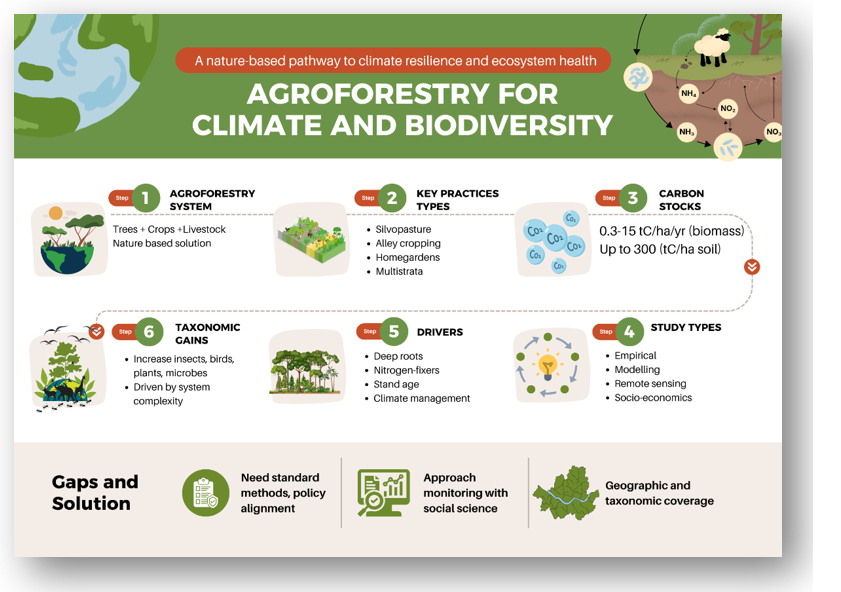
Agroforestry combines trees, crops, and livestock into systems that present an exciting nature-based approach for climate change mitigation and biodiversity conservation. This narrative study summarizes the current evidence on carbon sequestration and biodiversity outcomes across a variety of agroforestry practices such as silvopastoral systems, alley cropping, homegardens, and multistrata agroforestry in tropical, temperate, and dryland biomes. Furthermore, agroforestry systems offer significant socio-economic benefits by enhancing rural livelihoods and promoting sustainable land management practices that support long-term ecosystem resilience Evidence from empirical studies, modelling studies, remote sensing, and socio-economic analyses is synthesised to characterise carbon stocks in aboveground biomass, roots, and soils, and to compare taxonomic, functional, and structural diversity of agroforestry systems relative to conventional agriculture and forests. Agroforestry systems can sequester substantial amounts of carbon—ranging from about 0.3 to more than 15 metric tonnes of carbon per hectare per year in aboveground biomass—and can store up to approximately 300 metric tonnes of carbon per hectare in soils. However, there is considerable variability in the carbon storage potential due to species composition, climatic conditions, stand age, and management intensity. Often, soil organic carbon accounts for most of the material stored, while nitrogen-fixing and deep-rooted species promote belowground carbon sequestration. Notably, biodiversity consistently exceeds levels accrued in monocultures with increases in plant, insect, bird, and microbial taxa attributed to increased structural complexity and decreased inputs into the system, although variability from strata-to-strata does exist, and agroforestry systems do not typically reach the biodiversity levels of intact forests. Significant gaps in knowledge are recognized across geographic and taxonomic coverage, permanence of carbon storage, standardization of methods, and socio-economic dimensions. These gaps can be reduced through comparable monitoring frameworks, landscape-level experiments, social-science inquiry, and policy evaluation, thereby improving the quantification of climate benefits from implementing agroforestry practices. Agroforestry is identified as a valuable approach for achieving climate and biodiversity targets when designs are matched to specific places and supported by enabling policy.

Graphical Abstract

The role of carbon sequestration and biodiversity in agroforestry for climate change mitigation

Highlights

Ø  Biodiversity is typically higher than conventional agriculture across taxonomic groups due to vertical layering and low inputs, but still lower than intact forest—highlighting the importance of structural complexity and landscape connectivity;

Ø  Multi-strata/nature-regenerating systems provide carbon and biodiversity co-benefits; and high-intensity or short-rotation fodder monocultures create trade-offs; agroforestry can augment, but not supplant, forest conservation;

Ø  Evidence is limited by geographic and taxonomic bias; monitoring gaps; and lack of consistency in protocols - harmonized deep-soil MRV and landscape-scale socio-economic integrated studies are encouraged to help scale up adoption.

Keywords

Subjects

OPEN ACCESS

©2026 The author(s). This article is licensed under a Creative Commons Attribution 4.0 International License, which permits use, sharing, adaptation, distribution and reproduction in any medium or format, as long as you give appropriate credit to the original author(s) and the source, provide a link to the Creative Commons license, and indicate if changes were made. The images or other third party material in this article are included in the article’s Creative Commons license, unless indicated otherwise in a credit line to the material. If material is not included in the article’s Creative Commons license and your intended use is not permitted by statutory regulation or exceeds the permitted use, you will need to obtain permission directly from the copyright holder. To view a copy of this license, visit: http://creativecommons.org/licenses/by/4.0/

PUBLISHER NOTE

GJESM Publisher remains neutral concerning jurisdictional claims in published maps and institutional affiliations.

MAJOR DATABASES, CITATION METRICS & CAPTURES

Google Scholar | Scopus - SJR | Web of Science | Biological Abstracts: Clarivate | Biosis Preview: Clarivate | PlumX Metrics | Altmetrics | Mendeley |

CURRENT PUBLISHER

GJESM Publisher

Letters to Editor

GJESM Journal welcomes letters to the editor for the post-publication discussions and corrections which allows debate post publication on its site, through the Letters to Editor. Letters pertaining to manuscript published in GJESM should be sent to the editorial office of GJESM within three months of either online publication or before printed publication, except for critiques of original research. Following points are to be considering before sending the letters (comments) to the editor.

[1] Letters that include statements of statistics, facts, research, or theories should include appropriate references, although more than three are discouraged.
[2] Letters that are personal attacks on an author rather than thoughtful criticism of the author’s ideas will not be considered for publication.
[3] Letters can be no more than 300 words in length.
[4] Letter writers should include a statement at the beginning of the letter stating that it is being submitted either for publication or not.
[5] Anonymous letters will not be considered.
[6] Letter writers must include their city and state of residence or work.
[7] Letters will be edited for clarity and length.

Send comment about this article
Enter Name.
Enter a valid email address.
Enter a vaid affiliation.
Enter comments (At leaset 10 words)
CAPTCHA Image
Enter Security Code Correctly.

Article Podcasts

  • Receive Date 20 July 2025
  • Revise Date 25 September 2025
  • Accept Date 27 October 2025