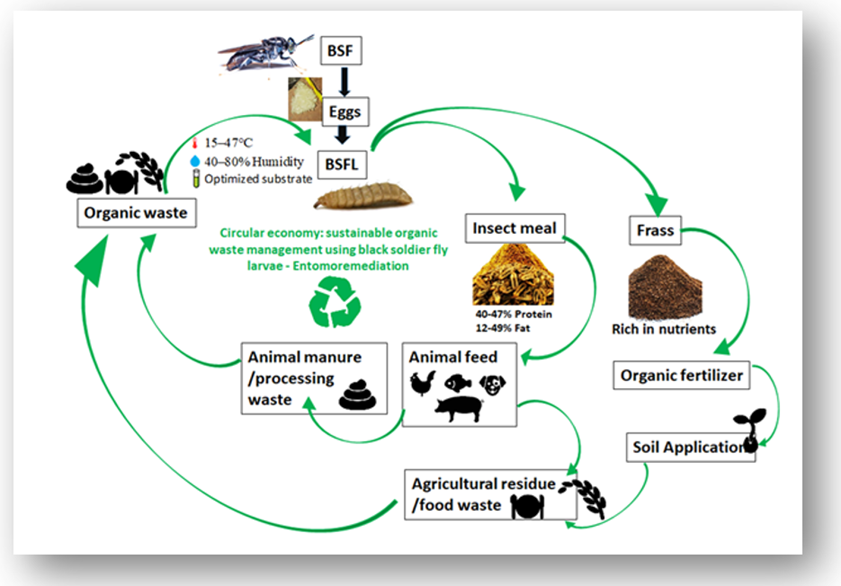
Sustainable solutions for entomoremediation organic waste into food and fertilizer using black soldier fly larvae

Document Type : REVIEW PAPER

Authors

1 Department of Integrative Agriculture, United Arab Emirates University, Abu Dhabi, P.O. Box 15551 United Arab Emirates

2 Research Center for Circular Agro–Animal Farming, Seoul 151–742, Republic of Korea

3 Research Center for Circular Agro–Animal Farming, Seoul 151–742 Republic of Korea

4 Department of Agricultural Biotechnology, Research Institute for Agriculture and Life Sciences, Seoul National University, Seoul 151–742 Republic of Korea

Abstract
Black soldier fly larvae offer an innovative solution to the escalating global problem of organic trash, which adversely affects both ecosystems and economies. The black soldier fly, a non–pest dipteran belonging to the Stratiomyidae family, is a world leader in the breakdown of organic waste, converting it into useful residue and biomass. This study investigates the process by which black soldier fly larvae transform organic waste into valuable products, including protein-rich insect meal and nutrient-dense organic fertilizer. Further, the biology of black soldier fly larvae; Hermetia illucens, important bioconversion factors, larvae meal and frass production techniques was thoroughly examined. It also identifies gaps in scalability, regulatory harmonization, and substrate optimization, proposing black soldier fly larvae as a scalable circular economy model. Under optimal conditions, the efficiency and quality of the bioconversion process are enhanced, which includes maintaining temperatures between 27 and 30 degrees Celsius for best results, with survival capabilities from 15 to 47 degrees Celsius. Humidity should ideally be set at 60 to 70 percent, with tolerances that can reach 40 to 80 percent, along with specially formulated substrate mixtures. Black soldier fly larvae meal is a viable substitute for fishmeal or soybean meal in animal feeds since it contains 40–47 percent protein and 11.8–49 percent fat and it is rich in lysine (6–8 percent), threonine (3–5 percent), and valine (4–6 percent), which are vital for animal nutrition. Similarly, black soldier fly larvae frasstilizer outperforms conventional compost by providing richer nutrients and beneficial microbes in a shorter period (12–15 days). Frass provides micronutrients including iron, zinc, nitrogen, phosphorus, potassium, calcium, and magnesium. By converting organic waste into valuable assets, the technology of black soldier fly larvae promotes a circular economy, alleviating environmental impact while aiding agriculture, livestock, pets, and aquaculture. To enhance maximum material recovery and minimize environmental effects, black soldier fly larvae can be combined with other waste management techniques like anaerobic digestion or composting. Further studies should be carried out to discover potential black soldier fly larvae strains that demonstrate high bioconversion efficiency and to advance these strains via a selective breeding strategy.

Graphical Abstract

Sustainable solutions for entomoremediation organic waste into food and fertilizer using black soldier fly larvae

Highlights

Ø  Black soldier fly larvae efficiently convert diverse organic wastes into high–value insect meal and nutrient–rich frass, fostering a circular economy for sustainable waste management;

Ø  Optimal bioconversion conditions, including 27–30°C temperature and 60–70% humidity, enhance BSFL growth and waste reduction by 50–80% in 12–15 days;

Ø  BSFL meal, with 40–47% protein, serves as a viable alternative to fishmeal and soybean meal in animal feeds, addressing overfishing and deforestation;

Ø  BSFL frass ("frasstilizer") provides superior nutrients and microbial benefits compared to traditional compost, improving soil health and crop yields while reducing methane emissions.

Keywords

Subjects

OPEN ACCESS

©2026 The author(s). This article is licensed under a Creative Commons Attribution 4.0 International License, which permits use, sharing, adaptation, distribution and reproduction in any medium or format, as long as you give appropriate credit to the original author(s) and the source, provide a link to the Creative Commons license, and indicate if changes were made. The images or other third party material in this article are included in the article’s Creative Commons license, unless indicated otherwise in a credit line to the material. If material is not included in the article’s Creative Commons license and your intended use is not permitted by statutory regulation or exceeds the permitted use, you will need to obtain permission directly from the copyright holder. To view a copy of this license, visit: http://creativecommons.org/licenses/by/4.0/

PUBLISHER NOTE

GJESM Publisher remains neutral concerning jurisdictional claims in published maps and institutional affiliations.

MAJOR DATABASES, CITATION METRICS & CAPTURES

Google Scholar | Scopus - SJR | Web of Science | Biological Abstracts: Clarivate | Biosis Preview: Clarivate | PlumX Metrics | Altmetrics | Mendeley |

CURRENT PUBLISHER

GJESM Publisher

Letters to Editor

GJESM Journal welcomes letters to the editor for the post-publication discussions and corrections which allows debate post publication on its site, through the Letters to Editor. Letters pertaining to manuscript published in GJESM should be sent to the editorial office of GJESM within three months of either online publication or before printed publication, except for critiques of original research. Following points are to be considering before sending the letters (comments) to the editor.

[1] Letters that include statements of statistics, facts, research, or theories should include appropriate references, although more than three are discouraged.
[2] Letters that are personal attacks on an author rather than thoughtful criticism of the author’s ideas will not be considered for publication.
[3] Letters can be no more than 300 words in length.
[4] Letter writers should include a statement at the beginning of the letter stating that it is being submitted either for publication or not.
[5] Anonymous letters will not be considered.
[6] Letter writers must include their city and state of residence or work.
[7] Letters will be edited for clarity and length.

Send comment about this article
Enter Name.
Enter a valid email address.
Enter a vaid affiliation.
Enter comments (At leaset 10 words)
CAPTCHA Image
Enter Security Code Correctly.

Article Podcasts

  • Receive Date 05 June 2025
  • Revise Date 10 September 2025
  • Accept Date 23 October 2025